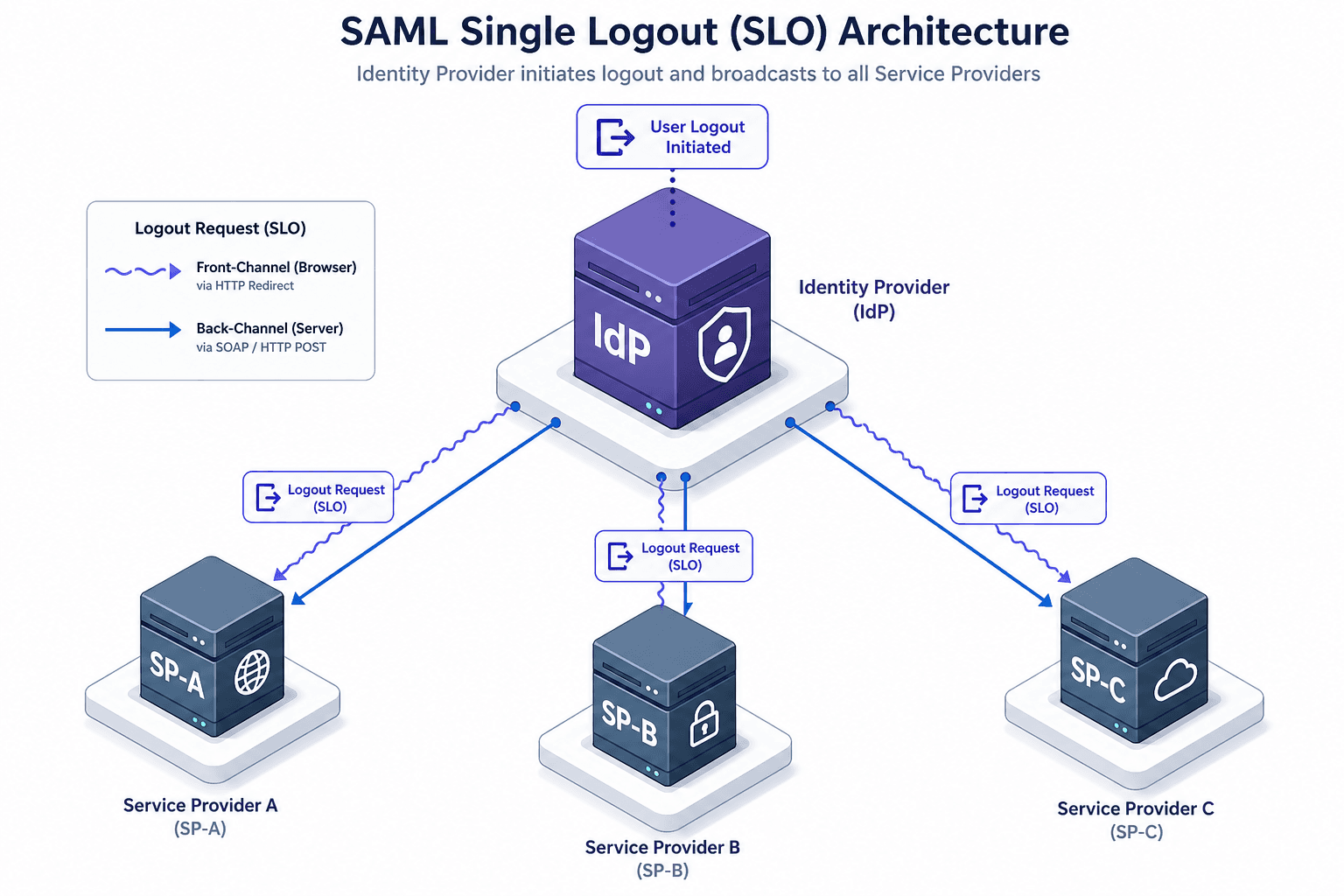
SAML Single Logout (SLO): The Mechanics of Session Termination
A technical examination of SAML Single Logout (SLO) mechanisms, covering front-channel and back-channel flows, session index handling, and protocol compliance for identity engineers.
Single Sign-On (SSO) solves the problem of remembering multiple passwords. SAML Single Logout (SLO) attempts to solve the inverse problem: remembering to invalidate every session established during that single login. For identity engineers, SLO is often the most fragile component of a SAML implementation. Unlike authentication, which is a request-response pattern that happens once at the start of a user's journey, SLO is a stateful broadcast protocol that must propagate through multiple Service Providers (SPs) before the Identity Provider (IdP) can safely declare the user logged out.
This article examines the mechanism-level details of SAML 2.0 Single Logout, focusing on how SessionIndex drives session tracking, the divergence between front-channel and back-channel bindings, and why compliance with the specification often requires handling failure gracefully rather than perfectly.
The SessionIndex: The Anchor of SLO
Before examining the transport mechanisms, we must understand the data structure that makes SLO possible: the SessionIndex.
When a user authenticates, the IdP issues a Response containing an <AuthnStatement>. Crucially, this statement includes a <SessionIndex> element. This value is a unique identifier for the session within the IdP's context. The SP stores this SessionIndex locally, typically in its own session cookie or server-side session store, associated with the user's local session.
Without SessionIndex, the IdP would have no way to know which specific session to terminate when a logout request arrives. If a user has logged into three different SPs (SP-A, SP-B, SP-C) using the same SSO session, the IdP must track three distinct SessionIndex values. When SP-A initiates a logout, it sends the SessionIndex back to the IdP. The IdP then looks up all other sessions associated with that SessionIndex and notifies SP-B and SP-C to terminate their respective sessions.
Front-Channel SLO: The Browser Relay
The most common implementation of SLO is the HTTP-Redirect or HTTP-POST binding, known as front-channel SLO. This flow relies entirely on the user's browser to relay messages between the SP and the IdP.
The Initiation Flow
- SP Initiates Logout: The user clicks "Logout" in SP-A. SP-A invalidates its local session and constructs a
LogoutRequest. This request contains theSessionIndexand theNameIDof the user. - Browser Redirect: SP-A redirects the user's browser to the IdP's Single Logout Service endpoint (usually via HTTP Redirect or POST).
- IdP Processing: The IdP receives the
LogoutRequest, validates the signature, and identifies the active sessions associated with the providedSessionIndex. - IdP Broadcast: The IdP now needs to tell SP-B and SP-C to log out. Since the IdP does not have direct network access to the internal networks of the SPs, it must use the browser as a relay. The IdP generates an HTML page containing hidden forms for each remaining SP (SP-B, SP-C). These forms contain
LogoutRequestmessages signed by the IdP. - JavaScript Execution: The IdP uses JavaScript to automatically submit these forms via POST. The browser sends
LogoutRequestmessages to SP-B and SP-C. - SP Response: SP-B and SP-C receive the requests, validate the IdP's signature, terminate their local sessions, and generate
LogoutResponsemessages. - Return to IdP: The browser is redirected back to the IdP with these
LogoutResponsemessages. - Finalization: The IdP collects all responses. If it receives positive
LogoutResponsesfrom all known SPs, it terminates the global SSO session and redirects the user back to SP-A with a finalLogoutResponse.
The Problem with Front-Channel
The front-channel flow is inherently asynchronous and dependent on client-side execution. Several failure modes exist:
- Browser Caching: If the IdP's HTML page is cached by the browser, the JavaScript may not execute, or the form submissions may fail silently.
- User Navigation: If the user closes the browser tab or navigates away before the JavaScript executes, SP-B and SP-C never receive the logout request. Their sessions remain active (orphaned).
- Ad Blockers/Script Blocking: Security tools may block the automatic form submission JavaScript.
Because of these risks, relying solely on front-channel SLO results in "partial logout" states, where the user is logged out of some SPs but not others.
Case Study: The Orphaned Session
Consider a typical enterprise scenario where an employee uses a corporate portal (SP-A) and an HR application (SP-B). The IdP manages both sessions under a single SSO context. When the user logs out of the corporate portal, the front-channel flow triggers a redirect to the IdP. The IdP then attempts to relay a logout message to the HR application via the browser.
If the user has the HR application open in a background tab that has been idle for an hour, the session cookie might have expired on the SP side, or the browser might have suspended the tab. When the IdP's JavaScript attempts to submit the LogoutRequest to the HR application, the request fails or times out. The IdP, assuming the user is still interacting with the browser, waits for a response. Eventually, the IdP gives up and logs the user out of itself. The result? The user is logged out of the corporate portal, but remains authenticated in the HR application. This "partial logout" creates a security vulnerability, as the user may believe their session is fully terminated when it is not.
Back-Channel SLO: The SOAP Guarantee
To address the unreliability of browser-based relaying, the SAML 2.0 specification defines the SOAP binding for Single Logout. This is known as back-channel SLO.
In back-channel SLO, the IdP communicates directly with the SPs using XML over HTTP (SOAP). This bypasses the browser entirely, ensuring that the logout request is delivered programmatically.
The Mechanism
- SP Initiates Logout: Same as front-channel. SP-A sends a
LogoutRequestto the IdP via the browser. - IdP Processing: The IdP receives the request and identifies the remaining SPs (SP-B, SP-C).
- Direct SOAP Request: The IdP's backend server sends a SOAP message directly to SP-B's and SP-C's Single Logout Service endpoints. This message contains the
LogoutRequest. - SP Processing: SP-B and SP-C receive the SOAP message, validate the signature, and terminate their local sessions.
- Direct SOAP Response: SP-B and SP-C send a SOAP
LogoutResponsedirectly back to the IdP. - Finalization: The IdP collects the direct responses. If all SPs confirm logout, the IdP terminates the global session and redirects the user to SP-A.
Why Back-Channel is Preferred
Back-channel SLO is the only method that provides a strong guarantee of delivery. Since the communication happens server-to-server, it is not subject to browser caching, user navigation, or script blocking. However, it requires the IdP to know the exact endpoint URLs for each SP's Single Logout Service, which must be configured in the metadata exchange.
Compliance and Failure Handling
The SAML 2.0 specification for SLO, particularly as detailed in the OASIS SAML V2.0 Specifications, does not require that all SPs successfully log out. It acknowledges that network failures, misconfigurations, or unsupported bindings can prevent complete logout.
Handling Partial Logout
An identity engineer must design the system to handle "partial logout" gracefully. If the IdP receives a LogoutResponse from SP-B but times out waiting for SP-C, it should not block the user from logging out of SP-A. The user should be redirected back to SP-A with a LogoutResponse indicating that the logout was successful for the IdP and SP-A, even if SP-C is still active.
SessionIndex Propagation
Engineers must ensure that the SessionIndex is consistent across all SPs. If SP-A uses one SessionIndex value and SP-B uses another for the same SSO session, the IdP will fail to correlate them, leading to orphaned sessions. This often happens when SPs generate their own SessionIndex values instead of using the one provided by the IdP in the AuthnStatement.
NameID and Session Correlation
The NameID in the LogoutRequest must match the NameID used during authentication. If the NameID format changes (e.g., from emailAddress to persistent), the IdP may fail to find the corresponding session. Ensure that the NameID policy is consistent across all SPs and the IdP.
Conclusion
SAML Single Logout is a complex, stateful protocol that relies on precise coordination between the IdP and multiple SPs. While front-channel SLO is easier to implement due to its reliance on standard HTTP bindings, it is inherently unreliable. Back-channel SLO via SOAP provides a stronger guarantee but requires more complex configuration.
For identity engineers, the key takeaway is that SLO is not a binary success/failure event but a best-effort broadcast. Design your systems to handle partial logout states, validate SessionIndex consistency, and prefer back-channel bindings where reliability is critical. Understanding these mechanisms allows you to build identity systems that are not just secure, but also predictable in their session lifecycle.
Related posts
SAML Assertions, Statements, and the Schema
An examination of SAML 2.0 assertion structure, statement types, and schema validation for developers and identity engineers.
SAML 2.0 in One Diagram
A visual walkthrough of the SAML 2.0 Single Sign-On flow, covering bindings, profiles, and how it compares to OIDC.
SAML Single Logout: Implementation Patterns and Pitfalls
An examination of SAML single logout implementation patterns, covering session management and pitfalls in SP-initiated and IdP-initiated logout flows.