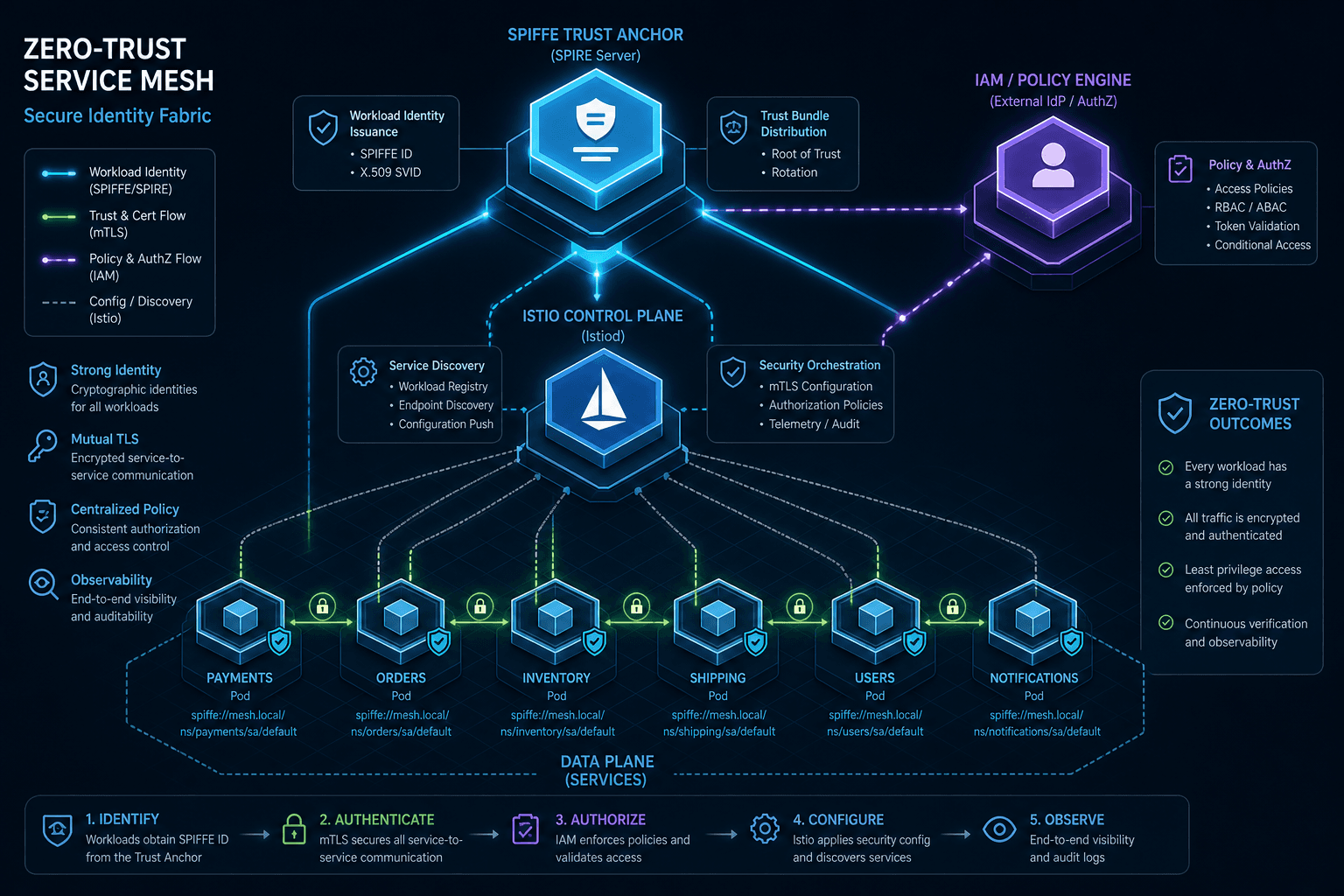
Building an Identity Service Mesh: Integrating IAM with Istio
An examination of integrating Identity and Access Management with service mesh technologies like Istio using SPIFFE for secure service-to-service communication.
Standard microservices often rely on perimeter defense, assuming internal trust once traffic crosses the network boundary. This model fails if a single service is compromised. While Istio's mutual TLS (mTLS) encrypts traffic, encryption alone lacks identity granularity. To achieve zero trust, we must bind cryptographic identities to business logic. The mechanism enabling this is SPIFFE, which integrates with Istio to create an identity service mesh where IAM policies enforce access based on verified workload provenance.
The Identity Gap in Standard mTLS
The core problem with standard Istio mTLS without SPIFFE integration is the scope of the identity. By default, Istio sidecars issue X.509 certificates where the Subject Alternative Name (SAN) often contains a Kubernetes Service Account or a generic host name. While this proves the traffic came from a valid pod, it is often static or tied to the cluster namespace. An external IAM system cannot easily interpret this data to make fine-grained decisions across multiple clusters or namespaces.
SPIFFE solves this by defining a standardized URI scheme (SPIFFE ID) that is cryptographically bound to the certificate. This ID follows the pattern spiffe://<trust-domain>/ns/<namespace>/sa/<service-account>, creating a portable, verifiable identity that survives cluster boundaries.
The SPIFFE/Istio Mechanism
When you integrate SPIFFE with Istio, the mechanism shifts from simple certificate issuance to a trust delegation model. Istio's control plane (Istiod) stops acting as the sole Certificate Authority and instead delegates the signing of workloads to a SPIRE (SPIFFE Runtime Environment) server. Here is the flow: a new pod spins up, the SPIRE agent running on the node detects the workload, and the pod requests a short-lived X.509 SVID (SPIFFE Verifiable Identity Document) from the SPIRE server.
The SPIRE server validates the workload's identity against a policy store—often integrated with your existing IAM or Kubernetes RBAC. Once signed, the SVID is injected into the Istio sidecar. The sidecar then uses this SVID to establish mTLS connections with peers. Crucially, the SVID contains the specific SPIFFE ID, which becomes the primary key for authorization decisions.
Policy Enforcement Flow
Consider a concrete scenario involving two services: OrderService and InventoryService. Without SPIFFE integration, an IAM policy might simply allow OrderService to call InventoryService if the source IP is in the orders namespace. If a developer accidentally deploys a rogue pod in the orders namespace, it gains access.
With the identity service mesh, the OrderService pod obtains an SVID with the SPIFFE ID spiffe://example.org/ns/orders/sa/order-sa. When it connects to InventoryService, the InventoryService sidecar performs an mTLS handshake. The certificate presented by OrderService contains the specific SPIFFE ID. The InventoryService sidecar extracts this ID and presents it to an authorization engine.
It is critical to distinguish the roles here: the Istio sidecar's local authorization engine evaluates the SPIFFE ID against local AuthorizationPolicy rules. The IAM system acts as the source of truth for the high-level policy definitions (e.g., "Service A can read Service B"), which are then translated into these local rules. The sidecar enforces the proof locally. If a rogue pod tries to impersonate OrderService without the correct private key, the handshake fails. If a legitimate pod tries to escalate privileges, the local engine sees the SPIFFE ID matches the order-sa account and denies write access if the policy restricts it to read-only.
Operational Tradeoffs and Configuration
Implementing this requires a specific configuration in Istio to enable the SPIFFE trust domain. You must configure istiod to use the SPIRE server as the external CA. This involves setting the trustDomain in the mesh configuration and ensuring the SPIRE agent is properly linked to the node. The configuration looks like this:
apiVersion: v1
kind: ConfigMap
metadata:
  name: istio-config
  namespace: istio-system
data:
  mesh: |
    trustDomain: "example.org"
    defaultConfig:
      proxyConfig:
        trustDomain: "example.org"
The sidecar then requests the certificate using the istio-proxy init container logic, which fetches the SVID from the SPIRE agent socket. This ensures that every connection carries the verified identity. The authorization policy in Istio then references this identity directly:
apiVersion: security.istio.io/v1beta1
kind: AuthorizationPolicy
metadata:
  name: inventory-restrictions
  namespace: inventory
spec:
  selector:
    matchLabels:
      app: inventory
  action: ALLOW
  rules:
  - from:
    - source:
        principals: ["spiffe://example.org/ns/orders/sa/order-sa"]
This setup creates a rigid dependency chain: the IAM system defines who the workload is, SPIRE issues the proof, Istio distributes the proof, and the sidecars enforce the proof. If any link breaks, the identity chain fails. For instance, if the SPIRE server is unreachable, the sidecars cannot rotate their certificates, leading to service disruption after the current certificate expires. This is a critical operational tradeoff. Relying on SPIRE adds a dependency layer that must be highly available. In contrast, native Kubernetes secrets are simpler but lack the cross-cluster portability and granular provenance that SPIFFE provides.
There is an argument that for single-cluster deployments, native Istio mTLS with ServiceAccount-based identities is sufficient and avoids the operational complexity of running a SPIRE server. However, this view ignores the requirement for true zero trust in multi-cluster environments. If your architecture spans multiple clusters, the ServiceAccount name alone is ambiguous; order-sa exists in Cluster A and Cluster B. Without the SPIFFE trust domain prefix, you cannot distinguish which cluster the request originated from. Therefore, the added complexity of SPIRE is not a bug but a feature required for distributed identity.
Lifecycle Management and Graceful Rotation
The final piece of the puzzle is the lifecycle management. SPIFFE SVIDs are short-lived, typically expiring in minutes. This forces the sidecars to constantly renew certificates. The mechanism here is a "graceful rotation": the sidecar maintains a cache of the current SVID and begins requesting a new one before expiration. The mTLS handshake switches to the new certificate once the rotation is complete. This ensures that even if a private key is leaked, the window of exposure is minimal. The IAM system must be configured to handle these frequent updates, usually by caching the identity-to-permission mapping to avoid querying the central IAM database on every request.
Conclusion
Building an identity service mesh is not about adding more encryption; it is about aligning the cryptographic identity with the logical identity defined by your IAM policies. By integrating SPIFFE with Istio, you transform the service mesh from a simple traffic manager into a strong enforcement point for zero trust. The mechanism ensures that every service-to-service interaction is authenticated by a verified, portable identity, making the network topology irrelevant to security. While the operational overhead increases, the resulting security posture allows you to enforce policies at the workload level, not just the network level, which is the fundamental requirement for modern microservice security.
FAQ
Q: What happens if the SPIRE server becomes unavailable? A: If the SPIRE server is unreachable, sidecars cannot request new SVIDs. Once existing certificates expire, service-to-service communication will fail. High availability for SPIRE is therefore a prerequisite for this architecture.
Q: Can I use SPIFFE with multiple Kubernetes clusters? A: Yes, this is one of the primary benefits. The SPIFFE ID includes the trust domain and namespace, allowing you to uniquely identify workloads across different clusters without ambiguity.
Q: Is the operational complexity worth the added security? A: For single-cluster environments, standard Istio mTLS may suffice. However, for multi-cluster or hybrid-cloud architectures requiring strict zero trust, the complexity is necessary to prevent lateral movement and ensure provenance.
Practical Takeaways
- Identity over Location: Always prioritize verifying the workload's identity (SPIFFE ID) rather than its network location (IP or Namespace).
- Local Enforcement: Remember that Istio sidecars enforce policies locally; the IAM system defines the rules, but the sidecar executes them.
- Short-Lived Certificates: Embrace short-lived SVIDs to minimize the impact of potential key leaks, accepting the operational cost of frequent rotation.
Common Pitfalls
- Ignoring Trust Domain Prefixes: Failing to include the
spiffe://<trust-domain>prefix in AuthorizationPolicy rules will result in ambiguous identity matching across clusters. - Underestimating SPIRE Availability: Treating SPIRE as a non-critical component leads to service outages when certificates expire and cannot be renewed.
- Confusing IAM and Istio Roles: Assuming the IAM system directly evaluates every request causes performance bottlenecks; IAM should define policies that Istio translates into local rules.
Related posts
Microservices Security Architecture: OAuth2, JWT, and mTLS Patterns
Examines microservices security patterns including OAuth2, JWT propagation, and mTLS within service mesh architectures.
Understanding Token Binding and Sender-Constrained Tokens
An examination of token binding and sender-constrained tokens including proof of possession, DPoP, and mTLS for enhanced token protection.
Securing gRPC with OAuth2 Token Propagation in Microservices
A guide to securing gRPC services using OAuth2 token propagation and interceptors for reliable microservice communication.