Securing gRPC with OAuth2 Token Propagation in Microservices
A guide to securing gRPC services using OAuth2 token propagation and interceptors for reliable microservice communication.
Securing gRPC with OAuth2 Token Propagation in Microservices
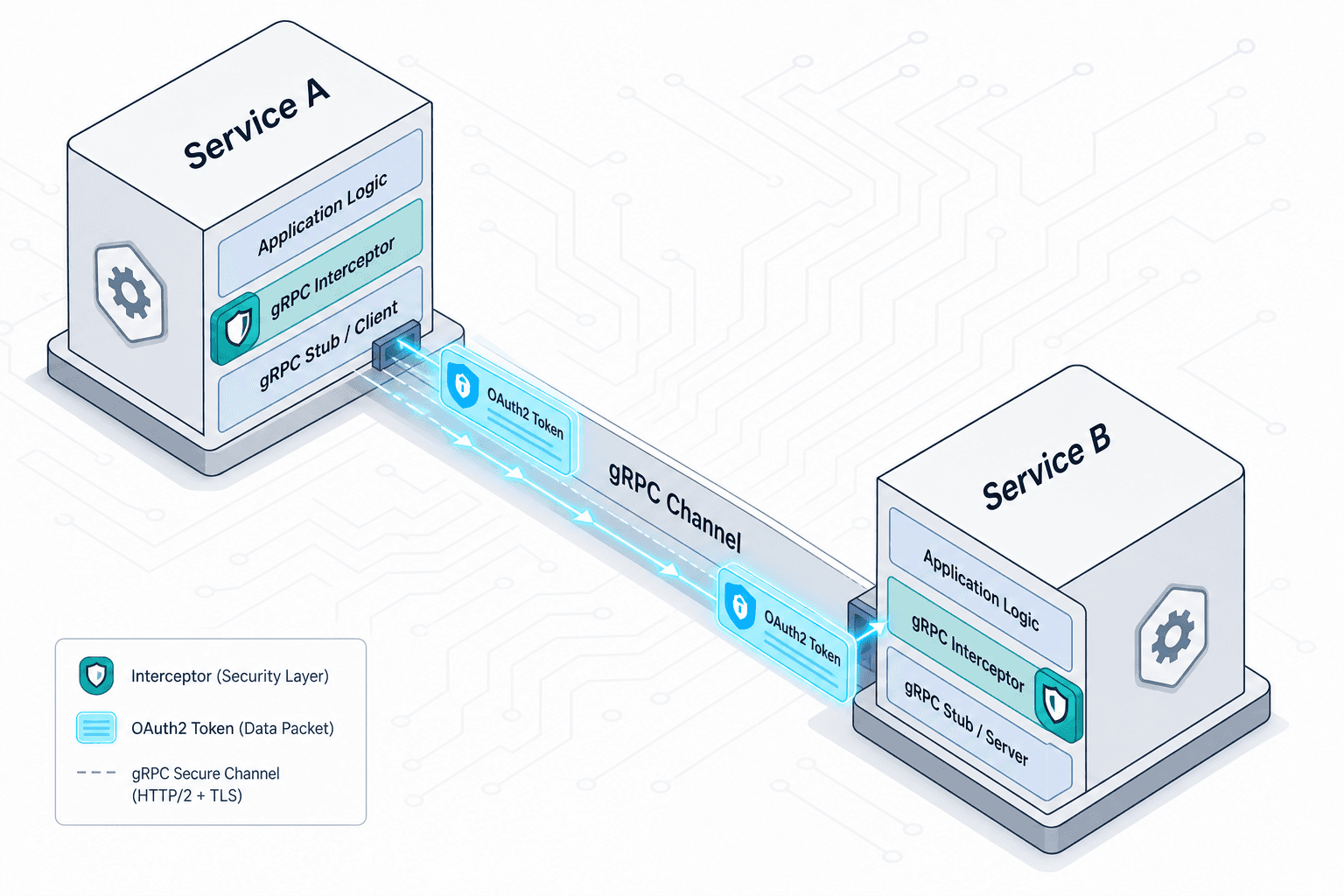
In a monolithic architecture, authentication often happens once at the gateway, and internal components trust each other implicitly. In a microservices mesh, this implicit trust is the single point of failure. When Service A calls Service B via gRPC, the transport layer (HTTP/2) provides confidentiality via TLS, but it does not provide identity. The server may see the connection from Service A's IP, or from the sidecar proxy if mTLS is used at the service mesh layer, but it cannot prove the request originated from a specific user or a specific service account authorized for a specific action. To solve this, we must implement token propagation. This is not a configuration setting; it is a mechanical process where an access token is extracted from the calling application's memory, serialized into gRPC metadata, and reconstructed on the receiving end.
The Transport Gap: Why Default gRPC is Blind
By default, a gRPC client generates a binary request and sends it over an HTTP/2 stream. The headers in this stream are standard HTTP/2 pseudo-headers (:method, :path, :authority) and standard headers. Unlike REST APIs where you might manually add an Authorization: Bearer <token> header in a fetch or axios call, gRPC clients abstract this away. The client library treats metadata as a generic key-value store, but it does not automatically populate it with security credentials.
If you do not explicitly inject the token, the downstream service receives a request with no identity context. It sees a valid connection from a trusted internal network but has no way to enforce Fine-Grained Access Control (FGAC). For example, if Service A acts on behalf of User X, Service B needs to know "User X" to check if they have permission to delete a specific record. Without propagation, Service B only knows "Service A," which might have broad permissions, leading to privilege escalation risks. The inability to distinguish between a service acting autonomously and a service acting on behalf of a specific user creates a blind spot where unauthorized actions can occur without detection. This lack of granular identity context means that even if the network is secure, the application layer remains vulnerable to lateral movement attacks where compromised services leverage their own credentials to access resources they shouldn't.
The Interceptor Pattern: Injecting Identity at the Edge
The mechanism to bridge this gap is the gRPC Interceptor. An interceptor is a middleware function that wraps the actual RPC call. It runs before the request is serialized and sent (client-side) or after the response is received (server-side). We use this hook to manipulate the grpc.Metadata object.
Consider a Go-based microservice acting as a client. The developer holds an OAuth2 token in a local variable or retrieves it from a secure vault. Instead of passing this token to every single RPC method call, we create a UnaryClientInterceptor. This interceptor inspects the context, finds the token, and attaches it to the outgoing metadata.
func oauth2Interceptor(ctx context.Context, method string, req, reply interface{},
    cc *grpc.ClientConn, invoker grpc.UnaryInvoker, opts ...grpc.CallOption) error {

    // 1. Retrieve the token from the context.
    // In a real app, this might come from a token source or a secure secret manager.
    token, ok := ctx.Value("oauth2_token").(string)
    if !ok || token == "" {
        return fmt.Errorf("no oauth2 token found in context")
    }

    // 2. Create new metadata with the Authorization header.
    // Note: While the string literal uses lowercase, the underlying HTTP/2 stack normalizes keys.
    // Explicit normalization is handled by the library, but the standard convention is to use
    // lowercase for HTTP/2 headers to avoid confusion in other languages.
    md := metadata.Pairs("authorization", "Bearer "+token)

    // 3. Merge with existing metadata (if any)
    ctx = metadata.NewOutgoingContext(ctx, md)

    // 4. Proceed with the actual call.
    return invoker(ctx, method, req, reply, cc, opts...)
}
When this interceptor is registered in the grpc.Dial options, it executes for every call made by that client instance. The token is now part of the HTTP/2 headers. The mechanism here is critical: the token is treated as opaque data until the server decides to parse it. The client never validates the token; it simply transports it.
The Downstream Validation: Extracting and Trusting
On the server side, the interceptor pattern works in reverse. We need a UnaryServerInterceptor that runs before the business logic handler executes. This interceptor's job is to read the incoming metadata, validate the token, and enrich the context so the handler can make authorization decisions.
The server must verify two things: the token's signature (to ensure it wasn't tampered with) and its validity (to ensure it hasn't expired). This usually involves fetching the public keys from the issuer's JWKS (JSON Web Key Set) endpoint.
func authInterceptor(ctx context.Context, req interface{}, info *grpc.UnaryServerInfo,
    handler grpc.UnaryHandler) (interface{}, error) {

    // 1. Extract metadata from the incoming context.
    md, ok := metadata.FromIncomingContext(ctx)
    if !ok {
        return nil, status.Error(codes.Unauthenticated, "metadata missing")
    }

    // 2. Parse the Authorization header.
    authHeaders := md.Get("authorization")
    if len(authHeaders) == 0 {
        return nil, status.Error(codes.Unauthenticated, "missing authorization header")
    }

    header := authHeaders[0]
    if !strings.HasPrefix(header, "Bearer ") {
        return nil, status.Error(codes.Unauthenticated, "invalid authorization format")
    }

    token := strings.TrimPrefix(header, "Bearer ")

    // 3. Validate the JWT.
    // This step involves cryptographic verification against the issuer's public key.
    claims, err := validateJWT(token)
    if err != nil {
        return nil, status.Error(codes.Unauthenticated, "invalid token")
    }

    // 4. Inject validated claims into the context.
    // The handler will later retrieve "user_id" from this context.
    newCtx := context.WithValue(ctx, "user_claims", claims)

    // 5. Call the actual handler.
    return handler(newCtx, req)
}
This mechanism shifts the burden of authentication from the application logic to the transport layer. The business logic handler no longer needs to know how to parse a JWT; it simply asks, "Who is the caller?" and retrieves the claims from the context. This decouples security concerns from business rules.
Tracing and Security Tradeoffs
Propagating tokens introduces a specific risk: token leakage. If the token is logged, stored in a database, or included in stack traces, it becomes a credential theft vector. In the interceptor mechanism, we must ensure that the token string is never written to standard output or logging frameworks. It exists only in memory within the context.Context and the grpc.Metadata buffer.
There is also a fundamental architectural tradeoff regarding "Token Forwarding" versus "Token Exchange."
- Token Forwarding: Service A passes the end-user's original JWT to Service B. This requires Service B to trust the token issuer (e.g., your Auth0 or Google Cloud Identity platform) because it validates the user's identity directly.
- Token Exchange (Delegation): Service A obtains a new, short-lived service-to-service token (using a client credentials grant) and passes that to Service B. Service B validates only this internal token, confirming the identity of the upstream service rather than the end-user.
Opinion: For most internal microservice meshes, Token Forwarding is acceptable if the internal network is isolated, but Token Exchange is strictly required if you are cross-boundary (e.g., Service A in VPC A talking to Service B in VPC B) or if you need to limit the scope of permissions Service B can exercise. Forwarding a user token to a downstream service grants that service the full scope of the user, which might violate the Principle of Least Privilege.
Conclusion
Securing gRPC is not about enabling a flag; it is about engineering the data flow of identity. By using interceptors, you move the token from the application's runtime memory into the transport stream and back out into the server's context. This mechanism ensures that every service call carries the necessary context for authorization, transforming a network of blind services into a chain of verified interactions. The cost is the complexity of managing the interceptor lifecycle and ensuring token hygiene, but the gain is a strong defense against lateral movement and unauthorized access within your microservices ecosystem.
Common Pitfalls
- Logging Sensitive Tokens: Developers often accidentally log the entire
grpc.Metadataobject or the raw request/response body during debugging. Since the token is present in the metadata, this exposes credentials in log files and monitoring systems. Always sanitize logs to exclude theauthorizationheader or the specific metadata keys containing tokens. - Forgetting to Merge Metadata: When creating new metadata in the client interceptor, failing to merge it with existing outgoing metadata can strip away other critical headers like trace IDs or tenant identifiers. Always use
metadata.NewOutgoingContextto merge new pairs rather than replacing the context entirely. - Handling Token Expiration Downstream: If using Token Forwarding, downstream services must handle token expiration gracefully. If the token expires mid-flight or shortly after issuance, the downstream service will reject the request. Implementing robust retry logic with token refresh mechanisms at the client level is essential to prevent cascading failures.
Practical Takeaways
- Implement Client-Side Interceptors: Create a reusable
UnaryClientInterceptorthat extracts tokens from the context and injects them into the outgoing metadata for every gRPC call. - Validate on the Server: Ensure every server service has a corresponding
UnaryServerInterceptorthat validates the token signature and extracts claims before processing business logic. - Choose the Right Strategy: Decide between Token Forwarding and Token Exchange based on your security boundaries. Use Token Exchange for cross-boundary communication to strictly limit the scope of delegated permissions.
FAQ
Q: Does token propagation introduce significant performance overhead? A: The overhead is minimal. The process involves reading a string from memory and appending it to a metadata map, which is computationally inexpensive. The primary cost comes from the server-side validation (JWK fetching and cryptographic verification), which should be cached to minimize latency.
Q: How do I handle token refresh if the token expires during a long-running gRPC stream? A: For unary calls, the client interceptor handles refresh logic before making the call. For streaming RPCs, you typically need to implement a stream wrapper that detects authentication errors and triggers a token refresh, then re-establishes the stream. Alternatively, use short-lived tokens with frequent refresh cycles to mitigate this risk.
Q: Can I use OAuth2 client credentials instead of user tokens for service-to-service communication? A: Yes, this is the recommended approach for Token Exchange. Instead of propagating the user's JWT, the service authenticates itself using client credentials to get a service-specific token. This token is then propagated to downstream services, ensuring they only validate the service identity, not the end-user.
Related posts
gRPC Security: TLS, Token Propagation, and Interceptor Patterns
An examination of gRPC security mechanisms including TLS, mTLS, token propagation, and interceptor patterns for advanced implementations.
Decoding client_secret_basic Default in RFC 8414
An examination of the token_endpoint_auth_methods_supported metadata field in RFC 8414 and why client_secret_basic remains the default authentication method.
Implementing OAuth2 Proof-of-Possession (PoP) Security Architecture
An examination of OAuth2 Proof-of-Possession (PoP) architecture, covering sender-constrained tokens and certificate-bound security mechanisms.