gRPC Security: TLS, Token Propagation, and Interceptor Patterns
An examination of gRPC security mechanisms including TLS, mTLS, token propagation, and interceptor patterns for advanced implementations.
gRPC Security: The Mechanics of Trust, Transport, and Context
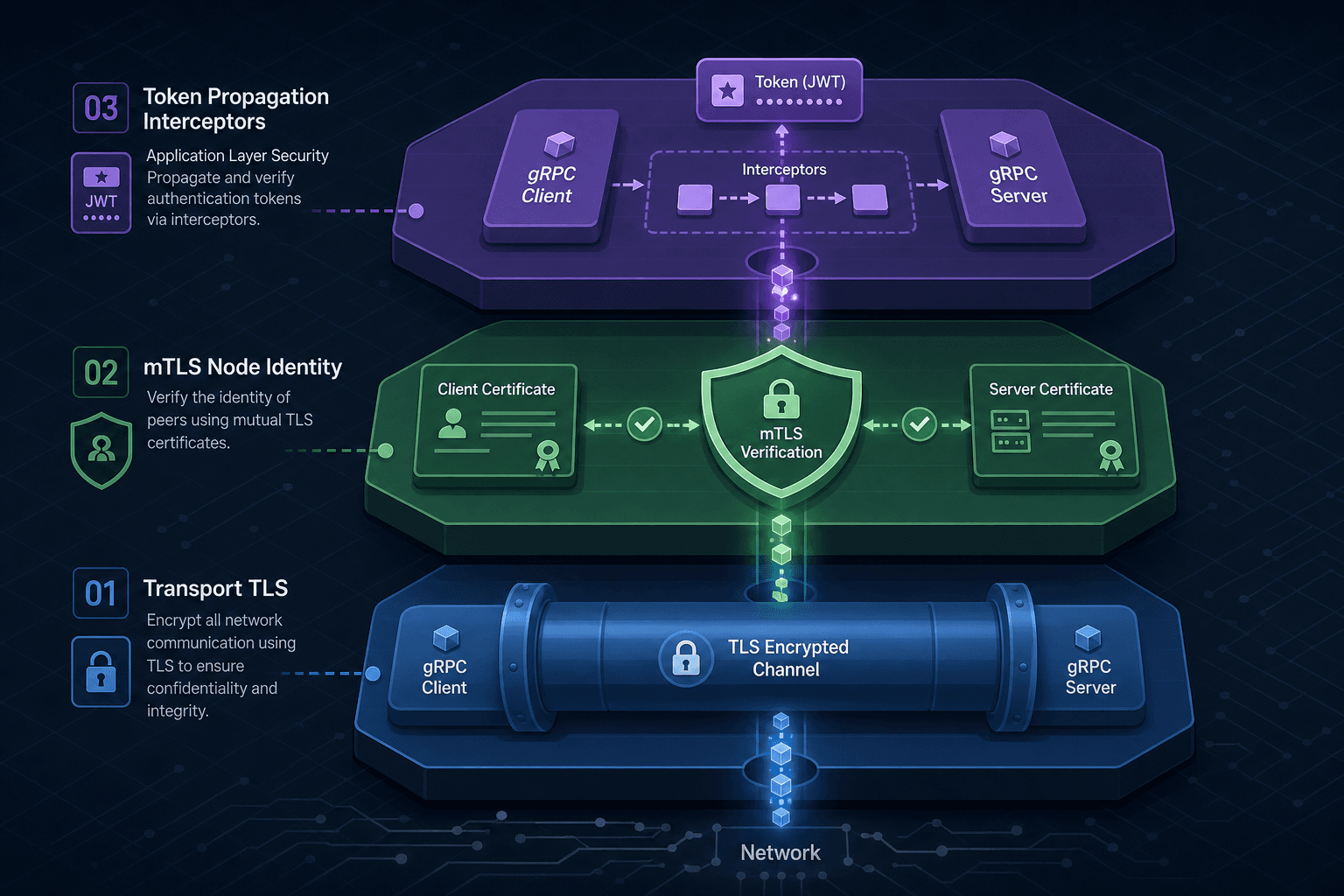
When architects discuss gRPC security, they often default to "enable TLS" and assume the problem is solved. This is a failure of mechanism. gRPC runs over HTTP/2, which relies heavily on the underlying transport layer for integrity, but the application layer—specifically the metadata and the code executing within it—requires explicit, manual wiring to maintain a chain of trust. Security in gRPC is not a feature you turn on; it is a protocol behavior you must construct through three distinct layers: the transport handshake, the mutual identity verification, and the runtime context propagation.
The Transport Layer: TLS as the Default Channel
The first mechanism to understand is how gRPC enforces encryption. Unlike HTTP/1.1, where encryption is optional, gRPC allows insecure connections by default (using in-memory credentials) and requires explicit configuration of transport credentials (like TLS) to enforce encryption. When you initialize a connection in Go, you must explicitly provide grpc.WithTransportCredentials. If you omit this or pass insecure.NewCredentials(), the client attempts to connect over unencrypted HTTP/2, which is rarely what is desired in production.
The mechanism here is the TLS handshake occurring before any application data flows. The client and server exchange certificates to establish a shared secret. In a standard TLS setup, the server presents a certificate, and the client verifies it against a trusted Certificate Authority (CA). The client remains anonymous.
Consider a scenario where a UserService client connects to a PaymentService server. The client creates a tls.Config containing the CA certificate. When the dial happens, the grpc library wraps the TCP connection. The TLS handshake negotiates standard TLS cipher suites (such as ECDHE-RSA-AES128-GCM-SHA256 for compatibility or ChaCha20-Poly1305 for performance) and derives the session keys. Without this, the metadata headers containing user IDs or tokens travel in cleartext, vulnerable to interception.
However, standard TLS only proves the server's identity. It does not prove the client's. In a microservices architecture where service A talks to service B, service B needs to know that service A is actually service A, not an attacker spoofing the hostname. This requires Mutual TLS (mTLS).
Mutual TLS: Verifying the Node Identity
mTLS extends the transport mechanism by requiring the client to present its own certificate during the handshake. This turns the certificate into a static identity token. The server validates the client's certificate chain against its own CA bundle. If the signature is invalid or the certificate is expired, the TLS handshake fails before the TCP connection is fully established, and the RPC call is never received.
In Go, this is implemented by swapping the RootCAs used for verification. The client loads its private key and certificate into a tls.Config with Certificates: []tls.Certificate{...}. The server configures ClientAuth: tls.RequireAndVerifyClientCert in its tls.Config.
// Server-side configuration for mTLS
serverTLS := &tls.Config{
    Certificates: []tls.Certificate{serverCert},
    ClientAuth:   tls.RequireAndVerifyClientCert,
    ClientCAs:    caPool, // Pool of trusted client CAs
}
creds := credentials.NewTLS(serverTLS)
server := grpc.NewServer(grpc.Creds(creds))
This mechanism ensures that only services possessing a valid certificate signed by the trusted CA can establish a connection. It is an effective defense against unauthorized lateral movement. However, it assumes that the network perimeter is the only threat. Once inside, if a rogue service obtains a valid certificate, it can impersonate any authorized service. To mitigate this, we must move identity verification from the transport layer to the application layer using tokens.
Token Propagation: The Context Problem
Here lies the most common point of confusion: how does the client identity established at the transport layer translate to the user identity required by the business logic? The transport layer proves "Service A" exists, but the business logic needs to know "User Alice" is making the request.
gRPC uses a context.Context to pass information down the call stack. A naive approach involves using context.WithValue to store a token. This works for a single process, but it fails in distributed systems because context is not serialized over the network. When Service A calls Service B, the context does not automatically carry the token unless explicitly configured.
The mechanism for propagation is the grpc.Metadata. Metadata is a map of string keys and values attached to the RPC header. To propagate a token, the client must extract it from its local context and inject it into the outgoing metadata.
Imagine a UserService handling a request from "Alice". The handler extracts the JWT from the incoming request. When UserService needs to call OrderService to fetch Alice's history, it cannot just call client.Order(). It must create a new context, attach the token to the metadata, and pass that context to the call.
// Extracting token from context and injecting into metadata
ctx := context.Background()
token := extractTokenFromContext(ctx) // Custom logic
ctx = metadata.AppendToOutgoingContext(ctx, "authorization", "Bearer "+token)

resp, err := orderClient.GetOrders(ctx, &orderpb.GetOrdersRequest{UserId: "alice"})
If you skip this step, OrderService receives the call from UserService (authenticated via mTLS) but has no knowledge of "Alice". It sees a generic service request. This is why automatic propagation is often desired but must be engineered carefully to avoid leaking sensitive data.
Interceptor Patterns: Automating the Chain
Writing manual metadata injection for every RPC call is brittle and error-prone. The mechanism to solve this is the gRPC Interceptor. Interceptors are hooks that wrap the call, allowing you to inspect, modify, or log requests and responses without changing the business logic.
There are two primary types: Unary Interceptors (for simple request-response) and Stream Interceptors (for streaming). The most critical security pattern is the ServerInterceptor for validation and the ClientInterceptor for propagation.
A ServerInterceptor acts as a gatekeeper. Before the actual RPC handler runs, the interceptor executes. It can extract the authorization header from the incoming metadata, validate the JWT signature, and populate the context with the user's claims. If validation fails, it returns an Unauthenticated error immediately.
func authInterceptor(ctx context.Context, req interface{}, info *grpc.UnaryServerInfo, handler grpc.UnaryHandler) (interface{}, error) {
    md, _ := metadata.FromIncomingContext(ctx)
    authHeader := md.Get("authorization")

    if len(authHeader) == 0 || !strings.HasPrefix(authHeader[0], "Bearer ") {
        return nil, status.Error(codes.Unauthenticated, "missing or invalid token")
    }

    token := strings.TrimPrefix(authHeader[0], "Bearer ")
    claims, err := validateJWT(token) // Your JWT validation logic
    if err != nil {
        return nil, status.Errorf(codes.Unauthenticated, "invalid token: %v", err)
    }

    // Inject claims into context for downstream handlers
    ctx = context.WithValue(ctx, "user_claims", claims)
    return handler(ctx, req)
}
On the client side, a ClientInterceptor automates the propagation. It reads the token from the current context and ensures it is present in the outgoing metadata. This creates a "chain of custody" where the token flows from the entry point, through the interceptor, to the next service, which repeats the validation.
// Define the Claims struct explicitly to resolve ambiguity
type Claims struct {
    Token string
    UserID string
}

func tokenInterceptor(ctx context.Context, method string, req, reply interface{}, cc *grpc.ClientConn, invoker grpc.UnaryInvoker, opts ...grpc.CallOption) error {
    // Retrieve token from context (set by previous service or entry point)
    claims, ok := ctx.Value("user_claims").(Claims)
    if ok && claims.Token != "" {
        ctx = metadata.AppendToOutgoingContext(ctx, "authorization", "Bearer "+claims.Token)
    }
    return invoker(ctx, method, req, reply, cc, opts...)
}
The trade-off here is complexity versus security. Interceptors centralize security logic, reducing the risk of a developer forgetting to validate a token in a specific handler. However, they introduce latency and require careful error handling. If the token validation logic is too slow, it becomes a bottleneck. Furthermore, if the token is propagated blindly, a compromised service can leak the token to downstream services that don't need it, increasing the attack surface.
Conclusion
Securing gRPC requires understanding that TLS handles the pipe, mTLS handles the node, and interceptors handle the user. Relying on transport security alone leaves the application blind to who is making the request. Relying on manual context passing is unsustainable at scale. The correct architectural pattern combines all three: enforce mTLS at the service mesh level to ensure only authorized nodes communicate, and use interceptors to inject and validate user tokens at the application boundary. This layered approach ensures that even if one layer is bypassed, the others provide defense in depth.
Common Pitfalls
Even with the right patterns in place, implementation errors can compromise the entire security posture. One frequent issue is leaking tokens in logs. Because gRPC interceptors often log incoming requests for debugging, developers may inadvertently log the full authorization header or the raw JWT payload, exposing sensitive tokens in centralized logging systems. Another critical pitfall is mTLS certificate rotation. In dynamic environments like Kubernetes, failing to automate certificate rotation can lead to service outages when certificates expire or are rotated, especially if the ClientCAs pool is not updated simultaneously across all nodes. Finally, over-propagation is a common design flaw where tokens are passed to services that do not require them, violating the principle of least privilege and expanding the potential blast radius if a downstream service is compromised.
Practical Takeaways
To navigate these complexities, adopt these mental models for gRPC security. First, treat transport security as a prerequisite, not a solution; it protects the pipe, not the payload's semantic meaning. Second, view interceptors as the single source of truth for authentication logic; never duplicate validation code across multiple handlers. Third, embrace defense in depth by assuming the network is hostile; even with mTLS, validate user-level tokens at every service boundary. These principles ensure that your security architecture remains resilient as your microservices scale.
FAQ
Q: Can I rely solely on mTLS for user authentication? A: No. mTLS authenticates the service (the node), not the user. It ensures the request comes from a valid service instance, but it cannot distinguish between different users acting through that service. You must still propagate user tokens for business logic authorization.
Q: Does gRPC automatically propagate context across services?
A: No. The context.Context object is local to a process and is not serialized over the network. You must manually extract values from the context and inject them into grpc.Metadata headers before sending the RPC, and extract them again on the receiving end.
Q: Is it safe to store JWTs in the context?
A: It is generally safe within a single process, provided you handle the memory carefully. However, be cautious not to log the context values or pass the token to untrusted downstream services. Storing the raw token string is often safer than storing complex objects if the context is accidentally serialized or logged.
Related posts
Securing gRPC with OAuth2 Token Propagation in Microservices
A guide to securing gRPC services using OAuth2 token propagation and interceptors for reliable microservice communication.
Understanding X.509 Certificates: From Basics to mTLS Implementation
An examination of X.509 certificates, covering core concepts, certificate management, and the implementation of mutual TLS (mTLS) within PKI infrastructure.
Keycloak Architecture Deep Dive: Internal Components and Data Flow
An examination of Keycloak architecture, internal components, SPI extensions, themes, and the core data model for advanced developers.