Understanding X.509 Certificates: From Basics to mTLS Implementation
An examination of X.509 certificates, covering core concepts, certificate management, and the implementation of mutual TLS (mTLS) within PKI infrastructure.
The Cryptographic Anatomy of Trust
To understand why X.509 certificates secure the internet, you must stop thinking of them as "ID cards" and start viewing them as signed data structures. An X.509 certificate is a specific encoding of a public key bound to an identity, signed by a trusted third party. The core mechanism relies on asymmetric cryptography: if a Certificate Authority (CA) signs a block of data, anyone with the CA's public key can verify that the data has not been altered and that the CA explicitly approved it.
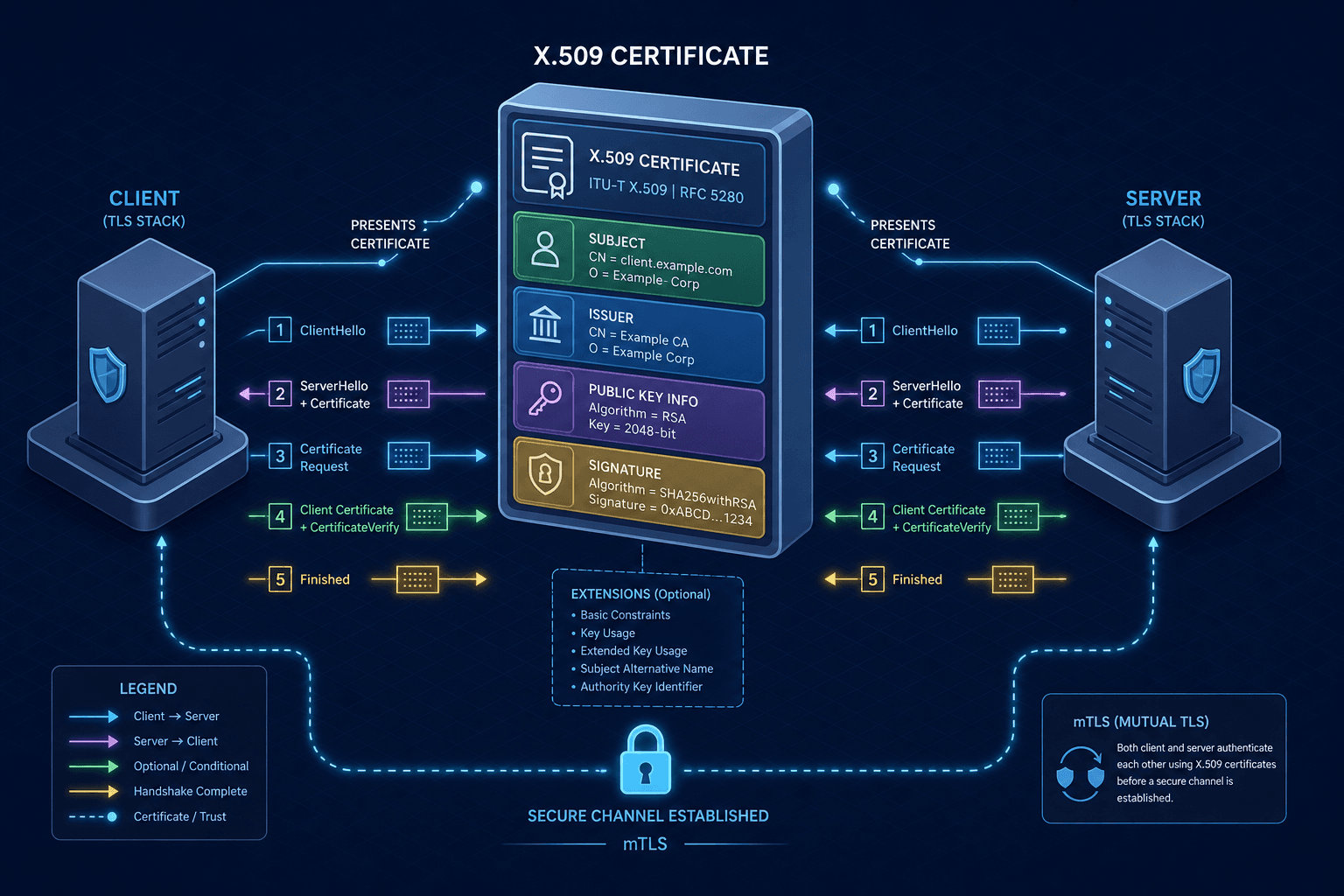
Consider a certificate for api.example.com. It contains a subject field identifying the domain, a validity period, and a publicKey field. Crucially, it includes a signatureAlgorithm (e.g., sha256WithRSAEncryption) and a signatureValue. The signatureValue is the result of taking a hash of all the other fields in the certificate and encrypting that hash with the CA's private key. When your browser receives this certificate, it uses the known public key of the issuing CA to decrypt the signature. If the decrypted hash matches the hash calculated from the certificate's content, the browser trusts the binding between the public key and the domain name. This mathematical binding is the fundamental unit of trust in Public Key Infrastructure (PKI).
The X.509 standard (specifically version 3) extends this basic structure with extensions. These are critical for modern security. The BasicConstraints extension tells a verifier whether the certificate belongs to a CA (allowing it to sign other certificates) or an end-entity (which cannot sign others). The KeyUsage extension restricts what the key can do, such as allowing only digital signatures or key encipherment. Without these extensions, a malicious actor could potentially issue a certificate that claims to be a root CA and sign arbitrary domains, breaking the entire trust model.

The Lifecycle: Issuance, Revocation, and Expiration
A certificate is only as good as its validity period and its revocation status. A common misconception is that a valid signature guarantees the certificate is currently trusted. It does not. A certificate might have been issued correctly but later compromised, or the private key might have been stolen. To handle this, PKI relies on two primary mechanisms: expiration and revocation.
Expiration is a simple, time-based check. Every X.509 certificate has a notBefore and notAfter timestamp. If the current system time falls outside this window, the certificate is immediately rejected by any compliant TLS implementation. This forces organizations to rotate keys regularly, limiting the window of opportunity for an attacker who might have obtained a private key.
Revocation handles the case where a certificate is compromised before its expiration date. There are two standard protocols for checking revocation: Certificate Revocation Lists (CRL) and the Online Certificate Status Protocol (OCSP). A CRL is a periodically updated list of serial numbers of revoked certificates, signed by the CA. The client downloads this list and checks if the certificate's serial number appears in it. This is inefficient for large systems because the CRL can become massive. OCSP allows a client to query a specific CA server with a certificate serial number, and the server responds with the status "good", "revoked", or "unknown". While more efficient, OCSP introduces a new dependency: if the OCSP responder is down, clients may block the connection entirely or, in a mode called "OCSP stapling," accept a cached response served by the web server itself.
In practice, managing this lifecycle manually is impossible at scale. A single enterprise might have thousands of internal services. If a certificate expires, the service goes down. This is why tools like HashiCorp Vault, Let's Encrypt, or internal PKI solutions automate the renewal process, ensuring that a new certificate is generated and deployed before the old one expires.
Mutual TLS: The Bidirectional Handshake
Standard TLS (Transport Layer Security) establishes a one-way trust: the client verifies the server's identity, but the server treats the client as anonymous. Mutual TLS (mTLS) flips this by requiring the client to present a certificate and prove it holds the corresponding private key. This transforms the connection from "anonymous user talking to a server" to "verified client talking to a verified server."
The mechanism occurs during the TLS handshake. In a standard TLS 1.3 handshake, the client sends a ClientHello, the server responds with a ServerHello and its own Certificate, and then the client verifies that certificate. In mTLS, the server adds a CertificateRequest message after sending its own certificate. This message asks the client to present a certificate that chains back to a trusted CA.
Imagine two actors: Alice (the client) and Bob (the server). Bob wants to ensure Alice is authorized.
- Bob sends his
Certificateand aCertificateRequestlisting the CAs he trusts for clients. - Alice receives the request. She looks up her own client certificate in her local store. If she has one signed by a CA in Bob's list, she sends it.
- Alice then generates a random "pre-master secret" and encrypts it using Bob's public key.
- Crucially, to prove she owns the private key corresponding to her client certificate, Alice must sign a
CertificateVerifymessage. In TLS 1.2, this signature covers the concatenation of all previous handshake messages. However, in TLS 1.3, the signature covers a hash of the entire handshake transcript up to that point, excluding theCertificateVerifymessage itself. This shift in TLS 1.3 simplifies the handshake logic and improves security by ensuring the signature is bound to the full context of the session negotiation rather than just a subset of messages. - Bob decrypts the pre-master secret and verifies Alice's
CertificateVerifysignature using her public key (extracted from her certificate). If the signature is valid, Bob knows Alice possesses the private key and is not just spoofing the certificate.
If Alice does not have a valid certificate, or if her certificate is expired or revoked, Bob will terminate the connection immediately. This prevents unauthorized access even if the attacker knows the server's IP address and port. The traffic is encrypted, but the identity is strictly verified on both ends.

Operational Tradeoffs and Implementation Strategy
Implementing mTLS introduces significant operational complexity compared to standard TLS. In standard TLS, you manage server certificates. In mTLS, you must manage the entire lifecycle of client certificates for every user, device, or service that connects. This includes generating keys, signing them, distributing them securely, and handling revocation when a user leaves or a device is lost.
For human users, distributing client certificates is difficult. You cannot simply email a .p12 file and expect it to be secure. Most modern systems use a hybrid approach: users authenticate via SSO (like OAuth/OIDC), and the system issues a short-lived client certificate for the session. For machine-to-machine communication (service-to-service), mTLS is often ideal because the certificates can be stored in a secrets manager and rotated automatically by the orchestration platform (e.g., Kubernetes with Istio or Linkerd).
The security tradeoff is clear: mTLS eliminates the risk of password theft and man-in-the-middle attacks at the transport layer. However, it shifts the burden of trust to the PKI infrastructure. If the internal CA is compromised, an attacker can issue valid client certificates and impersonate any service. Therefore, the security of mTLS is entirely dependent on the security of the CA and the key management practices of the organization.
In a mixed audience environment, the recommendation is to adopt mTLS for high-value internal microservices where the network is not trusted, while using standard TLS for external-facing public APIs. This balances the security benefit of mutual authentication with the operational cost of managing client identities at scale. The mechanism is resilient, but the management of the keys is where the primary engineering effort lies.
Common Pitfalls
When deploying X.509 and mTLS, several recurring errors can compromise security or availability:
- Incorrect Key Usage Extensions: Failing to set
keyUsageorextendedKeyUsagecorrectly can allow a certificate intended for server authentication to be misused for client authentication, or vice versa, leading to unintended trust relationships. - Expired Intermediate CAs: A valid end-entity certificate is useless if the intermediate CA certificate that signed it has expired or is missing from the chain, causing validation failures even when the leaf certificate is valid.
- Clock Skew Issues: Strict validation of
notBeforeandnotAftertimestamps means that significant time drift between clients and servers can cause valid certificates to be rejected immediately, disrupting service availability. - Weak Signature Algorithms: Continuing to use deprecated algorithms like SHA-1 for signatures creates vulnerabilities that allow attackers to forge certificate contents, undermining the integrity of the entire PKI chain.
Practical Takeaways
Engineers implementing mTLS should focus on these actionable steps to ensure success:
- Automate Lifecycle Management: Do not rely on manual processes. Use tools like HashiCorp Vault or ACME clients (Let's Encrypt) to automate issuance, rotation, and revocation.
- Validate Chain Completeness: Ensure your deployment environment includes all necessary intermediate certificates in the trust store to prevent chain validation errors.
- Enforce Strict Extensions: Rigorously configure
BasicConstraintsandKeyUsageextensions to prevent certificate misuse. - Monitor Clock Synchronization: Implement robust NTP synchronization across all services to prevent time-based validation failures.
FAQ
Q: Can I use the same certificate for both client and server authentication?
A: Technically yes, if the extendedKeyUsage extension includes both clientAuth and serverAuth, but it is generally discouraged. Separating roles reduces the attack surface and simplifies audit trails.
Q: How does mTLS differ from OAuth? A: OAuth is an authorization framework that delegates access decisions to an authorization server, typically using tokens. mTLS is an authentication mechanism at the transport layer that verifies the identity of the connecting entity using cryptographic certificates. They are often used together.
Q: What happens if a client certificate is revoked? A: The server will reject the connection during the handshake. Depending on the configuration, the server may return a specific alert code indicating revocation, or simply close the connection without further explanation to prevent information leakage.
Q: Is mTLS suitable for public-facing websites? A: Generally, no. While technically possible, requiring every public user to install a client certificate creates a poor user experience and significant distribution overhead. Standard TLS with strong server authentication is the standard for public web traffic.
Conclusion
X.509 certificates serve as the backbone of modern internet security, acting as cryptographically signed data structures rather than simple digital IDs. By understanding the mathematical binding of signatures, the rigorous lifecycle management required to maintain trust, and the bidirectional verification mechanism of mTLS, engineers can build systems that are resilient against identity theft and man-in-the-middle attacks. While the operational overhead of managing client certificates is significant, the elimination of password-based authentication risks makes mTLS an essential strategy for securing high-value internal infrastructure.
Related posts
Implementing Mutual TLS in Spring Boot Applications
A guide on configuring mutual TLS and X.509 authentication within Spring Boot applications for enhanced certificate-based security.
gRPC Security: TLS, Token Propagation, and Interceptor Patterns
An examination of gRPC security mechanisms including TLS, mTLS, token propagation, and interceptor patterns for advanced implementations.
Understanding Token Binding and Sender-Constrained Tokens
An examination of token binding and sender-constrained tokens including proof of possession, DPoP, and mTLS for enhanced token protection.