Implementing Mutual TLS in Spring Boot Applications
A guide on configuring mutual TLS and X.509 authentication within Spring Boot applications for enhanced certificate-based security.
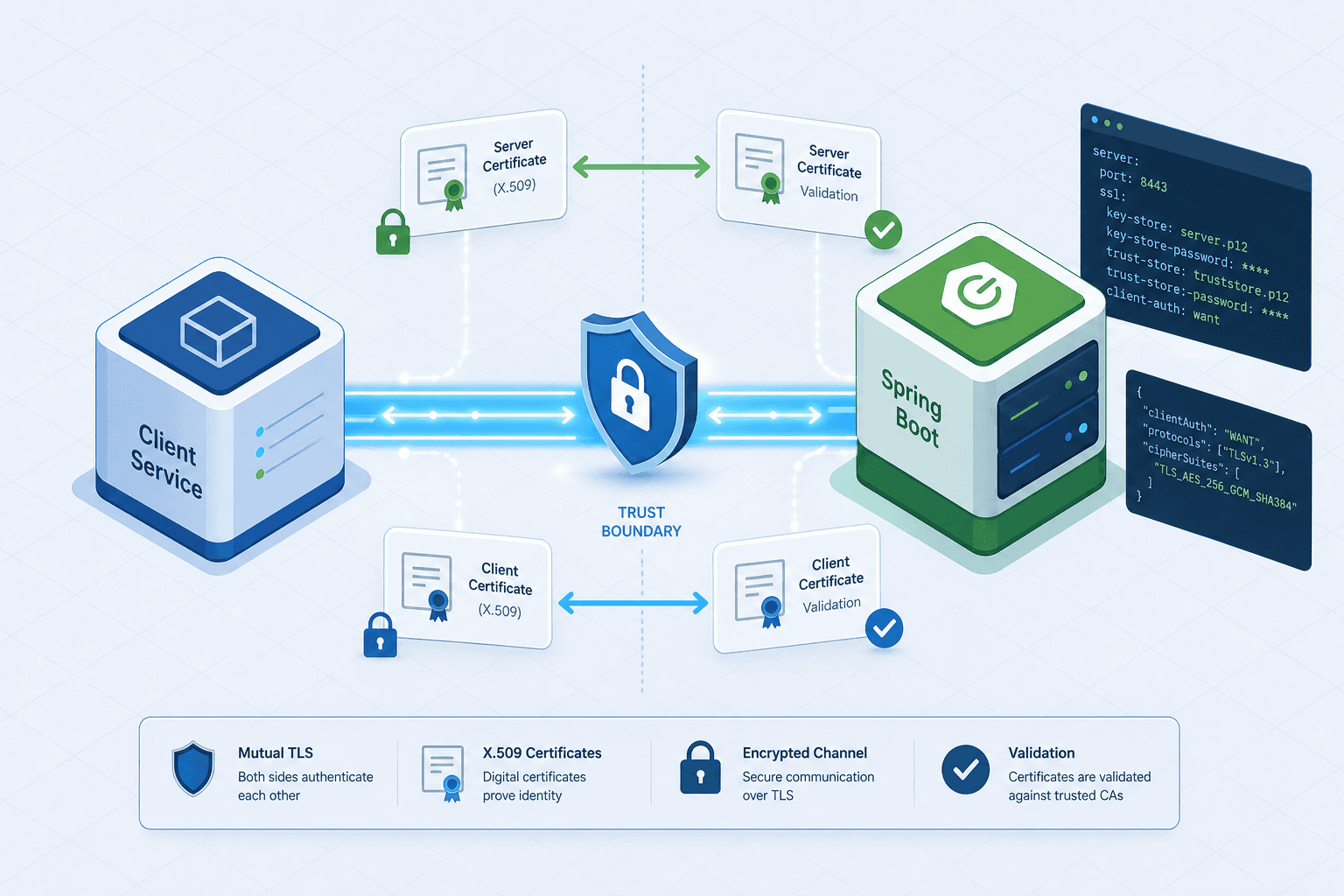
Standard Transport Layer Security (TLS) secures data in transit by verifying the server's identity to the client. Mutual TLS (mTLS) extends this protocol by verifying the client's identity to the server before any application logic executes. In a Spring Boot environment, this is not merely a configuration flag; it represents a fundamental shift in the security boundary. The authentication decision moves from the application context, where a token is validated against a database, to the network stack, where a cryptographic signature is validated against a trusted Certificate Authority (CA). This guide dissects the mechanism of establishing this trust, configuring the Spring security chain to enforce it, and extracting user identity from the X.509 certificate presented during the handshake.
The Mechanism: The ClientHello and CertificateRequest
To understand why mTLS works, we must examine the TLS handshake. In a standard TLS connection, the server sends a ServerHello followed by its Certificate. The client validates this certificate against its local truststore. If valid, the client generates a pre-master secret, encrypts it with the server's public key, and sends it in a ClientKeyExchange. The connection is now encrypted, but the client remains anonymous to the server.
In mTLS, the flow diverges immediately after the server sends its Certificate. The server includes a CertificateRequest message in the handshake. This message lists the Certificate Authorities (CAs) the server trusts and the types of certificates it accepts. The client must respond with a Certificate message containing its own certificate chain. If the client cannot provide a valid certificate signed by one of the listed CAs, the handshake terminates with an alert. Only after the client's certificate is verified does the ClientKeyExchange occur.
This mechanism ensures that possession of a private key (proven by the ability to sign the handshake) is a prerequisite for establishing a connection. The server effectively acts as a gatekeeper, refusing to decrypt traffic from unauthenticated entities.
Configuring Spring Boot for Client Authentication
Spring Boot abstracts the underlying Java Secure Socket Extension (JSSE) into KeyStore and TrustStore configurations. To enforce mTLS, the server must be configured to require a client certificate. This is achieved by setting the client-auth property to require in the SSL configuration.
Consider a scenario where api-server needs to accept connections only from service-a and service-b. Both services possess certificates signed by an internal CA named "Internal-Root".
First, define the application.properties or application.yml to load the truststore containing "Internal-Root" and the keystore containing the server's own identity. Crucially, the server must also enable client authentication.
server.port=8443
server.ssl.key-store=classpath:keystore.p12
server.ssl.key-store-password=changeit
server.ssl.key-store-type=PKCS12
server.ssl.key-alias=server
server.ssl.trust-store=classpath:truststore.p12
server.ssl.trust-store-password=changeit
server.ssl.trust-store-type=PKCS12
server.ssl.client-auth=need
The server.ssl.client-auth=need directive instructs the embedded Tomcat container to enforce the CertificateRequest step described earlier. If you use want, the client can choose to send a certificate, but the connection proceeds even if it doesn't, which defeats the purpose of mTLS for authentication.
However, configuration alone is insufficient. Spring Security must be told to trust the certificates it receives. By default, Spring Security does not automatically bind the client certificate to a user principal unless explicitly configured. We need to create a SecurityFilterChain that utilizes X.509 authentication.
@Configuration
@EnableWebSecurity
public class SecurityConfig {

    @Bean
    public SecurityFilterChain filterChain(HttpSecurity http) throws Exception {
        http
            .csrf(csrf -> csrf.disable()) // Often disabled in mTLS microservices
            .authorizeHttpRequests(auth -> auth
                .requestMatchers("/public/**").permitAll()
                .anyRequest().authenticated()
            )
            .x509(x509 -> x509
                .principalExtractor(new X509PrincipalExtractor()) // Custom logic to map DN to User
                .userDetailsService(new CustomUserDetailsService()) // Load user from DB/Cache
            );
        return http.build();
    }
}
The X509AuthenticationFilter sits in the filter chain. When a request arrives over HTTPS, this filter intercepts the SSLSession. It retrieves the PeerCertificateChain from the session, verifies the chain against the configured truststore (which was set up in the application.properties), and then extracts the subject information.
Extracting Identity: From DN to User Principal
The raw certificate contains a Subject Distinguished Name (DN), such as CN=service-a,O=Internal,C=US. Spring Security needs to convert this string into a UserDetails object. The default X509AuthenticationFilter uses a PrincipalExtractor to parse the DN. However, relying on the CN alone is often insufficient for modern microservices where multiple instances of the same service might exist.
A more robust approach involves extracting the Subject Alternative Name (SAN), specifically the dNSName or iPAddress extensions, which are standard in RFC 5280 for identifying entities.
Let's assume we have a custom X509PrincipalExtractor that parses the SAN.
public class SanPrincipalExtractor implements PrincipalExtractor {
    @Override
    public Object extractPrincipal(X509Certificate cert) {
        try {
            // Extract SAN extension
            byte[] sanBytes = cert.getExtensionValue("2.5.29.17");
            // Note: Parsing raw ASN.1 bytes is complex and error-prone.
            // Recommendation: Use Spring Security's SubjectNamePrincipalExtractor
            // or a library like Bouncy Castle for production code.
            if (sanBytes == null) {
                // Fallback to CN if SAN is missing
                return cert.getSubjectX500Principal().getName();
            }
            // Decode ASN.1 structure to find dNSName
            // Implementation details omitted for brevity, usually using Bouncy Castle
            // Return the specific DNS name or IP
            return "service-a.internal";
        } catch (Exception e) {
            throw new RuntimeException("Failed to extract principal", e);
        }
    }
}
In the security configuration, we inject this extractor. The UserDetailsService then queries a database or an in-memory store to verify if "service-a.internal" is authorized to access the requested endpoint. This decouples the certificate identity from the user account identity. The certificate proves "you are who you say you are," and the UserDetailsService determines "what you are allowed to do."
It is critical to note that the certificate validation happens before the UserDetailsService is invoked. If the certificate is expired, revoked, or not signed by a trusted CA, the X509AuthenticationFilter throws an exception, and the request is rejected at the SSL layer. If the handshake fails, the filter chain is never entered.
Operational Considerations and Tradeoffs
Implementing mTLS in Spring Boot offers significant security benefits, primarily eliminating the risk of token leakage. In a standard OAuth2/OIDC setup, a stolen JWT can be replayed until it expires. In mTLS, an attacker must steal the private key associated with the client certificate. Even if they steal the certificate file, without the private key (which should never leave the secure enclave or be stored in plain text), the handshake will fail.
However, this security comes with a heavy operational cost. Managing the lifecycle of client certificates is complex. You must handle issuance, rotation, and revocation. If a certificate is compromised, you must revoke it in the truststore and distribute a new one. This requires a PKI (Public Key Infrastructure) or an internal CA, often managed by tools like HashiCorp Vault or AWS Private CA.
Opinion: For public-facing consumer applications, mTLS is generally a poor choice due to the friction it introduces for end-users and the difficulty of distributing client certificates to millions of devices. For backend-to-backend communication within a controlled cloud environment (e.g., between Kubernetes pods or microservices), mTLS is the gold standard. It provides zero-trust networking where every service must prove its identity to every other service.
The tradeoff is between developer convenience and cryptographic rigor. Spring Boot makes the implementation straightforward via client-auth=need and the X509AuthenticationFilter, but the burden of infrastructure shifts to the operations team. Without a robust certificate management system, mTLS can become a single point of failure if certificates expire en masse.
Conclusion
Mutual TLS transforms Spring Boot applications into endpoints that demand cryptographic proof of identity. By configuring the embedded server to require client certificates and integrating the X509AuthenticationFilter, you leverage the TLS handshake to enforce authentication before any application code runs. The mechanism relies on the server validating the client's certificate chain against a truststore and the application mapping the certificate's Subject or SAN to a user principal. While this removes the attack surface associated with token theft, it demands a rigorous approach to certificate lifecycle management. For secure, internal microservices architectures, this mechanism provides a level of trust that token-based systems struggle to match.
Common Pitfalls
- Certificate Expiration: Unlike tokens which have explicit expiration times handled by the application, mTLS failures often occur silently if certificates expire. Implement automated monitoring for certificate expiry dates to prevent service outages.
- Truststore Management: Forgetting to update the truststore when a CA root certificate rotates can cause widespread connection failures. Ensure your deployment pipeline includes truststore synchronization.
- SAN Extraction Complexity: Attempting to manually parse ASN.1 structures for Subject Alternative Names (SANs) is error-prone. Rely on established libraries like Bouncy Castle or Spring Security's built-in extractors rather than custom decoding logic.
Practical Takeaways
- Set
server.ssl.client-auth=needto enforce strict client certificate validation at the SSL layer. - Use the
http.x509()DSL inSecurityFilterChainto configure principal extraction and user details services without manual filter injection. - Prioritize SAN (Subject Alternative Name) extraction over CN for robust identity mapping in microservice environments.
Related posts
Understanding X.509 Certificates: From Basics to mTLS Implementation
An examination of X.509 certificates, covering core concepts, certificate management, and the implementation of mutual TLS (mTLS) within PKI infrastructure.
Device Trust and Certificate-Based Authentication
An examination of device trust and certificate-based authentication using X.509 for secure managed device identity and posture verification.
Understanding Token Binding and Sender-Constrained Tokens
An examination of token binding and sender-constrained tokens including proof of possession, DPoP, and mTLS for enhanced token protection.