Device Trust and Certificate-Based Authentication
An examination of device trust and certificate-based authentication using X.509 for secure managed device identity and posture verification.
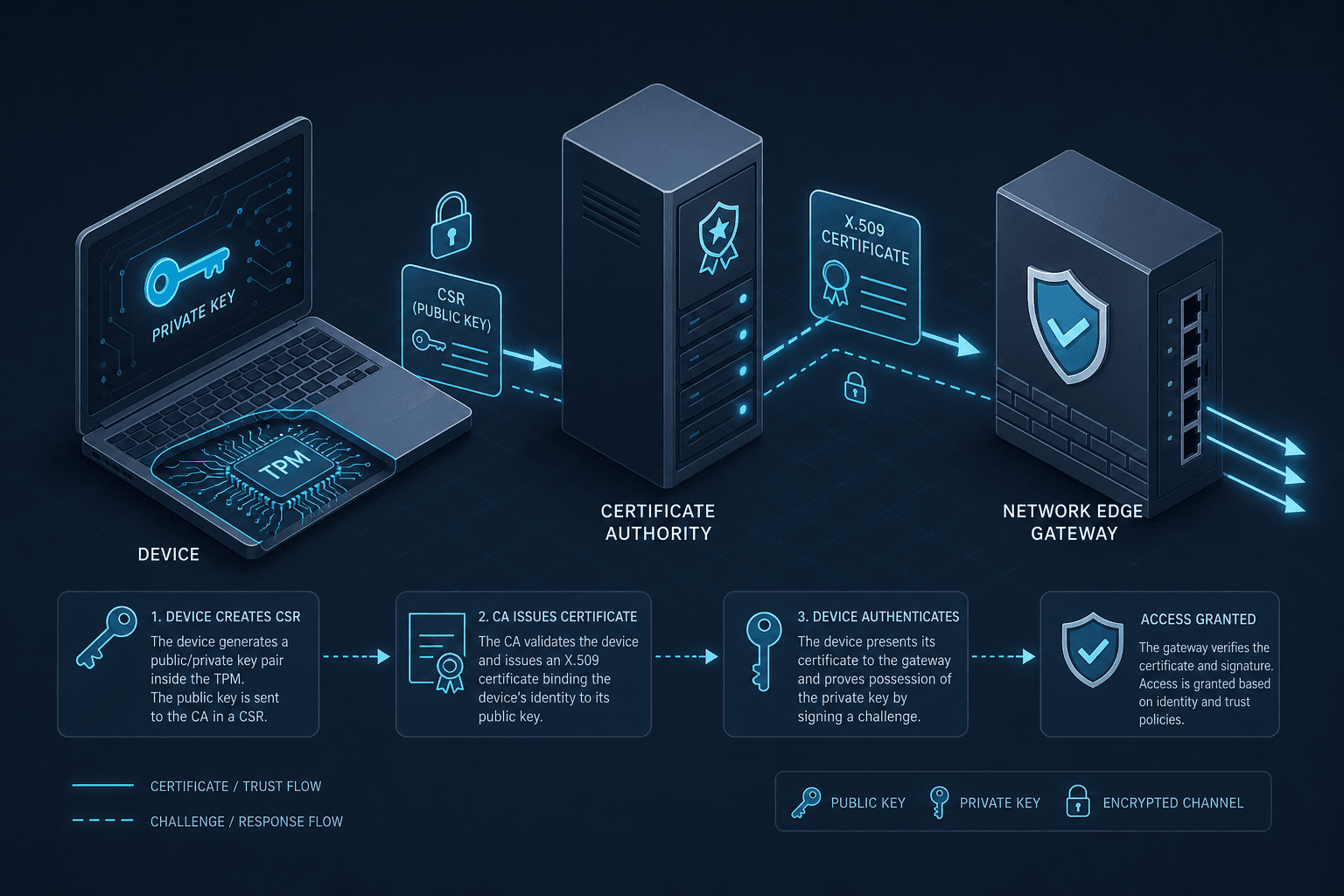
In a Zero Trust environment, the fundamental question shifts from "Who are you?" to "Is this device authorized to make this request, and is it currently safe?" Passwords fail this test because they are static secrets susceptible to theft, phishing, and reuse across devices. A certificate, however, establishes a dynamic binding between a specific cryptographic key pair and a specific device instance. The mechanism relies on asymmetric cryptography: the device holds a private key within a hardware security module (HSM) or OS keychain, while the public key resides in an X.509 certificate signed by a trusted Certificate Authority (CA). When connecting to the network, the device performs a cryptographic proof of possession rather than transmitting a shared secret. If the private key matches the public key and the chain validates against a trusted root, the device is authenticated, eliminating the risk of replay attacks inherent in password-based state.
The Anatomy of a Device Identity
An X.509 certificate for a device is not merely a digital ID but a structured data object defining the trust boundary. The critical field for device trust is the Subject Alternative Name (SAN), which contains unique identifiers like serial numbers, MAC addresses, or hardware-bound GUIDs. Unlike user certificates where the Common Name (CN) might be "john.doe@company.com," a device certificate SAN typically appears as device-id=SN1234567890 or dns=macbook-pro.local. This allows network infrastructure to enforce granular access control based on the device's physical or logical identity rather than the user's role.
The certificate also carries extensions that dictate usage constraints. The keyUsage extension restricts the certificate to specific operations, such as digitalSignature or keyAgreement, preventing a printer certificate from authenticating a user session. Furthermore, the extendedKeyUsage extension can specify clientAuth, explicitly indicating the certificate is intended for client authentication. This distinction is enforced by server-side policy; if a server is configured to require clientAuth and receives a certificate lacking this extension, it rejects the connection immediately, regardless of signature validity. This mechanism ensures that even if a certificate is leaked, it cannot be misused for unauthorized functions.
Enrollment: The Chain of Trust Initiation
Secure certificate issuance relies on the device proving possession of a key pair before the CA issues a certificate. In enterprise environments, this occurs via the Simple Certificate Enrollment Protocol (SCEP) or the newer EST (Enrollment over Secure Transport). The sequence begins when the operating system generates a key pair locally. On a Windows device, the CertEnroll component creates a Certificate Signing Request (CSR) containing the public key and device identity attributes.
The device sends this CSR to the SCEP server, proving it is the same entity that requested the certificate. In SCEP, this is often achieved via a challenge-response mechanism where the server provides a challenge (often a random value) which the client must include in the encrypted CSR payload, proving possession of the private key used to encrypt the request. This prevents replay attacks from third parties. Once the server validates the request and checks the device's identity against a directory service like Active Directory, the CA signs the CSR, creating the X.509 certificate. The device then installs the certificate and stores the private key in a protected area, such as the TPM (Trusted Platform Module) on Windows or the Secure Enclave on macOS.
# Example of a CSR generation using OpenSSL for a device
openssl req -new -newkey rsa:2048 -nodes -keyout device.key -out device.csr \
  -subj "/C=US/ST=California/L=San Francisco/O=Acme Corp/OU=IT" \
  -addext "subjectAltName=DNS:macbook-pro-01.local,IP:192.168.1.100"
This workflow ensures the private key is generated on the device itself, meaning it is never transmitted over the network in plaintext. Only the public key (in the CSR) and the signed response from the CA are transmitted. This "zero-knowledge" enrollment prevents man-in-the-middle attacks during the initial provisioning phase.
Posture Verification: The Handshake as a Policy Check
Once enrolled, the TLS handshake becomes a posture verification mechanism. When the device attempts to connect to a resource, it presents its certificate. The server, often a RADIUS server or a Network Access Control (NAC) gateway, inspects the certificate's attributes to determine the device's health status.
This integrates "device posture" with "device identity." The certificate can contain custom extensions or be mapped to attributes in a RADIUS policy. For instance, a Windows certificate might include a msPKI-Certificate-Application-Policy extension indicating the device runs a specific OS version or patch level. The RADIUS server can query this information or cross-reference the certificate with a device management system like Intune or Jamf via an API call during authentication. If the device lacks a critical security update, the RADIUS server can reject the request or place the device in a restricted VLAN, even if the certificate is cryptographically valid.
The mechanism relies on the certificate being bound to the device's state at the time of issuance and renewal. If compromised, the organization can revoke the certificate immediately. Revocation status is checked via OCSP (Online Certificate Status Protocol) or CRL (Certificate Revocation List) during the handshake. If the server detects a revoked certificate, the connection terminates. This dynamic revocation capability offers a significant advantage over static passwords, which often remain valid until explicitly changed by an administrator.
The Trade-off of Complexity
Implementing this architecture introduces significant operational complexity compared to password-based systems. The primary trade-off is the management overhead of the Public Key Infrastructure (PKI). Organizations must maintain the CA, manage the lifecycle of certificates, and handle revocation lists. If the CA is compromised, the entire trust model collapses. Additionally, devices must be configured to trust the specific CA, requiring careful distribution of root certificates to all managed endpoints.
There is also the issue of certificate renewal. Unlike a password that can be changed instantly, a certificate has a fixed validity period, typically 1 to 2 years depending on the CA implementation. If the renewal process fails, the device loses connectivity. This requires robust automated renewal mechanisms, such as the EST protocol or agent-based renewal services, to ensure the device can renew its identity without user intervention. While this complexity is higher than managing passwords, the security benefit is substantial: the private key is hardware-bound, the identity is tied to the device's specific attributes, and the revocation is immediate. In a Zero Trust model, where every access request is treated as untrusted, this level of granularity is not optional; it is the only viable path to securing the perimeter-less network.
Common Pitfalls
Deploying device certificates introduces specific risks that must be mitigated through rigorous planning:
- CA Compromise: Since the root CA is the source of all trust, a compromise of the CA private key invalidates the entire chain. Organizations must employ hardware security modules (HSMs) for root storage and implement strict offline storage practices for intermediate CAs.
- Renewal Failures: Automated renewal is critical but fragile. If the renewal agent fails due to network segmentation, expired credentials, or configuration drift, devices will lose connectivity en masse when certificates expire. Continuous monitoring of renewal success rates is essential.
- SAN Configuration Errors: Relying on the Common Name (CN) for identity validation is deprecated. Strict clients often reject certificates where the hostname is not present in the Subject Alternative Name (SAN) extension. Ensuring SANs match the exact FQDN and IP addresses expected by clients prevents silent authentication failures.
Practical Takeaways
To effectively implement device trust, adhere to these mental models:
- Hardware is the Root: Treat the private key as the ultimate secret. If the key leaves the hardware boundary (TPM/Secure Enclave), the trust model is broken.
- Identity is Contextual: A certificate proves who the device is, but posture checks prove what state it is in. Both are required for a complete Zero Trust decision.
- Revocation is Immediate: Unlike passwords, certificates can be killed instantly. Leverage this by configuring short lifecycles and aggressive revocation policies for high-risk environments.
FAQ
Q: How long should device certificates be valid? A: Validity periods should balance security and operational overhead. Shorter lifetimes (e.g., 30 days to 1 year) reduce the window of opportunity for an attacker who compromises a private key, but they increase the load on the PKI and the frequency of renewal operations. A common practice is 1 year for standard devices and shorter durations for high-security assets.
Q: Can a device authenticate without a certificate? A: Not in a pure certificate-based model. While some systems support hybrid approaches, the core promise of device trust is the cryptographic binding of the device to its identity. Without a valid, non-revoked certificate, the device cannot prove possession of the private key required for authentication.
Q: What happens if the CA is offline? A: If the CA is offline, new certificates cannot be issued, and existing certificates cannot be revoked. However, already issued certificates remain valid until their expiration date. The system relies on cached CRLs or OCSP responders to validate revocation status during the CA outage.
Conclusion
Device trust via X.509 certificates represents a fundamental shift from identity-centric to device-centric security models. By binding immutable hardware nonces to cryptographic keys, organizations can verify device integrity and identity simultaneously. While the operational burden of PKI management and automated renewal is higher than traditional password systems, the elimination of shared secrets and the ability to perform real-time posture verification make certificate-based authentication essential for modern Zero Trust architectures. As networks evolve into perimeter-less environments, the cryptographic anchor provided by device certificates becomes the cornerstone of secure access.
Related posts
Implementing Mutual TLS in Spring Boot Applications
A guide on configuring mutual TLS and X.509 authentication within Spring Boot applications for enhanced certificate-based security.
Understanding X.509 Certificates: From Basics to mTLS Implementation
An examination of X.509 certificates, covering core concepts, certificate management, and the implementation of mutual TLS (mTLS) within PKI infrastructure.
RFC 8693: Token Exchange, Delegation, and Impersonation
RFC 8693 defines token exchange, delegation, and impersonation mechanisms for OAuth 2.0, enabling secure identity propagation across service boundaries.