Continuous Authentication: Moving Beyond One-Time Login
Explore continuous authentication strategies using behavioral biometrics and session monitoring to enhance security beyond the initial login event.
This article, Part 9 of the Passwordless & Next-Gen Authentication Series, examines the architectural shift from static session validation to dynamic, real-time identity verification. By leveraging behavioral biometrics and passive session monitoring, organizations can close the "trust cliff" inherent in one-time logins, ensuring that the entity holding a session token remains the legitimate user throughout the entire interaction. As a leading cybersecurity trends topic, continuous authentication represents a critical evolution in how we defend against session hijacking and credential theft in modern environments.
The Failure of the Static Session
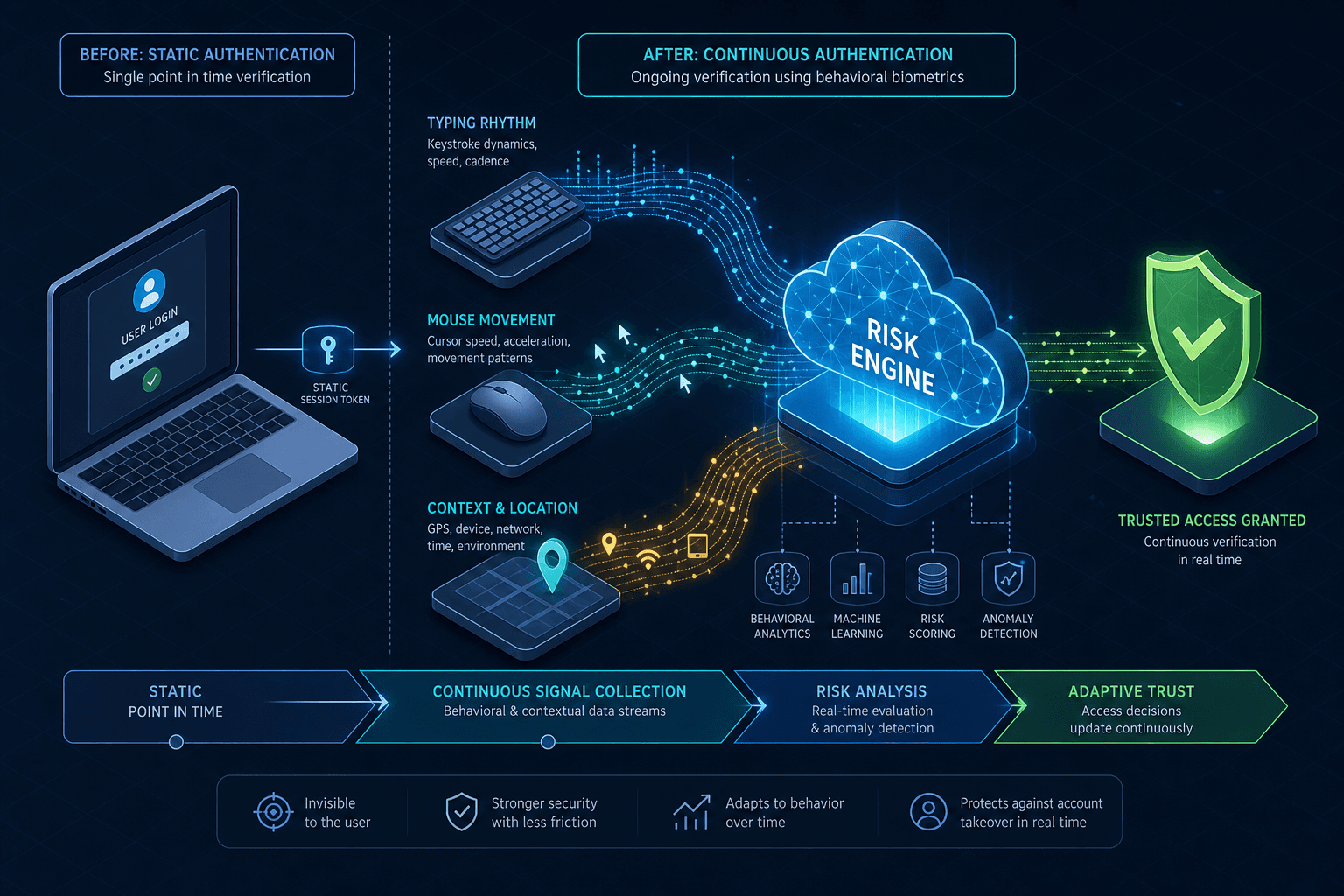
The modern security model relies on a fundamental flaw: the assumption that the person who logged in is the same person who is using the computer ten minutes later. This "one-time login" paradigm creates a trust cliff. Once a user authenticates, the system issues a session token (like a JWT or a browser cookie) and assumes the session remains valid for its entire duration, often hours or days. If an attacker steals that token or hijacks the session, the system has no mechanism to distinguish between the legitimate user and the imposter until the session expires or the user logs out. Continuous authentication attempts to close this gap by treating identity not as a static event, but as a continuous stream of data points that must be validated in real-time.
To understand the necessity of continuous checks, we must look at the mechanism of a standard web session. When you log in, your client receives a session ID. The server stores this ID and marks it as "active." Every subsequent request includes this ID in the header. The server's check is binary: "Does this ID exist in the database?" It does not ask, "Is the person holding the device the same as the one who generated this ID?"
Consider a scenario involving Alice, a financial analyst, and Bob, a malicious actor. Alice logs into her banking portal from her corporate laptop. She leaves her desk to get coffee. Bob, who knows Alice's password (perhaps from a previous phishing attack), sits at her terminal. In a traditional system, Bob is now Alice. The session token is still valid. The server sees a valid token and grants access to transfer funds. The mechanism here is purely cryptographic; it validates the key, not the keyholder.
This limitation is why Zero Trust architectures demand "never trust, always verify." If the initial verification is the only verification, the trust boundary is too large. Continuous authentication shrinks this boundary by constantly re-evaluating the context of the session.

Behavioral Biometrics: The Invisible Fingerprint
Continuous authentication relies heavily on behavioral biometrics to establish a dynamic baseline of the user. Unlike static biometrics (fingerprint, face), which are strictly "something you are," behavioral biometrics are "something you do." These actions are difficult to replicate because they are subconscious and highly individualized.
The mechanism works by collecting telemetry data passively in the background. For example, consider Keystroke Dynamics. When Alice types her username or navigates a form, the system records the flight time (time between key presses), dwell time (how long a key is held), and the pressure applied. Bob might know Alice's password, but he cannot mimic the specific rhythm and pressure with which she types. If the system detects a significant deviation from Alice's established baseline—say, a 30% increase in average dwell time—it flags the session as anomalous.
Another critical vector is Mouse Dynamics. Alice doesn't just click; she moves the mouse in specific curves, accelerations, and decelerations. Studies have demonstrated that mouse movement patterns can identify users with over 90% accuracy even when they are trying to mimic another user.
These metrics are aggregated into a "behavioral vector." This vector is not stored as a single value but as a probability distribution. The system calculates a similarity score between the current session's behavior and the user's historical profile. If the score drops below a threshold, the system assumes the identity has changed. This process happens transparently, requiring no additional input from the user, thus preserving the user experience while enhancing security.
Session Monitoring and Risk Scoring
Behavioral biometrics provide the raw data, but session monitoring provides the context. The system aggregates multiple signals: geolocation changes, device fingerprint shifts, network topology, and the behavioral vectors mentioned above. These signals feed into a risk engine that calculates a dynamic risk score.
Imagine a scenario where Alice logs in from her home office in New York. Two hours later, a request originates from a different IP address in London, but the mouse dynamics and typing rhythm match her profile perfectly. A static system might allow this if the IP is whitelisted or if the user hasn't been challenged recently. However, a continuous authentication system sees a "geolocation jump" combined with "device context change." Even if the behavior matches, the risk score spikes due to the impossibility of physical travel.
The mechanism here is Adaptive Authentication. The system does not block the user immediately; it escalates. If the risk score crosses a certain threshold, the system injects a challenge. This could be a push notification to a registered mobile device, a request for a one-time code, or a CAPTCHA. If the user fails the challenge, the session is terminated.
This approach is superior to static Multi-Factor Authentication (MFA) because it is context-aware. MFA is often a "one-time" gate. Continuous authentication makes MFA a "continuous" filter. NIST SP 800-63B supports risk-based authentication and adaptive verification, aligning with continuous authentication principles.

The Zero Trust Integration
Integrating continuous authentication into a Zero Trust architecture requires a shift in how the identity provider (IdP) communicates with the resource server. In a traditional setup, the IdP issues a token, and the resource server trusts it. In a continuous model, the resource server (or a dedicated policy decision point) acts as a listener for behavioral events.
The data flow changes from a linear path to a feedback loop:
- Telemetry Collection: The client agent collects behavioral and environmental data.
- Event Streaming: Data is sent to the analytics engine in near real-time.
- Risk Calculation: The engine updates the user's risk score.
- Policy Enforcement: If the score exceeds the threshold, the Policy Decision Point (PDP) may directly instruct the Resource Server to terminate the session or invalidate the token, or signal the IdP depending on the specific architecture.
This creates a "stateful" trust model within a "stateless" protocol environment. The token itself might remain unchanged, but the context around it is constantly re-verified. If the context is invalidated, the token becomes useless.
Trade-offs and Implementation Challenges
Implementing continuous authentication introduces complexity. The primary trade-off is privacy versus security. Collecting granular behavioral data requires careful handling to avoid surveillance creep. The data must be anonymized where possible and processed locally on the device before being sent to the cloud, if feasible.
Furthermore, false positives can degrade the user experience. If the system is too sensitive, legitimate users might be challenged repeatedly. For instance, if Alice switches from a laptop to a tablet, her mouse dynamics vanish, and her typing pattern changes. The system must account for these legitimate device transitions by adjusting baselines or lowering the sensitivity for known device switches.
There is also the challenge of adversarial attacks. Researchers have shown that it is possible to generate synthetic mouse movements that mimic human behavior. To counter this, systems must use multi-modal biometrics, combining behavioral data with device health checks and network analysis to make spoofing significantly harder.
Conclusion
The transition from one-time login to continuous authentication is a fundamental restructuring of how we define "identity." Key takeaways include:
- Shift from Static to Dynamic: Identity is no longer a single event at login but a continuous stream of verification data points.
- Role of Behavioral Biometrics: Subconscious behaviors like typing rhythm and mouse movement provide a robust, hard-to-spoof method for validating the user's presence.
- Balancing Privacy and Security: Successful implementation requires careful data handling to protect user privacy while maintaining a high-security posture against session hijacking.
By moving the verification mechanism from the moment of entry to the duration of the session, we eliminate the window of opportunity for attackers. While challenges regarding privacy compliance and false positive rates exist, the result is a security posture that aligns with the reality of a connected world: trust is not a destination, but a continuous journey.
Common Pitfalls
Organizations adopting continuous authentication often stumble on specific implementation hurdles:
- Privacy Compliance Risks: Aggregating granular behavioral data can lead to violations of regulations like GDPR or CCPA if not handled with strict anonymization and consent protocols.
- False Positive Rates: Overly sensitive thresholds can frustrate users with frequent challenges, leading to productivity loss and potential abandonment of the application.
- Adversarial Spoofing: Without multi-modal verification, attackers may attempt to spoof behavioral patterns using synthetic data or automated scripts, necessitating robust defense mechanisms.
Practical Takeaways
To successfully deploy continuous authentication, organizations should consider the following actionable steps:
- Start with Low-Risk Scenarios: Begin by implementing behavioral checks for non-critical actions to calibrate baselines before applying them to high-value transactions.
- Prioritize Local Processing: Where feasible, process behavioral telemetry on the client device to minimize data transmission and enhance user privacy.
- Implement Multi-Modal Biometrics: Combine behavioral data with device health checks and network analysis to create a layered defense that is difficult for attackers to bypass.
FAQ
Does continuous authentication slow down performance? No. Because behavioral data collection and risk scoring are designed to be passive and asynchronous, they typically run in the background without introducing perceptible latency for the end-user.
How is behavioral data stored? Sensitive behavioral vectors are rarely stored as raw data. Instead, systems often store hashed representations or probability distributions locally on the device or in encrypted databases, ensuring that the raw telemetry cannot be reverse-engineered to reveal user habits.
Is this compatible with existing MFA? Yes. Continuous authentication is designed to complement, not replace, traditional MFA. It acts as a continuous filter that can trigger additional MFA challenges dynamically if risk scores spike, creating a "defense-in-depth" strategy.
Related posts
Identity Threat Detection and Response (ITDR): The New Security Frontier
Explore identity threat detection and response (ITDR) as a critical component of identity security, focusing on credential theft detection, UEBA, and security analytics.
Zero Trust Architecture: A Practical Implementation Guide
A practical walkthrough of implementing zero trust architecture, covering identity security, least privilege, micro-segmentation, and continuous verification.
Building an Identity Service Mesh: Integrating IAM with Istio
An examination of integrating Identity and Access Management with service mesh technologies like Istio using SPIFFE for secure service-to-service communication.