Zero Trust Architecture: A Practical Implementation Guide
A practical walkthrough of implementing zero trust architecture, covering identity security, least privilege, micro-segmentation, and continuous verification.
The traditional network perimeter assumes internal trust, a flaw in modern hybrid environments. Zero Trust Architecture (ZTA) replaces this with explicit, continuous verification of identity, device health, and context. This guide details the specific mechanisms enforcing these principles: identity planes, least privilege, and dynamic session monitoring.
As Part 2 of the Zero Trust & Modern Security Architecture Series, this article details the operational mechanics required to build a resilient security posture.
The Identity Plane: Verifying "Who" Before "Where"
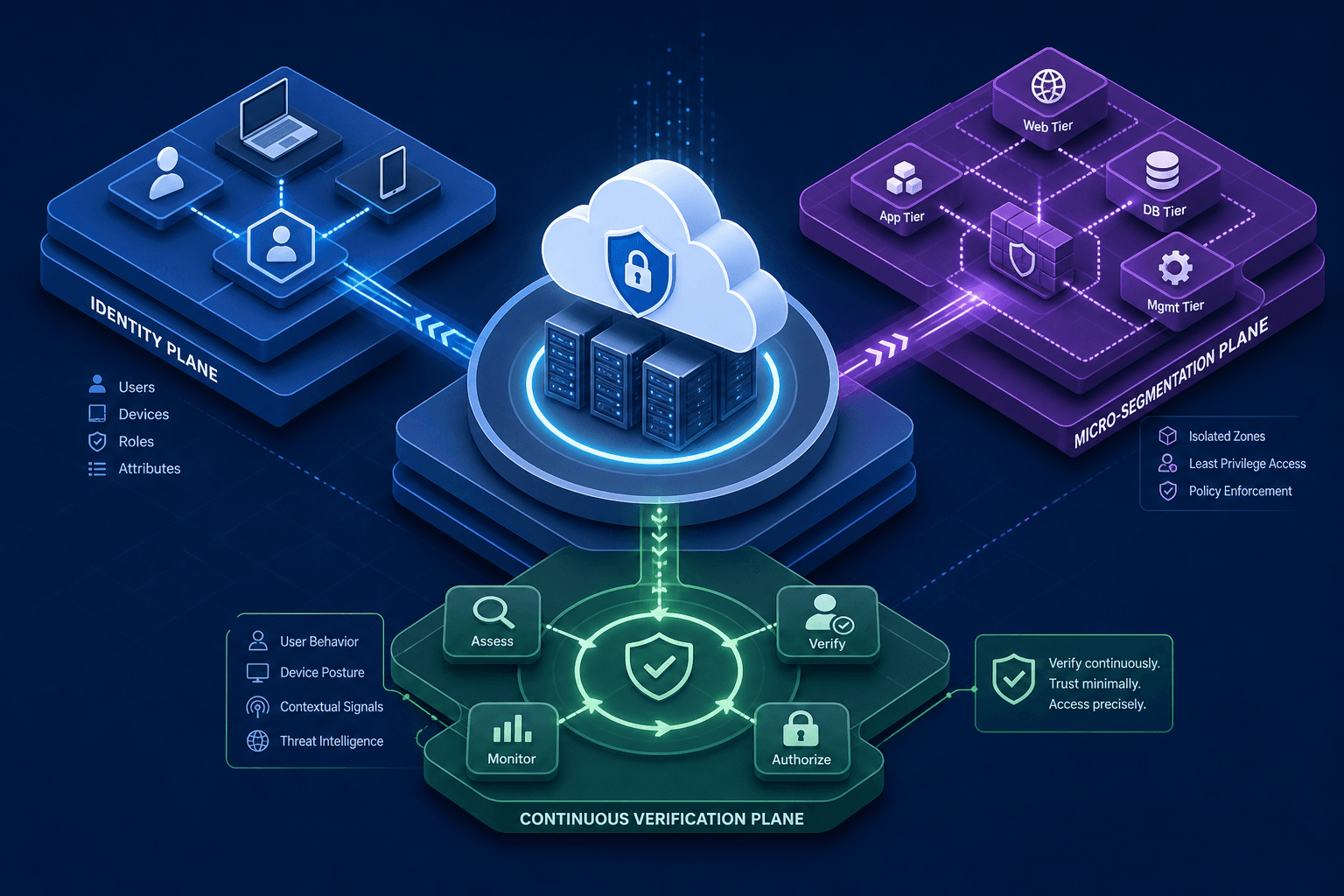
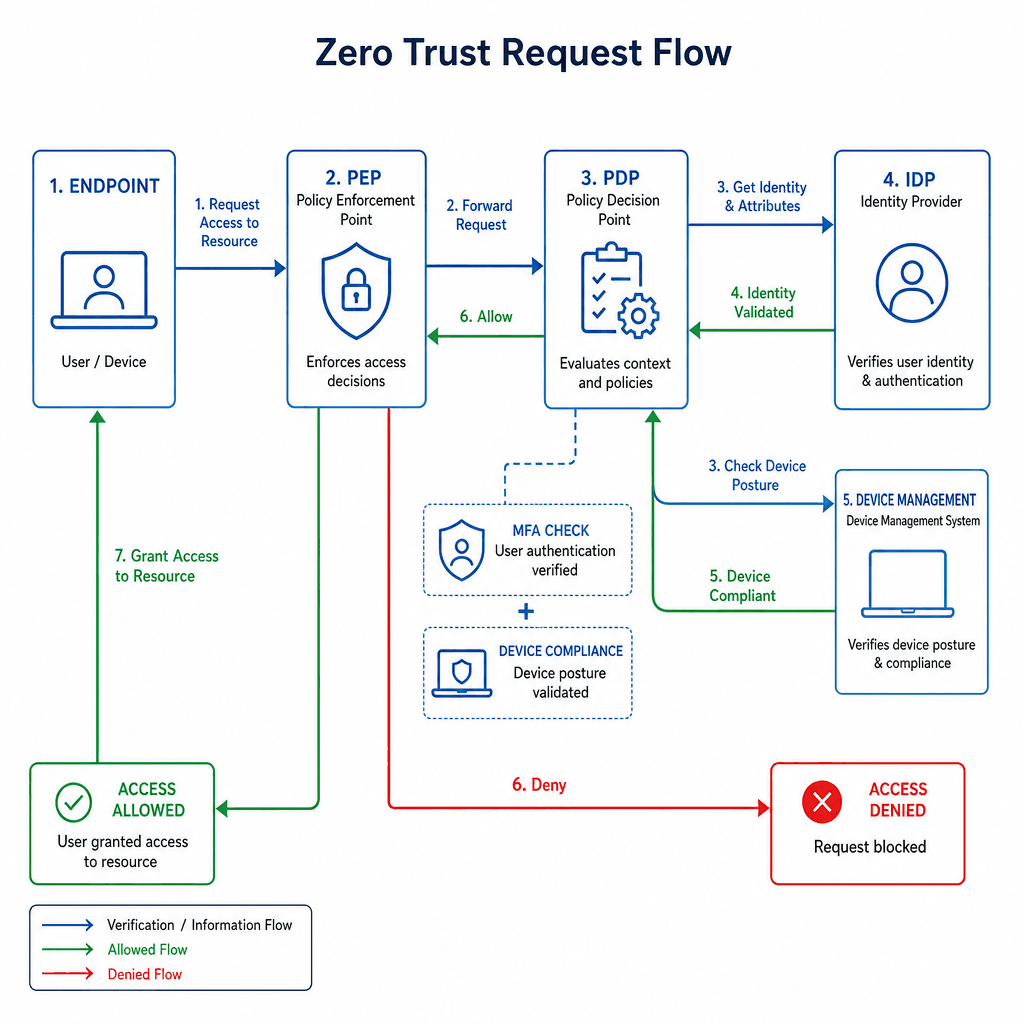
In a Zero Trust model, the first mechanism is the Identity Plane. Unlike legacy systems where domain login grants broad access, Zero Trust requires authentication and authorization before connection establishment. The core mechanism is the Policy Decision Point (PDP) acting as a gatekeeper. When a user attempts to access an application, the PDP checks identity credentials, device compliance, and risk context rather than just the IP address.
Consider an employee, "Alice," accessing the HR database. In a legacy model, corporate Wi-Fi might grant access. In Zero Trust, the request hits a Policy Enforcement Point (PEP) first. The PEP forwards the request to the PDP, which queries an Identity Provider (IdP) for Multi-Factor Authentication (MFA) status and a Device Management system for patch compliance. If checks fail, the PDP instructs the PEP to deny the request immediately. No traffic flows between Alice and the database until the PDP issues a positive decision. In token-based implementations, the PEP validates the issued token against the PDP or IdP before allowing the session to proceed. This ensures that even if a perimeter is breached, lateral movement is blocked without verified identity and posture.
Least Privilege and Micro-segmentation: Enforcing "What"
Once identity is verified, the next mechanism enforces least privilege through micro-segmentation. The goal is to limit the blast radius by ensuring users and workloads access only specific resources. This is achieved by breaking the network into small, isolated segments rather than relying on large VLANs. Each segment acts as a distinct security zone with its own access control policies.
Imagine the HR department's servers are segmented into a "High-Security Zone." The default policy is "deny all." Access is granted only to specific identities (e.g., HR Managers) and specific ports (e.g., HTTPS on 443) to specific applications. If Alice, compromised, tries to access a Finance server in the "General Zone," the micro-segmentation policy at the hypervisor or SDN controller blocks the connection. The mechanism relies on granular tags and labels applied to workloads, allowing policies to follow the workload regardless of IP. This prevents lateral movement, a common tactic in ransomware attacks, because attackers cannot scan the network; they are confined to the specific micro-segment they accessed.

Continuous Verification: The "Never Trust, Always Verify" Loop
The third critical mechanism is continuous verification. Traditional models trust authenticated sessions for long durations. Zero Trust assumes the environment is hostile and sessions can be compromised at any moment. Therefore, the system must continuously evaluate session risk.
This mechanism works by monitoring telemetry streams in real-time. As Alice accesses the HR database, the system collects data points: typing speed, login location, time of day, and device behavior. If Alice requests a massive data export at 3 AM from a new country, the continuous verification engine flags this as anomalous. The PDP receives this alert and can dynamically revoke the access token or force re-authentication with stronger MFA. This is a feedback loop where the trust score is recalculated for every transaction. If the score drops below a threshold, the PEP terminates the session immediately. This minimizes the window of opportunity for attackers by detecting behavioral deviations and cutting connections instantly.
Practical Takeaways: Mental Models for ZTA
Before diving into implementation, adopt these mental models to guide your strategy:
- The Perimeter is Virtual: Treat every network location as untrusted. Trust boundaries are defined by identity and data, not by physical or logical network location.
- Least Privilege by Default: Assume no user or device has inherent rights. Access must be explicitly granted for a specific resource, for a specific time, and under specific conditions.
- Verify Everything, Everywhere: Do not rely on a single check at the entry point. Continuous monitoring and re-evaluation are required throughout the entire session lifecycle.
Implementation Path: From Discovery to Enforcement
Implementing Zero Trust is a phased process. The first step is asset discovery. You cannot secure what you do not know. Inventory all users, devices, applications, and data flows across your environment, mapping the "to-be" architecture where trust boundaries are defined by identity and data.
The second step is integrating identity and device management. Consolidate your Identity Providers (IdPs) and enforce MFA for all users, bringing on-premise applications into the fold using Zero Trust Network Access (ZTNA) or Secure Access Service Edge (SASE). The third step is deploying Policy Enforcement Points (PEPs), which can be software agents, firewalls, or cloud-native security groups. Apply policies to critical assets first, such as financial databases. Finally, move to continuous monitoring and automation, using SIEM tools to correlate logs from the PDP, PEP, and identity providers.
# Example PEP Configuration Snippet (Generic YAML Schema)
apiVersion: security.example/v1
kind: AccessPolicy
metadata:
  name: hr-database-access
spec:
  target:
    workload: hr-db-cluster
  rules:
    - action: DENY
      source: "*"
    - action: ALLOW
      source:
        identity: "hr-managers-group"
        device_posture: "compliant"
      destination:
        port: 443
        protocol: tcp
      condition:
        time: "09:00-18:00"
Common Pitfalls in Zero Trust Implementation
Organizations often stumble when implementing ZTA due to specific challenges:
- Ignoring Legacy Dependencies: Attempting to enforce strict micro-segmentation without accounting for legacy applications that require broad network access or hardcoded IP dependencies can cause operational outages.
- Over-Reliance on Technology: Viewing Zero Trust as a product purchase rather than a cultural shift leads to failure. Without user training and executive buy-in, strict policies will be bypassed or misconfigured.
- Inconsistent Identity Sources: Failing to unify identity sources (e.g., mixing on-prem AD with cloud IdPs) results in fragmented policy enforcement, leaving gaps where attackers can exploit inconsistent authentication states.
Conclusion
Zero Trust Architecture is not a single product but a strategic design approach. By implementing the Identity Plane, you ensure only verified entities initiate connections. Through micro-segmentation and least privilege, you limit access scope to the absolute minimum. By adopting continuous verification, you maintain a dynamic state of trust. While implementation requires significant planning, the result is a resilient posture where the perimeter no longer exists. As NIST SP 800-207 notes, the core principle is "verify explicitly, assume breach," transforming security from a static barrier into an active defense system. For deeper technical context, refer to RFC 8280 regarding the architecture of Zero Trust networks.
FAQ
Q: Does Zero Trust require replacing all existing hardware? A: No. Zero Trust is a logical architecture that can be implemented over existing infrastructure using software-defined controls, though replacing legacy hardware with modern, API-driven devices is recommended for optimal performance.
Q: How does Zero Trust handle legacy applications that don't support MFA? A: You can place a ZTNA gateway or reverse proxy in front of legacy apps. This gateway handles the authentication and verification, presenting a trusted connection to the legacy application itself, effectively bridging the gap.
Q: Is Zero Trust suitable for small businesses? A: Yes. While enterprise-scale, the core principles of "never trust, always verify" and least privilege are scalable. Small businesses can start with cloud-native identity providers and simple segmentation before moving to complex micro-segmentation.
Related posts
Identity-First Security: Shifting to Identity Perimeter
An examination of shifting security strategy from network perimeter to identity perimeter using zero trust principles and perimeter-less security.
Continuous Authentication: Moving Beyond One-Time Login
Explore continuous authentication strategies using behavioral biometrics and session monitoring to enhance security beyond the initial login event.
Identity Threat Detection and Response (ITDR): The New Security Frontier
Explore identity threat detection and response (ITDR) as a critical component of identity security, focusing on credential theft detection, UEBA, and security analytics.