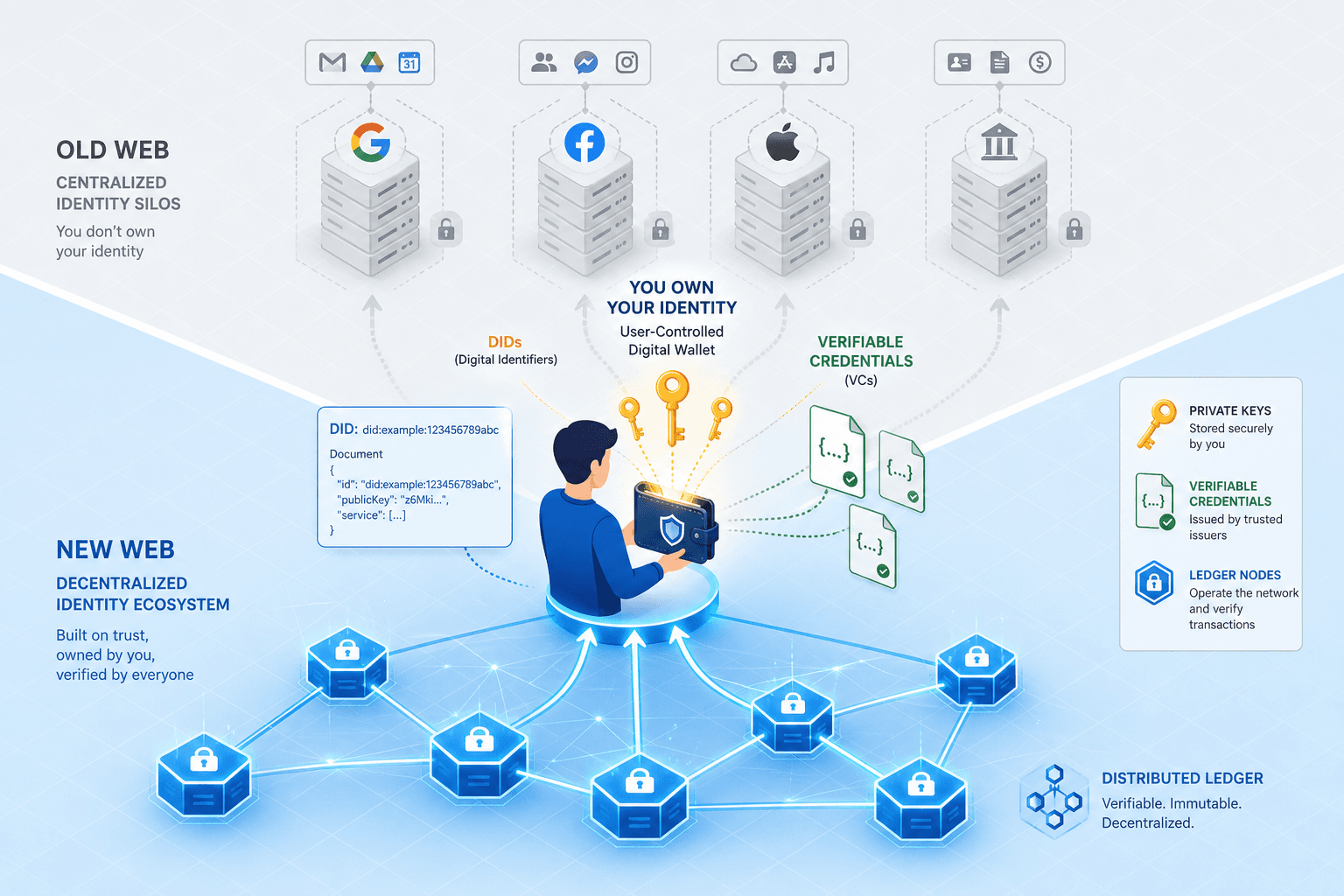
Decentralized Identity and Self-Sovereign Identity (SSI) Explained
An examination of decentralized identity and self-sovereign identity (SSI), covering DIDs, verifiable credentials, Web5, and blockchain identity solutions.
This is Part 8 of the Zero Trust & Modern Security Architecture Series.
The modern internet operates on a centralized identity model where platforms like Google or Facebook act as gatekeepers, holding your credentials against private databases. This creates a single point of failure: if the database is breached, millions of identities are compromised. Self-Sovereign Identity (SSI) addresses this by shifting the cryptographic burden from the service provider to the user. Instead of a central authority issuing a username and password, SSI utilizes Decentralized Identifiers (DIDs) and Verifiable Credentials (VCs) to create a system where the user controls the private keys that prove their identity, and the network verifies the signature rather than a database entry.
The Mechanism of Decentralized Identifiers (DIDs)
The core mechanism of SSI is the Decentralized Identifier (DID). Unlike a standard URL or email address which points to a resource hosted on a specific server, a DID is a string that resolves to a DID Document stored on a distributed ledger, such as a blockchain or a decentralized peer-to-peer network. A DID Document is not a record of personal data; it is a public JSON structure containing public keys, authentication methods, and service endpoints.
When Alice wants to prove she is Alice to a verifier (Bob), she does not send her password. She sends a cryptographic signature generated by the private key corresponding to the public key listed in her DID Document. The verifier queries the distributed ledger to find the DID Document associated with Alice's DID, retrieves the public key, and verifies the signature. If the signature matches, the ledger has confirmed the key belongs to the DID, but the ledger itself never stores Alice's name, address, or photo. This separation of the identifier (DID) from the data (attributes) is the fundamental architectural shift.
Resolving DIDs to Trust Anchors
To verify a signature, the system must first resolve the DID to its associated public key. This process, known as DID Resolution, eliminates the need for a central database lookup. When a verifier receives a DID, they query the distributed ledger to retrieve the current DID Document. This document acts as a trust anchor, listing the public keys authorized to act on behalf of that identifier and the service endpoints where the holder can be reached.
The resolution process ensures that the verifier is interacting with the current state of the identity without relying on a third-party directory service. If the key has been rotated or revoked, the DID Document reflects the latest state once propagated to the resolver. This mechanism allows verification to happen with low latency against a global, immutable state, ensuring that the public key used for verification is the most up-to-date version authorized by the DID owner, accounting for network propagation delays.
Verifiable Credentials and Selective Disclosure
Once the identifier is established, the mechanism for sharing attributes relies on Verifiable Credentials. In a traditional system, a government issues a physical driver's license to Alice, and she shows it to a bar. The bar assumes the license is valid because it looks real. In SSI, the government (the Issuer) issues a digital Verifiable Credential to Alice's digital wallet. This credential is a cryptographically signed JSON object containing claims, such as "Alice is over 21," signed by the Issuer's private key.
Alice does not store this credential in a central database; she stores it in her own digital wallet. When she needs to prove her age to the bar (the Verifier), she does not hand over the full credential. Instead, the bar sends a "Presentation Request" asking for proof of age over 21. Alice's wallet constructs a Verifiable Presentation, selecting only the necessary claims and signing them with her private key. The bar verifies the signature using the Issuer's public key (retrieved via the Issuer's DID) and the signature using Alice's private key (derived from her DID). This allows Alice to prove a fact without revealing her full identity or birthdate, a mechanism known as selective disclosure.
Web5 and the Decentralized Communication Layer
The ecosystem enabling this flow is often referred to as Web5. While Web2 was built on client-server architectures where identity was siloed within platforms, and early Web3 focused heavily on token ownership and anonymous wallets, Web5 proposes a user-centric web where the user owns their data and identity. Tim Berners-Lee and others argue that Web5 will utilize DIDs and VCs as the foundational protocol for the "Decentralized Web."
In this architecture, the "Decentralized Web" is not just about storing data on a blockchain, but about the ability for any two parties to communicate securely without a central intermediary. The mechanism here involves the DID Communication protocol (DIDComm), which allows agents (software acting on behalf of users) to exchange messages securely end-to-end. Unlike Web2 where messages pass through a central server that can be logged or intercepted, DIDComm uses cryptographic key exchange to establish a secure channel between the user's wallet and the service provider's agent, ensuring that even the network provider cannot read the communication.
Operational Tradeoffs: Key Management and Revocation
However, this shift introduces significant operational complexity and new attack vectors. The most critical mechanism change is the removal of the "forgot password" reset function. In the centralized model, if you lose access, the administrator resets your key. In SSI, if Alice loses her private key, she loses her identity forever. There is no central database to recover it. This requires the implementation of "Key Recovery" mechanisms, often involving social recovery (where trusted friends hold shares of a secret) or multi-signature schemes, which adds complexity to the user experience.
Furthermore, the mechanism for credential revocation is non-trivial. If a government issues a VC to Alice and later revokes it (e.g., due to fraud), the Verifier must know this. Since the ledger is append-only and immutable, you cannot simply delete the credential. The solution involves "Status Lists" or "Revocation Registries" where the Issuer publishes a list of revoked credential IDs. The Verifier must check this list before accepting a presentation. This introduces a latency requirement: the Verifier must be able to query the status list in real-time, creating a dependency on the availability of the status service.
The Oracle Problem and Trust Graphs
Finally, the "Oracle Problem" remains a persistent challenge in this architecture. SSI proves that a credential was signed by a specific entity at a specific time, but it does not inherently prove that the data inside the credential was true at the time of issuance. If a malicious Issuer signs a false credential, the cryptographic mechanism still validates it as "authentic." The trust model shifts from "trust the database" to "trust the Issuer."
If the Issuer is compromised or acts maliciously, the entire system's integrity is at risk. This necessitates a robust "Trust Graph" where Verifiers can evaluate the reputation of Issuers. In practice, this means the ecosystem relies on a mix of technical verification (crypto) and social/economic verification (reputation systems). For example, a bank might only accept VCs from issuers on its "Whitelist" of trusted government bodies. This reintroduces a form of centralization, but at the level of policy rather than infrastructure. The mechanism works perfectly for data integrity, but the "truth" of the data still depends on the initial entry point. In this context, the system functions as a cryptographic identity framework, validating the source but not the factual accuracy of the claim itself.
Conclusion
The transition to SSI is not merely a software upgrade; it is a fundamental restructuring of how trust is distributed. By moving the verification logic to the cryptographic layer and the storage of identity to the user, SSI removes the economic incentive for platforms to harvest and monetize user data. However, it demands a higher level of cryptographic literacy from the user and a more complex infrastructure for revocation and recovery. The mechanism is sound: signatures verify authenticity, DIDs resolve ownership, and VCs encapsulate claims. The friction lies in the user experience of managing these keys and the ecosystem's ability to handle the dynamic nature of trust in a decentralized world. Until the "key management" problem is solved, SSI will remain a specialized architecture for high-value identity interactions rather than a universal replacement for the login button.
Common Pitfalls
Implementing SSI introduces specific risks that must be anticipated during the design phase:
- Irreversible Key Loss: Unlike centralized systems, there is no admin reset. If a user loses their private key without a pre-configured recovery scheme, their identity and assets are permanently inaccessible.
- Revocation Latency: Because ledgers are append-only, revocation relies on external status lists. If a verifier fails to check the latest status list or if the status service is unavailable, revoked credentials may be erroneously accepted.
- The Oracle Problem: Cryptographic signatures only prove that an issuer signed data, not that the data is factually true. Relying on a compromised or malicious issuer undermines the validity of the entire credential chain.
Practical Takeaways
To navigate the complexities of SSI, adopt these mental models:
- Trust the Key, Not the Database: Verification is purely mathematical. Do not rely on a central directory to confirm validity; rely on the cryptographic proof linked to the DID Document.
- Recovery is Your Responsibility: In SSI, the user is the administrator. You must implement and manage your own key recovery strategies, such as social recovery or multi-sig, as no third party can help you regain access.
- Context Matters for Truth: Understand that a valid credential is not a guarantee of truth. The system validates the signature, but the trustworthiness of the claim depends entirely on the reputation of the issuer.
FAQ
What happens if I lose my keys? Without a pre-configured recovery mechanism (like social recovery or multi-signature backups), you permanently lose access to your identity and any credentials stored in your wallet. There is no central authority to reset your password.
How is SSI different from blockchain identity? Blockchain is often the underlying ledger used to store DIDs and resolve trust anchors, but SSI is the broader protocol and user experience layer. You can use SSI without a public blockchain (e.g., using a private P2P network), whereas blockchain identity often implies token ownership or specific chain-native protocols.
Can SSI prevent identity theft? SSI prevents impersonation via cryptographic signatures and eliminates centralized databases that can be mass-hacked. However, it does not prevent phishing or social engineering attacks where a user voluntarily hands over their private key or credentials to a malicious actor.