
Identity Threat Detection and Response (ITDR): The New Security Frontier
Explore identity threat detection and response (ITDR) as a critical component of identity security, focusing on credential theft detection, UEBA, and security analytics.
The traditional model of identity security relied on a binary check: does the password match the hash? Does the token match the signature? This "check-the-box" approach assumes that if you have the right credentials, you are the right person. It fails because modern attackers do not need to break the encryption; they only need to steal the key. When an attacker steals a session token via a man-in-the-middle attack or extracts a service principal secret from a compromised container, the authentication server sees a valid token from a valid user. The mechanism of authentication passes, but the intent is malicious. Identity Threat Detection and Response (ITDR) addresses this gap by treating the identity not as a static credential, but as a dynamic entity whose behavior must be continuously validated against a learned baseline.
As Part 3 of the Zero Trust & Modern Security Architecture Series, this article examines the specific mechanisms that allow ITDR to distinguish between legitimate activity and sophisticated compromise. By shifting focus from simple credential validation to continuous behavioral analysis, organizations can modernize their identity management strategies to withstand advanced persistent threats.
The Mechanics of Credential Compromise
To understand why ITDR is necessary, we must first look at the mechanism of credential theft in a modern cloud environment. Consider a scenario where an attacker compromises a developer's workstation. They do not need to crack the password. Instead, they use a tool like Mimikatz to extract the Kerberos tickets or steal the bearer tokens from the local memory of the IDE or browser.
In a legacy architecture, a Security Information and Event Management (SIEM) system might see a successful login from a known IP address at a known time and log it as "Success." It lacks the context to know that the user logged in at 2:00 AM from a different country than their usual pattern, or that the device fingerprint has changed. The SIEM sees the result of the authentication, not the context of the session.
Zero Trust principles, as defined by NIST SP 800-207, reject the assumption that a valid credential equals a valid user. ITDR intervenes here by ingesting telemetry not just from the Identity Provider (IdP), but from the endpoints, the applications, and the network. It correlates the authentication event with the device posture, the geolocation velocity, and the application access patterns. If a user who typically accesses Salesforce from a specific IP range suddenly attempts to access AWS from a Tor exit node using the same credentials, the authentication mechanism worked, but the behavioral mechanism failed.
UEBA: The Behavioral Engine
User and Entity Behavior Analytics (UEBA) is the engine that powers ITDR. Unlike traditional rule-based systems that trigger on "if X then Y," UEBA uses statistical modeling to establish a baseline of normal behavior for every user and entity (like a service account or a container).
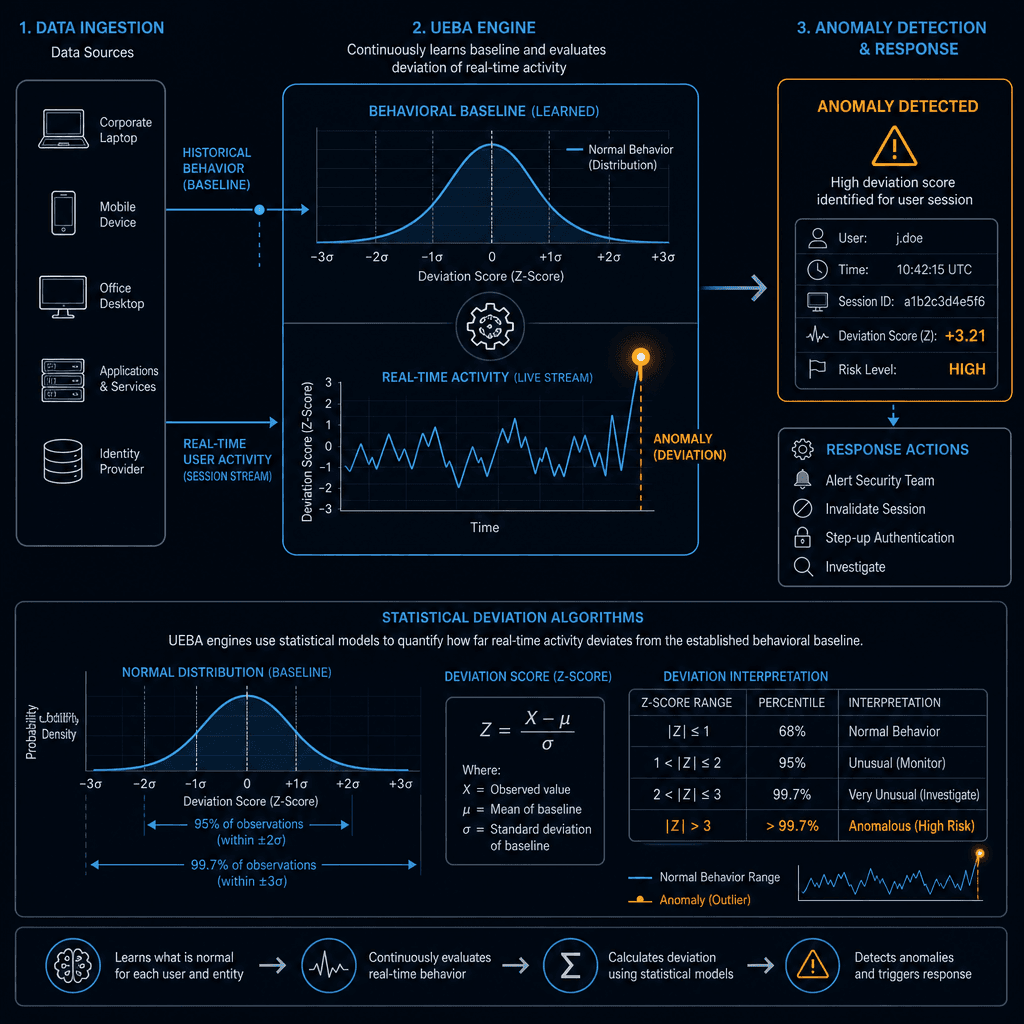
The mechanism works by collecting high-volume telemetry over time. For a specific user, the system learns that they log in between 9:00 AM and 6:00 PM, usually from three specific devices, and access a specific set of APIs. It builds a probability distribution for these actions. When a new event occurs, the UEBA engine calculates the deviation from this distribution using techniques such as Gaussian mixture models or isolation forests to identify outliers with high confidence.
Consider a service account named api-gateway-sync. Historically, this account authenticates every hour to fetch data from the database. Suddenly, at 3:00 AM, the account attempts to authenticate 50 times in one minute from a different subnet, attempting to write data rather than read. A rule-based system might not flag this unless a specific threshold is met. A UEBA system, however, recognizes the statistical anomaly immediately. It detects that the "velocity" of requests and the "direction" of data flow (read vs. write) are outliers.
The system doesn't just look at the login; it looks at the sequence of actions following the login. If the user logs in, waits 2 seconds, and then immediately begins downloading a massive dataset, the behavioral pattern suggests a compromised session, even if the credentials are valid.
For non-human entities, the statistical models shift focus. A database service account that typically queries a specific schema in a strict sequence will trigger an alert if it suddenly begins querying a different schema or accessing tables outside its defined role, even if the access frequency remains low. The anomaly is detected in the sequence and resource context, not just the volume of traffic. This granular view allows the system to detect lateral movement where an attacker pivots from a compromised service account to a sensitive database.
The Data Flow of Response
Detection is only half the battle. The "Response" in ITDR requires a mechanism to act on the detected anomaly without introducing latency for legitimate users. This is where the integration between ITDR, IAM, and PAM becomes critical.
When the UEBA engine flags a high-risk anomaly, it triggers an automated workflow. The data flow moves from the analytics engine to the policy decision point (PDP) in the identity infrastructure. In a Zero Trust model, the PDP makes the decision based on policy and context, and the Policy Enforcement Point (PEP) acts as the gatekeeper to enforce it.
Imagine the scenario where the api-gateway-sync account is flagged. The ITDR system does not simply alert a human analyst. Instead, it sends a real-time signal to the PDP. The PDP evaluates the risk score and instructs the PEP to revoke the active session token for that specific account. Simultaneously, it triggers a step-up authentication challenge for any other active sessions associated with that account.
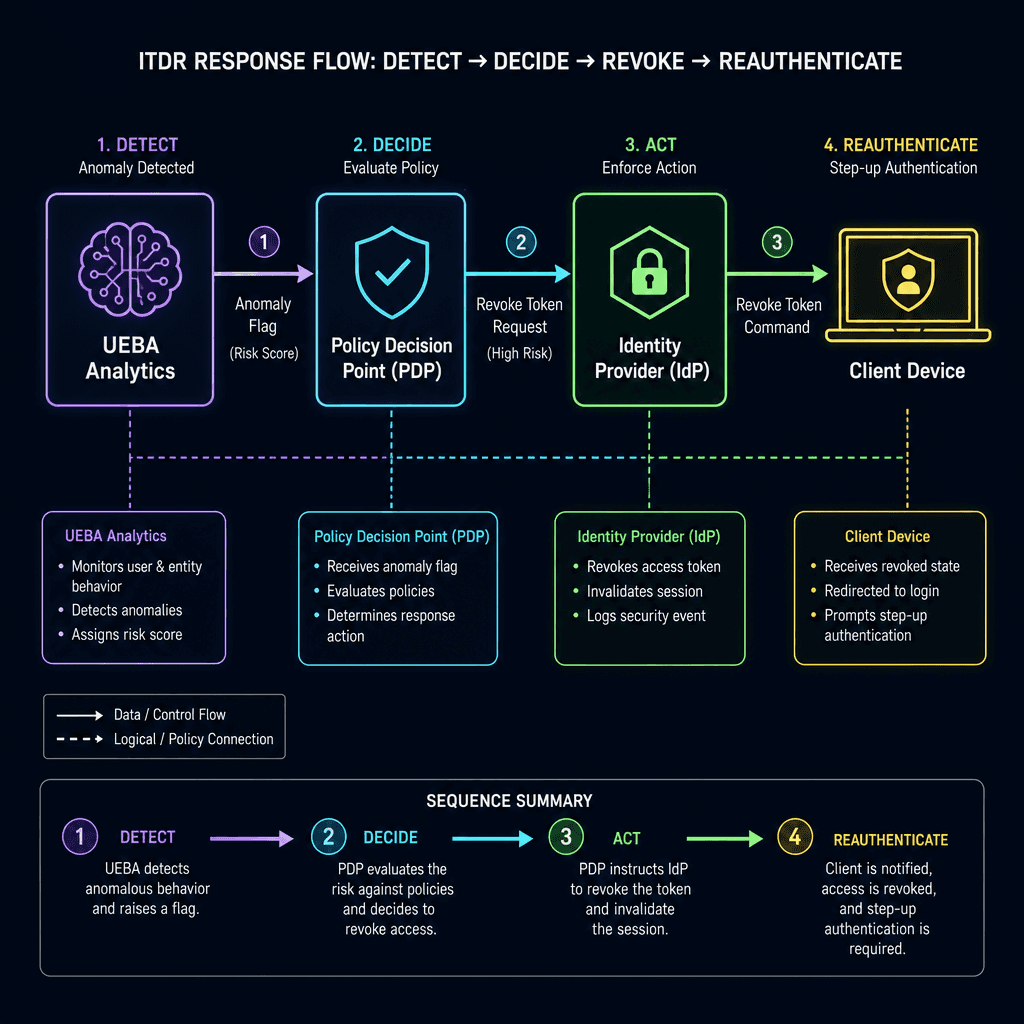
This mechanism relies on the "Just-in-Time" (JIT) and "Just-Enough-Access" (JEA) principles. By revoking the token, the attacker is immediately locked out, even though they still possess the stolen credentials. The system effectively breaks the chain of trust at the token level, not the password level.
The response logic must be granular. If the system detects a low-risk anomaly, such as a user logging in from a new device, it might only require a re-authentication. If it detects a high-risk anomaly, like data exfiltration, it might immediately isolate the entity from the network. This dynamic response is what differentiates ITDR from traditional Identity and Access Management (IAM). The ability to automate these responses based on risk scores is the defining characteristic of the new frontier.
The Architecture of Trust
Building an ITDR framework requires a shift in how security architects view data flow. You cannot rely on logs alone. You need a unified data lake that aggregates authentication logs, endpoint telemetry, network flow data, and application usage logs. This aggregation allows the UEBA engine to see the full picture.
For example, a user might log in successfully (IdP log), but their device might be reporting a missing security patch (Endpoint log), and their traffic might be routing through an unusual proxy (Network log). Individually, these are warnings. Together, they form a high-confidence threat signal.
The architecture must also account for the "identity of things." Service accounts, API keys, and IoT devices are often the targets of sophisticated attacks. They do not have the behavioral patterns of humans, so the UEBA models for entities must be tuned differently. These models rely on behavioral patterns based on access frequency, timing, and resource sequences. A service account that suddenly deviates from its established timing window or accesses a resource sequence it has never touched before is flagged as an anomaly, regardless of whether it has "human-like" behavior.
Conclusion
ITDR represents the evolution of identity security from a static gatekeeper to a dynamic guardian. It acknowledges that credentials will be stolen and that the perimeter is gone. By focusing on the mechanism of behavior and the flow of data, ITDR allows organizations to detect and respond to threats that would otherwise remain invisible behind a wall of valid tokens. This is not just an upgrade to existing tools; it is a fundamental re-architecture of how we define trust in a digital world.
FAQ
Q: How does ITDR integrate with existing IAM tools? A: ITDR typically operates as a layer on top of existing IAM infrastructure. It ingests logs from the Identity Provider (IdP) and integrates via APIs to trigger responses in the IAM system, such as revoking sessions or forcing MFA, without requiring a complete replacement of your current identity stack.
Q: Is ITDR too expensive for small to mid-sized businesses? A: While enterprise-grade solutions can be costly, many modern ITDR capabilities are now available as modular add-ons to cloud IAM platforms. By starting with focused use cases, such as protecting high-value service accounts, organizations can achieve significant ROI without a massive upfront investment.
Q: How do I handle false positives in a UEBA system? A: False positives are common during the initial learning phase. Most ITDR platforms allow for "tuning" periods where the system learns the baseline without triggering strict alerts. Administrators should review flagged anomalies regularly to refine the statistical thresholds and reduce noise over time.
Practical Takeaways
- Shift from Static to Dynamic: Move beyond verifying "who you are" (credentials) to validating "what you are doing" (behavior) in real-time.
- Unified Data Lake: Ensure your analytics engine has access to a consolidated view of identity, endpoint, network, and application telemetry to detect correlated threats.
- Automated Response: Implement automated workflows that can revoke tokens or enforce step-up authentication instantly upon detecting high-risk anomalies, reducing the window of exposure.
Common Pitfalls
- Ignoring Non-Human Identities: Failing to apply UEBA logic to service accounts and API keys leaves a massive blind spot for attackers targeting automated workloads.
- Over-Reliance on Rules: Relying solely on static rule-based alerts (e.g., "block login after 5 attempts") misses sophisticated attacks that mimic normal behavior but deviate in subtle statistical ways.
- Lack of Baseline Calibration: Deploying UEBA without a sufficient "learning period" can lead to excessive false positives that cause alert fatigue, causing security teams to ignore genuine threats.
Related posts
Continuous Authentication: Moving Beyond One-Time Login
Explore continuous authentication strategies using behavioral biometrics and session monitoring to enhance security beyond the initial login event.
Security Architecture Review: Patterns for Identity-First Design
An examination of security architecture patterns centered on identity-first design, covering threat modeling and IAM strategies.
Zero Trust Architecture: A Practical Implementation Guide
A practical walkthrough of implementing zero trust architecture, covering identity security, least privilege, micro-segmentation, and continuous verification.