Identity-Aware Proxy: Securing Applications Without VPNs
Explore how identity-aware proxies enable secure application access without VPNs, supporting BeyondCorp and ZTNA strategies.
In modern cloud-native environments, the traditional network perimeter has dissolved. Identity-Aware Proxies (IAP) dismantle this obsolete architecture by shifting trust decisions from the network layer to the application layer. Instead of verifying where a request originates via IP address, an IAP validates who is making the request and the posture of their device. As Part 7 of the Zero Trust & Modern Security Architecture Series, this approach enforces Zero Trust principles by granting access only after rigorous validation of user context, device health, and request intent, rendering traditional Virtual Private Networks (VPNs) unnecessary for most use cases.
The Failure of the Network Perimeter
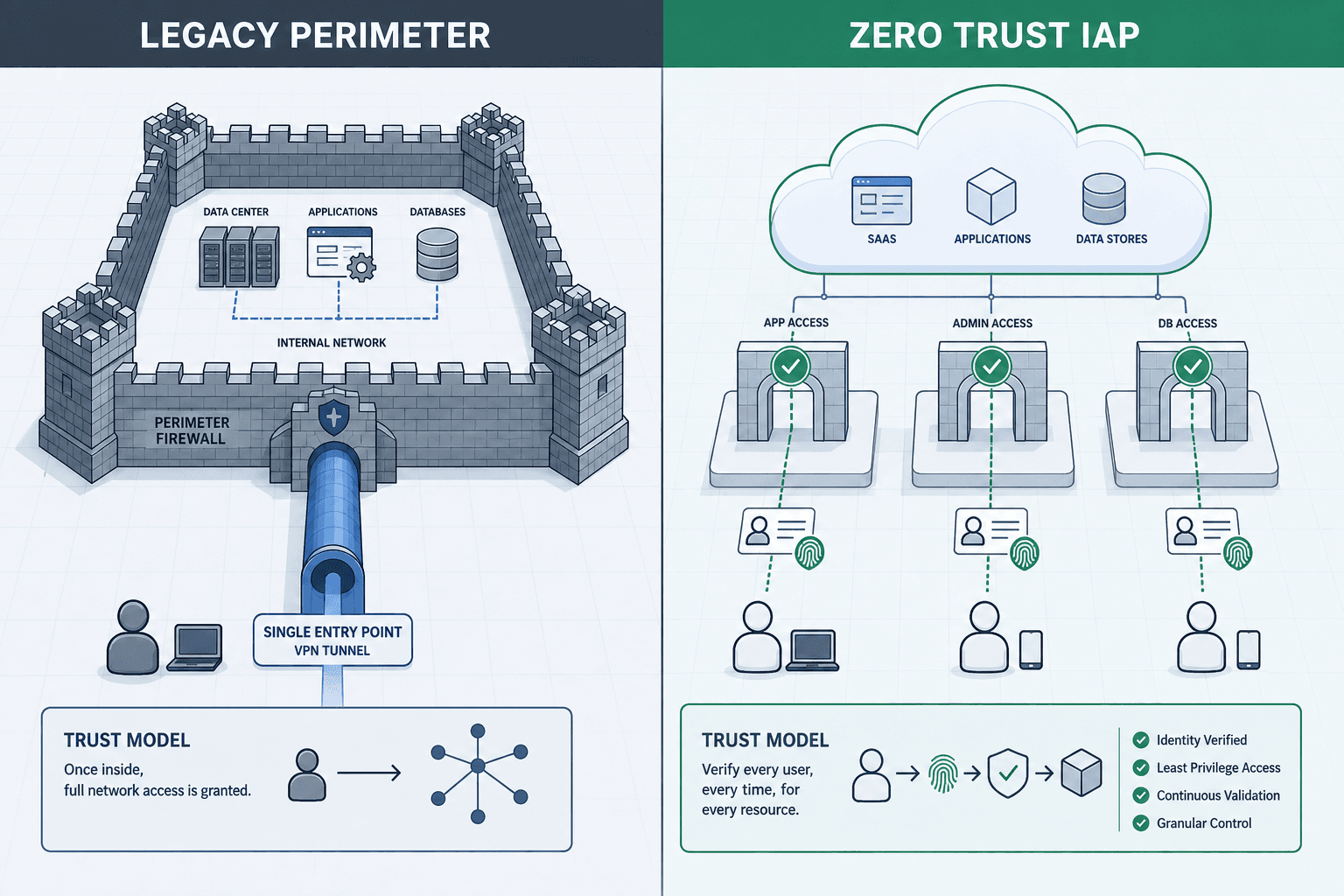
The legacy security model relied on a binary distinction: if a device was inside the corporate firewall (the "perimeter"), it was trusted; if outside, it was hostile. This required a VPN to extend the private network into the user's physical location. In cloud environments where applications reside in public clouds and users connect from anywhere, this perimeter is illusory.
In a legacy setup, a developer connects to an internal database via SSH. The firewall rule allows traffic from the corporate IP subnet 10.0.0.0/24. If a laptop leaves the office, the VPN tunnels the traffic, making the laptop appear to originate from 10.0.0.x. The security mechanism here is implicit trust based on network topology.
However, if an attacker compromises a user's credentials and their device is already inside the network, or if they spoof a corporate IP via a compromised router, the firewall cannot distinguish between a legitimate employee and an attacker. The trust is established at the network boundary, not at the resource.
Google's BeyondCorp initiative demonstrated that this model is obsolete for cloud applications. By treating all devices as untrusted regardless of location, organizations can eliminate the need for a VPN entirely. The IAP becomes the new perimeter, but it is a dynamic, software-defined boundary that exists only for the duration of a validated session.
The IAP Handshake Mechanism
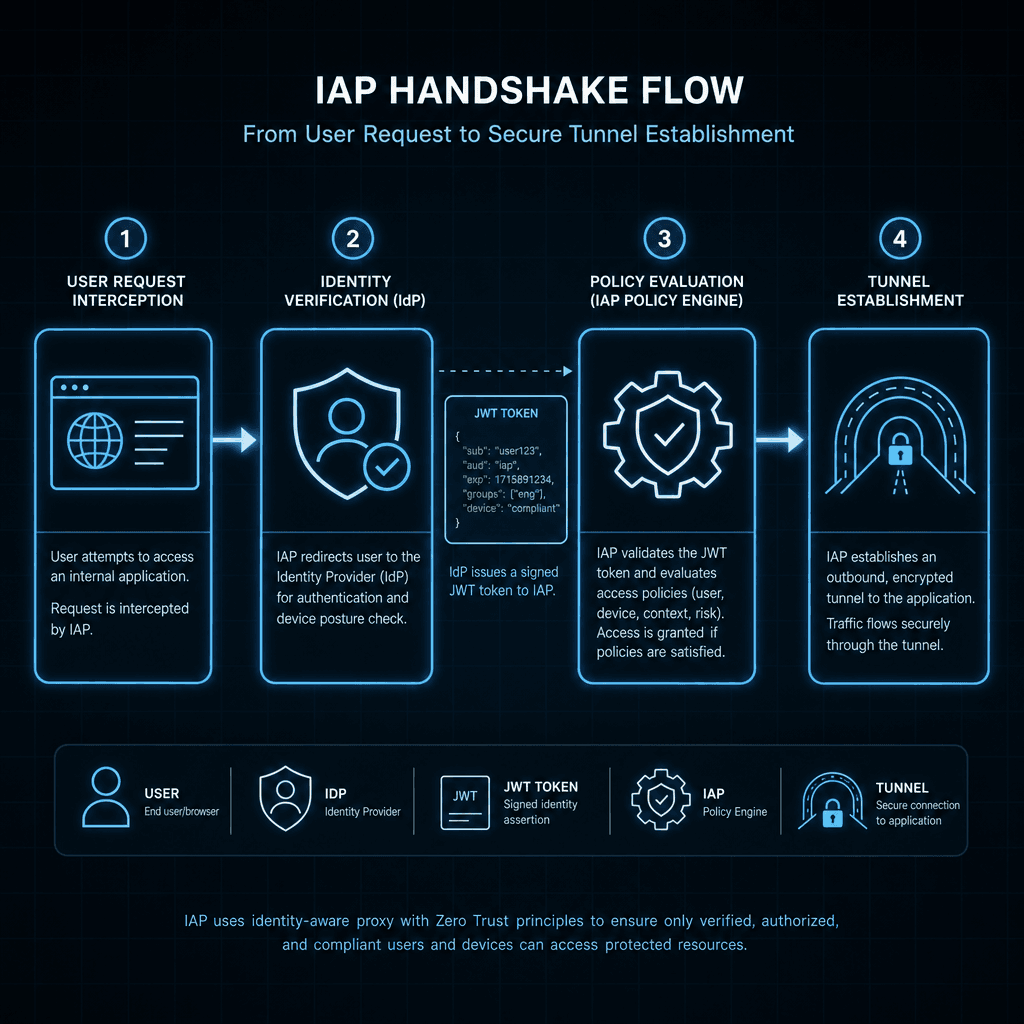
To understand how an IAP secures access without a tunnel, consider a specific scenario: Alice, a senior engineer, attempts to access the internal api-staging service running on a Kubernetes cluster. She does not use a VPN client. She simply opens her browser or runs a CLI command pointing to the application's public URL.
- Request Interception: Alice's request hits the IAP endpoint (e.g.,
api-staging.internal.example.com). The IAP acts as a reverse proxy. It terminates the incoming TLS connection immediately. It does not forward the request to the backend yet. - Identity Verification: The IAP redirects Alice to the Identity Provider (IdP), such as Okta or Google Workspace. Alice authenticates using MFA. The IdP issues a short-lived JSON Web Token (JWT) containing claims about Alice (e.g.,
sub: alice@example.com,group: engineering,device_status: compliant). - Policy Evaluation: Alice returns to the IAP with the JWT. The IAP decodes the token and evaluates it against the configured Access Policy. The policy might state: "Allow access to
api-stagingonly ifgroup == engineeringANDdevice_os == macOSANDdevice_compliance == true." - Tunnel Establishment: If the policy evaluates to true, the IAP establishes a separate, encrypted connection to the backend service. It forwards Alice's original request through this internal tunnel. To the backend service, the request appears to come from the IAP's internal IP, not Alice's public IP.
{
  "token_claims": {
    "sub": "alice@example.com",
    "group": "engineering",
    "device_status": "compliant",
    "device_os": "macOS"
  },
  "policy_match": true,
  "action": "forward"
}
If the policy fails—for instance, if Alice's device is missing a required security patch—the IAP returns a 403 Forbidden response immediately. The backend service never sees the request, and no connection is opened. This mechanism ensures that network access is granted only after identity and context are verified.
BeyondCorp and Zero Trust Architecture
This workflow is the operational implementation of Zero Trust Network Access (ZTNA). The NIST SP 800-207 standard defines Zero Trust as an architecture requiring explicit verification, and the IAP enforces principles aligning with this definition by mandating verification for every access request regardless of origin. The IAP enforces the "Never Trust, Always Verify" principle by making the identity the primary key for access control.
In a traditional VPN model, once the tunnel is open, lateral movement is often unrestricted within the network segment. An attacker who gains a foothold on a compromised laptop can scan the internal network. With an IAP, the "network" is effectively invisible to the user. Alice only has visibility into the specific resources defined in her policy. If she tries to access api-production while logged in to api-staging, the IAP denies the request because the policy for api-production likely requires different permissions or a higher risk score.
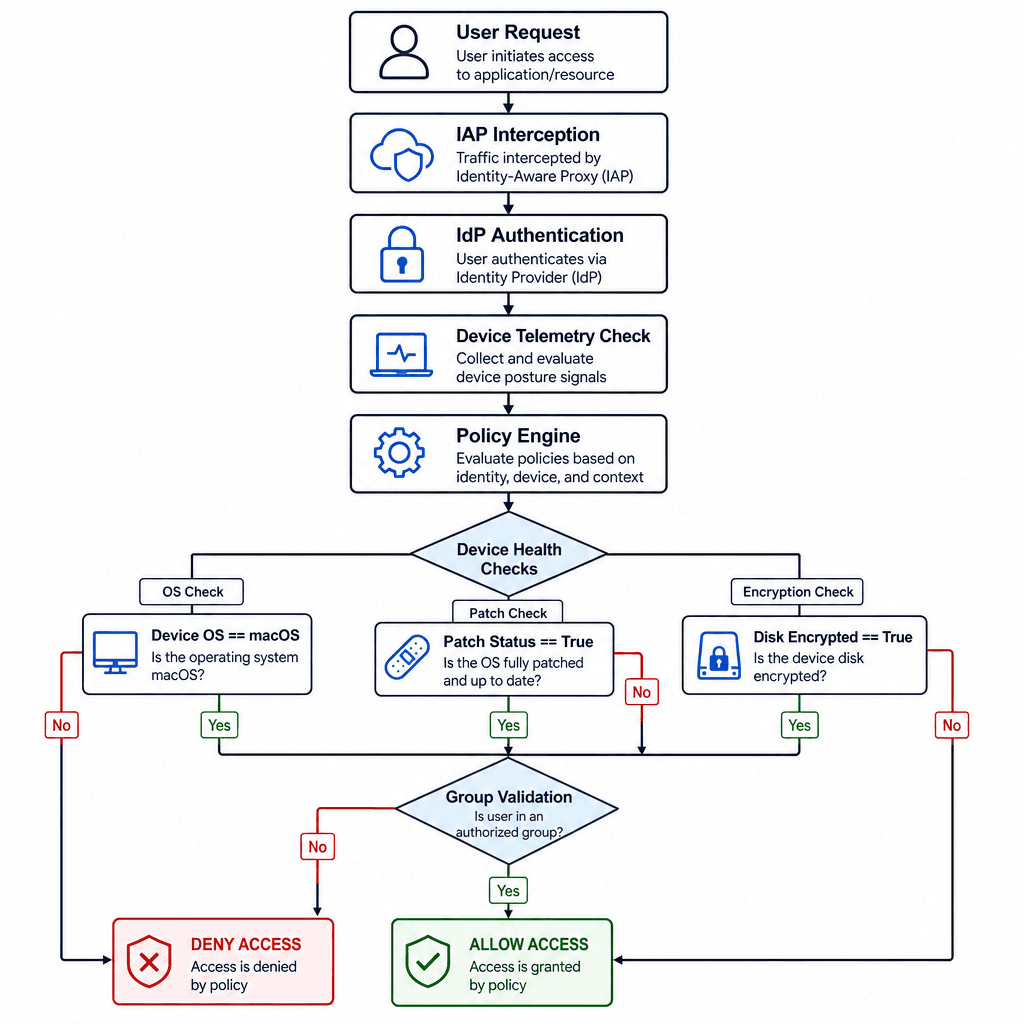
Furthermore, the IAP integrates with device posture systems. If a device is detected as non-compliant (e.g., missing encryption or an outdated OS), the policy can dynamically deny access or redirect the user to a remediation portal. This dynamic context-awareness is impossible with static IP-based firewall rules.
Operational Tradeoffs and Implementation
While IAP offers superior security, it introduces specific operational constraints. The most significant is latency. Signature validation is performed locally by the IAP using cached JSON Web Key Sets (JWKS), so the heavy lifting does not require a round-trip to the IdP for every request. Round-trips occur primarily during token refresh or when checking revocation lists, minimizing performance impact. In high-throughput systems, this local validation keeps latency low compared to the handshake overhead of a full VPN tunnel. Additionally, the system creates a single point of failure: if the IdP is unavailable, no users can authenticate, effectively locking out the entire application unless a robust failover mechanism is designed.
Another tradeoff involves the complexity of managing policies. In a firewall model, you manage a list of IP addresses. In an IAP model, you manage a matrix of users, groups, devices, and resource paths. For simple, stateless APIs, this is manageable. However, for legacy applications that rely on IP whitelisting for authentication (a common anti-pattern), migrating to IAP requires refactoring the application to accept OAuth tokens or integrating with an API gateway that can translate the IAP identity into a backend authentication method.
From a security perspective, the shift to IAP is non-negotiable for modern cloud architectures. The risk of maintaining a perimeter that assumes internal trust is too high. The IAP provides a granular, auditable, and context-aware access control layer that scales with the organization. It replaces the "dumb pipe" of the VPN with a smart gatekeeper that understands who you are, not just where you are.
Organizations must first inventory their applications and identify those that rely on IP-based trust. They must then configure the IdP to emit the necessary claims and define granular policies in the IAP. While the initial configuration is more complex than opening a port on a firewall, the long-term reduction in attack surface and the elimination of the "always-on" VPN risk make it the definitive standard for secure access.
Conclusion
Identity-Aware Proxies represent a fundamental paradigm shift in application security, moving the trust boundary from the network edge to the application entry point. By decoupling access from network location and enforcing strict identity and device verification, IAPs operationalize the core tenets of Zero Trust. While they introduce latency and configuration complexity compared to traditional firewalls, the security benefits of eliminating the perimeter and preventing lateral movement make them the essential component of modern, cloud-native security architectures.
Common Pitfalls
Migrating to an Identity-Aware Proxy architecture often reveals hidden dependencies that can cause outages if not addressed beforehand.
- Legacy IP Whitelisting: Many internal services or third-party APIs still rely on source IP addresses for authentication. Failing to identify these dependencies during the inventory phase can break integrations when the VPN is decommissioned.
- IdP Single Points of Failure: If the Identity Provider is down, access to all protected resources is denied. Without a configured failover strategy or local caching of authentication states, the entire organization loses productivity.
- Device Posture Gaps: Assuming all devices are compliant can lead to access denial for legitimate users if the device telemetry integration is misconfigured or if the OS updates are out of sync with the policy requirements.
Practical Takeaways
- Shift Trust to Identity: Decouple access from network location by validating user context and device health at the application layer.
- Local Validation Efficiency: Leverage local JWKS caching for JWT signature verification to maintain low latency while ensuring security.
- Granular Policy Enforcement: Replace broad network access with specific, attribute-based policies that restrict lateral movement.
FAQ
Does IAP introduce significant latency compared to a VPN? No. Because IAP validates JWT signatures locally using cached keys, the per-request latency is often lower than establishing a full encrypted VPN tunnel, which requires additional handshake overhead.
How do I handle applications that only accept IP-based authentication? You must refactor the application to accept OAuth tokens or integrate an API Gateway layer that translates the IAP identity context into a format the legacy application can understand.
What happens if my Identity Provider goes down? Access is blocked unless you have implemented a robust failover mechanism, such as backup IdPs or emergency access accounts, as the IAP relies on the IdP for initial authentication.
Call to Action
Audit your current access policies and inventory all applications relying on IP-based trust to begin your migration to an Identity-Aware Proxy architecture today. Review your IdP integration to ensure device telemetry is correctly emitting the necessary compliance claims for granular access control.
Related posts
Least Privilege in Practice
A practical guide to implementing least privilege in AWS using IAM Access Analyzer, policy generation, and condition keys for secure access management.
Identity Breach Response: Securing the Compromised Keymaker
A guide to handling an IAM system compromise, covering identity breach detection, incident response steps, and credential remediation.
Implementing Conditional Access Policies with Keycloak and ForgeRock
A technical examination of implementing conditional access policies using Keycloak and ForgeRock for context-aware access control.