Identity Breach Response: Securing the Compromised Keymaker
A guide to handling an IAM system compromise, covering identity breach detection, incident response steps, and credential remediation.
Identity Breach Response: When the Keymaker is Compromised
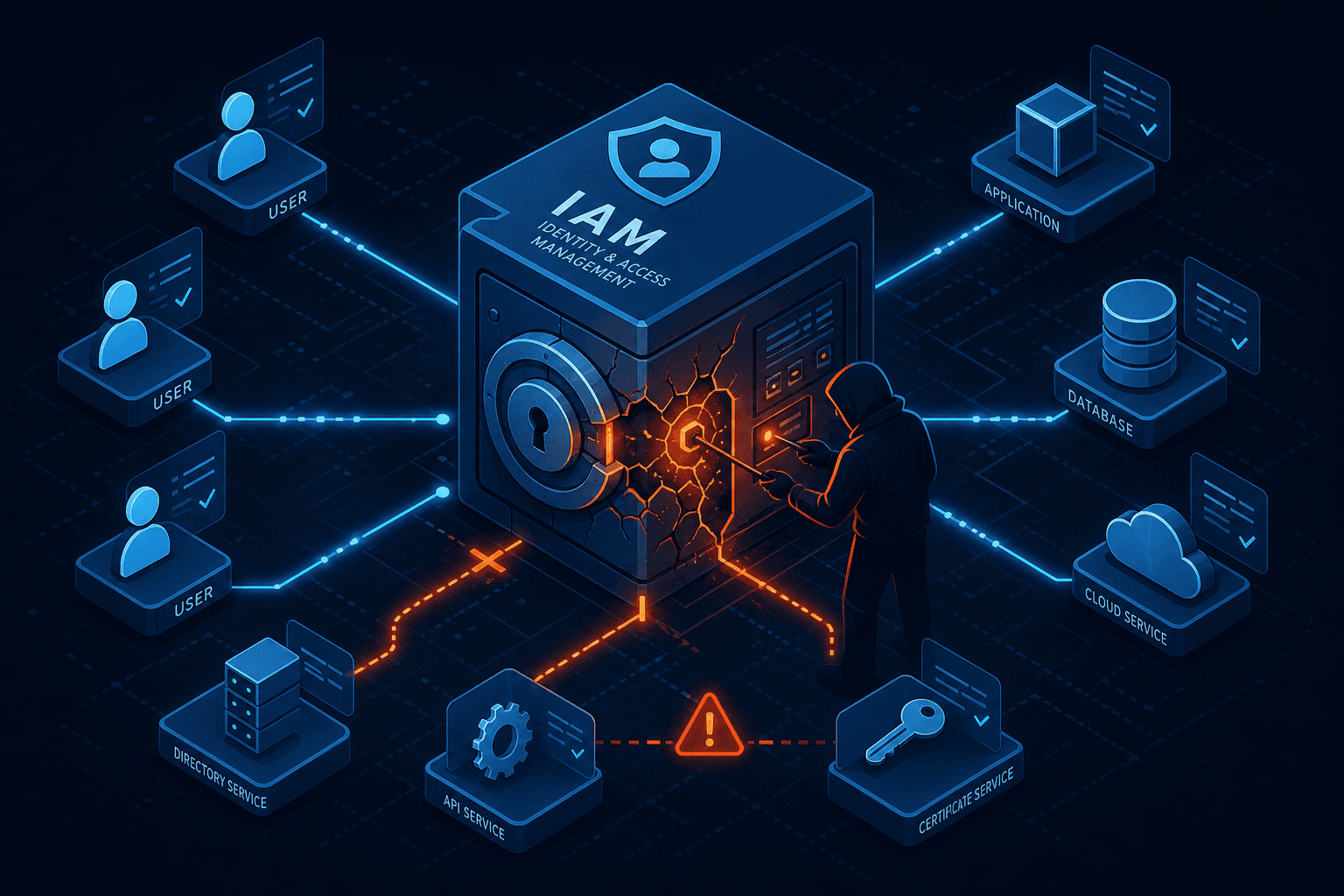
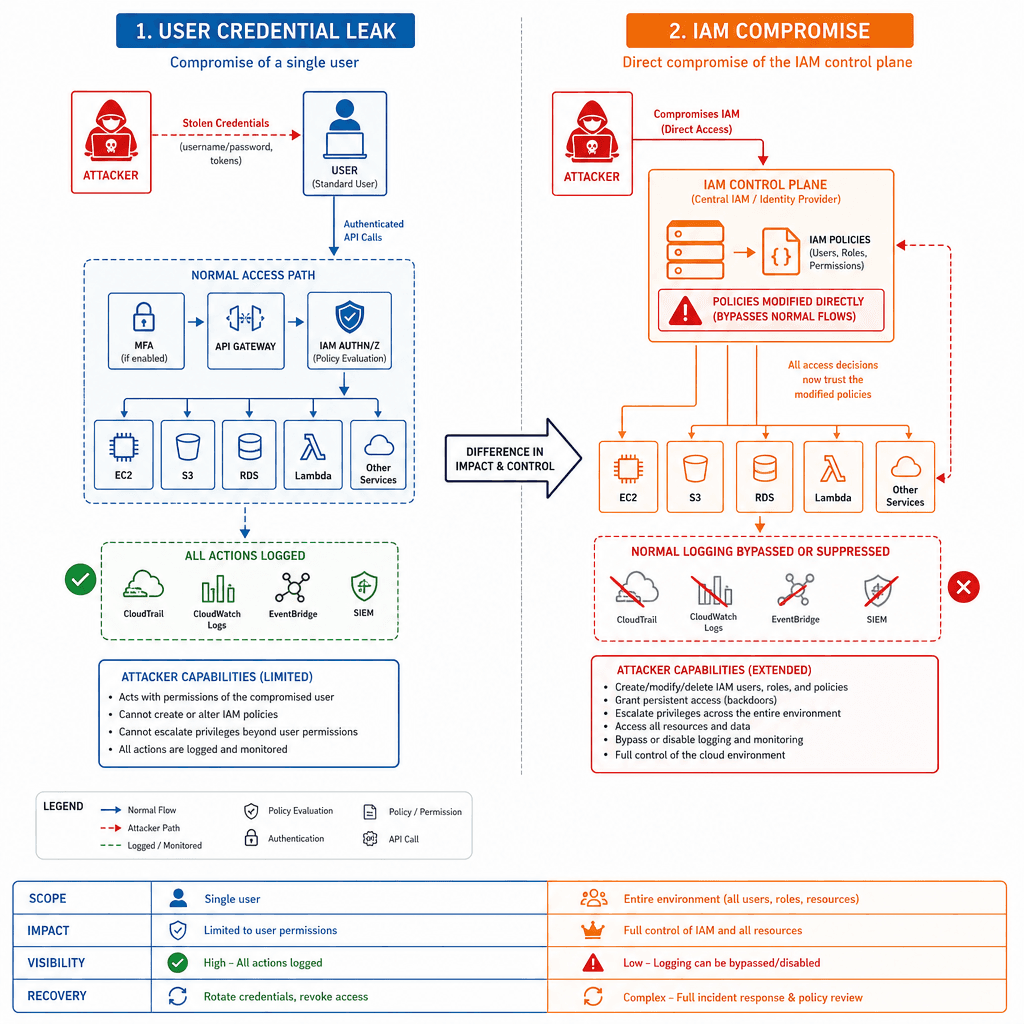
When your Identity and Access Management (IAM) system is compromised, the threat landscape shifts instantly from "user error" to "systemic collapse." Unlike a standard credential leak where a single actor gains access to a specific resource, an IAM breach means the attacker controls the mechanism that grants access to everything. They are not just a guest in the house; they have rewritten the lock on the front door. The primary mechanism of failure here is the loss of trust in the identity provider itself. If the source of truth for "who can do what" is corrupted, every downstream assertion becomes suspect.
Detecting the Control Plane Breach
Detection begins not with looking for a missing file, but by observing anomalies in the authorization logic. In a healthy system, administrative actions follow a predictable rhythm: a specific engineer logs in, performs a task, and logs out. In an IAM compromise, the attacker often seeks to establish persistence. They do this by creating new service accounts, modifying existing policies to allow broader access, or extracting long-lived access keys.
Consider a scenario involving a cloud environment where an attacker has gained an initial foothold via a phishing email targeting a DevOps engineer. The attacker does not stop at the engineer's personal console. Instead, they immediately pivot to the IAM service. The mechanism of detection relies on monitoring for specific API calls that deviate from the baseline. Look for CreateAccessKey events originating from IP addresses not associated with your corporate network or known CI/CD pipelines. More critically, monitor for UpdateRolePolicy or AttachUserPolicy calls that expand permissions beyond the principle of least privilege.
If you see a policy being updated to allow s3:* or ec2:* on * resources, and this action was not part of a scheduled deployment pipeline, the IAM system itself is likely compromised. The attacker is no longer trying to steal a specific bucket; they are trying to own the bucket list. In this state, standard alerts for "failed login attempts" are insufficient. You must trigger on "successful privilege escalation" events.
Severing the Trust Chain
Once the breach is confirmed, the first instinct might be to reset all user passwords. This is a dangerous misconception. In modern IAM architectures, particularly those using federated identities or service accounts, user passwords are often a secondary layer. The primary attack vector is the long-lived credentials (access keys, service account tokens, or signing certificates) that the IAM system manages.
The immediate containment mechanism is the revocation of the trust store. You must isolate the IAM control plane. If you are using a cloud provider, this involves immediately disabling the root user's access keys and any active MFA devices associated with administrative roles. However, it is critical to understand that disabling an MFA device only prevents future authentication attempts; it does not immediately invalidate existing active sessions. An attacker holding a valid session token will remain logged in even if MFA is disabled.
To achieve true session invalidation, you must rely on token rotation or force a logout mechanism. If the attacker has compromised the private key used to sign assertions (like SAML tokens or OIDC JWTs), simply changing a password does nothing; the attacker can still forge valid identity tokens. To stop this, you must rotate the signing certificate immediately. This action invalidates all existing tokens issued under the old key, effectively logging out every session, including the attacker's.
In a cloud-native context, this looks like a CLI command to revoke all access keys for the root user and any high-privilege roles, followed by a rotation of the master encryption keys used for secrets management. The goal is to create a "cold start" where no active session can be validated by the compromised system.
Forensic Triage and Credential Remediation
With the immediate threat contained, you enter the forensic triage phase. The attacker likely left artifacts. They may have created a new IAM role named "EmergencyBackup" or modified the trust policy of an existing role to include their own attacker-controlled AWS account ID. The mechanism here is a comparative audit. You must reconstruct the state of the IAM system prior to the breach.
Start by retrieving the CloudTrail logs or equivalent audit trails for the time window surrounding the detection. Filter for UpdateRole and CreateRole actions. Compare the current policy definitions against the last known good configuration stored in your version control system (Git). If a role's policy has changed, revert it. If a new role exists, delete it.
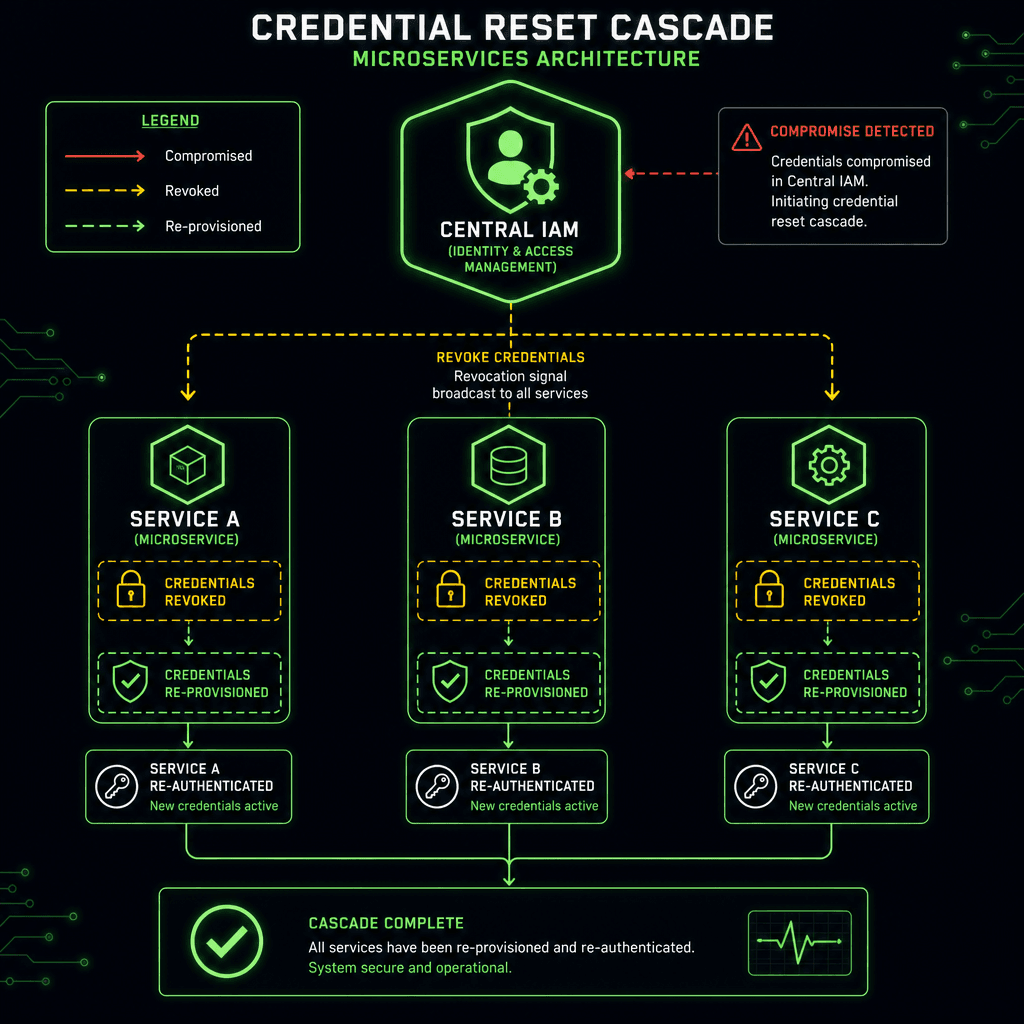
However, the remediation goes deeper than just IAM policies. You must assume that any service account or application identity that relied on the compromised IAM system is now untrusted. This is a "credential reset cascade." Every API key, secret, or certificate generated by the IAM system must be considered leaked.
Consider a microservices architecture where Service A authenticates to Service B using an IAM role. If the IAM system was compromised, the attacker could have intercepted the token exchange or modified the role to grant Service A access to Service C. The remediation step is to force all services to re-establish their trust relationships. This means regenerating the secrets for Service A, Service B, and Service C, and re-authorizing them against the cleaned IAM configuration. You cannot rely on the old tokens; they are tainted.
Re-establishing Trust and Prevention
The final phase is rebuilding the access control matrix with a "zero trust" mindset. Do not simply restore the old configuration. The old configuration contained the vulnerability. Instead, define a new baseline. Start with the principle of least privilege: grant only the specific permissions required for the task, nothing more.
Implement a mechanism for continuous verification. This involves setting up automated checks that alert if any policy change exceeds a certain threshold of permissions or if a new role is created without a corresponding ticket in your change management system.
Furthermore, enforce hardware-bound MFA for all administrative access. Software-based MFA (like an app on a phone) is vulnerable to SIM swapping or man-in-the-middle attacks, which were likely the initial entry point. Hardware tokens (YubiKey, FIDO2) provide a cryptographic binding that is much harder to exfiltrate.
Finally, document the incident. The mechanism of recovery is not just technical; it is procedural. Identify how the attacker bypassed your initial defenses. Was it a lack of MFA? Was it a stale access key? Update your incident response playbook to address this specific gap. The goal is to ensure that if the keymaker is compromised again, the damage is contained within minutes, not days. By adhering to a robust security protocol, you streamline access management recovery and significantly reduce the window for identity theft prevention.
Conclusion
The distinction between a standard breach and an IAM breach is the difference between losing a wallet and losing the ability to issue new wallets. By understanding the mechanism of trust, you can respond not with panic, but with surgical precision. The path forward requires immediate isolation, aggressive credential rotation, and a fundamental re-evaluation of how your system validates identity.
Common Pitfalls
Even with a clear plan, organizations often stumble during the chaos of an incident. Avoid these common errors:
- Resetting passwords without rotating signing keys: Changing user passwords is ineffective if the attacker holds the private key used to sign identity tokens (SAML/OIDC). Without rotating the signing certificate, the attacker can continue to forge valid tokens regardless of password changes.
- Relying on MFA disablement to kill active sessions: Disabling MFA prevents new logins but leaves existing, active sessions untouched. Attackers with valid session tokens will remain undetected and active until those tokens expire or are explicitly revoked through rotation.
- Restoring old configurations without auditing: Reverting to a backup configuration without verifying its integrity can reintroduce the vulnerability that caused the breach or fail to remove attacker-created backdoors. Always compare current states against known-good baselines before restoring.
Practical Takeaways
To navigate an IAM breach effectively, internalize these mental models:
- Trust is the attack surface: In an IAM breach, the system itself is the enemy. The attacker doesn't need to break the lock; they own the key. Your focus must shift from protecting endpoints to securing the identity provider.
- Credential reset is a cascade: You cannot fix one account in isolation. A compromised IAM system invalidates trust for every entity that relies on it, requiring a full cascade of key and secret regeneration across all services.
- Recovery is procedural, not just technical: Technical fixes are useless without a documented, practiced response plan. The speed of your reaction depends on how well your team understands the steps to isolate and remediate the breach.
FAQ
Q: Can I just disable MFA for the root user to stop an attacker? A: No. Disabling MFA only prevents future authentication attempts. If the attacker already has an active session or has stolen long-lived access keys, disabling MFA will not terminate their access. You must revoke active sessions and rotate signing keys to truly sever the connection.
Q: How do I detect an IAM breach if the attacker hides their tracks?
A: Focus on behavioral anomalies rather than just failed logins. Look for unexpected UpdateRolePolicy or CreateAccessKey events, especially those originating from unusual IP addresses or occurring outside of standard maintenance windows. Comparative auditing of policies against your version control history is also critical.
Q: Do I need to rotate secrets for every microservice if the IAM system is breached? A: Yes. If the IAM system is compromised, any credential it issued (API keys, tokens, certificates) is considered untrusted. You must perform a full credential reset cascade, regenerating secrets for all dependent services and re-authorizing them against the clean IAM configuration.
Call to Action
Don't wait for a breach to test your readiness. Audit your current IAM policies today to ensure they adhere to the principle of least privilege. Review your incident response playbook to verify that it includes specific steps for signing key rotation and session invalidation. Finally, schedule a drill to test your MFA revocation procedures, ensuring your team can execute a "cold start" recovery when it matters most.
Related posts
Identity-First Security: Shifting to Identity Perimeter
An examination of shifting security strategy from network perimeter to identity perimeter using zero trust principles and perimeter-less security.
Implementing Conditional Access Policies with Keycloak and ForgeRock
A technical examination of implementing conditional access policies using Keycloak and ForgeRock for context-aware access control.
IAM in Financial Services: PCI-DSS & SOX Compliance
An overview of Identity and Access Management strategies for financial institutions to meet PCI-DSS and SOX compliance requirements.