IAM in Financial Services: PCI-DSS & SOX Compliance
An overview of Identity and Access Management strategies for financial institutions to meet PCI-DSS and SOX compliance requirements.
IAM in Financial Services: PCI-DSS & SOX Compliance
In the financial sector, Identity and Access Management (IAM) is frequently misunderstood as a simple software layer designed to restrict login attempts. For the advanced engineer, the reality is far more granular: IAM is the mechanism that enforces the legal boundaries of the Cardholder Data Environment (CDE) and ensures the auditability of financial reporting. Compliance with PCI-DSS and SOX is not achieved by "checking a box"; it requires the system architecture to mechanically prevent unauthorized state changes and cryptographically guarantee the history of those changes. The following analysis dissects the specific mechanisms required to satisfy these rigorous regulations.
Enforcing Network Segmentation via RBAC Logic
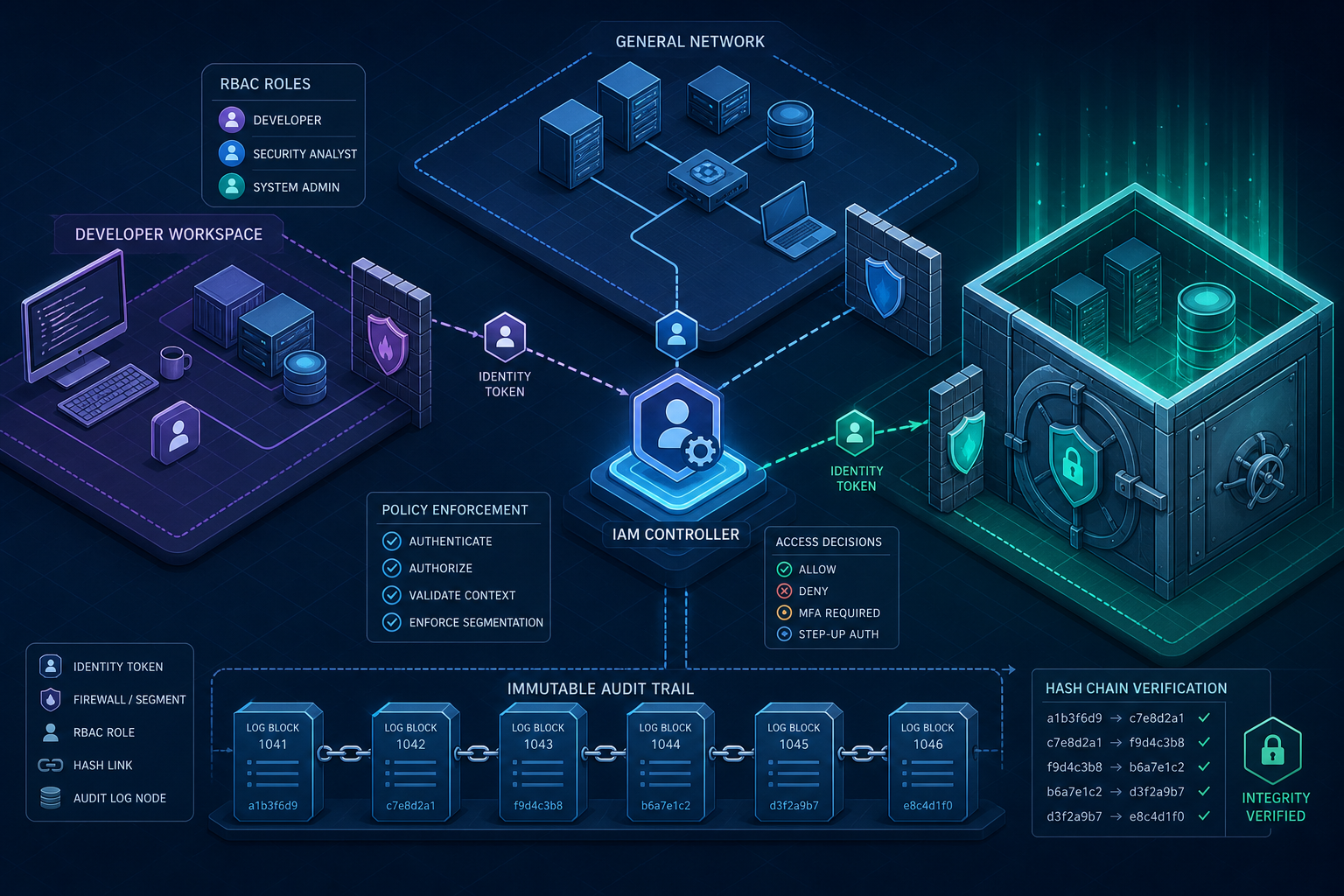
PCI-DSS Requirement 1 mandates that the Cardholder Data Environment be isolated from untrusted networks. In modern microservices or hybrid cloud architectures, physical air-gapping is rarely feasible. Instead, the isolation mechanism relies on strict Role-Based Access Control (RBAC) combined with network policy enforcement.
Consider a banking application where a developer needs to query a production database to debug a transaction failure. Without strict IAM mechanisms, the developer's credentials might grant them read access to the entire cluster. A compliant architecture treats the CDE as a distinct logical zone. The IAM system assigns a specific role, cde_readonly_debug, which is bound to a specific subnet or VPC peering connection.
The mechanism here is the enforcement of the "least privilege" principle at the network edge, not just the application layer. When the developer initiates a connection, the IAM controller (or the underlying PAM solution) validates the role against the firewall rules. If the role does not explicitly permit traffic to the CDE subnet, the TCP handshake is dropped before the database even sees the request. This is often implemented via a "jump host" or bastion architecture where all traffic to the CDE must originate from a specific, heavily monitored proxy.
This approach ensures that even if a developer's laptop is compromised, the attacker cannot pivot laterally into the CDE because the IAM-enforced identity token lacks the necessary network permissions. The mechanism is not "firewall rules"; it is "identity-as-a-firewall," where the identity itself carries the network policy.
The Immutable Audit Trail for SOX Section 404
SOX Section 404 requires management to assess the effectiveness of internal controls over financial reporting. The core challenge for engineers is proving that no unauthorized changes were made to financial data after the fact. Standard logging is insufficient because logs can be altered by a privileged user.
The mechanism for SOX compliance is the creation of an immutable, cryptographically signed audit trail. Every access event—authentication, authorization check, data retrieval, and modification—must be recorded in a log that cannot be modified or deleted by the account holder or the administrator.
Imagine a scenario where a senior analyst modifies a ledger entry. The IAM system captures the event: User: analyst_jane, Action: UPDATE, Resource: ledger_entry_123, Timestamp: 2023-10-27T14:00:00Z. This entry is immediately forwarded to a centralized logging service (e.g., SIEM) via a write-only API. The log entry includes a digital signature or a hash chain (like a Merkle tree) that links it to the previous entry. If a malicious actor tries to delete the log entry for analyst_jane, the hash chain breaks, and the integrity of the subsequent logs is invalidated.
For financial institutions, this means the IAM solution must integrate with a logging backend that enforces "WORM" (Write Once, Read Many) storage policies. The mechanism here is the separation of duties: the system that generates the log (IAM) is distinct from the system that stores the log (SIEM), and the storage system prevents any write/delete operations from the IAM administrators. This ensures that the audit trail remains a reliable source of truth for external auditors.
Automating Lifecycle Controls to Prevent Privilege Creep
One of the most significant risks in financial IAM is "privilege creep," where employees accumulate permissions over time that exceed their current job requirements. This violates the principle of least privilege and creates a massive attack surface. Both PCI-DSS (Requirement 7) and SOX require regular reviews of access rights.
The mechanism to solve this is automated identity lifecycle management (IdM) coupled with periodic access recertification. Instead of relying on manual HR processes to update access when an employee changes roles, the IAM system acts as the single source of truth. When an employee's status changes in the HR system (e.g., status: terminated or role: senior_dev), the IAM system triggers a workflow.
For a termination event, the workflow immediately revokes all active sessions and disables the identity across all connected systems (SAML, OIDC, LDAP). For a role change, the system performs a "access recertification" workflow. It flags the user's current permissions and requires the user's manager to re-validate them. If the manager does not explicitly confirm the permissions within a set timeframe (e.g., 30 days), the system automatically downgrades the access to the minimum required for the new role.
This automation removes the human error factor. In a manual process, an IT administrator might forget to remove a former employee's access to the payment gateway. In an automated system, the trigger is the HR record, and the action is immediate. This satisfies the SOX requirement for timely removal of access and the PCI requirement for regular reviews.
The Verification Layer: MFA and PAM for High-Risk Transactions
Even with robust segmentation and immutable logs, the final line of defense against credential theft is the authentication mechanism itself. Financial institutions handle high-value transactions that require a higher assurance level of identity.
The mechanism here is Multi-Factor Authentication (MFA) combined with Privileged Access Management (PAM). PCI-DSS Requirement 8.3 mandates MFA for all remote access to the CDE, and Requirement 8.2.2 requires MFA for non-console administrative access. The mechanism works by requiring a second factor that is bound to the user's physical device or biometric profile.
However, for privileged accounts (e.g., database administrators, root access), standard MFA is often insufficient because these accounts are high-value targets. The mechanism shifts to PAM, which implements "Just-In-Time" (JIT) access. Instead of a DBA having a permanent password, the IAM system generates a temporary, one-time password (OTP) or a short-lived certificate that is valid only for a specific task and time window (e.g., 1 hour).
In this workflow, the DBA requests access to the production database. The PAM system validates the request against the business justification and the user's role. Upon approval, the PAM system acts as a proxy to authenticate the DBA to the target, or provides a temporary credential that the user enters into the session, ensuring the PAM server never exposes the plaintext credential to the DBA. This ensures that even if a credential is intercepted, it is useless outside the narrow time window.
Conclusion: Compliance as a System State
Regulatory compliance in financial services is not a static document; it is a dynamic system state enforced by code. PCI-DSS demands that the network topology reflects the data sensitivity through strict identity-based segmentation. SOX demands that every action is logged in an immutable chain of custody.
The advanced engineer's role is to design IAM architectures where the regulatory requirements are hard-coded into the access control logic. By treating identity as the primary enforcement point for network segmentation, audit trails, and privilege management, financial institutions can move beyond "checking boxes" to building systems that are inherently secure and compliant. The mechanisms described—RBAC for segmentation, WORM logging for auditability, automated lifecycle management for privilege control, and JIT access for privilege elevation—form the backbone of a compliant financial infrastructure.
Common Pitfalls
Despite the availability of robust tools, financial institutions frequently stumble on specific implementation errors that undermine compliance efforts.
- Over-reliance on Static Passwords: Relying solely on long, complex passwords without dynamic rotation or MFA for privileged accounts creates a persistent attack surface. Static credentials are easily phished or leaked, bypassing the intended security posture.
- Failure to Automate Deprovisioning: Manual offboarding processes are prone to delays. If an employee is terminated but their access rights are not revoked immediately via an automated trigger, they retain access to sensitive systems, creating a direct violation of least privilege principles.
- Ignoring Shadow IT: Departments often deploy unauthorized SaaS applications or scripts to manage financial data without IAM integration. These "shadow" assets lack the necessary segmentation and logging, creating blind spots where data can be exfiltrated without detection.
Practical Takeaways
Engineers implementing IAM strategies in financial contexts should focus on these actionable steps:
- Map Roles to Data Sensitivity: Explicitly define RBAC roles based on the specific data zones (e.g., CDE vs. General) rather than job titles alone.
- Implement WORM Logging: Ensure your logging architecture strictly enforces Write-Once-Read-Many policies to guarantee the integrity of audit trails for SOX audits.
- Enforce JIT Access: Eliminate standing privileges for administrative accounts by configuring PAM solutions to grant access only for the duration of a specific task.
FAQ
Q: Does PCI-DSS allow exemptions for MFA in specific internal scenarios? A: Exemptions are extremely limited. While Requirement 8.3 specifically targets remote access, Requirement 8.2.2 mandates MFA for all non-console administrative access. Internal network segmentation does not typically exempt an admin from MFA if they require console-level access.
Q: How frequently must access reviews be performed for SOX compliance? A: SOX does not specify a rigid frequency, but it requires "timely" reviews. Industry best practice and auditor expectations generally dictate quarterly or semi-annual recertification cycles, with immediate reviews triggered by role changes or terminations.
Q: Can we use standard LDAP for the immutable audit trail? A: No. Standard LDAP directories are mutable and do not provide the cryptographic guarantees or WORM storage capabilities required for SOX audit trails. You must integrate with a dedicated SIEM or logging backend that supports immutability.
Related posts
Identity Breach Response: Securing the Compromised Keymaker
A guide to handling an IAM system compromise, covering identity breach detection, incident response steps, and credential remediation.
Implementing Conditional Access Policies with Keycloak and ForgeRock
A technical examination of implementing conditional access policies using Keycloak and ForgeRock for context-aware access control.
IAM for Data Lakes: Securing Big Data
An examination of identity and access management strategies for data lakes, covering Apache Ranger, Lake Formation, and column-level security.