Implementing Back-Channel Logout in OIDC: Reliable Session Termination
An examination of back-channel logout implementation in OpenID Connect to ensure reliable session termination and secure logout token handling.
Implementing Back-Channel Logout in OIDC: Reliable Session Termination
Standard front-channel logout mechanisms in OpenID Connect fail to terminate sessions on Service Providers (SPs) that are not in the user's current browser context, creating security vulnerabilities known as orphaned sessions. Back-channel logout solves this by forcing the Authorization Server (AS) to push a logout_token to each registered SP, requiring the SP to actively invalidate its local session state. This article details the implementation of this mechanism, covering logout token validation, session correlation strategies, and race condition handling.
The Flaw in the Redirect Loop
Consider a user, Alice, who authenticates against an Identity Provider (IdP) called "AuthCorp". She opens a tab in her browser to access "Project Alpha" (Service Provider A) and a second tab to access "Project Beta" (Service Provider B). Both services rely on the same session cookie stored in her browser. When Alice clicks "Logout" on Project Alpha, the standard OpenID Connect flow triggers a front-channel redirect. Her browser navigates to AuthCorp, which then redirects her back to Project Alpha with a post_logout_redirect_uri.
This mechanism works perfectly for the browser session currently visible to the user. However, it fails to address the session state held by Project Beta. The redirect instruction is a "pull" operation initiated by the client; it requires the user's browser to be the active agent. If Alice closes the tab for Project Alpha before the redirect completes, or if she is logged into Project Beta on a different device entirely, Project Beta never receives the notification that her global session has ended. The session on Project Beta remains valid, creating a security vulnerability known as an orphaned session. The user believes they are logged out globally, but they retain access to sensitive resources on Project Beta. This is the fundamental limitation of front-channel logout: it relies on the user's browser to propagate state changes, which is an unreliable delivery channel for distributed systems.
The Push Mechanism: Back-Channel Logout
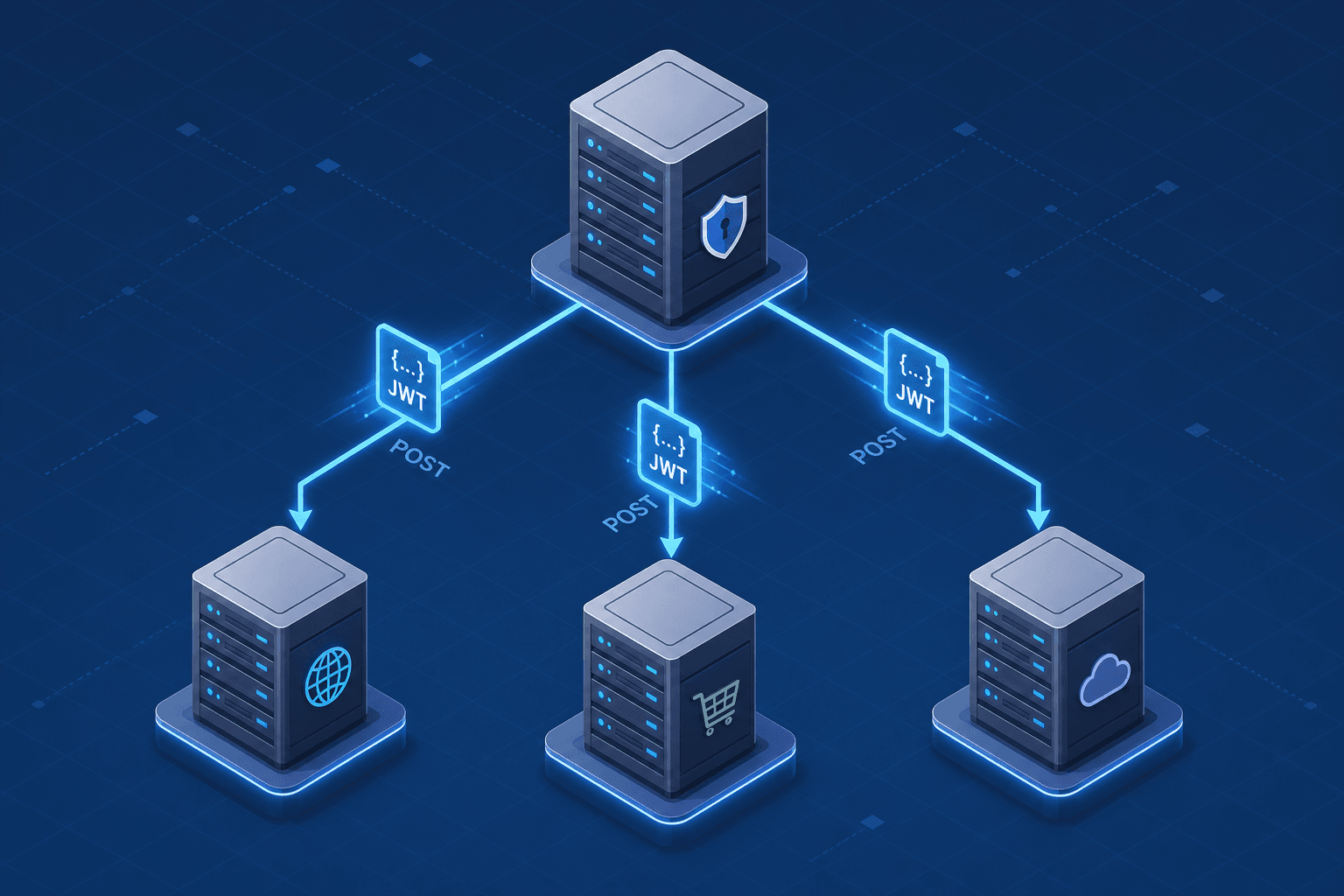
To solve this, OpenID Connect defines a back-channel logout mechanism where the Authorization Server (AuthCorp) becomes the initiator of the termination event. Instead of waiting for the user to visit the IdP, the IdP maintains a registry of all registered clients (Service Providers) and their specific logout_uri endpoints. When a logout request is received—whether from a front-channel redirect, a direct API call, or an admin action—the IdP does not just end its own session; it constructs a logout_token and pushes it via an HTTP POST request to every registered client's logout_uri.

This logout_token is a JSON Web Token (JWT) signed by the IdP. Its payload contains critical identifiers, most notably the sid (session ID) which links the token to the specific user session across all services, and the iat (issued at) timestamp. The mechanism forces the Service Provider to actively query its local session store using the sid provided in the token. If the sid exists, the SP deletes the associated session data immediately. This transforms the architecture from a passive, browser-dependent model to an active, server-to-server command protocol.
Handling the Token and Session Correlation
The security of this flow relies entirely on the integrity of the logout_token and the precision of the session correlation. The Service Provider must treat the incoming POST request as a privileged command. It cannot simply trust the sid; it must verify the JWT signature using the IdP's public keys (JWKs) fetched from the .well-known/openid-configuration endpoint. This prevents an attacker from spoofing a logout request from a compromised client or a malicious third party.
Consider a scenario where the IdP sends a logout_token to Project Beta. The token payload looks like this:
{
  "iss": "https://authcorp.example.com",
  "sub": "alice@example.com",
  "aud": "project-beta-client-id",
  "iat": 1678886400,
  "sid": "session-id-998877",
  "events": {
    "http://openid.net/event/backchannel-logout": {}
  }
}
Project Beta receives this request. The first step is cryptographic validation: verifying the signature against the IdP's current JWK set. If the signature is invalid, the request is rejected, and the session remains active. If valid, the SP extracts the sid. It then performs a lookup in its internal session store (e.g., Redis or a SQL database) for session-id-998877.
Here lies the critical mechanism: the SP must delete the session record associated with that sid. Crucially, the SP must also handle the iat claim. While the OIDC specification does not mandate a specific lifetime for logout tokens, security best practices recommend treating tokens issued more than a few minutes ago as stale to prevent replay attacks. Ignoring old tokens ensures that session termination is both atomic and fresh, preventing unnecessary lookups or potential denial-of-service conditions.
The Race Condition of Distributed State
Implementing this mechanism introduces a new class of race conditions. Suppose Alice logs out on her mobile device. The IdP immediately fires logout_token requests to Project Alpha and Project Beta. However, if Alice simultaneously refreshes the Project Beta page on her laptop, Project Beta might receive the refresh request before it processes the logout POST request.

In this window, Project Beta might attempt to validate the session cookie sent by the browser, find it valid, and render the page. Moments later, the back-channel logout request arrives, and the session is deleted. The user sees a page, then potentially gets a 401 or 403 error upon the next interaction. To mitigate this, the SP must treat the logout_token as the source of truth. Upon receiving the POST, the SP should immediately invalidate the sid in the session store. Any subsequent request arriving with that sid (even if it was in-flight before the logout) will fail the session lookup.
This requires the session store to be highly available and low-latency. If the session store is slow to update, the "orphaned" state might persist briefly. Furthermore, immediate removal of the session key upon valid logout_token receipt is the standard requirement for OIDC implementations. Soft deletes or revocation lists are only necessary for specific high-performance caching layers where immediate consistency is impossible to guarantee, not as a general alternative to standard deletion.
Implementation Strategy and Edge Cases
Building a robust back-channel logout handler requires strict adherence to the specification. The Service Provider must expose a public endpoint, typically /logout, configured in the IdP's metadata under backchannel_logout_uri. This endpoint must strictly accept application/x-www-form-urlencoded requests containing the logout_token parameter, as mandated by the OIDC Core 1.0 specification.
Here is a conceptual implementation in a Node.js environment handling the POST request:
const jwt = require('jsonwebtoken');
const jwksRsa = require('jwks-rsa');
const sessionStore = require('./session-store');

// Configure JWKS client to fetch keys dynamically
const jwksUri = 'https://authcorp.example.com/.well-known/jwks.json';
const client = jwksRsa({
  jwksUri: jwksUri,
  cache: true,
  rateLimit: true,
});

function getKey(header, callback) {
  client.getSigningKey(header.kid, (err, key) => {
    if (err) return callback(err);
    const signingKey = key.publicKey || key.rsaPublicKey;
    callback(null, signingKey);
  });
}

app.post('/logout', async (req, res) => {
  // OIDC Core 1.0 requires form-urlencoded format
  const { logout_token } = req.body;

  if (!logout_token) {
    return res.status(400).send('Missing logout_token');
  }

  try {
    // 1. Verify signature using the specific key from the JWK set
    const payload = await jwt.verify(logout_token, getKey, { algorithms: ['RS256'] });

    // 2. Check for required claims
    if (!payload.sid || !payload.iat) {
      return res.status(400).send('Invalid logout token structure');
    }

    // 3. Check freshness (prevent replay of old tokens)
    const now = Math.floor(Date.now() / 1000);
    if (now - payload.iat > 300) { // 5 minutes threshold heuristic
      console.warn('Logout token too old, ignoring');
      return res.status(400).send('Token expired');
    }

    // 4. Invalidate session in store
    await sessionStore.delete(payload.sid);

    // 5. Acknowledge receipt to IdP (optional but recommended)
    res.status(200).send('Logout processed');

  } catch (err) {
    console.error('Back-channel logout verification failed', err);
    // Do not reveal internal details to IdP
    res.status(401).send('Unauthorized');
  }
});
A common edge case is the "silent logout" where the user does not see a confirmation page. The IdP sends the token, the SP deletes the session, and the SP returns a 200 OK. The user, however, might still be logged in if their browser holds a stale cookie that hasn't been sent yet. The SP should ideally return a redirect to a generic "logged out" page or a specific "session expired" page to force the browser to clear its local storage or redirect the user to the login screen, ensuring the UI reflects the backend state change.
Another consideration is the sid lifecycle. If the IdP assigns a new sid after a token refresh, the old sid becomes invalid for logout purposes. The SP must ensure that it only terminates the session associated with the exact sid provided in the token, not the user's entire identity. If a user has multiple concurrent sessions (e.g., one on mobile, one on desktop), a logout from the mobile device should only kill the mobile session, leaving the desktop session intact. This granular control is the primary advantage of the back-channel approach over front-channel redirects.
Conclusion
Back-channel logout is not merely an optional feature; it is a requirement for any system claiming to support "Single Sign-Out" (SSO). Relying solely on front-channel redirects leaves systems vulnerable to orphaned sessions and inconsistent state. By implementing the push-based logout_token mechanism, Service Providers ensure that session termination is a coordinated, server-side operation that propagates reliably regardless of the user's browser activity. The trade-off is the added complexity of managing the logout_uri endpoint and handling asynchronous session invalidation, but the security guarantee of reliable session termination justifies the architectural effort.
FAQ
What happens if the Authorization Server (IdP) is down when a logout occurs?
If the IdP is unavailable, it cannot push the logout_token to your Service Providers. In this scenario, back-channel logout cannot occur, and the system reverts to the limitations of front-channel logout. Clients may need to implement fallback mechanisms or alert administrators of the IdP's unavailability.
How do I handle concurrent sessions for the same user?
The sid (session ID) in the logout token uniquely identifies a specific session instance. If a user has multiple active sessions (e.g., Mobile App and Desktop Browser), a logout request from the mobile app will contain the mobile sid. Your Service Provider will only invalidate the session matching that specific sid, leaving the desktop session active.
Is the logout token replayable?
No, not if implemented correctly. The iat (issued at) timestamp in the token allows the Service Provider to enforce a short validity window (e.g., 5 minutes). Tokens older than this window are rejected. Additionally, the cryptographic signature ensures the token cannot be altered, and the sid ensures it targets a specific session.
Common Pitfalls
- Ignoring the
iatclaim: Failing to check the issued-at timestamp allows attackers to replay old logout tokens, potentially causing denial of service or inconsistent state. - Accepting JSON payloads: The OIDC Core 1.0 specification strictly requires
application/x-www-form-urlencodedfor back-channel logout. Accepting JSON can lead to parsing errors or security misconfigurations. - Caching session lookups without invalidation: Caching session data without a mechanism to immediately evict the cached entry upon receiving a logout token can leave "orphaned" sessions active for the duration of the cache TTL.
Related posts
OIDC Front-Channel vs Back-Channel Logout: Implementation Guide
A technical examination of OIDC front-channel and back-channel logout mechanisms, comparing implementation strategies for session management.
Implementing and Validating Discovery in Your Client
A technical walkthrough for backend developers on implementing OAuth 2.1 discovery, issuer validation, and strict discovery document validation using OpenIDConnectConfigurationRetriever.
SAML Single Logout: Implementation Patterns and Pitfalls
An examination of SAML single logout implementation patterns, covering session management and pitfalls in SP-initiated and IdP-initiated logout flows.