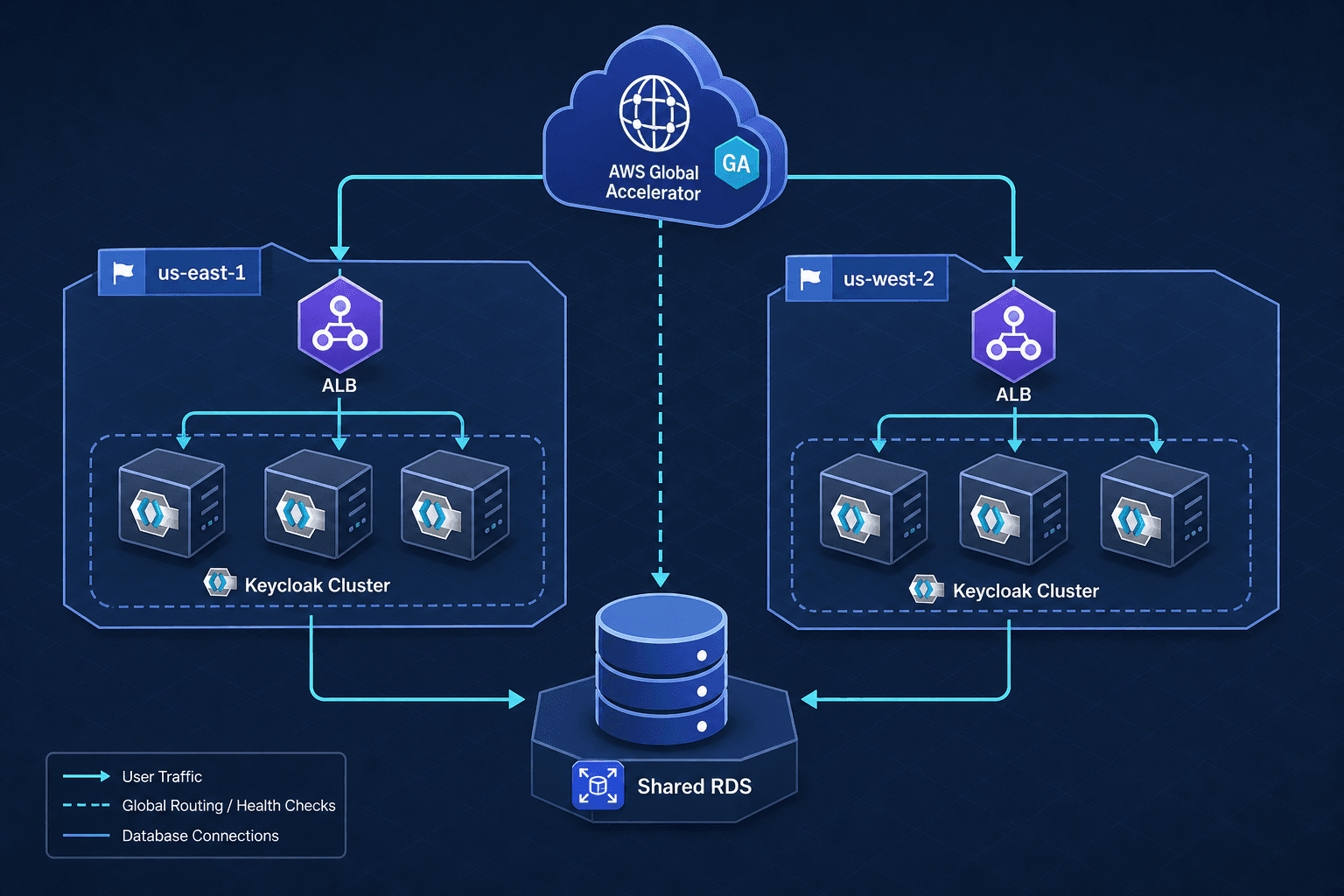
Building Resilient Multi-Region IAM with Keycloak and AWS Global Accelerator
This guide covers designing a resilient multi-region IAM architecture using Keycloak and AWS Global Accelerator for high availability and disaster recovery.
Identity management acts as the single point of failure for most cloud architectures; if the Identity Provider (IdP) becomes unavailable, applications cannot authenticate users, effectively locking the organization out of its infrastructure. A common architectural error is assuming that deploying two identical Keycloak clusters in different AWS regions provides sufficient high availability. This approach often fails because session state and token validation logic remain tightly coupled to the local database. To build a truly resilient multi-region IAM, architects must decouple the network routing mechanism from the state synchronization mechanism.
The Network Edge: AWS Global Accelerator
The first layer of resilience is the entry point. Standard DNS routing is too slow for disaster recovery; if a region fails, DNS propagation can take minutes, during which users encounter errors. AWS Global Accelerator (GA) solves this by providing two static Anycast IP addresses that serve as a global entry point.
When a user attempts to connect, their request hits the nearest GA edge location. GA then evaluates the health of the registered endpoints, which are your Keycloak load balancers in Region A and Region B. If Region A is healthy, GA routes traffic there. If Region A fails its health checks, GA reroutes traffic to Region B within seconds (typically under 60 seconds, often much faster).
This mechanism works because GA operates at Layer 4 (TCP/UDP) and Layer 7 (HTTP/HTTPS). It does not rely on DNS TTLs. Instead, it maintains a continuous stream of health probes.
# Example: Creating a Listener and Endpoint Group via CLI
# This command registers the Application Load Balancer in Region B as a failover target
aws global-accelerator create-listener \
    --accelerator-arn arn:aws:global-accelerator::123456789012:accelerator/your-accelerator-id \
    --protocol HTTP \
    --port-ranges StartPort=443,EndPort=443 \
    --traffic-dial 100 \
    --region-list RegionName=us-east-1,EndpointGroupId=endpoint-group-id-a

aws global-accelerator create-traffic-dial \
    --accelerator-arn arn:aws:global-accelerator::123456789012:accelerator/your-accelerator-id \
    --regions RegionName=us-east-1,Weight=100 \
    --regions RegionName=us-west-2,Weight=0
In this setup, the application never needs to know about the region. It simply connects to the static GA IP. The mechanism ensures that if the primary Keycloak cluster in us-east-1 becomes unreachable, the network layer automatically shifts the data flow to us-west-2.
State Consistency: Solving the Split-Brain Problem
Routing traffic is only half the battle. The critical failure mode in multi-region IAM is state inconsistency. If a user logs in to Region A, their session is stored in Region A's database. If the user is then routed to Region B due to a failover, Region B's Keycloak instance looks at its local database, sees no session record, and forces the user to log in again. This breaks the user experience and creates a "split-brain" scenario where the IdP believes the user is logged out while the user thinks they are still authenticated.
To prevent this, the Keycloak clusters must share a single source of truth for session data. We cannot rely on database replication alone if the regions are geographically distant, as replication lag can cause authentication failures.
The robust mechanism involves using an external, globally available store for sessions. Keycloak supports storing sessions in a distributed cache (like Redis) or a shared database. For maximum resilience, we recommend using a shared RDS instance configured as an AWS Global Database or a single-region RDS instance accessed by both regions (though latency is a trade-off).
A more modern approach, favored for microservices, is to use Amazon ElastiCache (Redis) in a cluster mode or a dedicated Redis cluster in a third region, but the simplest mechanism for pure HA is a shared database.

In this configuration, both us-east-1 and us-west-2 Keycloak instances write session tokens to the same database. When a failover occurs, Region B immediately reads the existing session from the database. Crucially, the database is queried to validate session state (existence, revocation, expiration), while the JWT signature is validated cryptographically using the shared secret key. This distinction ensures that the cryptographic integrity of the token remains independent of the database lookup, preventing performance bottlenecks and clarifying that signature verification does not require a DB hit. This is the mechanism that defines true high availability versus simple redundancy.
# Modern Keycloak Configuration (v17+) via environment variables
# Configure the shared database for session persistence
KC_DB=postgres
KC_DB_URL=jdbc:postgresql://shared-db-endpoint:5432/keycloak
KC_DB_USER=keycloak_user
KC_DB_PASSWORD=secure_password

# Optional: Force session storage to JDBC if not default
# KC_SPI_STORE_JDBC_TABLE=SESSION
The Failover Sequence: A Worked Scenario
Let's trace a specific failure event to see these mechanisms interact.
Actors:
User Alice: Client application running in a browser.Keycloak A: Primary cluster inus-east-1.Keycloak B: Secondary cluster inus-west-2.Shared DB: PostgreSQL instance ineu-central-1(accessible via private link).GA: AWS Global Accelerator.
Scenario: A power outage takes down the us-east-1 region.
- Health Check Failure: GA sends a TCP/HTTP probe to the Application Load Balancer (ALB) in front of Keycloak A. The probe fails.
- Traffic Rerouting: GA updates its internal routing table. All new connections from Alice's browser to the GA Anycast IP are now directed to the ALB in
us-west-2(Keycloak B). This typically happens within seconds (often much faster than DNS). - Request Arrival: Alice's browser sends a request to
/auth/realms/myrealm/account. The request lands on Keycloak B. - Session Lookup: Keycloak B receives the session cookie. It queries the
Shared DBfor the session ID. - Authentication Success: The
Shared DBreturns the active session data. Keycloak B validates the token signature cryptographically and grants access. Alice remains logged in. - Recovery: Once
us-east-1is restored, Keycloak A starts up and connects to theShared DB. GA detects the health check passing on Keycloak A. Traffic begins to shift back to the primary region based on the configured weight.
This sequence demonstrates that resilience is not about having two servers; it is about having a shared state that survives the network partition.

Tradeoffs and Operational Reality
Implementing this architecture introduces specific tradeoffs. The primary constraint is latency. If you use a shared database in a third region (eu-central-1), every authentication request incurs the network round-trip time to that region. This adds latency to the login flow.
For most enterprise workloads, the latency penalty of a shared database in a third region is acceptable given the guarantee of zero data loss and immediate failover. However, relying on local databases with asynchronous replication for session state is generally discouraged for IAM. Standard async replication is optimized for read scaling and may not fit session store requirements without specific configuration, often leading to split-brain risks and non-zero Recovery Point Objectives (RPO) during a failover.
Another consideration is the cost. You are paying for two sets of Keycloak infrastructure plus the cross-region data transfer and the shared database. This is the cost of resilience.
Finally, the "warm-up" time for the secondary region matters. Keycloak B must be running and ready to accept traffic before the failover happens. It should not be a "cold" standby. It must be a "hot" standby, meaning it is running, connected to the shared database, and processing health checks, but receiving no production traffic until the primary fails.
Conclusion
Building a resilient multi-region IAM system is not about duplicating infrastructure; it is about decoupling the network path from the state storage. AWS Global Accelerator provides the fast, deterministic network failover required to hide regional outages from the client. Keycloak, configured with a shared session store, provides the state continuity required to keep users logged in during that transition. By understanding the mechanism of the health checks and the database locking strategies, architects can design systems that survive regional disasters without sacrificing user experience.
The result is an IAM system that behaves as a single logical entity, regardless of the physical location of the underlying servers. This is the definition of true high availability.
Common Pitfalls
Even with a solid architectural plan, implementation errors can undermine resilience. Be vigilant against these common mistakes:
- Assuming Local Databases are Sufficient: Deploying independent databases in each region without a shared store guarantees session loss during failover, forcing users to re-authenticate and breaking the user experience.
- Ignoring Latency Penalties: Placing the shared session store in a region that is geographically distant from both active regions can introduce unacceptable latency for login flows, degrading performance even during normal operations.
- Neglecting Warm-up Requirements: Configuring the secondary region as a cold standby means it will take time to start up and connect to the database after a failure, introducing a delay that defeats the purpose of automated failover.
Practical Takeaways
To successfully implement this architecture, focus on these actionable insights:
- Decouple State from Routing: Ensure your network layer (Global Accelerator) handles traffic shifting independently of your state layer (Database).
- Use a Shared Store: Configure Keycloak to use a single, accessible database or Redis cluster for all session data to prevent split-brain scenarios.
- Test Failover Regularly: Automate failover drills to verify that the shared database is accessible from the secondary region and that Global Accelerator correctly reroutes traffic.
FAQ
Q: Can I use asynchronous database replication between regions for session storage? A: Generally, no. Async replication introduces a window where data exists in one region but not the other, creating a risk of data loss (RPO > 0) and split-brain states during a failover. Synchronous or shared stores are preferred for session data.
Q: How long does AWS Global Accelerator take to failover? A: GA typically reroutes traffic within seconds (often under 60 seconds), which is significantly faster than DNS-based failover that relies on TTL propagation.
Q: Is Redis better than a shared RDS instance for Keycloak sessions? A: Redis offers lower latency, making it ideal for high-frequency scenarios, but it requires careful management of persistence and cluster topology. RDS offers stronger consistency guarantees but introduces higher network latency depending on the region placement.
Related posts
Migrating an Existing User Base to Passwordless
A practical guide to migrating an existing user base to passwordless authentication, covering enrollment strategies, user adoption, and rollout planning.
Implementing Conditional Access Policies with Keycloak and ForgeRock
A technical examination of implementing conditional access policies using Keycloak and ForgeRock for context-aware access control.
Identity as the Perimeter
Explore how treating identity as the new security perimeter enables continuous evaluation and strong authentication within a zero trust architecture.