IAM for Data Lakes: Securing Big Data
An examination of identity and access management strategies for data lakes, covering Apache Ranger, Lake Formation, and column-level security.
Identity and Access Management for Data Lakes: Securing Big Data
The fundamental vulnerability in most data lake architectures is not a lack of firewalls, but a mismatch between storage granularity and access control granularity. In a traditional Hadoop ecosystem, administrators often rely on HDFS permissions (ACLs) to secure data, treating a Parquet or ORC file as an atomic unit of security. However, modern data lakes are accessed primarily through query engines like Apache Spark, Presto, or Trino. These engines operate as distinct services that authenticate users and issue direct requests to the storage layer. When a user runs SELECT * FROM sales_data, the query engine does not check HDFS ACLs for every individual cell; it checks if the user can read the file. If the file is readable, the data flows. The mechanism of failure here is the "read-file" abstraction, which grants access to the container but ignores the contents within. To secure big data, we must move from file-level gating to policy engines that intercept and rewrite queries before execution.
The Mechanism of Failure in Traditional File Systems
The core issue lies in how traditional systems handle trust boundaries. Query engines bypass OS-level checks when executing SQL, creating a gap where file-level permissions are insufficient. When a user executes a query, the engine validates the file path but lacks the context to understand the sensitivity of specific rows or columns inside that file. This creates a scenario where a user with broad file access inadvertently gains visibility into highly sensitive data fields, such as PII or financial records, simply because they possess the read permission for the container file.
Apache Ranger Architecture and Policy Propagation
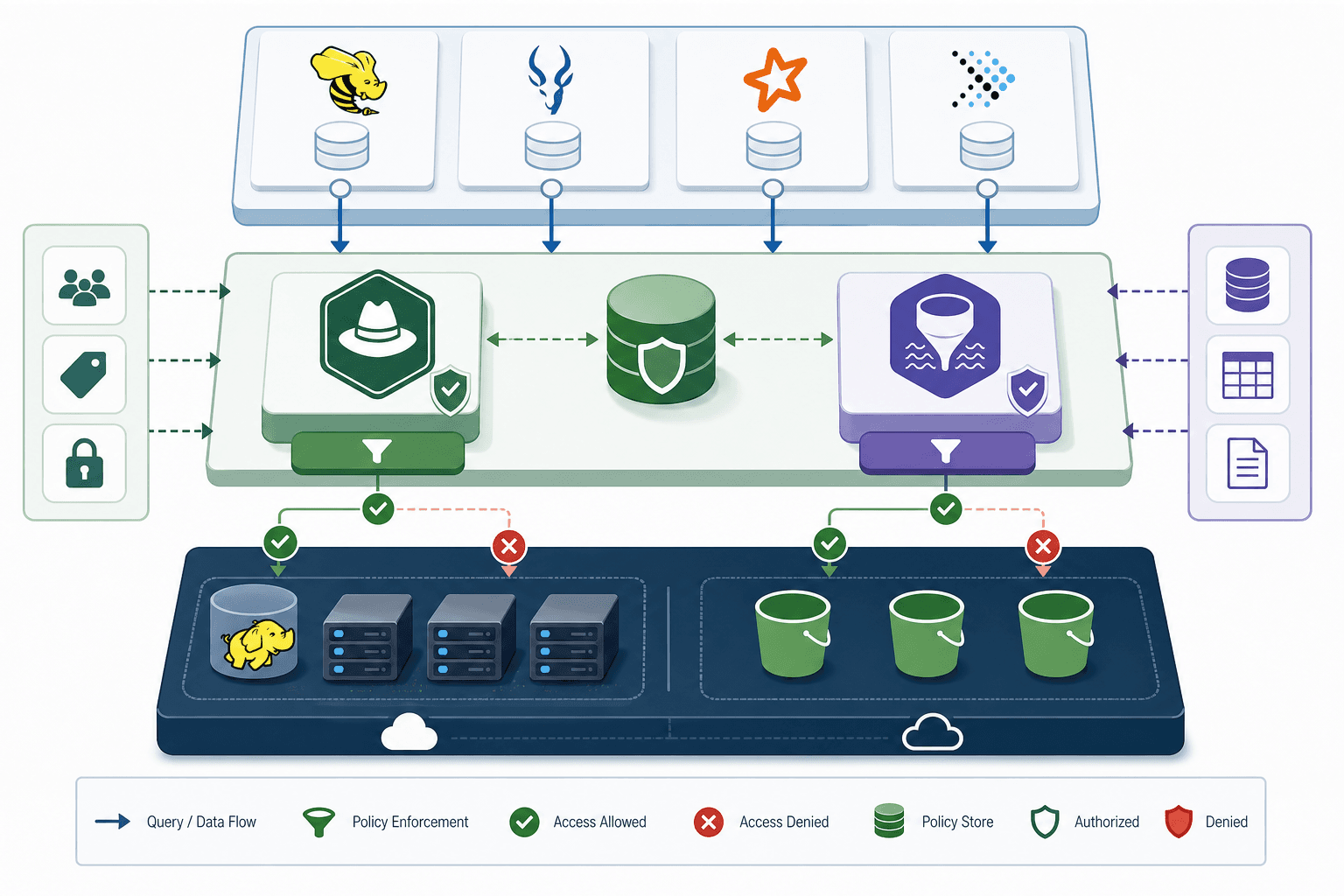
Apache Ranger provides the architectural pattern for solving this mismatch by functioning as a centralized policy management service that decouples policy definition from policy enforcement. The core mechanism involves a "push" model where Ranger stores policies in a database and propagates them to plugin services via Apache ZooKeeper. When a user submits a query to Hive or Impala, the specific service plugin (e.g., the Hive Plugin) checks its local cache, which is synchronized with ZooKeeper. If a policy exists for that resource, the plugin intercepts the request.
Consider a concrete scenario: A data analyst named Alice wants to run a query on a sensitive table. Her request hits the Hive service. The Hive Plugin, acting as a gatekeeper, queries the Ranger policy cache. It finds a rule stating: "User Alice can read table_a only if region equals 'US'." The mechanism here is not just a deny; it is a dynamic rewrite. The Ranger Hive Plugin modifies the SQL AST (Abstract Syntax Tree) to inject the filter WHERE region = 'US' before the query is optimized or executed. This ensures that even if Alice tries to bypass the filter, the policy engine has already altered the execution plan.
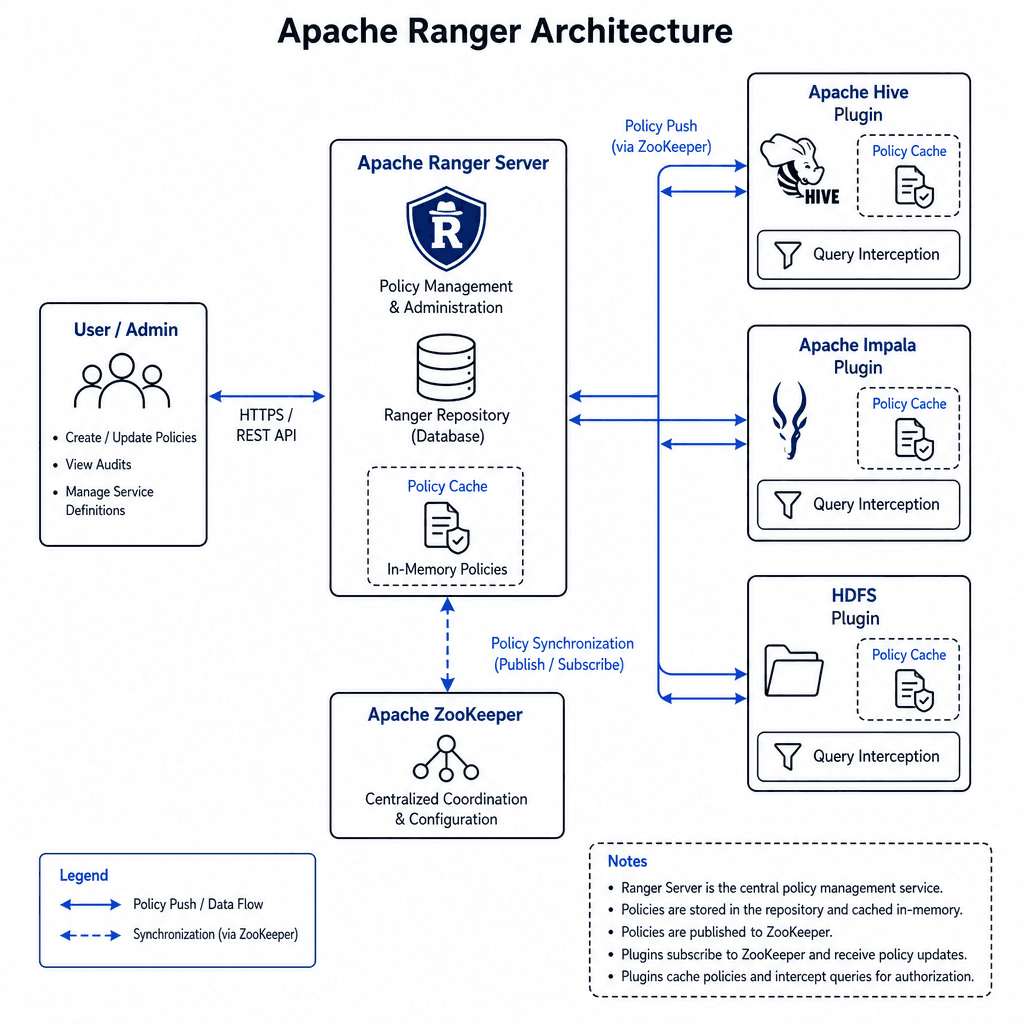
This centralized approach allows administrators to define a single source of truth for policies across Hive, HDFS, HBase, and Kafka, ensuring that access control is consistent regardless of the entry point.
AWS Lake Formation and Fine-Grained Access
Moving to cloud-native environments, AWS Lake Formation introduces a different mechanism: the tight coupling of IAM identities with data lake metadata. In Lake Formation, the security boundary is defined at the catalog level. When you grant a permission, you are not granting access to an S3 bucket path directly; you are granting access to a table view within the Glue Data Catalog. The critical mechanism here is the "Data Filter." When a user with limited privileges queries a table, Lake Formation integrates with the compute engine (such as Amazon Athena or Redshift Spectrum) to enforce these filters.
For example, imagine a financial dataset stored in S3 containing columns for salary, department, and employee_id. An HR manager has a role that grants access to the table but restricts the salary column. When the manager queries the table, the Lake Formation integration instructs the compute engine to apply the column-level security policy. The compute engine effectively executes a query equivalent to SELECT department, employee_id FROM table. The salary column is never materialized in the compute engine's memory, never cached, and never returned to the client as raw data. This is distinct from traditional row-level security because it operates on the metadata layer, preventing the compute engine from ever seeing the restricted data. While the raw value is excluded from the result set, the final output presented to the user is the masked or filtered result set generated by the engine under Lake Formation's direction.
Column-Level Security Implementation Strategies
The most granular control available in modern data lakes is column-level security, which addresses the "PII problem" in big data. In a regulated environment, a single dataset might contain public marketing data and highly sensitive PII (Personally Identifiable Information). An effective IAM strategy must ensure that a marketing analyst can access the customer_id and purchase_history columns but cannot access ssn or credit_score.
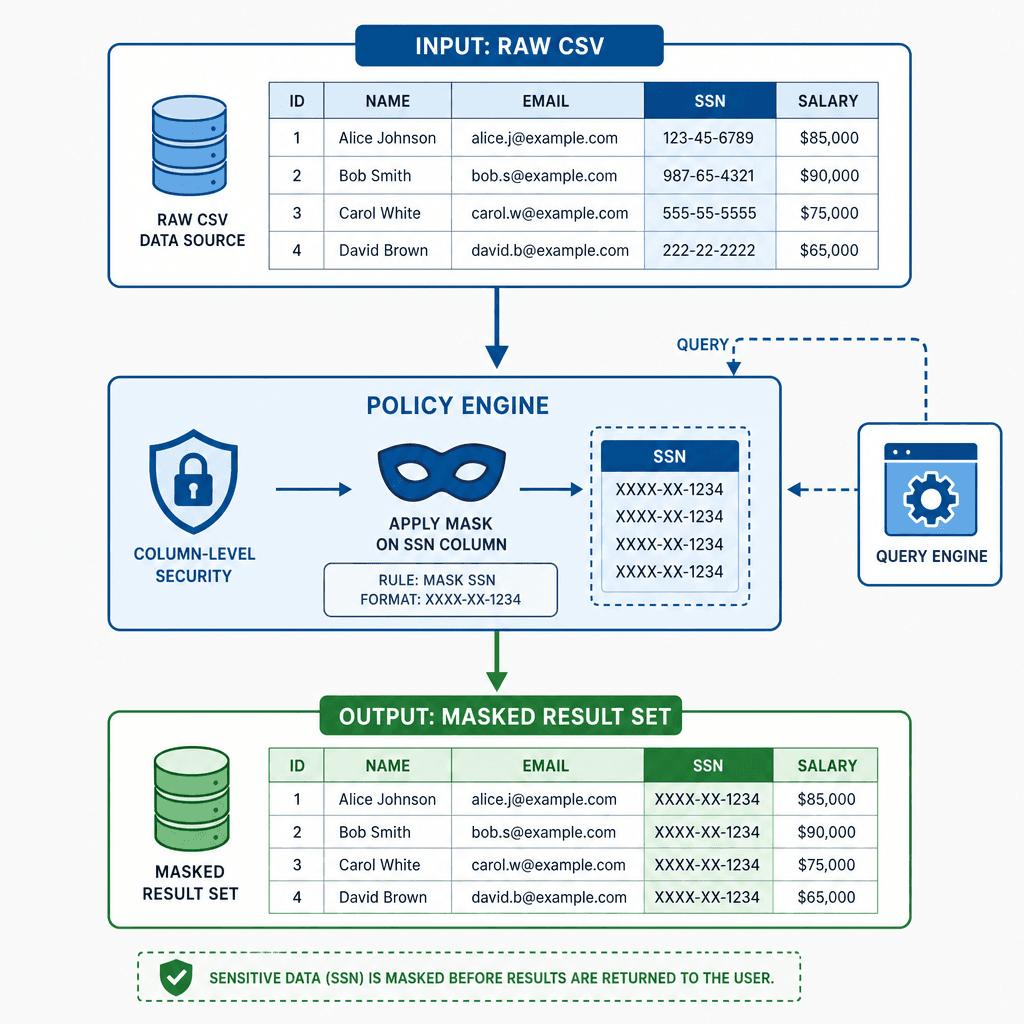
To implement this, tools like Apache Ranger and Lake Formation utilize dynamic masking or projection. Let's trace the data flow for a specific artifact: a CSV file named customer_transactions.csv located in an S3 bucket.
- Ingestion: The data lands in the bucket. No access is granted yet.
- Catalog Registration: The file is registered in the Data Catalog (Glue or Hive Metastore).
- Policy Definition: An administrator defines a policy: "Group
marketinghasSELECTpermission oncustomer_transactionsbutMASKpermission onssn." - Query Execution: A user in the
marketinggroup runsSELECT * FROM customer_transactions. - Policy Enforcement: The policy engine identifies the
ssncolumn. Instead of returning the raw value, it applies a transformation function (e.g.,XXXX-XX-1234). - Result Delivery: The query engine returns the result set with the masked column.
This mechanism ensures that data leakage is prevented at the source of the query, not at the network perimeter. It relies on the assumption that the query engine trusts the policy engine. If the policy engine is compromised, the entire security model fails. Therefore, the architecture must isolate the policy store (often a separate database) from the data storage.
Operational Shifts and Shadow IT Risks
Implementing these strategies requires a significant shift in operational mindset. You cannot manage data lake security by managing file permissions on a distributed filesystem; you must manage policies as code. The dependency chain is strict: the identity provider (IdP) authenticates the user, the IAM system resolves the role, the policy engine evaluates the context against the data catalog, and the query engine enforces the result. If any link in this chain is weak—such as relying on S3 bucket policies alone—the mechanism breaks.
A common pitfall is the "shadow IT" effect where developers bypass the central policy engine by writing custom scripts that read directly from S3 using pre-signed URLs. This often happens because developers find the centralized policy evaluation too slow or restrictive for their immediate needs. To prevent this, organizations must enforce that all data access flows through approved query engines. This is often achieved by disabling direct S3 access for compute roles and forcing all data retrieval through the data platform's API or CLI, which logs the activity and enforces the Ranger/Lake Formation policies.
Managing policies as code introduces its own operational challenges. Unlike static file permissions, dynamic policies require version control, testing, and CI/CD pipelines to ensure that changes do not inadvertently lock out legitimate users or expose sensitive data. Administrators must treat policy definitions with the same rigor as application code, implementing automated testing to validate that policies behave as expected in staging environments before deployment. Furthermore, the complexity of maintaining consistent policies across hybrid environments (on-prem Hadoop and cloud S3) can lead to configuration drift, where the actual access rights diverge from the intended security posture.
Common Pitfalls
Organizations frequently stumble into specific traps when deploying data lake security architectures. Three of the most critical pitfalls include:
- Direct S3 Access Bypass: Developers often write Python or SQL scripts that query S3 directly using temporary credentials, completely bypassing the Hive or Athena query engines where Ranger or Lake Formation policies are enforced. This creates a "backdoor" where sensitive data is exposed to anyone with valid cloud credentials, regardless of their data-specific permissions.
- Stale Policy Caches: In distributed systems like Apache Ranger, policy changes propagate via caches (often via ZooKeeper). If a policy is updated but the plugin cache is not refreshed, users may temporarily retain access to data they should no longer see, or conversely, be denied access they were granted. This latency can create security gaps or operational outages.
- Over-Reliance on Bucket Policies: Relying solely on S3 bucket policies (IAM policies attached to the bucket) is insufficient for fine-grained control. Bucket policies operate at the object level, not the row or column level. They cannot distinguish between a user who needs to see all columns and one who needs only a subset, leading to either over-permissioning or under-utilization of data.
Practical Takeaways
To successfully secure a data lake, teams should focus on these actionable strategies:
- Enforce Centralized Policy Enforcement: Ensure all data access flows through a unified query engine (like Spark, Hive, or Athena) that is integrated with a policy engine like Apache Ranger or AWS Lake Formation. Disable direct object-store access for application users to eliminate bypass vectors.
- Adopt Policy-as-Code: Treat security policies as code artifacts. Store them in version control systems, review them in pull requests, and test them automatically. This reduces human error and ensures that policy changes are auditable and reproducible.
- Implement Column-Level Masking: Move beyond row-level filtering to column-level masking for sensitive data. This ensures that even users with broad table access cannot see specific PII fields unless explicitly authorized, minimizing the blast radius of a compromised account.
FAQ
Q: How does Apache Ranger differ from AWS Lake Formation? A: Apache Ranger is an open-source, centralized policy engine that works across multiple data platforms (Hive, HDFS, HBase, etc.) often requiring manual integration with the query engines. AWS Lake Formation is a fully managed AWS service that tightly integrates with the AWS ecosystem (S3, Glue, Athena), handling metadata and security enforcement natively within the AWS console and API.
Q: Can column-level masking prevent data leakage if a user has admin access? A: No. Column-level masking protects against standard users and prevents accidental exposure. If a user has administrative privileges over the underlying compute engine or the storage itself, they may be able to bypass the masking logic. Defense-in-depth, including strong IAM roles and audit logging, is required to protect against privileged users.
Q: What happens if the policy cache fails to update in Apache Ranger? A: If the cache fails to update, there is a window of inconsistency where users might retain old permissions or lose new ones. To mitigate this, organizations should configure shorter cache refresh intervals and implement monitoring alerts for cache synchronization failures between the Ranger server and the service plugins.
Conclusion
Securing a data lake is not about building a bigger wall; it is about building a smarter gatekeeper. The mechanism of column-level security transforms the data lake from a passive repository into an active security boundary. By leveraging centralized policy engines like Apache Ranger or cloud-native integrations like AWS Lake Formation, organizations can enforce granular access controls that align with the actual structure of the data, not just the file system. This approach ensures that even if a user has broad access to a dataset, they only see the data they are explicitly authorized to see, preserving both utility and compliance.
Related posts
Least Privilege in Practice
A practical guide to implementing least privilege in AWS using IAM Access Analyzer, policy generation, and condition keys for secure access management.
AWS IAM Boundaries, SCPs & ABAC: Advanced Access Control
An examination of AWS IAM policy boundaries, SCPs, ABAC, and conditions for advanced multi-account security.
Identity Breach Response: Securing the Compromised Keymaker
A guide to handling an IAM system compromise, covering identity breach detection, incident response steps, and credential remediation.