Understanding JWKS: Rotating Signing Keys Gracefully
An examination of JSON Web Key Set (JWKS) mechanisms for securely rotating signing keys and verifying JWTs without service interruption.
Understanding JWKS: Rotating Signing Keys Gracefully
Traditional authentication architectures often suffer from a brittle design where client applications hardcode the public keys used to verify JSON Web Tokens (JWTs). This approach creates a critical failure mode: when a service needs to rotate its signing key for security reasons, such as a suspected leak or scheduled maintenance, operators must manually update every client instance. If the update is delayed, valid tokens are rejected, causing an outage; if rushed, the system may momentarily accept tokens signed with a compromised key. The JSON Web Key Set (JWKS) mechanism eliminates this binary state by decoupling key distribution from token issuance, allowing clients to fetch a rotating set of public keys dynamically.
The Static Bottleneck of Hardcoded Keys
Consider a scenario where "Client A" is configured with a specific RSA public key to trust tokens issued by "Service B." In this static model, "Client A" has no knowledge of any other key. When "Service B" needs to rotate its signing key, the operator faces a dilemma. A manual update to "Client A" introduces a window of vulnerability. If the propagation of the new key is delayed across the distributed client fleet, "Client A" rejects valid tokens signed with the new key, resulting in a service interruption. Conversely, if the old key is removed too quickly before all clients have updated, a security gap opens where the compromised key might still be in use or accepted. This rigid dependency between the token issuer and the verifier is the fundamental flaw that dynamic key discovery mechanisms are designed to solve.
The JWKS Mechanism and Discovery
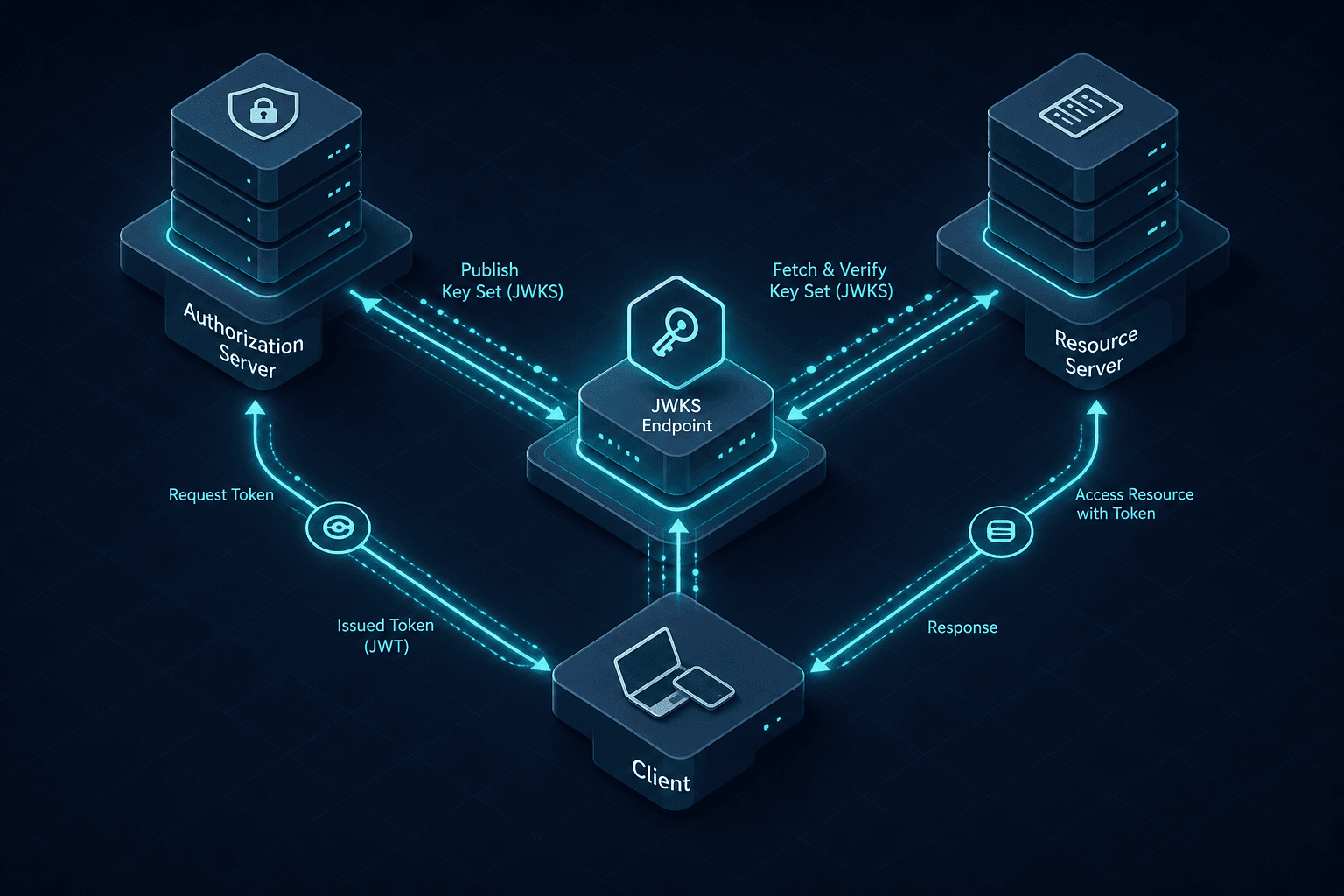
The core innovation of JWKS is the separation of the key repository from the token payload, as defined in RFC 7517. Instead of embedding the public key directly in the client configuration, the client retrieves a JSON array of public keys from a well-known endpoint, typically exposed at a jwks_uri. This document contains a collection of key objects, each identified by a unique kid (Key ID). The JWT itself carries this kid in its header, acting as a pointer to the specific key within the set. When a client receives a token, it reads the kid, fetches the current JWKS document, and selects the matching public key from the array to perform the cryptographic verification. This design allows the server to add new keys to the JWKS array without requiring any reconfiguration of the client.
The Rotation Dance: Coexistence and Transition
To understand the grace of rotation, consider a specific workflow involving three named actors: "Alice" (the API Client), "Bob" (the Authorization Server), and "Charlie" (the protected Resource Server). Initially, Bob signs tokens with key_v1 and publishes its public half in the JWKS with kid: "v1". Alice caches this JWKS locally with a Time-To-Live (TTL) of 600 seconds. When Bob decides to rotate keys, it does not immediately stop signing with key_v1. Instead, Bob generates key_v2, assigns it kid: "v2", and updates the JWKS endpoint to include both keys in the array.
During this transition window, Bob begins signing new tokens with key_v2 but continues to honor existing tokens signed with key_v1. Charlie, who relies on the same JWKS endpoint to validate incoming requests, fetches the updated document. The JWKS now looks like this:
{
  "keys": [
    {
      "kty": "RSA",
      "use": "sig",
      "kid": "v1",
      "n": "0vx7...",
      "e": "AQAB"
    },
    {
      "kty": "RSA",
      "use": "sig",
      "kid": "v2",
      "n": "8W7...",
      "e": "AQAB"
    }
  ]
}
Alice receives a token signed by Bob with key_v2. She reads the header, sees kid: "v2", checks her local cache, and if the key is missing, she fetches the updated JWKS. She finds v2 in the list and successfully verifies the signature. Simultaneously, if Alice still holds an old token signed with key_v1, she can still verify it because v1 remains in the active JWKS set. This coexistence ensures that no request fails during the rotation window. Only after a defined grace period does Bob remove key_v1 from the JWKS, and eventually, Alice's cache refreshes to reflect this removal.
Verification Logic and Caching Strategy
The verification logic on the client side must be resilient to handle this dynamic state. The standard algorithm, often referred to as "JWK Validation," requires the client to first check if the requested kid exists in the local cache. If the kid is present, the client uses that key immediately. If the kid is missing, the client must fetch the latest JWKS from the server. Crucially, the client should not fail immediately if the kid is not found; it should attempt to refresh the JWKS and retry. However, relying on network calls for every token verification is inefficient and introduces latency. Therefore, best practice dictates caching the entire JWKS document with a strict TTL, typically aligned with the server's expected rotation frequency, to minimize network chatter while ensuring freshness.
A common pitfall in implementing this mechanism is the handling of key expiration and revocation. Unlike a simple boolean flag, key rotation in a distributed system requires managing the lifecycle of the kid. If a key is compromised, the server must immediately remove it from the JWKS. Clients do not actively monitor the server for these changes; instead, they trigger a fetch only when their local cache expires based on TTL or when a verification failure occurs due to a missing kid. If a client retries a token with a kid that has been removed from the JWKS, the verification will fail, and the client should respond with a 401 Unauthorized or 403 Forbidden, prompting the user to re-authenticate. This immediate invalidation is the security trade-off for the availability provided by the rotation mechanism.
Implementation Nuances and Key Types
The implementation details also vary by key type. While RSA is common, Elliptic Curve (EC) keys are increasingly preferred for performance. The kty field in the JWKS JSON object distinguishes between RSA, EC, oct (for symmetric keys), and others. The client library must be capable of parsing these different structures and applying the correct cryptographic algorithm (e.g., RS256 vs ES256) based on the alg field in the JWT header and the key type in the JWKS. For instance, an EC key will have x and y coordinates in the JWKS, whereas an RSA key will have n (modulus) and e (exponent).
Common Pitfalls
Implementing JWKS requires careful attention to several failure modes that can compromise security or availability.
- TTL Misconfiguration: Setting the JWKS cache TTL too high increases the window of exposure if a key is compromised, as clients will continue trusting the old key set for too long. Conversely, a TTL that is too low creates excessive network traffic and latency, potentially causing temporary outages during high load.
- Stale Cache Handling: Failing to implement proper logic for "stale" keys can lead to verification failures. If a client caches a JWKS document but the server has already removed a key, the client must be prepared to retry fetching the JWKS upon encountering an unknown
kidrather than immediately rejecting the token. - Key Revocation Latency: There is often a delay between a server removing a key from the JWKS endpoint and the propagation of this change to all distributed clients. During this latency window, some clients may still hold the compromised key in their cache, creating a brief period where the key is effectively unrevoked.
Practical Takeaways
To successfully implement graceful key rotation, consider these mental models and rules of thumb:
- Dual Trust Window: Always assume a period of dual trust exists. Design your rotation process so that the old key remains valid until the majority of your client base has refreshed their cache, rather than trying to cut over instantly.
- Cache as Source of Truth: Treat the local cache as the primary source of truth for performance, but strictly enforce TTLs to ensure eventual consistency with the server's state.
- Graceful Degradation: Your verification logic should treat a missing
kidas a signal to refresh the cache, not as an immediate fatal error. Implement exponential backoff for cache fetch failures to avoid hammering the server during transient network issues.
FAQ
Q: Can I use the same kid for multiple keys?
A: No. The kid must be unique within a specific JWKS document and across the lifetime of the key pair to avoid ambiguity. If you reuse a kid for a new key, clients may incorrectly use the old private key to verify signatures or the new public key to verify old signatures, leading to security vulnerabilities.
Q: How often should I rotate my signing keys? A: The frequency depends on your security requirements and the sensitivity of your data. A common practice is to rotate every 24 to 72 hours for high-security environments, provided your caching strategy supports frequent refreshes without performance degradation.
Q: What happens if the JWKS endpoint goes down?
A: If the endpoint is unreachable, clients cannot fetch new keys. If they rely on a cached key that is still valid, service continues. However, if the cache expires or a token arrives with a new kid, verification will fail. It is critical to implement high availability for the JWKS endpoint itself.
Conclusion
Ultimately, JWKS transforms key rotation from a disruptive, manual operation into a continuous, automated process. By decoupling the key distribution mechanism from the token issuance logic, systems can rotate keys frequently without impacting user experience. The mechanism relies on the kid pointer and the array-based structure of the JWKS to maintain a state of "dual trust" during transitions. This approach balances the competing demands of security—requiring frequent key changes—and availability—requiring zero downtime. As organizations adopt more granular access controls and microservices architectures, the ability to rotate signing keys gracefully becomes not just a convenience, but a necessity for maintaining a secure perimeter.
Related posts
OAuth 2.0 vs JWT: Understanding the Relationship
An examination of the relationship between OAuth 2.0 and JSON Web Tokens, covering opaque tokens, token format selection, and JWT best practices.
Decoding client_secret_basic Default in RFC 8414
An examination of the token_endpoint_auth_methods_supported metadata field in RFC 8414 and why client_secret_basic remains the default authentication method.
JWT Expiration, Rotation, and Revocation: A Lifecycle Guide
A guide to JWT expiration, rotation, and revocation strategies for secure token lifecycle management.