Decoding client_secret_basic Default in RFC 8414
An examination of the token_endpoint_auth_methods_supported metadata field in RFC 8414 and why client_secret_basic remains the default authentication method.
The Hidden Cost of the Default: Decoding client_secret_basic in RFC 8414
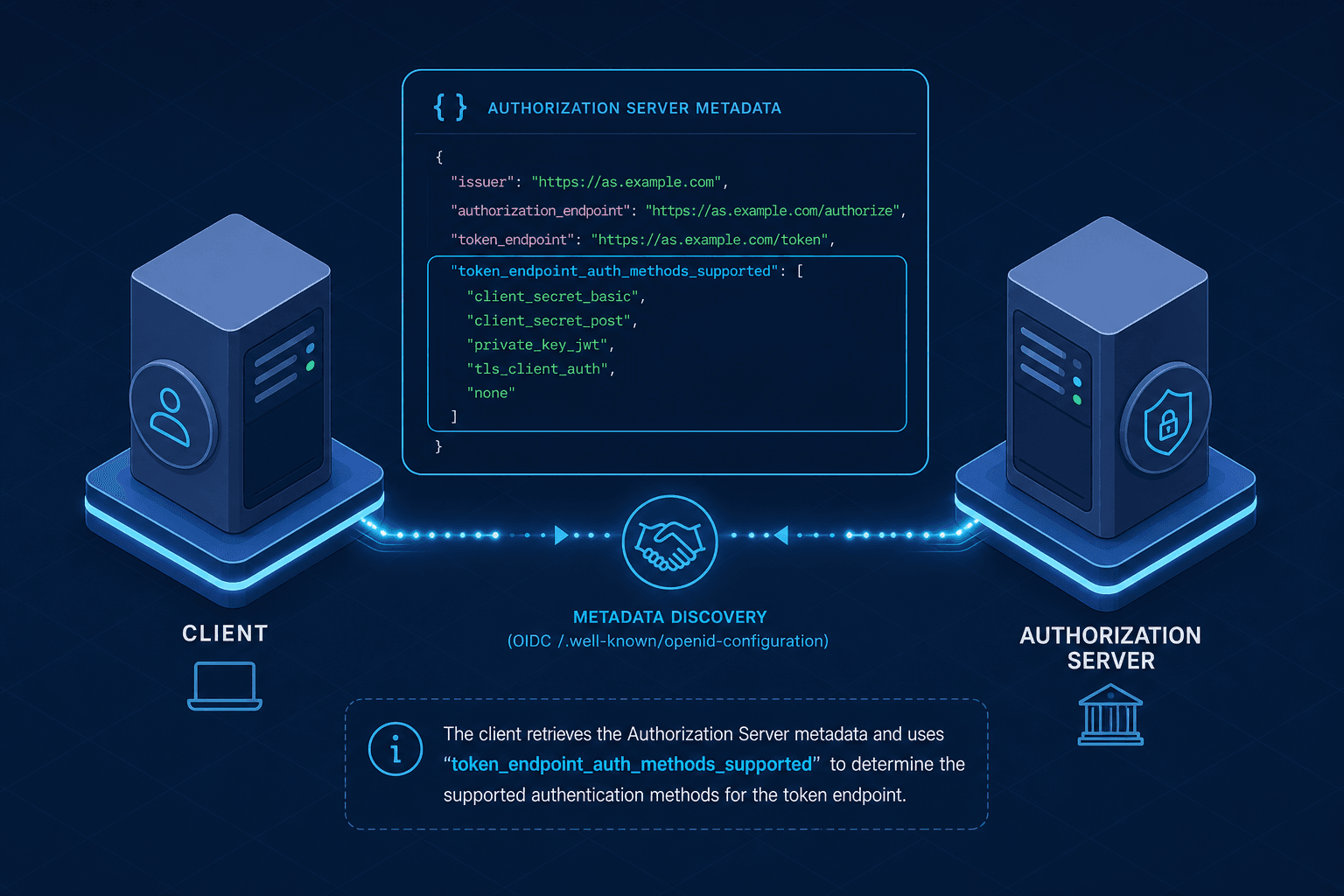
When a backend service integrates with an Identity Provider (IdP), it rarely asks how to authenticate. It assumes the library handles it. However, the negotiation of which authentication method to use is defined by a single metadata field: token_endpoint_auth_methods_supported. This field, defined in RFC 8414, is the first handshake between client and authorization server. It dictates the security posture of the entire exchange.
Most developers never read this field. They accept the default. And in many legacy configurations, that default is client_secret_basic. This post examines the mechanism of that default, why it persists, and why it is increasingly considered a security liability in modern infrastructure.
The Metadata Contract: Capability Negotiation
Before a client sends a token request, it must know what the Authorization Server (AS) accepts. RFC 8414 standardizes the discovery of this information via the token_endpoint_auth_methods_supported field in the AS Metadata document (typically fetched from /.well-known/openid-configuration).
The mechanism here is declarative capability negotiation. The AS publishes a JSON array of strings, such as:
{
  "token_endpoint": "https://auth.example.com/token",
  "token_endpoint_auth_methods_supported": [
    "client_secret_post",
    "client_secret_basic",
    "private_key_jwt"
  ]
}
The client must select one of these values. If the client sends a method not listed, the AS returns an invalid_client error response, which implementations typically map to 400 Bad Request, though 401 is sometimes used. This prevents silent failures where a client tries to send credentials in a way the server cannot parse, forcing an explicit agreement on the protocol.
Anatomy of client_secret_basic
client_secret_basic is the default authentication method inherited from OAuth 2.0 (RFC 6749). Its mechanism is straightforward but historically problematic.
The client constructs a string: client_id:client_secret. This string is Base64-encoded. The resulting value is placed in the HTTP Authorization header with the scheme Basic:
Authorization: Basic Y2xpZW50X2lkOmNsaWVudF9zZWNyZXQ=
The Logging Problem
The core issue is not the cryptography (there is none; it’s just Base64) but the data flow. In modern cloud architectures, HTTP requests pass through multiple intermediaries:
- Load Balancers (ALB/NLB): Often log request headers for health checks or access logs.
- CDNs (Cloudflare, Akamai): May log headers for WAF rules or analytics.
- API Gateways: Often capture headers for rate-limiting or tracing.
The Authorization header is frequently included in these logs unless explicitly scrubbed. Since client_secret_basic transmits the secret in every request, every intermediary that logs headers becomes a potential secret exfiltration point.
In contrast, client_secret_post places the secret in the request body:
POST /token HTTP/1.1
Host: auth.example.com
Content-Type: application/x-www-form-urlencoded

grant_type=authorization_code&code=AUTH_CODE&client_id=CLIENT_ID&client_secret=CLIENT_SECRET
While still risky (body logs exist), most modern logging systems are more aggressive about scrubbing POST bodies than headers, and edge devices are less likely to log full request bodies for performance reasons. However, neither method is ideal for robust client authentication.

The Alternatives: Moving Beyond Shared Secrets
RFC 8414 supports several methods. Understanding their mechanisms reveals why client_secret_basic is falling out of favor.
client_secret_post
As described, this uses the HTTP POST body. It is functionally identical to client_secret_basic in security posture (shared secret transmission) but avoids the header-logging risk. It is the minimal upgrade from the default.
private_key_jwt (Recommended)
This method uses asymmetric cryptography. The client signs a JWT (JSON Web Token) using a private key, and the AS verifies it using the public key.
{
  "alg": "RS256",
  "typ": "JWT",
  "jti": "unique-id",
  "iss": "client_id",
  "sub": "client_id",
  "aud": "https://auth.example.com/token",
  "exp": 1234567890,
  "iat": 1234567880
}
The signature is sent in the assertion parameter of the POST request. No shared secret is transmitted over the network. The private key never leaves the client. This eliminates the risk of secret exfiltration via logs entirely.
tls_client_auth
This method uses mutual TLS (mTLS). The client presents a certificate during the TLS handshake. The AS validates the certificate against a trusted list. No HTTP-level authentication parameters are needed. This is the most secure method for machine-to-machine communication.
Why Does client_secret_basic Remain the Default?
The persistence of client_secret_basic is a legacy artifact. RFC 6749 (OAuth 2.0) defined it as the primary method. RFC 8414 (AS Metadata) was published later (2018) to standardize discovery, but it inherited the common practices of the time.
Many IdPs list client_secret_basic first in the token_endpoint_auth_methods_supported array because it is the most widely supported by older libraries. However, listing order does not imply endorsement. The RFC explicitly states:
"The order of the values is not significant." (RFC 8414, Section 2)
Yet, many SDKs and libraries iterate through the list and pick the first available method. If client_secret_basic is first, it is chosen. This creates a default trap where security-conscious developers must explicitly override the library’s behavior to avoid logging risks. While client_secret_post is often listed alongside it, the inertia of basic auth remains strong.
Best Practices for Backend Engineers
- Inspect the Metadata: Never assume a method. Fetch
/.well-known/openid-configurationand verifytoken_endpoint_auth_methods_supported. - Prefer Asymmetric Auth: Use
private_key_jwtortls_client_authfor all service-to-service authentication. These methods do not transmit shared secrets. - Avoid
client_secret_basic: If you must use a shared secret, preferclient_secret_post. But better yet, migrate away from shared secrets entirely. - Scrub Headers: If you are stuck with
client_secret_basic, ensure your load balancer, CDN, and API gateway are configured to strip or redact theAuthorizationheader from logs. This is a mitigation, not a fix.
By following these steps, you can enhance the security of your backend systems and ensure robust client authentication protocols are in place.
Conclusion
The token_endpoint_auth_methods_supported field is not just a list of options; it is a security policy declaration. The default method, client_secret_basic, persists due to legacy inertia, not security merit. Its mechanism—Base64-encoding secrets in HTTP headers—creates unnecessary exposure in modern logging infrastructures. Backend engineers must actively choose stronger methods like private_key_jwt to align with current best practices and reduce the attack surface of their authentication flows.
The future of client authentication is moving away from shared secrets altogether. By understanding the mechanism of these methods, you can make informed choices that protect your secrets from the very infrastructure designed to monitor your traffic.
Related posts
OpenID Connect Guide: Extending OAuth 2.0 for Identity Verification
An examination of OpenID Connect (OIDC) and how it extends OAuth 2.0 to handle identity verification using ID tokens and discovery protocols.
Implementing and Validating Discovery in Your Client
A technical walkthrough for backend developers on implementing OAuth 2.1 discovery, issuer validation, and strict discovery document validation using OpenIDConnectConfigurationRetriever.
Securing gRPC with OAuth2 Token Propagation in Microservices
A guide to securing gRPC services using OAuth2 token propagation and interceptors for reliable microservice communication.