Implementing Identity Governance with Custom Policy Engines
An examination of implementing identity governance using custom policy engines like OPA, Cedar, and XACML for policy-as-code.
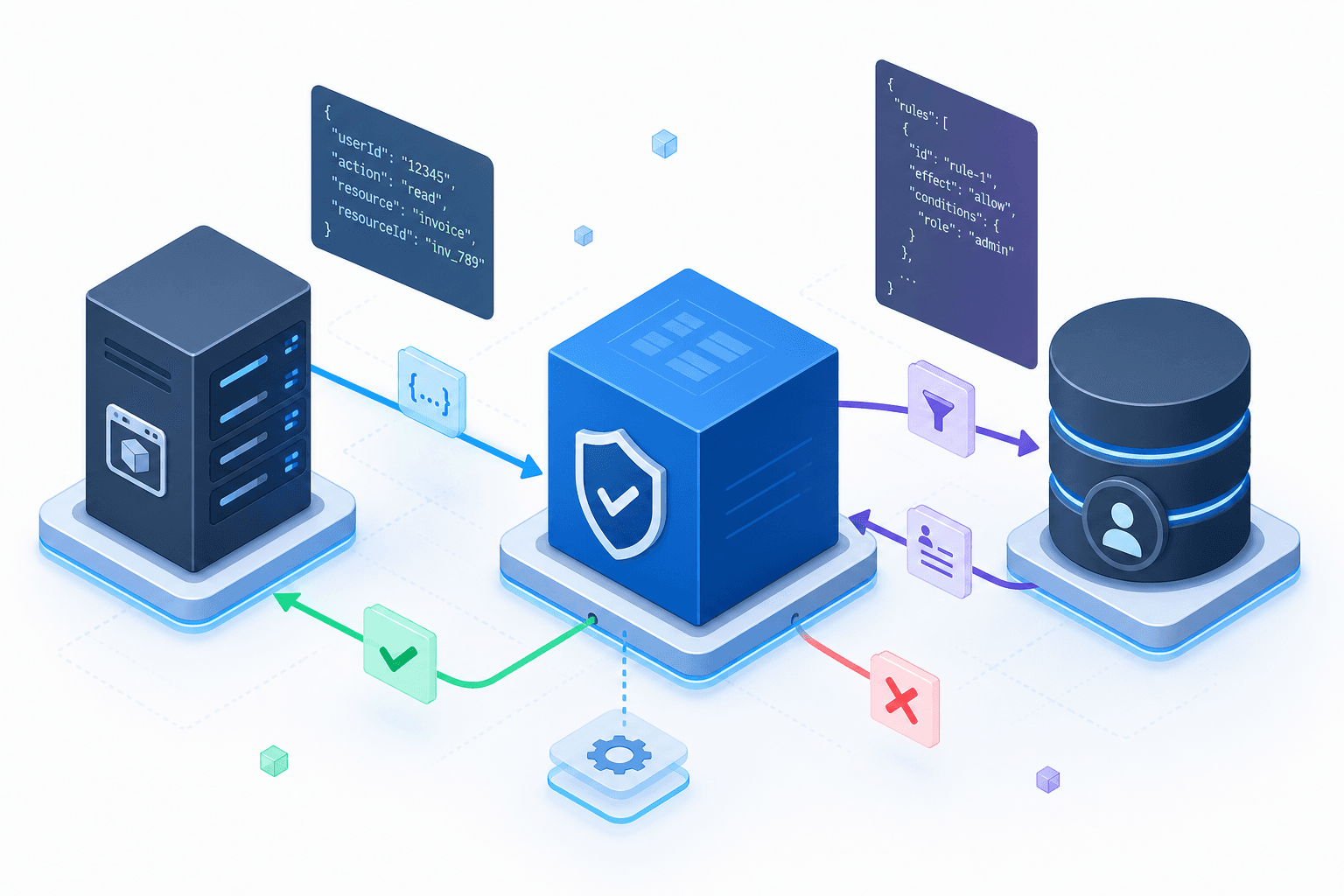
The fundamental friction in legacy identity governance stems from tightly coupling access logic within application code. Hardcoding checks like if (user.role == 'admin') creates a rigid cycle of modification and deployment whenever governance requirements shift. Custom policy engines resolve this by introducing a distinct execution layer between the application and the identity store. The mechanism is straightforward: the application acts as a requester sending a structured query to a decision engine, which returns an allow or deny based on declarative rules. This architecture effectively decouples the policy from the application. [RFC 8391]
The Mechanism of Separation
Decoupling the decision from the request allows policy engines to evaluate attributes—such as user identity, resource sensitivity, and environmental context—against declarative rules without recompiling application binaries. In this model, the application becomes a stateless client that constructs a JSON payload containing the necessary context variables. It sends this payload to the policy engine via a standardized API call. The engine then loads the relevant policies and data into its evaluation context, traverses the logic graph, and returns a decision.
Consider a scenario involving a developer named Alex, who is building a microservice for a financial platform. Alex needs to ensure that only users from the "Audit" group can view transaction logs, but only if the request originates from the internal network. In a traditional model, Alex writes conditional logic directly in the Go handler. With a custom policy engine like Open Policy Agent (OPA), Alex defines the logic in a Rego file. The application no longer contains the condition; it simply constructs a JSON request containing the user's ID, the target resource ID, and the source IP.
package audit.access

import future.keywords.in
import future.keywords.if
import future.keywords.then

allow {
    input.user.group == "Audit"
    input.source_ip in ["10.0.0.0/8", "192.168.1.0/24"]
}
In this workflow, the Go service serializes the context into a JSON payload and POSTs it to the OPA endpoint. The OPA server loads the Rego policy and the external data (user groups, IP ranges) into its evaluation engine. The engine traverses the data graph, matches the input against the rules, and returns a decision. If the user is not in the Audit group, the rule fails, and OPA returns false. The critical mechanism here is that the policy engine maintains a cache of data and policies. When the identity provider updates a user's group membership, the application does not need to restart. The next request simply pulls the updated data context, and the engine re-evaluates against the existing rules. This reduces the blast radius of identity changes from "system-wide outage risk" to "configuration update."
Open Policy Agent Implementation
While OPA offers flexibility, it relies on a flexible schema and a Turing-complete language, which can lead to complex, non-deterministic policies if not carefully managed. OPA's Rego language allows for deep data traversal and arbitrary logic, making it suitable for complex, data-driven governance scenarios. However, this power requires discipline to prevent logic errors that might only surface at runtime. [OPA Documentation]
Cedar's Formal Approach
This is where Cedar introduces a different mechanism: formal verification through a strict type system. Cedar is designed specifically for authorization and enforces a "no implicit conversion" rule. In a worked scenario, imagine a policy engineer, Sam, writing a policy for a cloud storage service. Sam defines a principal (the user) and an action (read/write). Cedar's compiler checks the policy before it is even deployed. If Sam attempts to compare a string user ID against an integer resource ID, the compilation fails immediately because the types do not match exactly.
permit (
    principal,
    action,
    resource
) when {
    principal.hasRole("Admin") && resource.region == "us-east-1"
};
The mechanism here is static typing enforced at the policy definition stage. Unlike OPA, where you might write a rule that works in one context but breaks in another due to type coercion, Cedar guarantees that all policy expressions are well-typed. This prevents a class of errors where a policy inadvertently grants access because a string "100" was treated as equal to an integer 100. For identity governance, this is crucial because governance policies often involve complex hierarchies and attribute constraints. Cedar's approach ensures that the "decision" logic is mathematically sound, reducing the risk of policy drift over time. However, this strictness comes with a tradeoff: Cedar policies are less expressive for arbitrary data transformations than Rego, requiring a more disciplined data modeling upfront. [Cedar Specification]
XACML Legacy Integration
For organizations with deep investments in XACML (eXtensible Access Control Markup Language), the mechanism of integration shifts from native implementation to translation. XACML relies on a verbose XML structure to define policies, rules, and obligations. A legacy system might define a policy where a user can access a document only if the "Time" attribute is between 9 AM and 5 PM. In a modern custom engine, this XML is parsed, normalized, and mapped to a JSON-like internal representation. The mechanism here is the "Request/Response" pattern defined in the XACML standard, which maps directly to the OPA/Cedar request/response model. However, the parsing overhead of XML is significant compared to JSON.
<Request>
  <Subject>
    <Attribute AttributeId="urn:oid:2.5.4.3">
      <AttributeValue>alice@example.com</AttributeValue>
    </Attribute>
  </Subject>
  <Resource>
    <Attribute AttributeId="urn:oid:2.5.4.3">
      <AttributeValue>report.pdf</AttributeValue>
    </Attribute>
  </Resource>
  <Action>
    <Attribute AttributeId="urn:oasis:names:tc:xacml:3.0:action:action-type">
      <AttributeValue>read</AttributeValue>
    </Attribute>
  </Action>
</Request>
When implementing this, the custom engine must act as a bridge. It accepts the XACML XML, deserializes it into an internal object graph, evaluates the logic using the modern engine's rules, and then serializes the result back to an XACML response. This adds latency but preserves compatibility with existing identity providers that only speak XACML. The decision to adopt a custom engine like OPA or Cedar over XACML usually hinges on the complexity of the governance requirements. If the governance logic requires dynamic attribute evaluation (e.g., "allow if the user's location matches their department's HQ"), a custom engine with a rich query language is superior. If the requirement is purely hierarchical and static, the overhead of a custom engine might not be justified. [XACML 3.0 Spec]
Operational Considerations and Tradeoffs
The operational cost of maintaining a custom policy engine is the primary tradeoff. Unlike a static code check, the policy engine becomes a critical dependency. If the engine goes down, the application cannot make authorization decisions. To mitigate this, "fail-open" or "fail-closed" behavior must be explicitly configured. In most identity governance scenarios, the default should be "fail-closed": if the policy engine is unreachable, deny access. This prevents a denial-of-service attack on the governance layer from inadvertently granting access to sensitive resources. Engines often cache decisions for short durations to reduce load, but this introduces staleness. Balancing performance and freshness depends on the volatility of the identity data.
Conclusion
Custom policy engines represent a paradigm shift in identity governance, moving the locus of control from the application codebase to a dedicated, decoupled service layer. By leveraging tools like OPA, Cedar, and XACML integration patterns, organizations can achieve dynamic, context-aware access control that adapts rapidly to changing business needs. Whether prioritizing the flexibility of Rego, the formal safety of Cedar, or the compatibility of XACML, the core mechanism of separating policy logic from application code remains the foundation of modern, scalable identity governance.
Common Pitfalls
- Neglecting Policy Versioning: Failing to version policies leads to configuration drift and makes rollback impossible when a new rule breaks an existing workflow.
- Over-Caching Decisions: Caching decisions for too long without invalidation strategies can result in stale access grants if identity attributes change rapidly.
- Ignoring Contextual Data: Relying solely on user attributes without passing sufficient environmental context (like IP range or time) renders policies ineffective against dynamic threats.
Practical Takeaways
- Decoupling is Key: Separating policy logic from application code reduces deployment risk and accelerates governance updates.
- Type Safety Matters: Using engines like Cedar with strict typing prevents subtle logic errors that are hard to debug in loose schemas like Rego.
- Fail-Safe Defaults: Always configure policy engines to deny access by default when the service is unavailable to prevent security breaches.
FAQ
Q: Can I mix OPA and Cedar in the same infrastructure? A: Yes, but it requires an abstraction layer or gateway to normalize requests and responses between the two different engines, as they use distinct query languages and data models.
Q: Does a custom policy engine add significant latency? A: There is a small latency overhead for the API call and evaluation, but this is often mitigated by local caching and optimized engine configurations, making it negligible for most use cases.
Q: How do I handle complex hierarchical permissions in OPA? A: OPA excels at this through its flexible data traversal capabilities, allowing you to define recursive rules that traverse organizational hierarchies dynamically without hardcoding paths.
Related posts
Implementing Entitlement Management for Fine-Grained Authorization
An examination of entitlement management and fine-grained authorization using XACML and policy engines for secure access control.
RBAC vs ABAC: Static Roles vs. Dynamic Attributes
A detailed examination of Role-Based Access Control versus Attribute-Based Access Control, covering OPA, XACML, and authorization strategies.
Implementing Conditional Access Policies with Keycloak and ForgeRock
A technical examination of implementing conditional access policies using Keycloak and ForgeRock for context-aware access control.