Implementing Entitlement Management for Fine-Grained Authorization
An examination of entitlement management and fine-grained authorization using XACML and policy engines for secure access control.
Implementing Entitlement Management for Fine-Grained Authorization
Traditional Role-Based Access Control (RBAC) fails when permissions must change based on time, location, or data sensitivity. To solve this, we shift from static assignments to dynamic evaluation. The core mechanism constructs a queryable state where every access attempt is evaluated against logical rules defined by attributes. This is the essence of Entitlement Management: the systematic definition, storage, and evaluation of permissions based on the intersection of subject, resource, and environmental attributes.
The Anatomy of an Entitlement
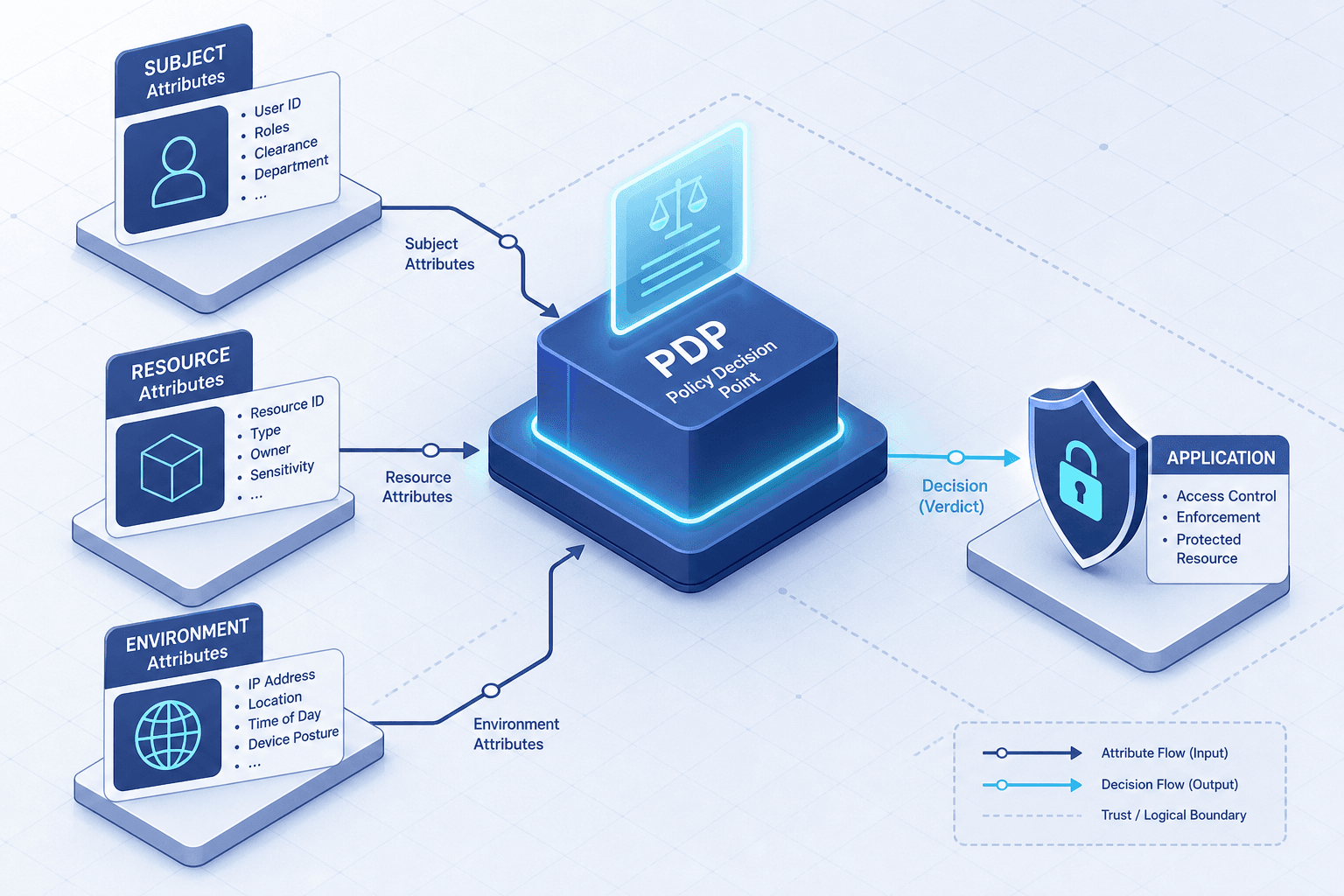
An entitlement is not a property of a user; it is a derived state. In a robust system, a user is identified by a Subject context containing attributes like department, clearanceLevel, and employeeStatus. A resource is identified by a Resource context containing attributes like dataType, classification, and owner. The environment provides Action and Context attributes such as timeOfDay, ipAddress, and deviceType.
The mechanism of fine-grained authorization evaluates a policy rule against these three contexts. If the rule states "Allow access if clearanceLevel >= resource.classification AND timeOfDay is within business hours," the system does not check a static list. It computes the truth value of that expression in real-time. This allows for "attribute-based access control" (ABAC), where the entitlements are generated dynamically rather than pre-assigned.
The critical distinction in implementation is separating the policy (the logic) from the enforcement (the code). If you hardcode if (user.isAdmin) into your application logic, you create a tight coupling that is brittle and hard to audit. Instead, the application must construct a request and send it to a Policy Decision Point (PDP). The PDP is a stateless service that holds the policies but knows nothing about the application's business logic, only the abstract attributes.
XACML: The Language of Exchange
To ensure the PDP can evaluate policies regardless of the application's language or architecture, we need a standardized protocol. eXtensible Access Control Markup Language (XACML) serves this purpose. It is an OASIS standard that defines how to structure the request sent to the PDP and the response returned.
Consider a scenario where a client application needs to determine if a user can read a specific file. The application constructs an XACMLRequest. This request is an XML document containing the Subject attributes, the Resource attributes, the Action (e.g., read), and the Environment attributes. The PDP receives this request, parses the XML, and matches the attributes against the loaded policies.
A policy in XACML is defined using the XACML Policy Definition Language. It consists of Rules which contain Conditions. These conditions are written in a specific expression language (often XPath or XQuery based) that evaluates the boolean logic. For example, a rule might look like this:
<Rule Effect="Permit" RuleId="rule-1">
  <Condition>
    <Apply FunctionId="urn:oasis:names:tc:xacml:3.0:function:integer-greater-than-or-equal">
      <Apply FunctionId="urn:oasis:names:tc:xacml:3.0:function:integer-one-and-only">
        <AttributeValue DataType="http://www.w3.org/2001/XMLSchema#integer">5</AttributeValue>
      </Apply>
      <Apply FunctionId="urn:oasis:names:tc:xacml:3.0:function:integer-one-and-only">
        <SubjectAttributeDesignator AttributeId="clearanceLevel" DataType="http://www.w3.org/2001/XMLSchema#integer"/>
      </Apply>
    </Apply>
  </Condition>
</Rule>
When the PDP evaluates this, it extracts the clearanceLevel from the request context, compares it to the literal 5, and returns a boolean. The result is then wrapped in an XACMLResponse. The response contains a Result element with a Status code. The possible verdicts are Permit, Deny, Indeterminate (if data was missing), or NotApplicable (if no rule matched).
This separation ensures that the application code only needs to know how to parse the XML response, while the security logic resides entirely within the policy engine.
The Evaluation Loop: A Worked Scenario
To understand the flow, imagine a specific actor: Alice, a Data Analyst. She attempts to access a file named Q4_Financials.xlsx hosted on the InternalServer. The request originates from her laptop at 8:00 PM on a Friday.
The application intercepts the request and gathers attributes:
- Subject:
Alice,Role: Analyst,Clearance: Level 3. - Resource:
Q4_Financials.xlsx,Classification: Confidential,Owner: CFO. - Action:
Read. - Environment:
Time: 20:00,Day: Friday,Location: Remote.
The application sends this context to the PDP via an XACML request. The PDP loads its policies. One policy might state: "Confidential resources can only be read by users with Clearance Level 4." Another policy might state: "Confidential resources cannot be accessed after 18:00 on Fridays."
The PDP evaluates the first rule. Level 3 is not greater than or equal to Level 4. This rule does not trigger a Permit. The PDP moves to the second rule. 20:00 is greater than 18:00. This rule triggers a Deny.
The PDP aggregates the results. In XACML 3.0, the default combining algorithm is "Deny Overrides," meaning if any rule matches and evaluates to Deny, the final result is Deny. The PDP returns the response. The application receives the Deny verdict and blocks the file download.
Crucially, if a third rule existed saying "CFO can always access their own files," the PDP would still return Deny if both the time restriction rule and the owner exception rule matched. The "Deny Overrides" algorithm aggregates all matching rules; it does not inherently prioritize specific rule types over others. If one rule permits and another denies, the denial takes precedence. This mechanism allows administrators to layer restrictions without fear of accidental overrides.
Operational Tradeoffs and Implementation
Implementing this architecture introduces specific operational realities. The primary tradeoff is complexity versus flexibility. You must maintain a policy store, a PDP, and potentially a Policy Administration Point (PAP) for managing policies. This adds latency to every request because the application must now perform a network call (or at least a service call) to the PDP.
For high-throughput systems, parsing XML and evaluating complex XPath expressions can become a bottleneck. Opinion: If your latency requirements are sub-millisecond and your policies are relatively simple, a dedicated XACML engine might be overkill compared to a lightweight engine like Open Policy Agent (OPA), which uses the Rego language and avoids the overhead of XML parsing. However, for regulated industries where audit trails and strict standardization are mandatory, XACML remains the gold standard due to its maturity and compliance certifications.
Another consideration is the "Entitlement Cache." Since evaluating policies for every request is expensive, many systems cache the result of a policy evaluation for a short duration, keyed by the specific combination of attributes. However, this introduces a risk: if a user's clearance level changes in the identity provider, the cache might serve a stale Permit until it expires. To mitigate this, you must ensure that attribute updates trigger immediate invalidation of the cache or use a very short TTL.
Finally, the complexity of writing policies can be a barrier. Unlike code, policies are often written by security architects rather than developers. The learning curve for XACML's expression language is steep. It is often necessary to build a layer of abstraction on top of XACML to allow non-technical stakeholders to define policies using natural language or form-based inputs, which then compile down to the standard XACML format.
Conclusion
Fine-grained authorization is not a feature you toggle on; it is an architectural pattern that shifts the locus of control from the application to the policy engine. By leveraging XACML, you create a standardized mechanism for exchanging context and receiving decisions, allowing your application to remain agnostic to the specific security rules. The mechanism works by decoupling the "who" (subject), "what" (resource), and "when" (environment) into a unified evaluation loop. While this introduces latency and complexity, it provides the only viable path to managing the dynamic, context-sensitive entitlements required in modern, secure software ecosystems.
Common Pitfalls
Implementing entitlement management often leads to specific failure modes if not carefully planned:
- Over-Caching: Caching policy decisions without considering attribute volatility can lead to security breaches where a revoked clearance remains valid until the cache TTL expires.
- Policy Sprawl: Without a clear governance model, policies can become an unmaintainable web of exceptions, making it difficult to audit who has access to what.
- Performance Bottlenecks: Failing to optimize the PDP for high-volume requests can introduce unacceptable latency, causing the authorization layer to become a system-wide choke point.
Practical Takeaways
To successfully deploy fine-grained authorization:
- Start with Attributes: Define your subject, resource, and environment attributes clearly before writing a single line of policy logic.
- Separate Concerns: Ensure your application code never contains hardcoded access checks; delegate all decisions to the PDP.
- Plan for Evolution: Design your policy store and administration tools to handle changes without requiring code redeployments.
FAQ
Q: Is XACML the only standard for fine-grained authorization? A: No. While XACML is the most mature OASIS standard, other approaches like Open Policy Agent (OPA) with Rego or JSON-based policies are gaining traction for their simplicity and performance in cloud-native environments.
Q: How do I handle performance issues with XML parsing? A: Consider using binary encodings if supported by your PDP, switching to a more efficient protocol like JSON for internal microservices, or implementing aggressive caching strategies with short TTLs.
Q: Can I mix XACML with custom logic? A: Yes, but it is generally recommended to keep the policy evaluation pure within the PDP. Custom logic should be handled by extending the PDP's decision capabilities or by post-processing the PDP's response, rather than embedding custom checks in the application code.
Related posts
Implementing Conditional Access Policies with Keycloak and ForgeRock
A technical examination of implementing conditional access policies using Keycloak and ForgeRock for context-aware access control.
Implementing Identity Governance with Custom Policy Engines
An examination of implementing identity governance using custom policy engines like OPA, Cedar, and XACML for policy-as-code.
RFC 8693: Token Exchange, Delegation, and Impersonation
RFC 8693 defines token exchange, delegation, and impersonation mechanisms for OAuth 2.0, enabling secure identity propagation across service boundaries.