RBAC vs ABAC: Static Roles vs. Dynamic Attributes
A detailed examination of Role-Based Access Control versus Attribute-Based Access Control, covering OPA, XACML, and authorization strategies.
The Mechanism of Control: Static Roles vs. Dynamic Attributes
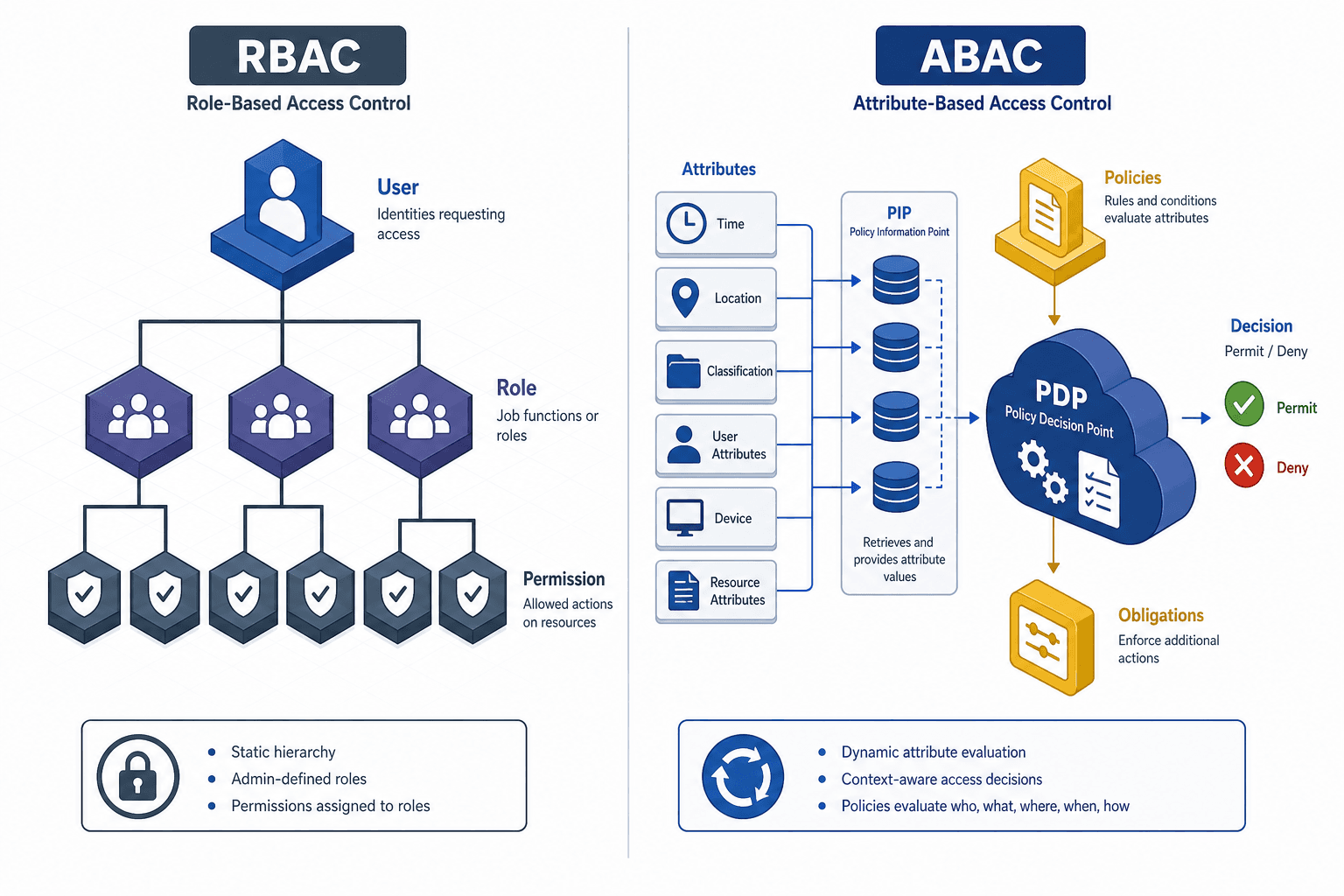
Access control is not a single switch; it is a decision engine. The fundamental difference between Role-Based Access Control (RBAC) and Attribute-Based Access Control (ABAC) lies in how they resolve the query: "Can User A perform Action B on Resource C?" RBAC resolves this by looking up a static mapping between a user and a set of permissions defined by their job function. ABAC resolves this by evaluating a logical expression against the current state of the user, the resource, and the environment.
To understand the mechanism, consider a scenario where a developer needs to delete a database record. In an RBAC model, the system checks if the user holds the db-admin role. If yes, the action is permitted. If no, it is denied. This is a binary lookup in a role-to-permission table. The mechanism assumes that if a person has the role, they should have the permission regardless of when or where they act.
In contrast, an ABAC model does not check roles at all. It checks attributes. The request carries attributes: user.department = "Engineering", resource.classification = "Production", time = "2023-10-27T14:00:00Z". The policy engine evaluates a rule like: allow if user.department == "Engineering" AND resource.classification == "Production" AND time < "2023-10-27T17:00:00Z". The mechanism here is predicate evaluation, not table lookup.
The RBAC Triplet and Its Limits
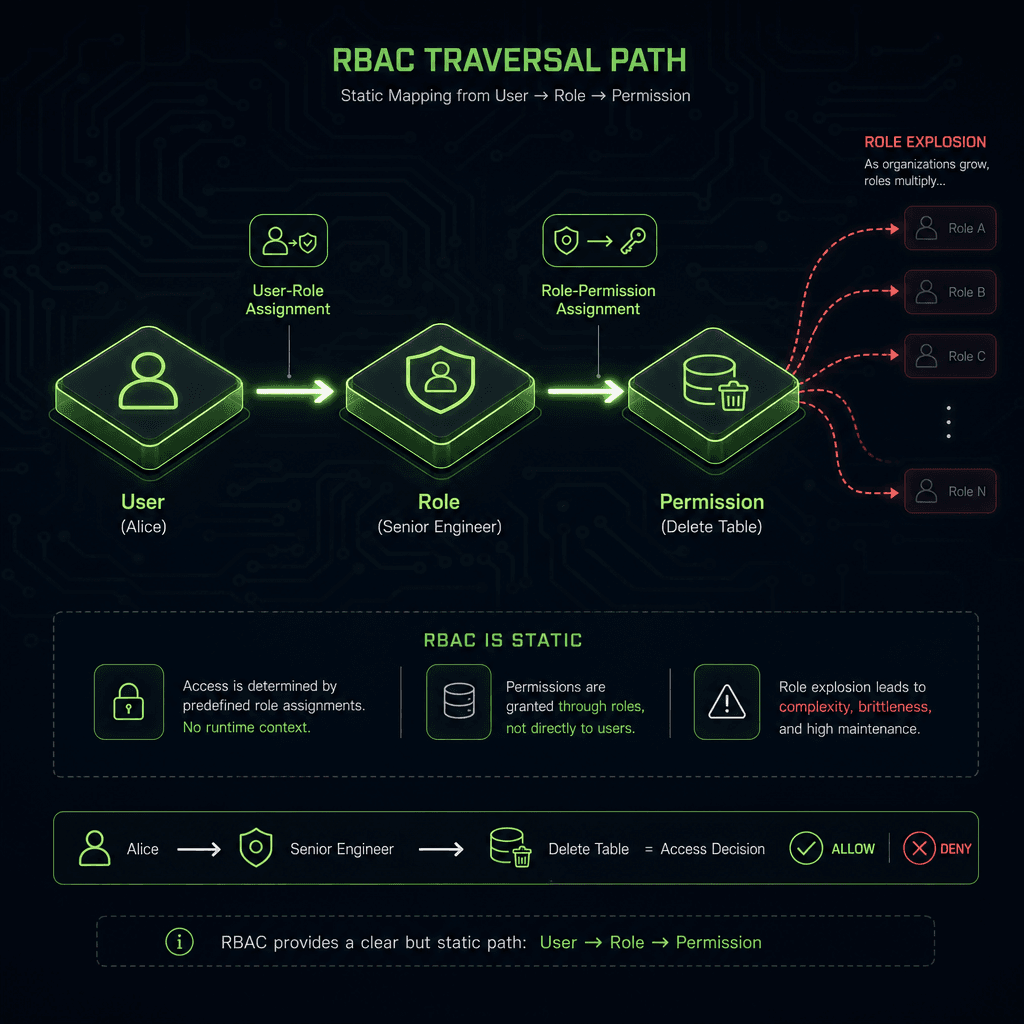
RBAC was standardized by NIST to address the complexity of managing individual user permissions. The core data model relies on three sets: Users (U), Roles (R), and Permissions (P). The relationships are defined by two mappings: User-Role Assignment (UA) and Role-Permission Assignment (PA). When a request arrives, the system traverses this graph: User -> Role -> Permission.
Consider an actor named Alice, a "Senior Engineer." She is assigned the senior-engineer role. This role is assigned the permission delete:production:table. When Alice attempts to delete a row at 2:00 AM, the RBAC engine finds the path: Alice -> senior-engineer -> delete:production:table. The decision is "Allow."
The limitation of this mechanism becomes apparent when business logic requires context. Suppose the company policy states: "Senior Engineers can delete production data, but only during business hours." In pure RBAC, you cannot encode "business hours" into the role. You would need to create a new role, senior-engineer-daytime, and assign it to Alice. If you need another constraint, like "only from the corporate network," you create senior-engineer-daytime-corp.
This leads to the "role explosion" problem. If you add five contextual constraints, the number of required roles grows exponentially. The mechanism breaks because RBAC treats permissions as intrinsic properties of the role, not emergent properties of the context.
The ABAC Predicate Engine
ABAC decouples the decision logic from the identity hierarchy. Instead of roles, every entity—user, resource, action, and environment—is a collection of attributes. A user has title, department, clearance_level. A resource has sensitivity, owner, region. An action has method, target.
The enforcement mechanism relies on a Policy Decision Point (PDP). The PDP receives a request containing the subject, action, and resource attributes. It queries a Policy Information Point (PIP) to retrieve any missing attributes (e.g., fetching the user's current IP address or the resource's classification tag). Finally, it evaluates the policy rules against these attributes.
Let's look at a concrete implementation using Open Policy Agent (OPA) with the Rego language. Unlike XACML, which uses verbose XML, OPA uses a declarative logic language that evaluates to true or false. While OPA can evaluate role attributes, strict ABAC logic relies on predicates rather than structural role assignments.
package auth

default allow = false

# Rule: Allow if user department is Engineering and resource is Production
# AND the current hour is between 9 and 17.

allow {
    input.user.department == "Engineering"
    input.resource.classification == "production"
    input.time.hour >= 9
    input.time.hour < 17
}

# Rule: Allow if user is the owner of the resource
allow {
    input.user.id == input.resource.owner_id
}
In this scenario, the PDP does not ask "Does Alice have the admin role?" It asks "Do the attributes of this request satisfy the allow rule?" If Alice tries to access the resource at 18:00, the input.time.hour < 17 predicate fails, and the rule returns false. The mechanism handles the constraint dynamically without creating a new role.
XACML vs. OPA: The Implementation Layer
Historically, ABAC was standardized via the OASIS eXtensible Access Control Markup Language (XACML). XACML defines a rigid architecture: the PDP, Policy Enforcement Point (PEP), Policy Administration Point (PAP), and PIP. Policies are written in XML.
While XACML provides a standardized syntax for describing policies, its verbosity makes it difficult to author and debug. A simple "allow if department is Sales" rule requires dozens of XML tags defining namespaces, profiles, and attribute identifiers. The parsing overhead is significant, and the feedback loop for developers is slow.
OPA represents a modern evolution of the ABAC mechanism. It decouples the policy engine from the application runtime, often running as a sidecar or a dedicated service. OPA uses Rego, a logic-based language that is Turing-complete and optimized for high-performance evaluation.
The architectural difference is critical. In XACML, the policy engine is often a monolithic component that must be tightly integrated with the application server. In OPA, the policy is stateless. The application sends a JSON request to the OPA endpoint, and OPA returns a decision. This allows the same policy logic to be reused across microservices, APIs, and Kubernetes clusters without rewriting the enforcement layer.
Operational Tradeoffs and Strategy
Choosing between RBAC and ABAC is a tradeoff between operational simplicity and granular expressiveness.
RBAC is superior when your organization has clear, stable job functions and low frequency of context-based changes. If a "Manager" always needs "Approve" permissions, and those permissions never change based on time or location, RBAC is the correct mechanism. It is easier to audit: "Who has the Manager role?" yields a definitive list.
ABAC is necessary when your security requirements depend on dynamic context. If you need to restrict access based on the user's geo-location, the sensitivity of the file being accessed, or the time of day, RBAC cannot scale. However, ABAC introduces complexity in attribute management. You must ensure that every resource has a classification tag, and every user has a department attribute populated in your Identity Provider (IdP). If these attributes are missing or stale, the ABAC engine might deny valid requests (false negatives) or, worse, allow invalid ones if the default policy is misconfigured.
Opinion: For most modern cloud-native infrastructures, a hybrid approach is optimal. Use RBAC for coarse-grained access (e.g., "All developers can read the staging environment") and ABAC for fine-grained, high-risk actions (e.g., "Only developers in the Security team can modify production secrets").
Common Pitfalls
Implementing these models often leads to specific failure modes if not carefully managed.
- Role Explosion in RBAC: As noted earlier, adding context to RBAC creates a combinatorial explosion of roles. Organizations often end up with hundreds of narrowly scoped roles (e.g.,
dev-prod-daytime-corp) that are difficult to maintain and prone to drift. - Stale Attributes in ABAC: ABAC relies entirely on the freshness of attributes. If a user's department changes in the IdP but the attribute sync is delayed, the ABAC engine may incorrectly deny access or grant permissions based on outdated data.
- Policy Maintenance Complexity: While OPA simplifies syntax, complex logic can become a "spaghetti code" nightmare. Without strict version control and testing for Rego policies, changes can inadvertently break access for large groups of users.
Practical Takeaways
When deciding on your strategy, consider these key differentiators:
- Choose RBAC when your access patterns are stable, roles are clearly defined, and auditability of "who has what role" is the primary concern.
- Choose ABAC when access decisions must change dynamically based on real-time context (time, location, resource sensitivity) that cannot be captured by static roles.
- Choose Hybrid for most cloud environments, using RBAC for broad group management and ABAC for protecting high-value assets or handling sensitive operations.
FAQ
Can I use both RBAC and ABAC? Yes, this is known as a hybrid model. You can use RBAC to assign broad permissions to a group (e.g., "Developers") and then use ABAC policies to refine those permissions based on specific attributes (e.g., "Only Developers in the 'Security' team can access Production Secrets").
Does OPA replace XACML? OPA is not a direct replacement for XACML but rather a modern alternative. XACML remains a standard for enterprise interoperability, while OPA offers better performance and developer experience for cloud-native environments. They serve similar architectural purposes but differ significantly in implementation and language.
How do I handle role attributes in ABAC?
In ABAC, roles are treated as just another attribute (e.g., user.role = "Senior Engineer"). You do not traverse the role hierarchy. Instead, you write policies that check the value of the role attribute alongside other attributes like department or clearance_level to make a decision.
Conclusion
The mechanism of access control dictates how your infrastructure responds to requests. RBAC relies on a static graph of roles and permissions, which is efficient but rigid. ABAC relies on a dynamic evaluation of predicates against attributes, which is flexible but requires rigorous attribute governance.
When implementing ABAC, the choice of tool matters. XACML provides a standard but is often too heavy for microservices. OPA offers a performant, code-driven approach to ABAC that fits the cloud-native paradigm. The decision is not merely about which acronym to use; it is about whether your security model needs to be a fixed map or a living logic engine.
Related posts
Implementing Attribute-Based Access Control (ABAC) with Spring Security
A technical guide on implementing attribute-based access control (ABAC) using Spring Security and Open Policy Agent for dynamic policy enforcement.
Implementing Identity Governance with Custom Policy Engines
An examination of implementing identity governance using custom policy engines like OPA, Cedar, and XACML for policy-as-code.
Least Privilege in Practice
A practical guide to implementing least privilege in AWS using IAM Access Analyzer, policy generation, and condition keys for secure access management.