Healthcare Identity Management: HIPAA Compliance & IAM
An examination of healthcare identity management, HIPAA compliance requirements, and IAM strategies for securing EHR access and patient identity.
The Architecture of Trust: Mechanisms of HIPAA-Compliant IAM
The core misunderstanding in healthcare security is treating Identity and Access Management (IAM) as a compliance checklist rather than a data-flow control system. HIPAA's Security Rule (45 CFR § 164.312) does not simply demand that "access is restricted"; it mandates specific technical safeguards that operate at the protocol level. The "Access Control" standard is an enforcement mechanism for the "Minimum Necessary" rule. When a clinician queries an Electronic Health Record (EHR), the system must evaluate a dynamic set of attributes against the data's sensitivity level before a single byte of Protected Health Information (PHI) is decrypted and transmitted to the client.
Unique Identification and the Failure of Shared Credentials in Healthcare IAM
The foundational mechanism of HIPAA compliance is the requirement for unique user identification (45 CFR § 164.312(d)). In a hospital environment, the temptation to use shared credentials—such as a generic "NurseStation1" account—is a direct violation of this rule because it severs the causal link between the action and the actor. If a breach occurs, the audit log cannot distinguish which individual performed the unauthorized query.
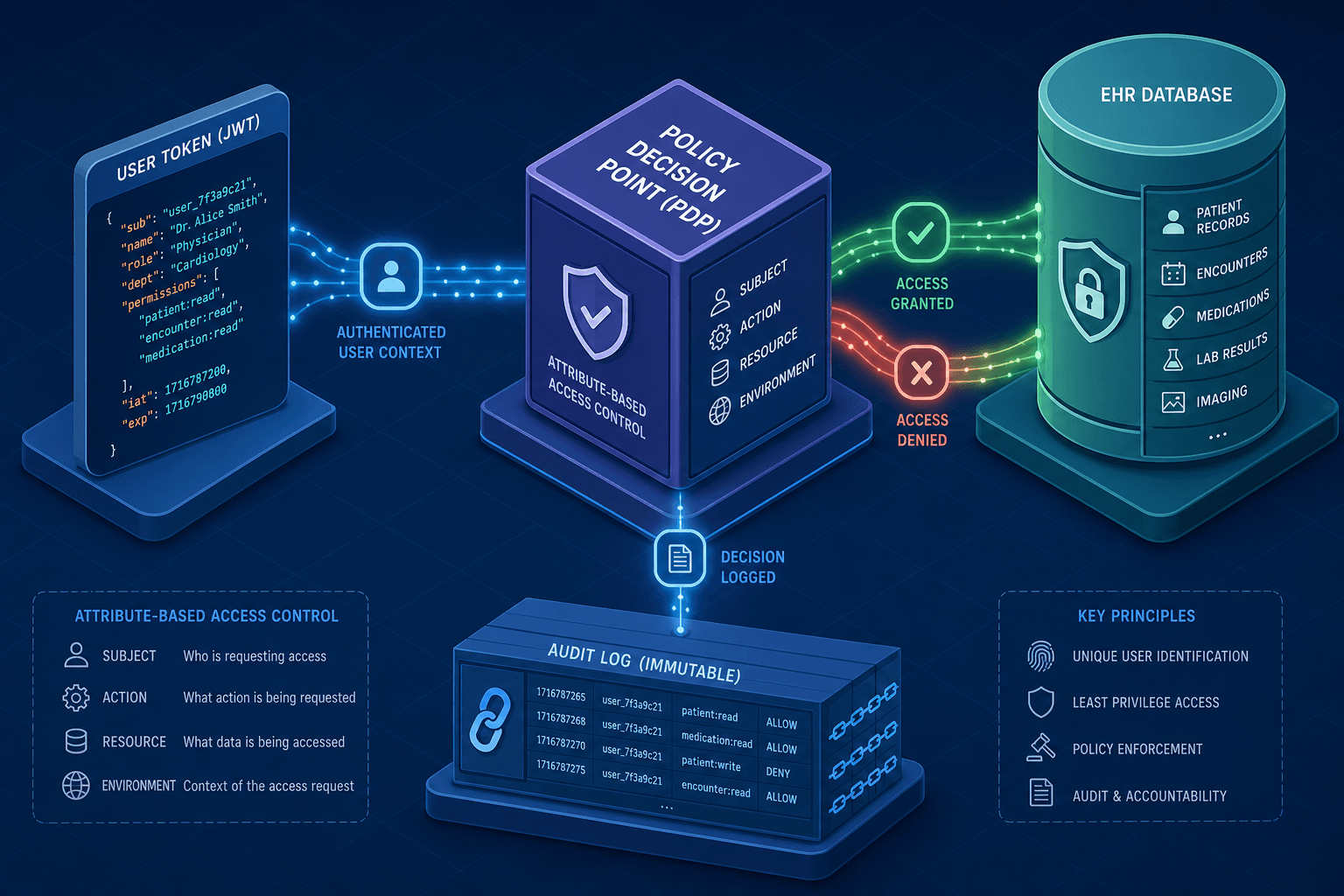
Technically, this requires the IAM system to enforce a one-to-one mapping between a cryptographic identity and a logical user ID. Consider a scenario involving Dr. Aris and Nurse Ben. In a compliant architecture, Dr. Aris authenticates using a certificate bound to his hardware token or biometric. The Identity Provider (IdP) issues a JSON Web Token (JWT) containing a sub (subject) claim unique to Dr. Aris. When this token reaches the EHR API Gateway, the gateway validates the signature and extracts the sub. The EHR then uses this sub to query the Policy Decision Point (PDP).
If Dr. Aris and Nurse Ben share a login, the PDP receives a generic sub (e.g., nurse_shift_a). The system cannot enforce "Least Privilege" effectively because it cannot distinguish between a senior nurse accessing a pediatric record and a junior intern doing the same. The mechanism fails because the access decision is based on a group, not an individual, violating the non-repudiation requirement inherent in HIPAA audits.
From Roles to Attributes: The ABAC Model in EHRs
Traditional Role-Based Access Control (RBAC) assigns permissions to a job title (e.g., "Physician"). While simple, RBAC is brittle in healthcare because a physician's access needs are context-dependent. A cardiologist should see cardiac records for their patients, but they should not see the psychiatric history of a patient admitted to the ER, even if the patient is technically "under their care" due to a temporary consult.
The mechanism required for HIPAA compliance is Attribute-Based Access Control (ABAC). In this model, access is not granted based on who the user is, but on the intersection of user attributes, resource attributes, and environmental conditions.
Consider the following policy logic implemented in a PDP:
{
  "effect": "DENY",
  "principal": "Dr. Aris",
  "action": "READ",
  "resource": {
    "type": "PHI",
    "tags": ["psychiatric", "substance_abuse"]
  },
  "conditions": [
    {
      "attribute": "patient_relationship",
      "operator": "NOT_EQUALS",
      "value": "primary_care"
    },
    {
      "attribute": "department",
      "operator": "NOT_EQUALS",
      "value": "psychiatry"
    }
  ]
}
Here, the EHR system evaluates the request in real-time. Even if Dr. Aris has a "Physician" role (which might grant general access), the ABAC engine checks the patient_relationship attribute. If Dr. Aris is not the primary care provider for Patient X, and the record contains sensitive tags, the access is denied at the application logic layer before any data retrieval or decryption occurs. This ensures the "Minimum Necessary" standard is enforced technically, not just procedurally. Without this attribute-level filtering, the IAM system is merely a gatekeeper that allows too much traffic through.
The Audit Trail as a Cryptographic Chain
HIPAA's Audit Controls standard (45 CFR § 164.312(b)) requires the recording and examination of system activity. This is often misunderstood as "logging." In a secure architecture, logging is a causal chain of custody. Every access event must be immutable and linked to the unique identity that initiated it.
The mechanism here involves the generation of an audit entry at the moment of authorization. The entry includes the user_id, timestamp, resource_id, action, and outcome. Crucially, this log entry must be signed by the system to prevent tampering. If an attacker compromises the database and deletes the logs, the integrity check fails.
In a modern microservices EHR architecture, the audit log is often written to a separate, write-once storage bucket. When a nurse attempts to view a patient's record, the EHR service generates a log entry:
TIMESTAMP: 2023-10-27T14:32:05Z
USER_ID: UID_992834 (Dr. Aris)
ACTION: READ
RESOURCE: PATIENT_ID_554422
DATA_CLASS: VITAL_SIGNS
RESULT: ALLOWED
SESSION_TOKEN: JWT_x8y9z0
This entry is then hashed and appended to a blockchain-like ledger or a WORM (Write Once, Read Many) storage device. This creates a forensic mechanism where any attempt to alter the access history is immediately detectable. The "audit" is not a post-mortem report; it is a real-time verification mechanism that ensures the identity claiming to be the user is the same identity that performed the action.
The Break-Glass Protocol and Its Security Trade-offs
Clinical reality often conflicts with strict access controls. A patient arrives unconscious, and the attending physician needs immediate access to their history, but the patient is not in the physician's current roster, or the system is down. HIPAA explicitly allows for emergency access under the assumption that life safety supersedes privacy controls.
However, the mechanism for break-glass must be tightly controlled to prevent abuse. A simple "bypass all" button is a security vulnerability. The compliant mechanism involves a two-step process:
- Trigger: The user selects "Emergency Access" and provides a secondary reason code (e.g., "Patient Unconscious," "System Down").
- Enforcement: The system grants temporary, elevated access for a limited window (e.g., 15 minutes) and simultaneously triggers a high-priority alert to the Security Officer.
The technical implementation requires the IAM system to tag the session with a break_glass flag. This flag overrides the ABAC policies but forces the generation of a distinct, high-fidelity audit entry that flags the session for immediate review.
ALERT: BREAK_GLASS_TRIGGERED
USER: Dr. Aris
PATIENT: Patient_ID_554422
REASON: UNCONSCIOUS
TIME: 2023-10-27T14:35:00Z
EXPIRY: 2023-10-27T14:50:00Z
NOTIFICATIONS: SENT_TO_SECURITY_TEAM
Opinion: Many organizations fail here by making break-glass too easy or by failing to enforce the "review" phase. If the review is delayed, the break-glass mechanism becomes a backdoor for data mining. The compliance requirement is not just the ability to bypass, but the ability to detect and penalize the bypass immediately.
Conclusion: IAM as the Data Flow Controller
Healthcare IAM is not a boundary defense; it is the internal routing logic for sensitive data. The mechanism of HIPAA compliance relies on the tight coupling of unique identities, dynamic attribute evaluation, and immutable audit trails. When these three components function together, the IAM system enforces the "Minimum Necessary" rule at the packet level, ensuring that even if a network is breached, the PHI remains inaccessible without the specific, context-aware key held by the authorized identity.
The shift from RBAC to ABAC is not just an upgrade; it is a necessity for handling the complexity of patient care where context dictates privacy. Without this granular, attribute-driven enforcement, healthcare organizations are relying on human diligence rather than system logic, which is a failure point that HIPAA explicitly seeks to eliminate.
Common Pitfalls
Implementing HIPAA-compliant IAM often fails due to predictable architectural oversights.
- Over-Reliance on RBAC: Organizations frequently default to static role definitions that cannot capture the nuance of clinical workflows. A "Physician" role is too broad, leading to excessive data exposure when combined with rigid role assignments that lack contextual constraints.
- Weak Break-Glass Review Processes: While emergency access is permitted, many systems lack automated, immediate review workflows. Delayed post-access reviews allow malicious actors to exploit emergency privileges for data mining without detection.
- Legacy Shared Credentials: Despite clear regulations, many legacy systems still permit shared accounts for convenience. This practice fundamentally breaks the audit trail, making it impossible to attribute actions to specific individuals and violating the core requirement of unique identification.
Practical Takeaways
To successfully implement ABAC in complex EHR environments, consider these mental models:
- Context is King: Never grant access based solely on identity or role. Always require at least one environmental condition (e.g., location, device posture, or time of day) alongside user and resource attributes.
- Deny by Default: Design policies that deny access unless explicitly allowed by the intersection of attributes. This ensures that new or unknown scenarios do not inadvertently grant permissions.
- Immutable Auditing: Treat audit logs as a cryptographic ledger rather than a simple database. If the log can be altered without detection, the entire compliance posture is compromised.
FAQ
Q: Can we use RBAC if we add many custom roles? A: While adding roles increases granularity, it often leads to "role explosion," where the system becomes unmanageable. ABAC is superior because it uses attributes to dynamically construct access decisions without needing a unique role for every scenario.
Q: Does HIPAA require encryption for all PHI? A: HIPAA mandates encryption for data at rest and in transit as an "addressable" implementation specification. However, the Security Rule allows for alternative measures if encryption is deemed unreasonable or inappropriate for a specific entity, provided equivalent security is maintained.
Q: How do we handle multi-factor authentication (MFA) for break-glass scenarios? A: MFA should generally be required even during emergency access to verify identity. However, the "break-glass" mechanism may allow for a temporary bypass of secondary factors if the user's MFA device is unavailable, provided this action triggers an immediate, high-priority alert.
Related posts
Least Privilege in Practice
A practical guide to implementing least privilege in AWS using IAM Access Analyzer, policy generation, and condition keys for secure access management.
Identity Breach Response: Securing the Compromised Keymaker
A guide to handling an IAM system compromise, covering identity breach detection, incident response steps, and credential remediation.
Implementing Conditional Access Policies with Keycloak and ForgeRock
A technical examination of implementing conditional access policies using Keycloak and ForgeRock for context-aware access control.