IGA: Mechanisms Over Checklists
A technical examination of Identity Governance and Administration best practices covering access certification, role mining, RBAC, PAM, identity lifecycle, and compliance.
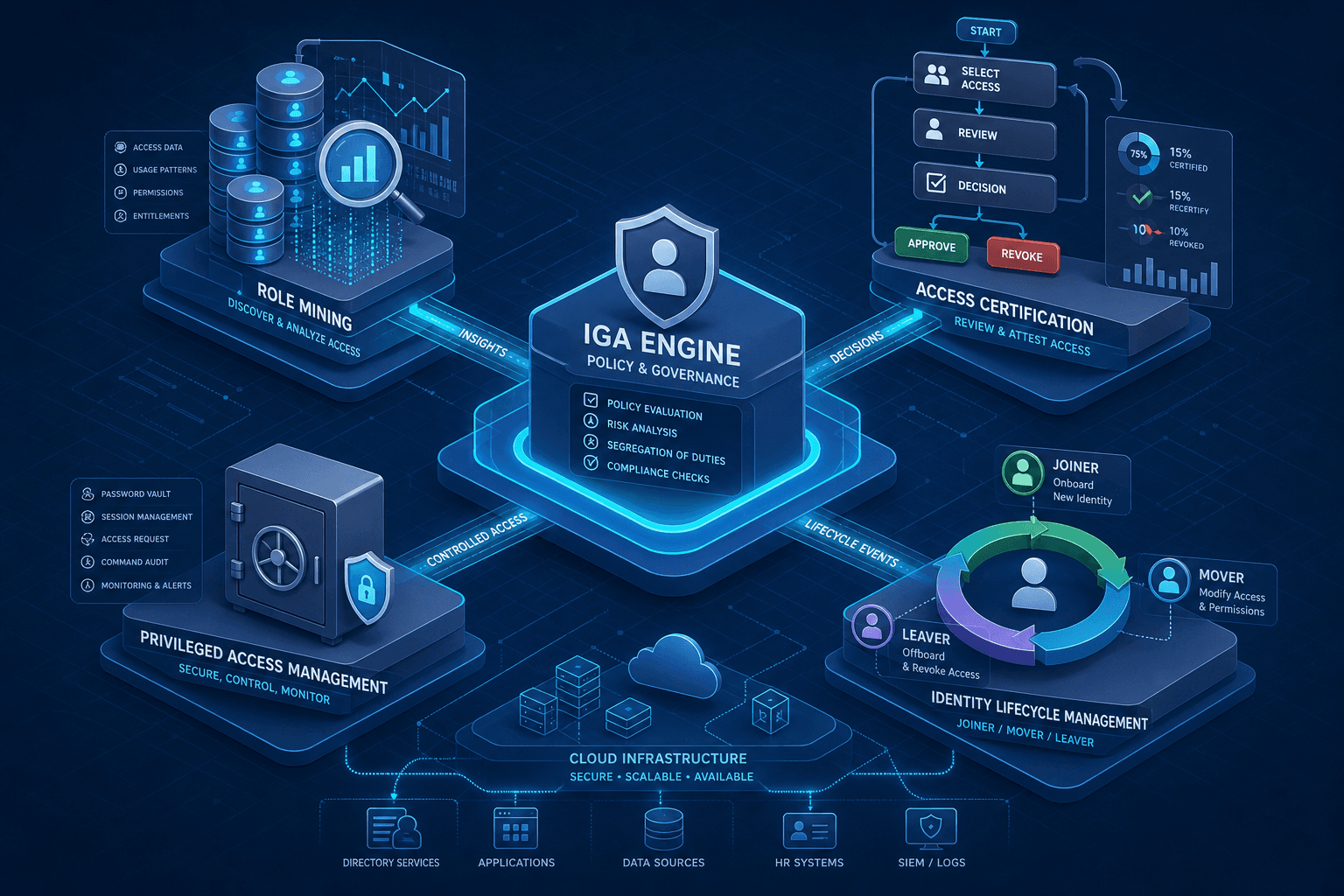
Identity Governance and Administration (IGA) is frequently mischaracterized as a software module for generating audit reports. This view fails because it treats governance as a retrospective activity rather than a proactive control plane. In a Zero Trust architecture, IGA is the mechanism that enforces the principle of least privilege by translating business intent into executable access policies. It manages the full lifecycle of an identity as a state machine, mines historical data to define roles, and executes time-bound access certifications. Without this mechanistic approach, organizations accumulate "access debt"—permissions granted for specific tasks that persist long after the task is complete, creating primary vectors for lateral movement.
This article is Part 9 of the Zero Trust & Modern Security Architecture series.
Deriving Roles from Data, Not Assumption
The most common failure point in Role-Based Access Control (RBAC) is the assumption that business roles map cleanly to technical permissions. In reality, legacy systems accumulate permissions through ad-hoc requests, creating a "spaghetti" permission matrix where a single user might hold 400+ disparate rights across Active Directory, SQL databases, and cloud SaaS platforms. Role mining is the mechanism used to collapse this noise into a manageable set of defined roles.
Role mining is not a manual exercise; it is a statistical clustering process. An IGA engine ingests access logs, current entitlements, and job descriptions to identify correlations. For example, if 95% of users in the "Finance" department have read access to the GL_Journal table and write access to the AP_Vendor table, but 5% do not, the algorithm flags the outliers for review. This process relies on the assumption that actual usage patterns are a better predictor of necessary access than job titles.
Consider a scenario involving "Alice," a financial analyst. Her static job title is "Analyst," but her access log shows she frequently accesses the HR_Salaries table while debugging a payroll integration script. A naive RBAC implementation would grant her the "HR View" role permanently based on her title. A role mining engine, however, analyzes the co-occurrence of GL_Journal and HR_Salaries. If these permissions rarely coexist in the broader dataset, the system flags this as an anomaly. The resulting role definition becomes a cluster of permissions required for a specific workflow, not a generic job function. This reduces the blast radius: if Alice leaves, she loses a tightly bounded set of permissions rather than a broad "analyst" bucket that includes sensitive HR data.

The Mechanics of Access Certification
Access certification is often reduced to a "click-through" exercise where managers approve or deny lists of users. Mechanistically, this is insufficient because it lacks context. True access certification functions as a verification loop where the system must prove that an entitlement is still required for the user's current state.
In a comprehensive IGA implementation, a certification campaign does not simply ask, "Do you still need this?" It asks, "What business justification exists for this access right now?" The system constructs a graph of the user's current state against their defined role baseline. If a user holds a permission outside their baseline (a "drift"), the campaign forces a specific justification field, requiring a link to a ticket or a project code. If the justification cannot be validated against an active workflow, the access is automatically revoked.
This mechanism prevents "permission creep." Imagine a developer, "Bob," who was granted access to a production database for a three-month migration project. When the project ends, the IGA system detects that Bob's state has not changed from "Project Member" to "Standard Developer," yet the production access remains. During the next certification cycle, the system highlights this drift. Bob's manager must provide a new justification or the access is auto-removed. This transforms certification from a passive approval into an active enforcement of the principle of least privilege.

The PAM and IGA Handshake
Privileged Access Management (PAM) and IGA are distinct but must operate in a tight feedback loop. PAM manages the execution of privileged credentials (vaulting passwords, session recording), while IGA manages the authorization to access those credentials. The critical mechanism here is the separation of the policy decision point (PDP) from the policy enforcement point (PEP).
In a standard workflow without this integration, a user might request a password for a root account and receive it via email, granting them persistent knowledge of the credential. In a modern IGA-PAM architecture, the IGA engine acts as the gatekeeper. When a user requests access, the IGA checks their current state: Are they in the correct role? Is their access certification current? Has their identity been flagged for offboarding? If the IGA policy evaluates to true, it issues a temporary token to the PAM vault. The PAM vault then provides the credential to the user for a strictly defined window (e.g., 30 minutes).
This creates a Just-In-Time (JIT) model. The privileged credential never exists in the user's local environment; it is streamed only when authorized. Furthermore, if the user attempts to use the credential outside the authorized scope (e.g., trying to run a command not in the allowed list), the PAM session terminates immediately. This prevents the "standing privilege" problem where a compromised admin account holds keys to the kingdom indefinitely. The IGA ensures that only the right person gets the key for the right time; the PAM ensures the key cannot be copied or reused.

Identity Lifecycle as an Atomic State Machine
The final pillar of IGA is the management of the identity lifecycle. Identities are not static objects; they are processes that move through states: Joiner, Mover, and Leaver. A resilient IGA treats these transitions as atomic transactions within its internal orchestration logic. An atomic transaction means that either all steps in the transition succeed, or all steps roll back, leaving the system in a consistent state.
Consider a "Leaver" scenario. When an employee's status is updated to "Terminated" in the HR system, this event triggers a workflow in the IGA. The IGA does not simply send a "delete" command to every connected system. Instead, it executes a sequence:
- Revoke all active sessions (Kerberos tickets, SSO tokens).
- Disable the account in the Identity Provider (IdP).
- Revoke access to cloud resources (IAM policies).
- Remove group memberships.
- Archive data for compliance retention.
If step 4 (removing group membership) fails due to a network timeout, the IGA engine must detect this failure and trigger a retry or an alert before proceeding to step 5. While target systems like LDAP or Cloud IAM may not natively support atomic multi-system transactions, the IGA acts as the orchestrator using protocol-agnostic connectors (e.g., SCIM, proprietary adapters) to abstract these differences. The IGA engine ensures that the identity's state in the target system matches its state in the source of truth (HR) at every microsecond, effectively simulating atomicity across heterogeneous environments. This eliminates the "zombie accounts" that plague most organizations, where accounts remain active long after the employee has left.
Conclusion
Building a secure identity landscape requires moving beyond the assumption that "roles" are static and "reviews" are periodic. The mechanism of IGA is a continuous feedback loop where data drives role definitions, state transitions enforce least privilege, and privileged access is ephemeral. By treating identity as a state machine and leveraging role mining to derive actual usage patterns, organizations can reduce their attack surface significantly. The goal is not to prevent every single breach, but to ensure that if a credential is compromised, the blast radius is contained by the strict, mechanism-driven boundaries of the governance layer.
Common Pitfalls
Implementing IGA often falls into predictable traps that undermine its effectiveness.
- Treating IGA as a One-Time Project: Many organizations configure IGA once to satisfy an audit and then neglect updates. Without continuous tuning, the system quickly becomes obsolete as applications evolve, leading to stale role definitions and ineffective certifications.
- Ignoring Drift Detection: Focusing solely on initial provisioning while ignoring runtime drift allows permissions to accumulate unnoticed. Systems that do not actively monitor deviations between assigned roles and actual usage patterns create silent security gaps.
- Over-Reliance on Static Role Definitions: Relying exclusively on HR job titles for role mapping ignores the reality of cross-functional work. This leads to over-provisioning, where users are granted broad access based on titles rather than their actual workflow requirements, increasing the attack surface.
Practical Takeaways
To maximize the value of your IGA implementation, focus on these core mechanisms:
- Adopt Statistical Role Mining: Move away from manual role creation. Utilize algorithms to analyze historical access logs and cluster permissions based on actual usage patterns rather than job titles.
- Enforce Context-Aware Certification: Transform access reviews from passive checklists into active verification loops. Require business justifications linked to active workflows for any permission outside the user's baseline.
- Orchestrate Atomic Lifecycle Transitions: Treat identity state changes as complex transactions. Ensure your IGA engine coordinates across all connected systems to guarantee that no step in a joiner, mover, or leaver process is skipped or left in a partial state.
FAQ
Q: How does IGA differ from simple RBAC? A: RBAC is a model for assigning permissions based on roles, but it is often static. IGA is the operational framework that dynamically manages those roles, enforces lifecycle transitions, and continuously validates that the assigned roles still match the user's current needs and context.
Q: Can IGA replace PAM? A: No. IGA and PAM serve different functions. IGA manages the authorization (who is allowed to access what), while PAM manages the execution (how privileged credentials are stored, rotated, and used). They work best when integrated, with IGA acting as the gatekeeper for PAM access.
Q: What happens if a target system doesn't support atomic operations? A: The IGA engine acts as the orchestrator. Even if the target system (like an older LDAP server) does not natively support atomic multi-step transactions, the IGA uses connectors to manage the sequence. If a step fails, the IGA triggers a rollback or alert, ensuring the overall identity state remains consistent from the IGA's perspective.
Related posts
Automating Access Reviews with Keycloak and Spring Boot
This guide covers automating access reviews using Keycloak and Spring Boot to ensure compliance and streamline identity governance.
Implementing Identity Verification for KYC
A technical guide to implementing identity verification for Know Your Customer compliance using document verification and biometrics in fintech.
Implementing Identity Governance with Custom Policy Engines
An examination of implementing identity governance using custom policy engines like OPA, Cedar, and XACML for policy-as-code.