Supply Chain Identity Security: Managing Third-Party Access
An examination of supply chain security strategies for managing third-party identity, vendor access, and federated identity in partner environments.
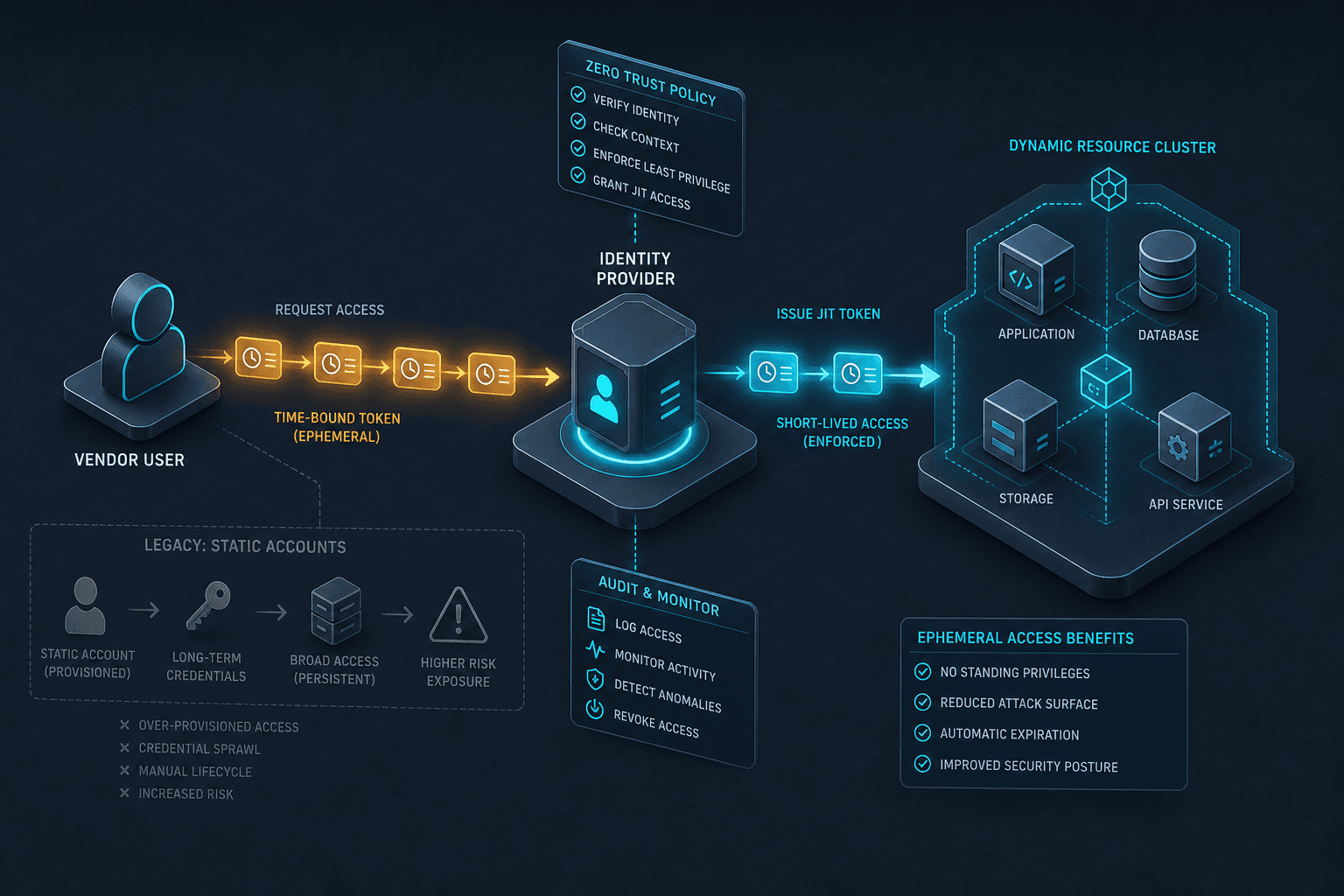
The traditional model of supply chain security relies on a fundamental architectural flaw: it treats third-party access as a permanent state. When a vendor needs to access your internal infrastructure to patch a server, support a database, or audit logs, the standard procedure has historically been to provision a persistent username and password or a long-lived API key. This creates a static trust boundary that, once crossed, allows an attacker who compromises the vendor's environment to move laterally into your network indefinitely. The mechanism of failure is simple: the credential exists. As long as the account exists, the risk exists. To secure the supply chain, we must shift from managing accounts to managing sessions. The goal is to ensure that no long-lived third-party identity persists in your system longer than the specific task requires.
This article is Part 10 of the Zero Trust & Modern Security Architecture Series.
The Static Trust Failure
Consider a scenario where a software vendor, "DevCorp," requires access to your production Kubernetes cluster to deploy a critical update. In a legacy model, your IT team creates a user devcorp_admin with a static password and assigns it the cluster-admin role. This account sits in your Active Directory or LDAP directory forever.
If DevCorp suffers a breach, and the attacker exfiltrates the devcorp_admin password, they now have a valid key to your kingdom. Because the account is persistent, the attacker can return months later, use the same credentials, and bypass all perimeter defenses. The mechanism here is the persistence of the credential itself. The identity provider (IdP) has no way to distinguish between a legitimate admin and a stolen credential because the credential does not expire or validate context; it only validates the hash.
Furthermore, these accounts often accumulate privilege creep. A vendor might need read-only access for a week, but the account remains with write access for years. This violates the principle of least privilege at a structural level. The vulnerability is not just the password; it is the existence of the entry in the directory. Every static vendor account is a standing order for access that can be executed at any time by anyone holding the key.
Federation as the Control Plane
To break this cycle, we must move authentication away from the application and into a federated identity protocol like SAML 2.0 or OIDC. The mechanism here is the delegation of trust. Instead of your system storing a password for the vendor, you establish a trust relationship between your IdP (e.g., Okta, Azure AD) and the vendor's IdP.
When a vendor engineer attempts to access your resource, they do not log in with your credentials. They initiate a login flow on their own internal portal. Their identity provider validates their credentials and issues a signed security token (a SAML assertion or OIDC JWT). This token is then presented to your resource.
Let's trace the data flow in a SAML-based federation scenario:
- Initiation: The vendor clicks "Login" on your portal. Your application redirects them to the vendor's IdP (Identity Provider).
- Authentication: The vendor's IdP prompts the engineer for their own credentials (and MFA). Your system never sees these.
- Assertion: Upon successful authentication, the vendor's IdP generates a signed SAML assertion containing attributes like
email,role, andsession_id. - Validation: The assertion is POSTed back to your application. Your application uses a public key (distributed via metadata) to verify the digital signature of the assertion.
- Provisioning: If the signature is valid and the attributes match a policy, your application grants access.
This mechanism ensures that your system never holds the vendor's secrets. The trust is established cryptographically via the signature, not via a shared secret. If the vendor's IdP is compromised, the attacker cannot forge a valid assertion without the private key, which is held securely by the vendor. More importantly, this flow allows for immediate revocation. If a vendor employee leaves, the vendor's IdP can invalidate their session, and any subsequent token request will fail, cutting off access instantly without needing to change a password in your directory.
JIT Provisioning Mechanics
Federation solves the authentication problem, but we still need to solve the authorization problem. Even with federation, granting a vendor a permanent role like admin is dangerous. The solution is Just-In-Time (JIT) provisioning. This is not merely a policy statement; it is an automated workflow that dynamically creates a temporary identity for the duration of a specific task. This approach is central to modern vendor access management, ensuring that access is granted only when necessary and revoked immediately after.
Imagine a scenario where "LogisticsCo" needs to access a specific database for a 4-hour window to run a migration script. A JIT system intercepts the request. It does not grant immediate access. Instead, it triggers a workflow:
- Request: The JIT engine receives the federated token and parses the requested scope (e.g., "access DB-01 for 4 hours").
- Validation: The engine checks the vendor's current session context (MFA status, device health) against your Zero Trust policies.
- Creation: The engine dynamically creates a temporary user object or assigns a temporary role to the federated identity. This object has an explicit expiration time set to the end of the requested window.
- Execution: The vendor performs the migration.
- Revocation: At the 4-hour mark, or immediately upon session closure, the engine automatically deletes the temporary role or revokes the token.
The mechanism here is the ephemeral nature of the identity. The artifact (the user object) exists only in memory or a transient store for the duration of the operation. There is no persistent record of a "LogisticsCo Admin" account in your directory. If an attacker steals a session token, it is useless after the window closes.
This approach is critical for supply chains because it decouples the vendor's internal identity lifecycle from your access lifecycle. You do not need to know who works at LogisticsCo today; you only need to know that the person logging in right now has a valid, time-bound token.
The Zero Trust Verification Loop
Implementing JIT and federation is the foundation, but true supply chain security requires a continuous verification loop. In a Zero Trust architecture, no access is granted based on a single login event. The system must continuously evaluate the context of the session.
Consider the "Supply Chain Attack" vector where a vendor's internal network is compromised. The attacker gains access to a legitimate engineer's workstation. If the vendor logs in, the JIT system grants access. Later, the attacker moves laterally from the engineer's machine to the vendor's IdP. This highlights a major partner security risk: the compromise of a single vendor can cascade if the trust model is static.
In a Zero Trust model, your IdP does not just accept the token once. It maintains a session state. If the vendor's IdP pushes a "session invalidation" signal via a webhook or revocation list check (such as OCSP/CRL) because the engineer's device was flagged as non-compliant, your system must immediately terminate the session. Note that SCIM manages user lifecycle (creation/deletion) rather than session termination; therefore, session revocation relies on token validation events or direct webhook notifications from the IdP. Furthermore, the mechanism of "continuous authentication" means that every API call or database query is re-evaluated against the current context.
For example, if the vendor engineer logs in from a known IP range but suddenly attempts to access a sensitive resource from a different geographic region within minutes, the Zero Trust policy engine triggers a step-up challenge or blocks the request. The mechanism relies on the correlation of the token's claims with real-time telemetry from the vendor's environment.
This shifts the security model from "trust but verify" to "never trust, always verify." The identity is not a static badge; it is a dynamic stream of evidence. If the evidence stops being valid—because the device is lost, the MFA token is expired, or the user's role changes—the access is revoked immediately.
Conclusion
Managing third-party identity in the supply chain requires a fundamental architectural shift. We must stop provisioning accounts that live forever and start provisioning sessions that die when the work is done. By leveraging SAML/OIDC federation to separate authentication from authorization, and implementing JIT provisioning to enforce ephemeral access, organizations can reduce the attack surface of their supply chain to near zero. The mechanism is clear: remove the persistent credential, automate the temporary grant, and verify the context continuously. This is not just a configuration change; it is the operationalization of Zero Trust for the modern supply chain.
- Audit your current vendor access policies to identify any static accounts or long-lived API keys that have not been rotated in over 90 days.
- Implement a JIT workflow for your next vendor onboarding, ensuring that access is time-bound and scoped to the specific task.
- Integrate webhook listeners into your access control layer to receive real-time revocation signals from your Identity Providers.
FAQ
Q: Does JIT provisioning replace the need for SAML or OIDC? A: No. JIT provisioning handles authorization (what the user can do), while SAML/OIDC handles authentication (who the user is). They work best together: federation verifies the identity, and JIT grants the temporary permission.
Q: How do we handle vendors who need access for irregular, unpredictable tasks? A: JIT systems can be configured to trigger on-demand requests. A vendor engineer submits a ticket or request via a portal, which the JIT engine approves based on pre-defined policies, granting access for a short, specific window without requiring a standing account.
Q: What happens if a JIT session is interrupted mid-task due to a network issue? A: Because the session is ephemeral and tied to a specific token, a network interruption typically causes the token to expire or the connection to drop. The JIT system is designed to revoke the temporary role immediately upon session termination, preventing lingering access.
Practical Takeaways
- Ephemeral is Safe: Treat every vendor identity as if it will be compromised. Design systems assuming the worst-case scenario where the credential is stolen.
- Decouple Identities: Separate the vendor's internal HR lifecycle from your access lifecycle. You should not need to know when a vendor employee leaves to revoke their access to your systems.
- Verify Continuously: A single login is not enough. Continuous evaluation of context (device health, location, behavior) is the only way to mitigate lateral movement in a compromised supply chain.
Common Pitfalls
- SCIM Misconfiguration: Attempting to use SCIM for session revocation. SCIM updates user attributes (like status) but does not instantly invalidate active tokens or open sessions; you must use token revocation endpoints or webhooks.
- Over-Provisioning Roles: Granting JIT access to broad roles (e.g.,
admin) instead of granular permissions. Even temporary admin access is a significant risk if the session is hijacked. - Ignoring Metadata Rotation: Failing to rotate the public keys used to verify SAML assertions or OIDC tokens. If an attacker obtains the old private key or if the metadata expires, the validation mechanism fails.
Related posts
What Zero Trust Actually Requires
An examination of the practical requirements for Zero Trust Architecture based on NIST 800-207, covering tenets, maturity models, and implementation steps.
Integrating SAML with AWS IAM Federated Access
This guide covers integrating SAML with AWS IAM for federated access, explaining IAM roles, AWS SSO, and STS usage.
Multi Cloud Identity Management Framework: A Reference Architecture
A reference framework for cross-cloud IAM that addresses multi-cloud identity management, entitlements, and reference architecture for architects.