API Security Best Practices: Rate Limiting, JWT, and OAuth2 Scopes
Examination of API security best practices including rate limiting, JWT, and OAuth2 scopes to protect against common vulnerabilities.
The Mechanism of Trust: Rate Limiting, JWTs, and Scopes
In modern Zero Trust architectures, security is not a perimeter but a series of checks performed at every hop. When an API receives a request, it must answer three distinct questions: Is this client allowed to send this many requests? Does this client possess a valid credential that hasn't been tampered with? Does this credential grant permission for this specific action? The industry standard answers are rate limiting, JSON Web Tokens (JWT), and OAuth2 scopes. These are not interchangeable features; they are distinct mechanisms solving different failure modes.
This article is Part 6 of the Zero Trust & Modern Security Architecture series.
Rate Limiting: The Stateful Allocator
Rate limiting is often mistaken for a simple "max requests per minute" counter. At the mechanism level, it is a resource allocator that prevents the denial of service (DoS) of downstream services. Without it, a malicious actor or a misconfigured client can exhaust CPU, memory, or database connections, causing a cascade failure.
Consider a scenario where Client A (IP: 192.168.1.50) attempts to query a database-heavy endpoint. If the system uses a naive counter, it might allow 100 requests, reset, and allow another 100 immediately. This leaves gaps where an attacker can flood the system. The effective mechanism is the Token Bucket or Sliding Window Log.
In a Token Bucket implementation, the server maintains a "bucket" with a capacity of $C$ tokens for a specific client identity. The bucket fills at a rate of $R$ tokens per second. Every incoming request consumes one token. If the bucket is empty, the request is rejected with a 429 Too Many Requests status.
# Example response from an API Gateway (e.g., Kong or Nginx)
HTTP/1.1 429 Too Many Requests
Retry-After: 60
X-RateLimit-Limit: 100
X-RateLimit-Remaining: 0
X-RateLimit-Reset: 1678901234
The critical mechanism here is statefulness. The Gateway must persist the token count, often in a shared store like Redis, so that multiple instances of the Gateway agree on the limit. This ensures that even if a request hits a different pod in a Kubernetes cluster, the rate limit holds. Without this shared state, an attacker could distribute requests across multiple load-balanced nodes to bypass the limit.
JWT: The Mutable State Object
JSON Web Tokens (JWTs) are often implemented incorrectly because developers treat them as opaque strings rather than structured data objects. A JWT consists of three Base64Url-encoded parts: Header, Payload, and Signature. The signature is what guarantees integrity.
The most dangerous vulnerability in JWT implementation is Algorithm Confusion (or Algorithm Switching). The header specifies the signing algorithm, such as RS256 (RSA with SHA-256) or HS256 (HMAC with SHA-256). If a server accepts a token with alg: none, it might skip signature verification entirely. If a server accepts alg: RS256 but only checks the signature using the public key of an HMAC secret, an attacker can forge a token by signing it with the HMAC secret, which they might have stolen via a separate vulnerability.
Let's trace the verification mechanism for a legitimate request. The server receives a token. It parses the header to find alg: RS256. It retrieves the corresponding public key. It then takes the header and payload, encodes them, and verifies the signature against the public key. If the math checks out, the payload is trusted.
// Malicious attempt: Changing the algorithm to 'none'
{
  "header": {
    "alg": "none",
    "typ": "JWT"
  },
  "payload": {
    "sub": "user123",
    "role": "admin"
  },
  "signature": ""
}
If the application code blindly trusts the role claim in the payload without verifying the signature first, the attacker gains admin access. The mechanism must enforce that the algorithm matches the expected type and that the signature is non-empty and cryptographically valid.
Furthermore, while the JWT format itself is stateless (meaning the server does not store the token in a session store), revocation strategies introduce statefulness. This creates a revocation problem: if a user's password changes or a token is leaked, the server cannot easily invalidate the token until it expires because it holds no record of it. The mechanism to solve this is short-lived access tokens paired with rotating refresh tokens, or maintaining a "blocklist" of JWT IDs (jti) in a high-speed cache.
OAuth2 Scopes: The Granular Deny-by-Default
While authentication proves who you are, authorization proves what you can do. In OAuth2, this is handled by Scopes. A scope is a string value (e.g., read:users, write:orders) that represents a specific permission.
The mechanism of scope validation differs significantly from role-based access control (RBAC). In RBAC, a user has a role, and permissions are mapped to that role. In OAuth2, the Access Token contains a list of scopes granted by the Authorization Server. The Resource Server (the API) must explicitly check if the requested action falls within the token's scopes.
Consider a scenario where User Alice logs in. The Authorization Server issues a token with scope: read:profile. Later, User Alice tries to call the endpoint DELETE /api/users/123. The API gateway extracts the token and inspects the scope claim. It sees only read:profile. The mechanism rejects the request because the scope delete:users is not present.
This enforces the principle of least privilege. Even if a user has an admin role in the database, if their OAuth2 token does not carry the admin:delete scope, the API will not execute the deletion. This is critical because tokens can be compromised or misconfigured; the scope acts as the final gatekeeper.
// Pseudocode for scope validation in the API handler
function handleDeleteUser(request, tokenPayload) {
  const requiredScope = 'delete:users';

  // Check if the token has the specific scope
  if (!tokenPayload.scope.includes(requiredScope)) {
    return { status: 403, error: 'Insufficient scope' };
  }

  // Proceed with deletion
  return deleteResource(request.userId);
}
If the API relies solely on the sub (subject) claim or a custom role claim without validating the OAuth2 scopes, it bypasses the explicit authorization grant made by the user during the login flow.
Integration in a Zero Trust Flow
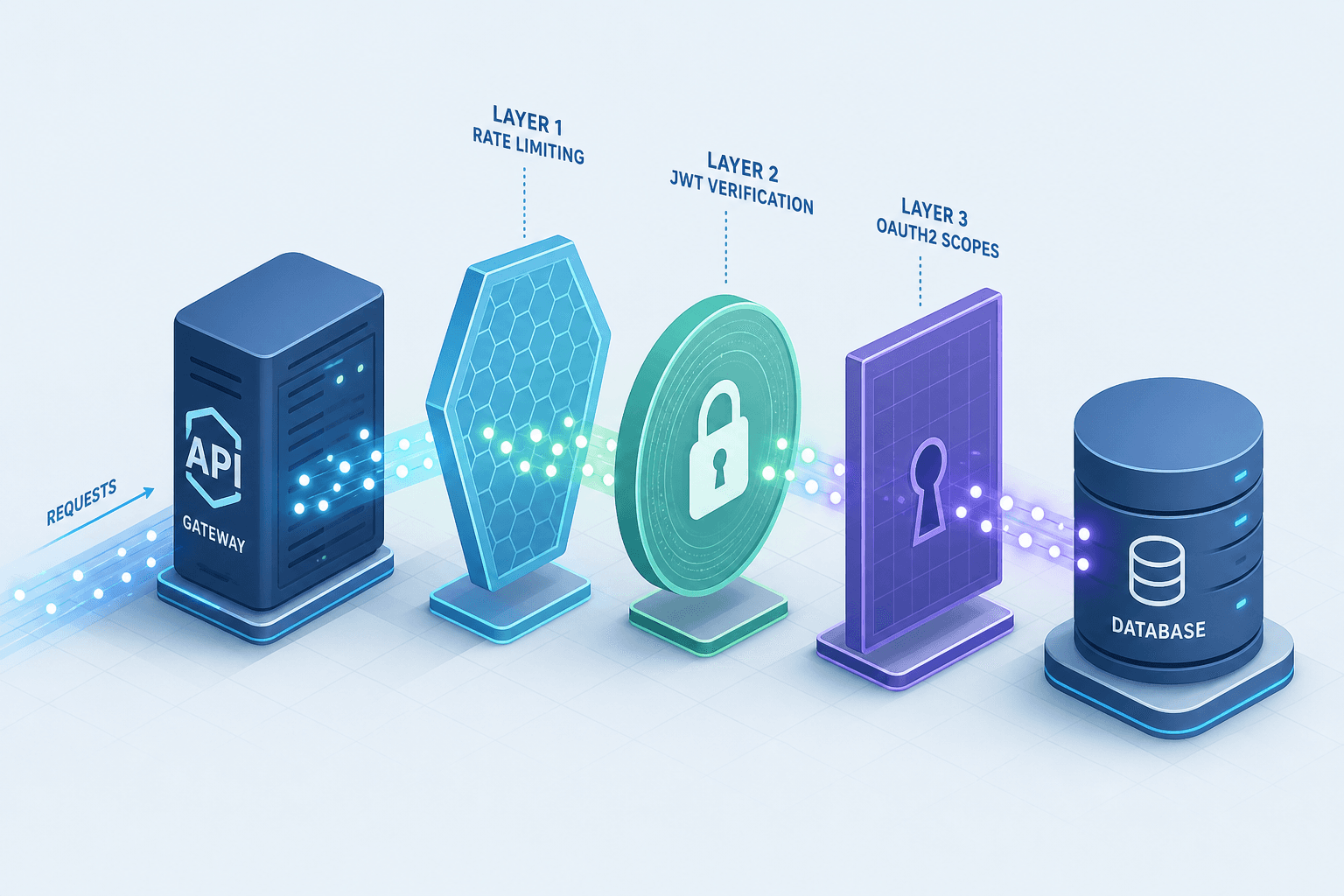
To secure an API effectively, these three mechanisms must work in concert. The data flow in a secure Zero Trust architecture looks like this:
- Ingress: The API Gateway receives a request. It checks the client IP and identity against the rate limit bucket. If the bucket is empty, the API Gateway returns 429 immediately, and the request is terminated before reaching the backend service.
- Authentication: The Gateway forwards the request to the API service. The service extracts the
Authorization: Bearer <token>header. It verifies the JWT signature using the public key. It validates theexp(expiration) andnbf(not before) timestamps. - Authorization: The service parses the
scopeclaim from the validated payload. It compares the requested resource action (e.g.,POST /orders) against the allowed scopes (e.g.,create:orders). - Execution: Only if the rate limit passed, the signature is valid, and the scope matches, does the service execute the business logic.
This layered approach ensures that even if one mechanism fails (e.g., a JWT is stolen), the other layers (rate limiting and scope validation) mitigate the damage. For instance, a stolen token with limited scopes cannot access sensitive data, and a token used too frequently triggers rate limiting.
The OWASP API Security Top 10 highlights that Broken Object Level Authorization (BOLA) and Broken Function Level Authorization (BFLA) are persistent threats. Proper implementation of OAuth2 scopes directly addresses BFLA by ensuring the token explicitly grants permission for the function being called. Rate limiting addresses the risk of DoS and brute-force attacks. JWT verification addresses the risk of forged identities.
There is an opinion worth noting here: relying solely on the API Gateway for all security checks is a single point of failure. While the Gateway can handle rate limiting and initial JWT verification, the API service itself must perform scope validation. If the service trusts the Gateway implicitly without re-validating scopes, a compromised Gateway or a misconfiguration in the Gateway headers could bypass authorization entirely. The "Zero Trust" mindset dictates that the service must verify every claim, regardless of where it came from.
By understanding the mechanism of the token bucket, the cryptographic structure of the JWT, and the deny-by-default nature of OAuth2 scopes, engineers can build APIs that are resilient against the most common attack vectors. Security is not a feature; it is the result of correctly implemented mechanisms.
Common Pitfalls
Implementing these mechanisms introduces specific risks if not handled with precision.
- Stateless Assumption in Revocation: Developers often assume that because JWTs are stateless, they cannot be revoked. This leads to long-lived tokens that remain valid even after a breach. Relying solely on expiration times without a blocklist strategy or short-lived access tokens leaves a window of vulnerability.
- Gateway-Only Validation: A common architectural error is offloading all authorization checks to the API Gateway. If the Gateway validates scopes but the backend service trusts the
scopeclaim in the header without re-verifying it against its own internal logic, a compromised Gateway or a header injection attack can bypass security entirely. - Naive Rate Limiting: Using a simple counter per IP address without a sliding window or token bucket allows attackers to "burst" traffic right after the counter resets. Additionally, failing to share state across gateway instances in a clustered environment allows request distribution attacks to bypass limits.
Practical Takeaways
To operationalize these concepts, keep these mental models in mind:
- Defense in Depth: Treat rate limiting, JWT verification, and scope checks as independent layers. If one fails, the others should still prevent the attack. Never rely on a single mechanism for total security.
- State vs. Stateless: Remember that while the JWT format is stateless, the system managing it (for revocation) must be stateful. Design your infrastructure to support the necessary state stores (like Redis) for blocklists and rate limiters.
- Deny by Default: In OAuth2, never assume a token grants access. Explicitly check for the required scope for every action. The presence of a token proves identity, but the scope is the only proof of permission.
FAQ
Q: Can I use the same rate limit for authenticated and unauthenticated users? A: Generally, no. Unauthenticated requests should be rate-limited more strictly to prevent abuse, while authenticated users might require higher limits based on their subscription tier or role. Mixing these can lead to Denial of Service for legitimate users or allow anonymous brute-force attacks.
Q: How do I revoke a JWT without a centralized database? A: Purely stateless JWTs cannot be revoked instantly. To achieve revocation, you must introduce state. The most common patterns are using short-lived access tokens (e.g., 5-15 minutes) combined with rotating refresh tokens, or maintaining a "blocklist" of token IDs (jti) in a high-speed store like Redis.
Q: Does OAuth2 scope validation happen at the Gateway or the Service? A: Ideally, both. The Gateway can filter requests based on broad scopes to reduce load, but the Service must perform the final, granular validation. Relying solely on the Gateway creates a trust boundary that, if breached, compromises the entire API.
Conclusion
True API security requires treating rate limiting as a stateful resource allocator, JWTs as self-contained but mutable state objects requiring strict validation, and OAuth2 scopes as the granular enforcement of the principle of least privilege at the authorization layer. By integrating these three mechanisms within a Zero Trust architecture, organizations can effectively mitigate the risks of resource exhaustion, identity forgery, and unauthorized access.
Related posts
Understanding JWKS: Rotating Signing Keys Gracefully
An examination of JSON Web Key Set (JWKS) mechanisms for securely rotating signing keys and verifying JWTs without service interruption.
Building an Identity-Aware API Gateway with Kong and OIDC
A guide to configuring Kong Gateway with OpenID Connect for secure API authentication using JWT tokens.
OAuth 2.0 vs JWT: Understanding the Relationship
An examination of the relationship between OAuth 2.0 and JSON Web Tokens, covering opaque tokens, token format selection, and JWT best practices.