Security Architecture Review: Patterns for Identity-First Design
An examination of security architecture patterns centered on identity-first design, covering threat modeling and IAM strategies.
Security Architecture Review: Patterns for Identity-First Design
In the era of cloud-native architectures and distributed workforces, the traditional network perimeter has dissolved. The modern security paradigm shifts the boundary from the infrastructure to the user or service principal. This identity-first design treats the network as untrusted, requiring every request to present cryptographic proof of identity before accessing resources. As the first installment of the Passwordless & Next-Gen Authentication Series, this review examines the mechanisms behind this shift, applying STRIDE threat modeling to the identity layer and evaluating state management patterns within a Zero Trust framework.
The Mechanism of Identity-First Perimeters
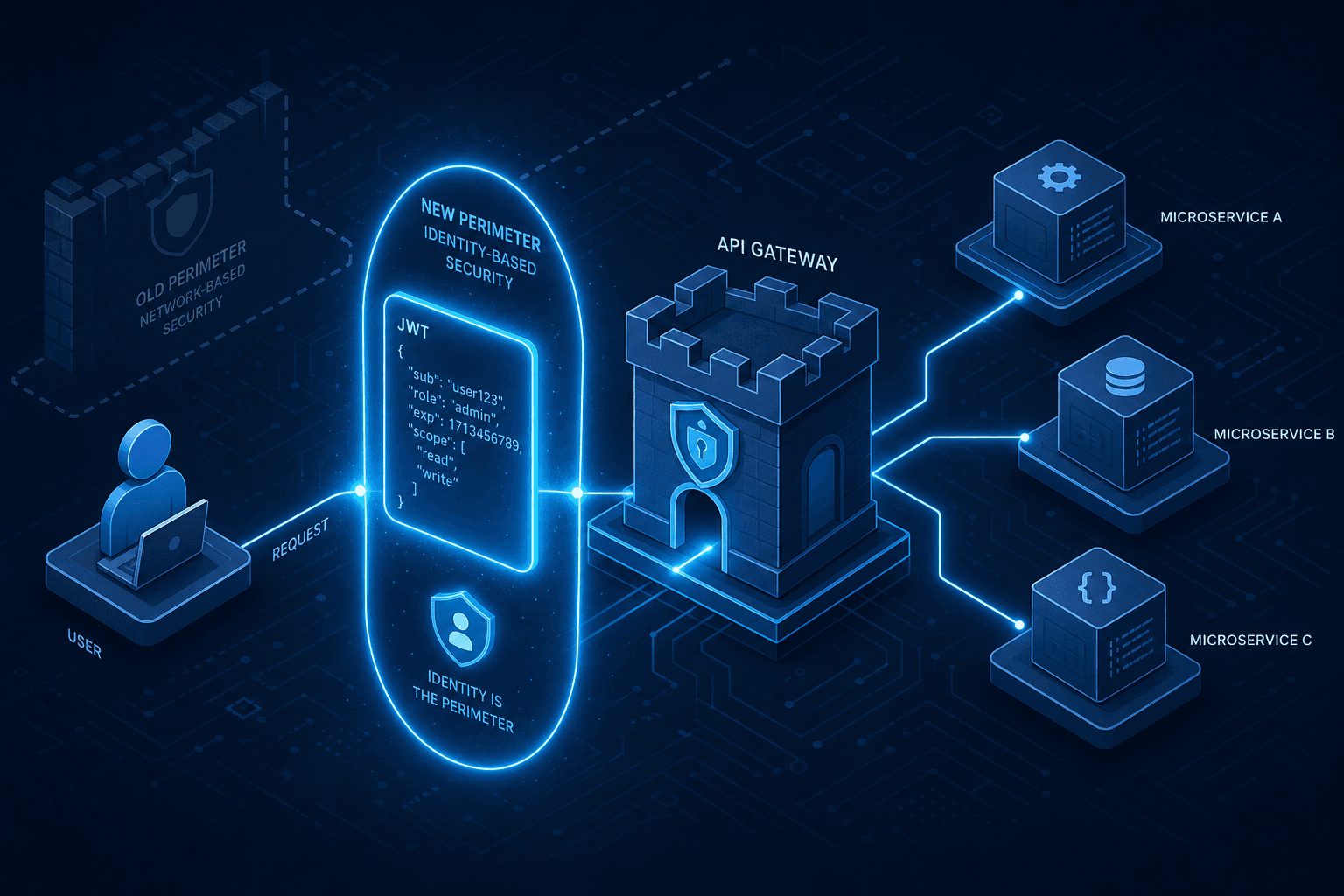
The transition to identity-first design collapses the legacy trust model where internal subnets were implicitly trusted. In this architecture, the API Gateway or Service Mesh acts as the primary enforcement point, intercepting traffic before it reaches backend services. The backend ignores source IP addresses entirely, relying instead on signed tokens presented in the Authorization header.
When a user authenticates, the Identity Provider (IdP) issues a JSON Web Token (JWT). This token contains claims such as sub (subject) and roles, signed by a private key held exclusively by the IdP. The gateway performs two critical cryptographic checks: verifying the digital signature against the public key and validating the token's expiration time (exp).
If the signature is invalid or the token is expired, the gateway rejects the request with a 401 Unauthorized status code. The backend service never processes the payload. Only upon successful validation does the gateway inject the user's identity into downstream headers (e.g., X-User-ID) and forward the request. This mechanism ensures that even if an attacker successfully spoofs the network path, they cannot access resources without the private key used to sign the token.
STRIDE Threat Modeling for Identity
To secure the identity layer, we must apply the STRIDE threat model specifically to the authentication flow. STRIDE stands for Spoofing, Tampering, Repudiation, Information Disclosure, Denial of Service, and Elevation of Privilege. Consider a scenario where an attacker attempts to hijack a valid session token.
Spoofing: The attacker attempts to impersonate a legitimate user by forging a JWT.
- Mechanism Check: The API validates the signature using the IdP's public key. Without the private key, signature verification fails.
- Mitigation: Enforce strict key rotation and use short-lived tokens to minimize the window of opportunity if a key is compromised.
Tampering: The attacker modifies the token payload to escalate privileges, changing a role from viewer to admin.
- Mechanism Check: Because JWTs are signed, any alteration to the payload invalidates the signature. The hash of the header and payload no longer matches the signature.
- Mitigation: Use strong signing algorithms (e.g., RS256 or ES256) rather than
noneorHS256with weak secrets. Never trust the client to define its own privileges.
Repudiation: A user performs an action and later denies doing so.
- Mechanism Check: A signed token provides non-repudiation because only the IdP could have issued it.
- Mitigation: Maintain immutable audit logs at the IdP and the API Gateway that link the token ID to specific user actions.
Information Disclosure: The token contains sensitive data such as a user's email or PII.
- Mechanism Check: If the token is stored in browser local storage or transmitted over an unencrypted channel, it is exposed.
- Mitigation: Minimize claims in the token (principle of least data) and enforce HTTPS. Use opaque tokens if payload size or sensitivity is a concern, trading readability for security.
Denial of Service (DoS): An attacker floods the IdP with login requests to exhaust resources.
- Mechanism Check: The IdP CPU becomes overwhelmed trying to verify signatures or generate new tokens.
- Mitigation: Implement rate limiting at the gateway level before requests reach the IdP and use circuit breakers.
Elevation of Privilege: The user exploits a vulnerability to access a resource outside their authorization scope.
- Mechanism Check: The API checks the
rolesclaim in the token against the resource's access control list (ACL). - Mitigation: Enforce authorization checks at every service boundary, never assuming the gateway handled all security requirements.

Zero Trust and State Management Patterns
Identity-first design relies heavily on the choice between stateless and stateful session management. In a stateless approach, the API validates the JWT locally without querying a database. This is efficient but creates a revocation challenge. If a user's credentials are compromised, the token remains valid until it expires.
Consider a scenario where a user logs out. In a stateless system, the token on the client side remains valid. The only way to invalidate it immediately is to maintain a blocklist (a "deny-list") of revoked token IDs. This introduces a dependency on a fast lookup store (like Redis) and adds latency to every request.
In contrast, a stateful system (like traditional session cookies) stores the session ID in a database. When the user logs out, the server deletes the session record. The next request fails immediately. However, this introduces a single point of failure and scales poorly for massive distributed systems.
The modern pattern for identity-first architectures often hybridizes these approaches. We use short-lived access tokens (e.g., 15 minutes) to minimize the window for replay attacks, paired with a refresh token mechanism. The refresh token is stored securely (e.g., HttpOnly cookie) and is stateful on the server. If a user is compromised, revoking the refresh token prevents the generation of new access tokens. This balances the performance of stateless validation with the security of stateful revocation.
Furthermore, Zero Trust requires that identity is verified for every request, not just the initial login. This is achieved by passing the identity context through the entire request chain. In a service mesh, the identity of the service calling the API is also verified using mTLS (mutual TLS), ensuring that the "user" is actually a trusted service account, not a rogue process.

Implementation Strategy
Implementing these patterns requires a shift in how developers write code. The application logic should not handle authentication; it should consume the identity injected by the infrastructure. The API Gateway or Service Mesh becomes the gatekeeper.
For example, in a Node.js environment, you would configure a middleware that validates the JWT signature and extracts the claims. You would then pass these claims to the business logic layer, which uses them to enforce authorization rules.
// Middleware example for validating identity
async function verifyIdentity(req, res, next) {
  const token = req.headers.authorization?.split(' ')[1];
  if (!token) return res.status(401).send('No token');

  try {
    const payload = jwt.verify(token, publicKey);
    req.user = payload; // Inject identity into request context
    next();
  } catch (err) {
    return res.status(401).send('Invalid token');
  }
}
This separation of concerns ensures that authentication logic is centralized and consistent. If the signing algorithm needs to change or a key needs to rotate, you update the middleware, not every individual service.
Finally, trust in this architecture is not blind. It is cryptographically verified at every hop. The network path is irrelevant; the only thing that matters is the validity of the credential presented by the actor. This is the core mechanism of identity-first design: treating identity as the primary security boundary.
Common Pitfalls
Even with a well-designed architecture, implementation errors can undermine security. A common pitfall is over-reliance on client-side claims. Developers sometimes assume that a role claim in a JWT is trustworthy and skip server-side authorization checks, allowing privilege escalation if the token is tampered with. Another frequent issue is improper key storage; storing private keys for JWT signing in environment variables accessible to all developers or in unencrypted configuration files exposes the signing capability to attackers. Finally, many teams ignore refresh token revocation strategies. By failing to implement a mechanism to revoke refresh tokens upon user logout or compromise, the system allows attackers to generate new access tokens indefinitely, negating the benefits of short-lived access tokens.
Practical Takeaways
To navigate identity-first design effectively, adopt these mental models: First, treat identity as the new perimeter; the network is merely transport, not a security control. Second, never trust the network path; assume any request could originate from a compromised node or malicious actor. Third, enforce short-lived access tokens with stateful refresh token management to balance usability with immediate revocation capabilities. These principles form the bedrock of a resilient Zero Trust architecture.
FAQ
Q: Can I revoke a JWT immediately after it is issued? A: Not natively, as JWTs are stateless. To achieve immediate revocation, you must implement a deny-list (blocklist) of token IDs or use a short-lived access token paired with a stateful refresh token that can be invalidated on the server side.
Q: Why not just use opaque tokens instead of JWTs? A: Opaque tokens (where the server must look up the token details in a database for every request) simplify revocation and allow for dynamic policy updates. However, they introduce latency and a database dependency for every request, whereas JWTs allow for local validation. The choice depends on your performance requirements and revocation needs.
Q: How do I handle key rotation without causing authentication failures? A: Implement a key versioning strategy where the IdP publishes multiple public keys. The gateway should attempt verification against all active keys before rejecting a token. This allows you to retire old private keys while maintaining backward compatibility for tokens issued under those keys.
Conclusion
Identity-first design redefines the security perimeter by moving it from the network to the user. By applying STRIDE threat modeling to the identity layer and adopting hybrid state management patterns, architects can build systems that are resilient against token hijacking and privilege escalation. Specifically in managing key rotation schedules and implementing token revocation, the trade-off is a robust Zero Trust architecture capable of securing distributed, cloud-native environments.
Related posts
Securing Legacy Applications with a Reverse Proxy Identity Gateway
An examination of securing legacy applications using reverse proxy identity gateways like Pomerium and Ory Oathkeeper for modernization.
Microservices Security Architecture: OAuth2, JWT, and mTLS Patterns
Examines microservices security patterns including OAuth2, JWT propagation, and mTLS within service mesh architectures.
BeyondTrust: Building a Zero Trust Identity Framework
An examination of BeyondTrust's approach to zero trust identity frameworks, covering AAL, IAL, and identity assurance for secure access decisions.