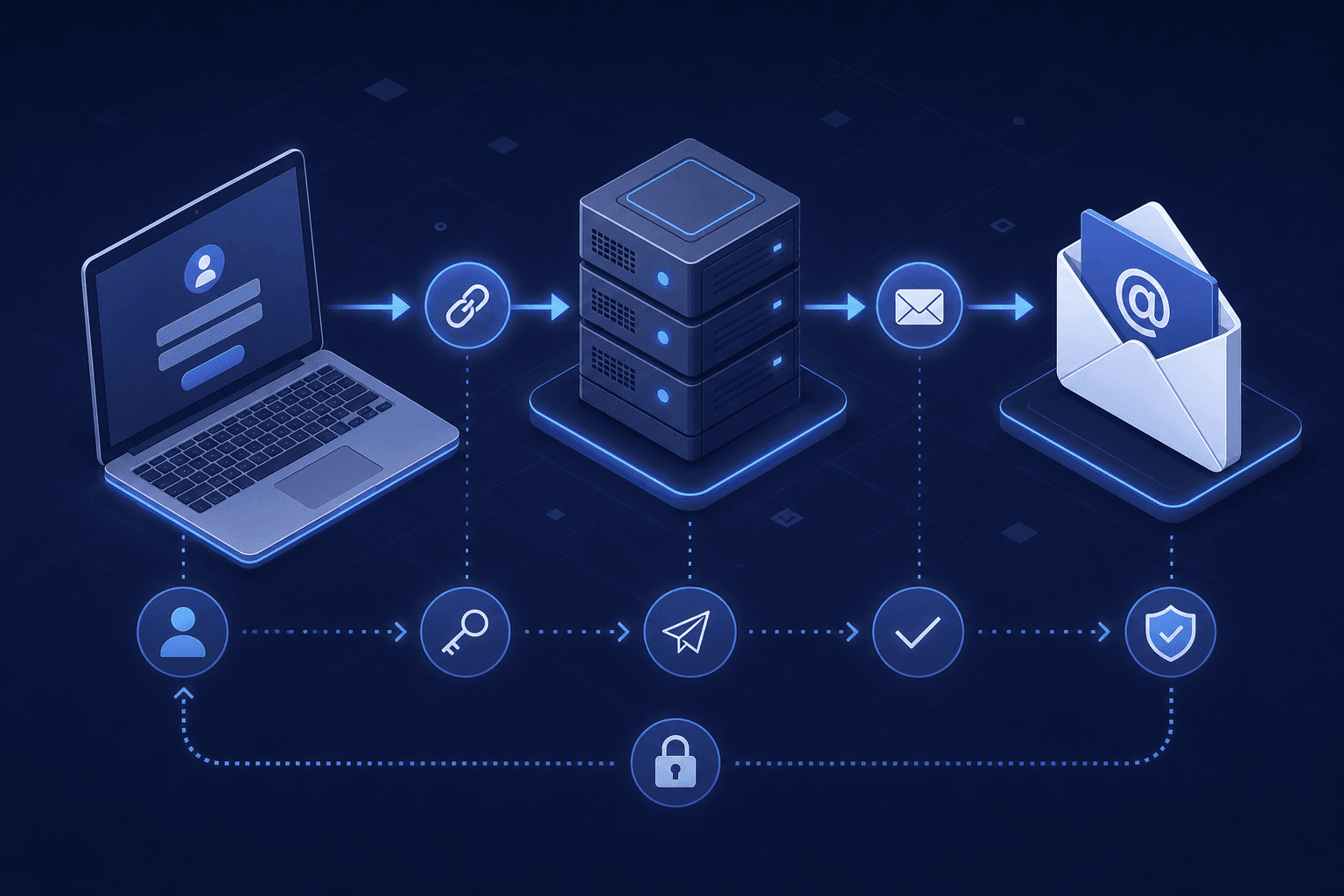
Magic Link Authentication: Implementation and Security Considerations
This article examines magic link authentication, covering implementation steps and security considerations for passwordless login systems.
Magic Link Authentication: Implementation and Security Considerations
Magic link authentication represents a paradigm shift from knowledge-based verification to possession-based verification. Instead of relying on a shared secret like a password, the system validates the user's control over a specific email inbox. This mechanism replaces the complexity of password management with the security of cryptographic tokens and strict lifecycle management, relying heavily on the integrity of the email channel to prevent replay and enumeration attacks.
The Mechanics of Magic Link Authentication
Magic link authentication operates on a fundamental shift in trust: instead of verifying "what you know" (a password), the system verifies "what you have" (access to a specific email inbox). The mechanism is deceptively simple but relies on precise cryptographic boundaries to function securely.
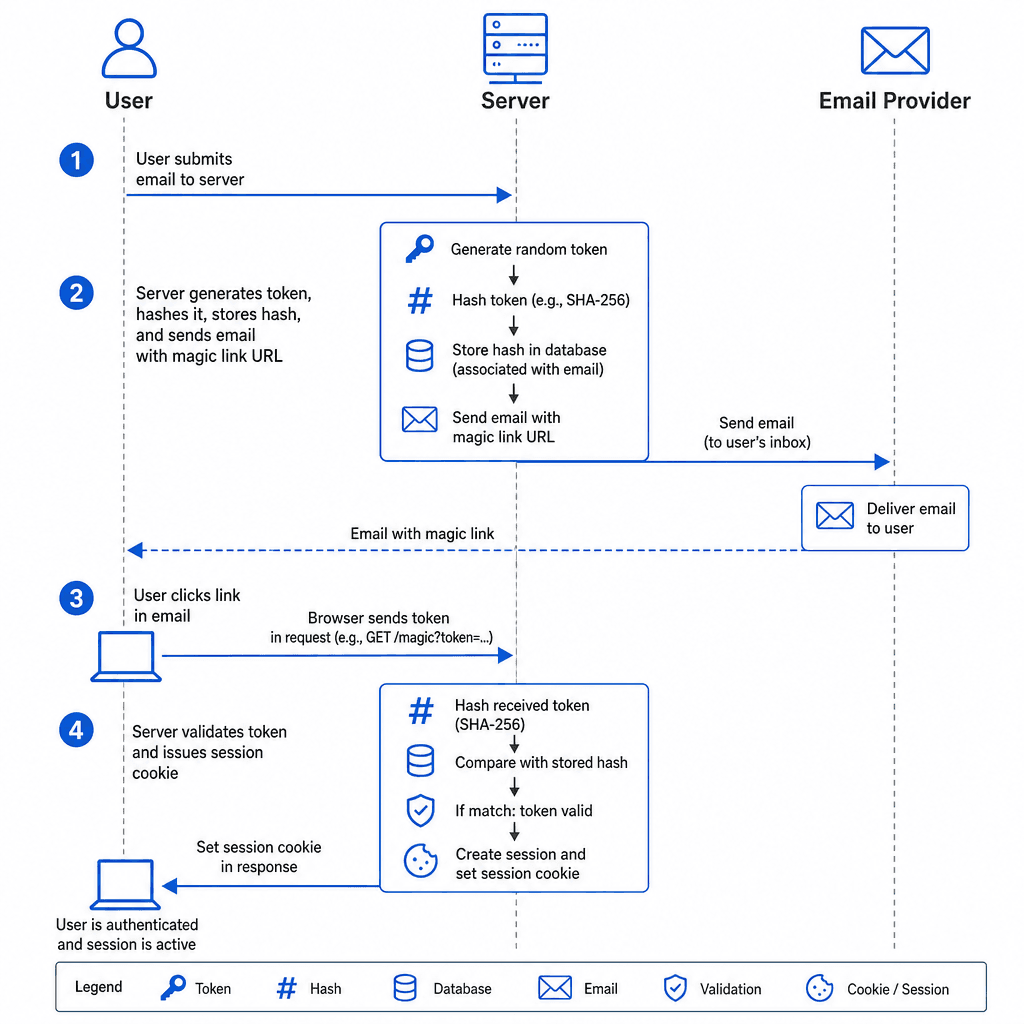
Consider a user, Alice, who attempts to log into example.com. She enters alice@example.com into a form. The server does not check a database for a matching password hash. Instead, it performs three distinct operations. First, it generates a cryptographically secure random string using a CSPRNG (Cryptographically Secure Pseudo-Random Number Generator). Second, it hashes this string (e.g., using SHA-256) and stores the hash in a temporary database table alongside a timestamp and the associated email address. Third, it constructs a URL containing the unhashed random string as a query parameter, such as https://example.com/auth/verify?token=8f3a9c.... This URL is sent to Alice via email.
When Alice clicks the link, her browser sends a GET request to the server with the token. The server receives the raw token string in the URL, hashes it locally, and compares it to the stored hash. If they match and the timestamp indicates the token is within the valid window (e.g., 15 minutes), the server invalidates the token immediately to prevent reuse, creates a new session cookie for Alice, and redirects her to the application.
The critical security property here is the one-time use. The token is ephemeral. Once validated, the record is deleted. This ensures that even if the email is intercepted later, the token is useless. Unlike a static password, a magic link token has a built-in expiration and a single-use constraint, reducing the attack surface significantly.
Token Lifecycle and Storage Architecture
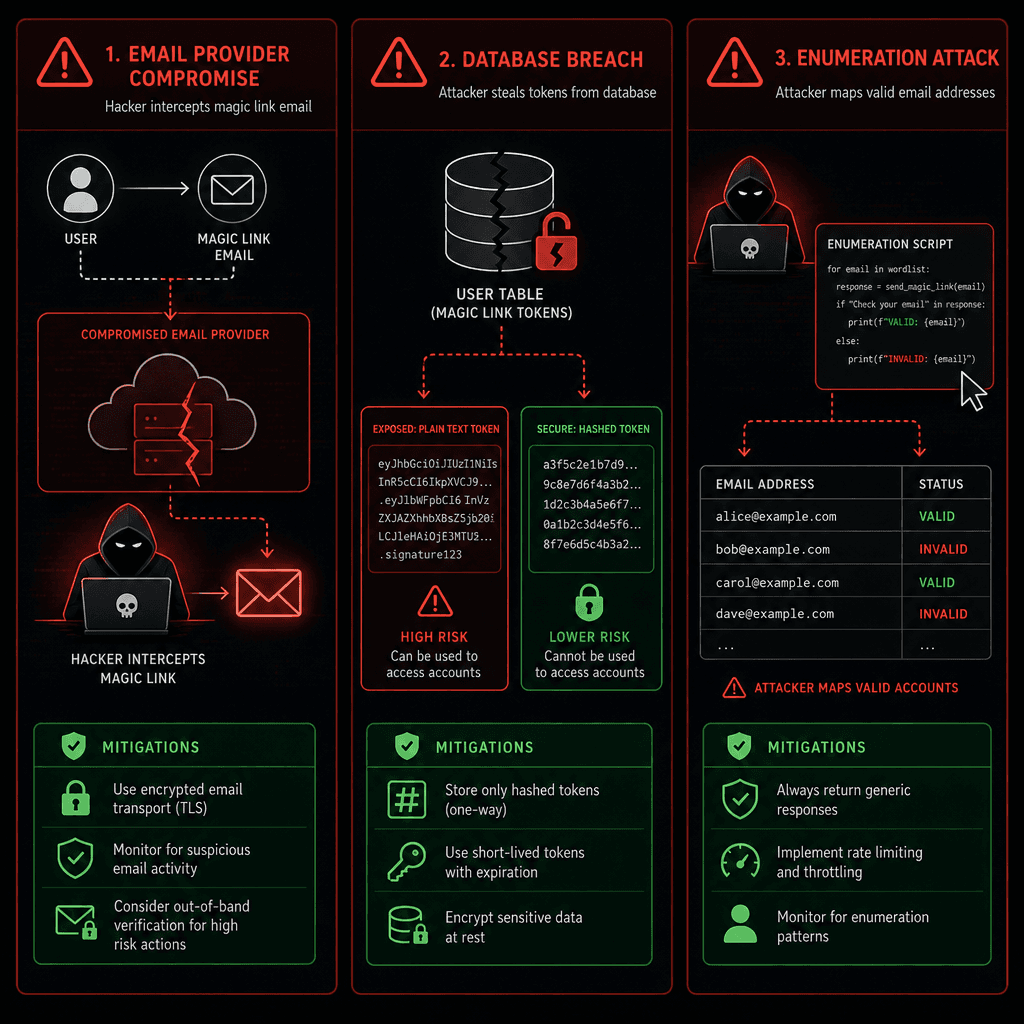
The security of the magic link system hinges entirely on how the token is stored and managed on the server. A common misconception is that the token can be stored in plain text to allow for easy verification. This is a critical failure point. If an attacker gains read access to the database, they can scrape the tokens and forge login links for any user.
The correct mechanism requires storing the hash of the token, not the token itself. When the server generates the token T, it computes H = Hash(T) and stores H in the database. When the user clicks the link, the server receives T, computes Hash(T), and compares it to H. This mirrors the standard password hashing workflow.
However, magic link tokens differ from passwords in their lifecycle. They are transient. The database schema must support rapid deletion. A typical implementation uses a dedicated table magic_tokens with columns for email, token_hash, created_at, and expires_at.
CREATE TABLE magic_tokens (
    id SERIAL PRIMARY KEY,
    email VARCHAR(255) NOT NULL,
    token_hash VARCHAR(255) NOT NULL,
    created_at TIMESTAMP DEFAULT NOW(),
    expires_at TIMESTAMP NOT NULL,
    UNIQUE (email, token_hash)
);

-- Index for fast lookup and cleanup
CREATE INDEX idx_magic_tokens_email ON magic_tokens(email);
The expiration time is a crucial parameter. NIST guidelines suggest that authentication factors should have limited validity. For magic links, a window of 15 to 60 minutes is standard. Too short, and users lose tokens due to latency or slow email delivery; too long, and the window for an attacker to intercept and replay the token widens.
Furthermore, the token generation process must be atomic. The server must generate the token, hash it, and insert the record in a single transaction. If the insert fails after generation, the token is lost, potentially causing user confusion, but never leaking a valid token without a database record.
Security Threats and Mitigations
While magic links remove the risk of weak user-chosen passwords, they introduce new vectors for attack. The primary threat model shifts from credential stuffing to email compromise and information leakage.
Email Enumeration
If the server responds differently when a user submits an existing email versus a non-existent one, an attacker can enumerate valid accounts. For example, if alice@example.com returns "Link sent!" and bob@fake.com returns "Invalid user", the attacker now knows which emails are registered.
Mitigation: The server must always return a generic success message regardless of whether the email exists in the database. "If an account exists for this email, we have sent a link." This prevents attackers from mapping the user base.
Token Interception and Forwarding Security threats regarding token transmission and usage must be distinguished. Network Interception occurs when traffic is captured between the client and the server. This vector is effectively mitigated by enforcing HTTPS, which encrypts the transport layer. Email Account Compromise occurs when an attacker gains access to the user's mailbox. This is inherent to the "something you have" model and is mitigated by short Token Time-To-Live (TTL) windows and requiring Multi-Factor Authentication (MFA) for sensitive actions.
Regarding Token Forwarding, this is a direct consequence of email account compromise rather than a solved problem inherent to the model. If an attacker intercepts the email, they can forward the link. The specific mitigation for forwarding is binding the session to the IP address or User-Agent at the moment of token consumption, though this can degrade user experience on mobile networks where IPs change dynamically.
Session Hijacking Post-Click Once the magic link is clicked, the server issues a session cookie. If this cookie is long-lived and not bound to the device, an attacker who steals the cookie (e.g., via XSS) gains persistent access. Mitigation: Treat the magic link click as a high-privilege action. Issue a short-lived session initially, or require re-authentication for sensitive actions immediately after the magic link login. Ideally, the session should be marked as "freshly authenticated" and require re-entry of credentials or MFA for high-value operations.
Rate Limiting
Because the mechanism involves sending emails, it is vulnerable to denial-of-service attacks where an attacker floods the system with login requests, incurring email costs and overwhelming the mail queue.
Mitigation: Implement strict rate limiting on the /request-magic-link endpoint based on IP address and email domain. For example, limit to 3 requests per hour per IP.
Common Pitfalls
Implementing magic links correctly requires attention to detail to avoid common architectural errors.
- Weak Entropy in Token Generation: Using a standard PRNG (Pseudo-Random Number Generator) instead of a CSPRNG can result in predictable tokens. Attackers may be able to guess valid tokens if the entropy is insufficient. Always use cryptographically secure random sources.
- Missing Rate Limiting: Failing to implement rate limits on the request endpoint allows attackers to exhaust email quotas or trigger spam filters, causing service degradation. Limits should be applied per IP and per email address.
- Improper Token Deletion: If tokens are not immediately invalidated or deleted upon successful authentication, they remain valid for potential replay attacks. Ensure the database transaction handles deletion atomically with session creation.
Practical Takeaways
To ensure a secure and effective magic link implementation, focus on these core practices:
- Enforce HTTPS: Never transmit magic links over unencrypted channels to prevent network interception.
- Short TTLs: Keep token expiration windows tight (15–60 minutes) to minimize the window of opportunity for attackers.
- Atomic Operations: Ensure token generation, hashing, and storage happen in a single database transaction to maintain data integrity.
FAQ
Q: Can users reuse a magic link? A: No. Magic links are designed as one-time links. Once a token is used to authenticate a user, it is immediately invalidated and removed from the database. Attempting to use the same link again will fail.
Q: What happens if the email is delayed? A: If the email arrives after the token's expiration time (TTL), the link will be rejected by the server. Users should be advised to check their spam folder if they do not receive the email within a few minutes.
Q: Is magic link authentication safer than passwords? A: Magic links eliminate risks associated with weak user-chosen passwords and credential stuffing. However, they introduce dependency on the security of the email provider. For many applications, the frictionless authentication experience combined with reduced password management overhead makes it a superior choice, provided the implementation follows security best practices.
Conclusion
Magic link authentication offers a compelling balance between security and user experience by removing the burden of password management while relying on the reliable infrastructure of email providers. The mechanism is sound, provided the implementation adheres to strict token lifecycle management. The core security guarantees come from hashing the tokens before storage, enforcing short expiration times, and preventing information leakage during the request phase.
By treating the email channel as a secure pipe and the token as a transient, single-use key, developers can build systems that are resistant to credential stuffing and phishing, provided they remain vigilant against email-specific threats. The tradeoff is the dependency on the user's email security posture, but for many applications, this is an acceptable and often superior alternative to traditional password-based flows. The frictionless authentication model significantly reduces login abandonment rates while maintaining high security standards.
Related posts
Decoding client_secret_basic Default in RFC 8414
An examination of the token_endpoint_auth_methods_supported metadata field in RFC 8414 and why client_secret_basic remains the default authentication method.
Securing gRPC with OAuth2 Token Propagation in Microservices
A guide to securing gRPC services using OAuth2 token propagation and interceptors for reliable microservice communication.
Spring Security SAML Extension: Enterprise SSO Integration
This guide covers enterprise SSO integration using Spring Security SAML, SAML service provider setup, and Spring SAML migration strategies.