Adaptive Authentication: Risk-Based Access Control with ML
An examination of adaptive authentication leveraging machine learning for risk-based access control and behavioral biometrics.
The End of "One-and-Done" Authentication
For decades, identity systems relied on a binary gate: provide the correct key, and you were in. This static model assumes valid credentials imply legitimacy, ignoring that passwords are frequently stolen or phished. A threat actor with a valid password is indistinguishable from the owner under this model until damage occurs. Adaptive authentication solves this by introducing a continuous, probabilistic layer of verification. Instead of asking "Is the password correct?", the system asks "Does this session look like the legitimate user?" based on a composite risk score calculated in real-time.
Part 7 of the Passwordless & Next-Gen Authentication Series, this article explores how adaptive authentication shifts from static "yes/no" validation to a dynamic, probabilistic risk score derived from behavioral biometrics and contextual signals, allowing systems to dynamically enforce step-up challenges only when the ML model detects an anomaly.
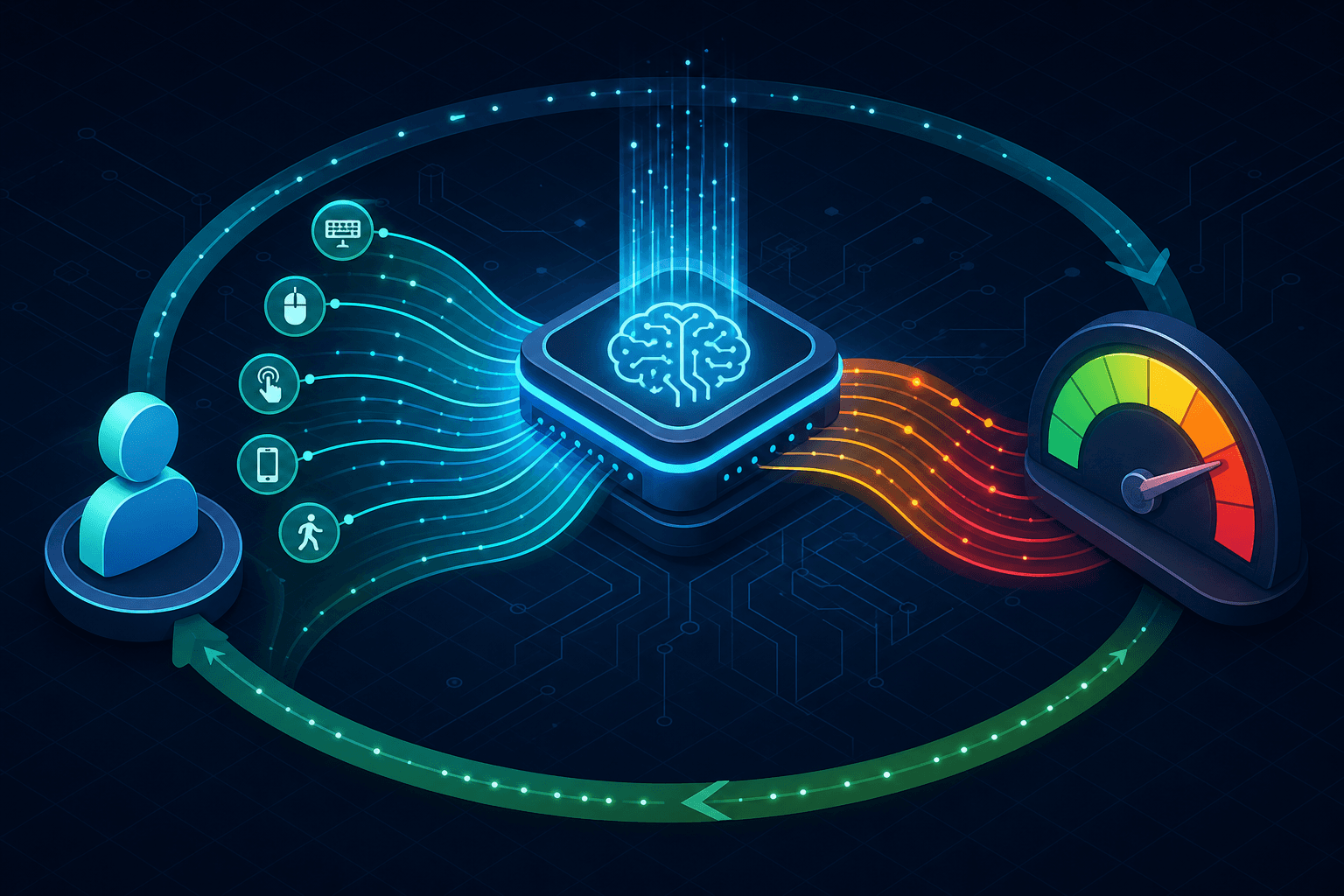
The core mechanism here is not just checking a list of rules, but running a Machine Learning (ML) model against a stream of behavioral and contextual data points. When a user initiates a login, the system does not wait for a second factor; it immediately begins scoring the request. If the request originates from a known device, at a typical location, using standard keystroke dynamics, the risk score remains low, and access is granted. If the request comes from a new device, an unusual geographic location, or exhibits erratic typing patterns, the risk score spikes. This score drives the decision loop: low risk equals pass, medium risk equals step-up challenge (like an OTP), and high risk equals denial. This approach aligns with the Zero Trust principle of "never trust, always verify," but applies it granularly to the session rather than the entire infrastructure.
Extracting Signals: The Behavioral Biometrics Engine
How does the system distinguish between a user rushing to log in and a bot or a fraudster? The answer lies in behavioral biometrics and feature engineering. Unlike static attributes like IP address or User-Agent string, behavioral signals capture the "how" of the interaction. A sophisticated adaptive system ingests high-dimensional features such as keystroke dynamics (dwell time on keys, flight time between keys), mouse trajectory curvature, touch pressure, and even the angle at which a device is held.

Consider a user named "Alice" who types her password with a specific rhythm: she pauses 200ms before hitting the "Enter" key and types her username with a specific velocity. An ML model, trained on Alice's historical baseline, learns this signature. When a login attempt occurs, the system compares the incoming session's telemetry against this baseline. If a fraudster has stolen Alice's password but types it on a different device or with a different cadence, the behavioral deviation triggers a statistical anomaly.
This process relies on unsupervised or semi-supervised learning algorithms, often Isolation Forests or Autoencoders, which are particularly effective at identifying outliers without needing a labeled dataset of every possible attack vector. The model calculates a distance metric between the current session and the user's established cluster of behavior. If the distance exceeds a dynamic threshold, the risk score increases. This mechanism allows the system to detect anomalies that rule-based engines miss, such as a legitimate user traveling abroad (contextual change) versus a fraudster mimicking a user (behavioral mismatch).
The Decision Loop: Real-Time Inference and Step-Up Challenges
Once the risk score is calculated, the system enters the decision loop. This must happen in milliseconds to avoid disrupting the user experience. The logic is not a simple if/else statement but a weighted aggregation of multiple signals. A login from a corporate IP address might carry a negative weight (lowering risk), while a login from a Tor exit node carries a heavy positive weight (increasing risk).
Imagine a scenario where "Bob" attempts to access his banking portal. His request comes from a new laptop in a different city.
{
  "scenario": "Bob's Banking Login",
  "context_check": {
    "ip_location": "Non-corporate",
    "geolocation_delta": "500 miles from home",
    "risk_weight": 40
  },
  "device_fingerprint": {
    "status": "New",
    "user_agent_match": "Recent Chrome update",
    "risk_weight": 20
  },
  "behavioral_check": {
    "keystroke_rhythm": "Matches baseline",
    "risk_weight": 0
  },
  "total_risk_score": 60,
  "threshold_limit": 75,
  "decision": "Medium Risk -> Step-Up Challenge"
}
In this scenario, a static system would block Bob or force a full MFA reset because the device is unknown. An adaptive system sees the behavioral match and determines the risk is "Medium." It triggers a step-up challenge, such as a push notification to his registered mobile device, rather than a full password reset. If Bob approves the push, the system records the new device as "trusted" for that specific session, but crucially, the behavioral baseline is updated incrementally over multiple successful sessions to avoid model poisoning, rather than immediately after one approval. If he denies it, the session is terminated.
This dynamic friction is critical. Overly aggressive policies cause "alert fatigue" and force users to abandon workflows, while lenient policies invite account takeover. The ML model continuously adjusts the thresholds based on the organization's tolerance for risk. For high-value actions, like changing a password or transferring funds, the system lowers the threshold for requiring step-up verification.
Operational Tradeoffs: False Positives and the Feedback Loop
The most significant challenge in deploying adaptive authentication is balancing security with usability. A false positive occurs when the system incorrectly identifies a legitimate user as a threat, forcing unnecessary challenges. A false negative occurs when the system fails to catch an attacker. In the world of ML, these are often inversely related; tightening the model to catch more attacks usually increases false positives.
To manage this, systems employ a feedback loop. When a user completes a step-up challenge, the system records the outcome. If the user complains that the challenge was unjustified, this data point is fed back into the training pipeline. Over time, the model learns to distinguish between a user who is genuinely traveling (high risk context, but consistent behavior) and a user who is being coerced or attacked (high risk context, inconsistent behavior).
However, there are privacy and performance considerations. Collecting behavioral data requires processing power and raises questions about data retention. Furthermore, the model can be subject to "adversarial attacks" where attackers intentionally mimic user behavior to lower their risk score. To counter this, modern implementations often use ensemble models that combine multiple algorithms and periodically retrain on fresh data to adapt to evolving attack patterns.
Ultimately, adaptive authentication acts as a force multiplier within zero trust architecture, shifting the burden of security from the user remembering complex passwords to the system continuously validating intent. By leveraging user behavior analytics and real-time threat detection, organizations can secure their environments without creating the friction that drives users to bypass security controls entirely. This approach is particularly vital as we move toward passwordless security ecosystems, where the absence of a secret key makes behavioral validation even more critical.
Common Pitfalls
Implementing adaptive authentication requires navigating several specific pitfalls that can undermine the system's efficacy:
- Adversarial Mimicry: Attackers are increasingly using AI to mimic user behavior patterns, such as keystroke dynamics or mouse movements, to bypass behavioral checks. Relying on a single algorithm or static baseline makes the system vulnerable to these sophisticated impersonation attacks.
- Alert Fatigue from Aggressive Policies: Setting risk thresholds too low to catch every anomaly can result in excessive step-up challenges for legitimate users. This constant friction leads to "alert fatigue," where users begin to ignore warnings or abandon workflows entirely, negating the security benefits.
- Privacy and Data Retention Concerns: The collection of granular behavioral data raises significant privacy issues. Organizations must ensure compliance with regulations like GDPR or CCPA by defining clear data retention policies and ensuring that behavioral data is anonymized or processed locally where possible.
Practical Takeaways
To successfully deploy adaptive authentication, consider these mental models and rules of thumb:
- Friction Scales with Value: Treat risk thresholds as dynamic variables. Low-risk actions (viewing a profile) should require minimal friction, while high-risk actions (changing a password) should trigger immediate, robust verification.
- Incremental Learning is Key: Never update a user's behavioral baseline based on a single session. Use a sliding window of successful interactions to gradually adjust the model, preventing rapid degradation from one-off anomalies or potential attacks.
- Human-in-the-Loop is Essential: No ML model is perfect. Always design a seamless path for users to report false positives, and ensure that this feedback is weighted heavily in the retraining cycle to improve future accuracy.
FAQ
How does adaptive authentication differ from traditional MFA? Traditional MFA typically requires a second factor (like an OTP) every time a user logs in, regardless of the context. Adaptive authentication is dynamic; it only triggers MFA or step-up challenges when the risk score exceeds a certain threshold, reducing friction for low-risk sessions while maintaining high security for high-risk ones.
What happens if the ML model makes a mistake? If the model flags a legitimate user incorrectly (false positive), the user experiences an extra challenge. If it misses an attacker (false negative), the breach occurs. Both scenarios feed into the feedback loop; false positives are often resolved via user reporting, while false negatives require retrospective analysis and model retraining to close the gap.
Is adaptive authentication GDPR compliant? Yes, provided it is implemented with privacy-by-design principles. Organizations must ensure they have a lawful basis for processing behavioral data, provide transparency about what data is collected, and allow users to opt-out or delete their data. Minimizing data collection to only what is necessary for risk scoring is a best practice for compliance.
Conclusion
Adaptive authentication represents a paradigm shift from static credential validation to continuous, context-aware risk assessment. By integrating behavioral biometrics, device fingerprinting, and real-time machine learning inference, organizations can enforce a "never trust, always verify" strategy that scales with the actual threat level of each session. While operational challenges regarding false positives and data privacy remain, the ability to dynamically adjust friction based on probabilistic risk scores makes this approach essential for modern Zero Trust architectures. As attack vectors evolve, such as the rise of deepfake voice authentication or AI-driven credential stuffing, the feedback loops inherent in these systems will continue to refine the balance between security and user experience.
Related posts
Implementing Risk-Based Authentication with Keycloak and Spring Boot
A technical walkthrough on implementing risk-based authentication using Keycloak and Spring Boot, covering adaptive authentication and risk scoring strategies.
AI in Identity Security: Opportunities & Risks
An examination of AI identity security opportunities and risks, covering machine learning IAM, AI fraud detection, deepfake security, and AI authentication for advanced audiences.
RFC 8693: Token Exchange, Delegation, and Impersonation
RFC 8693 defines token exchange, delegation, and impersonation mechanisms for OAuth 2.0, enabling secure identity propagation across service boundaries.