Securing Legacy Applications with a Reverse Proxy Identity Gateway
An examination of securing legacy applications using reverse proxy identity gateways like Pomerium and Ory Oathkeeper for modernization.
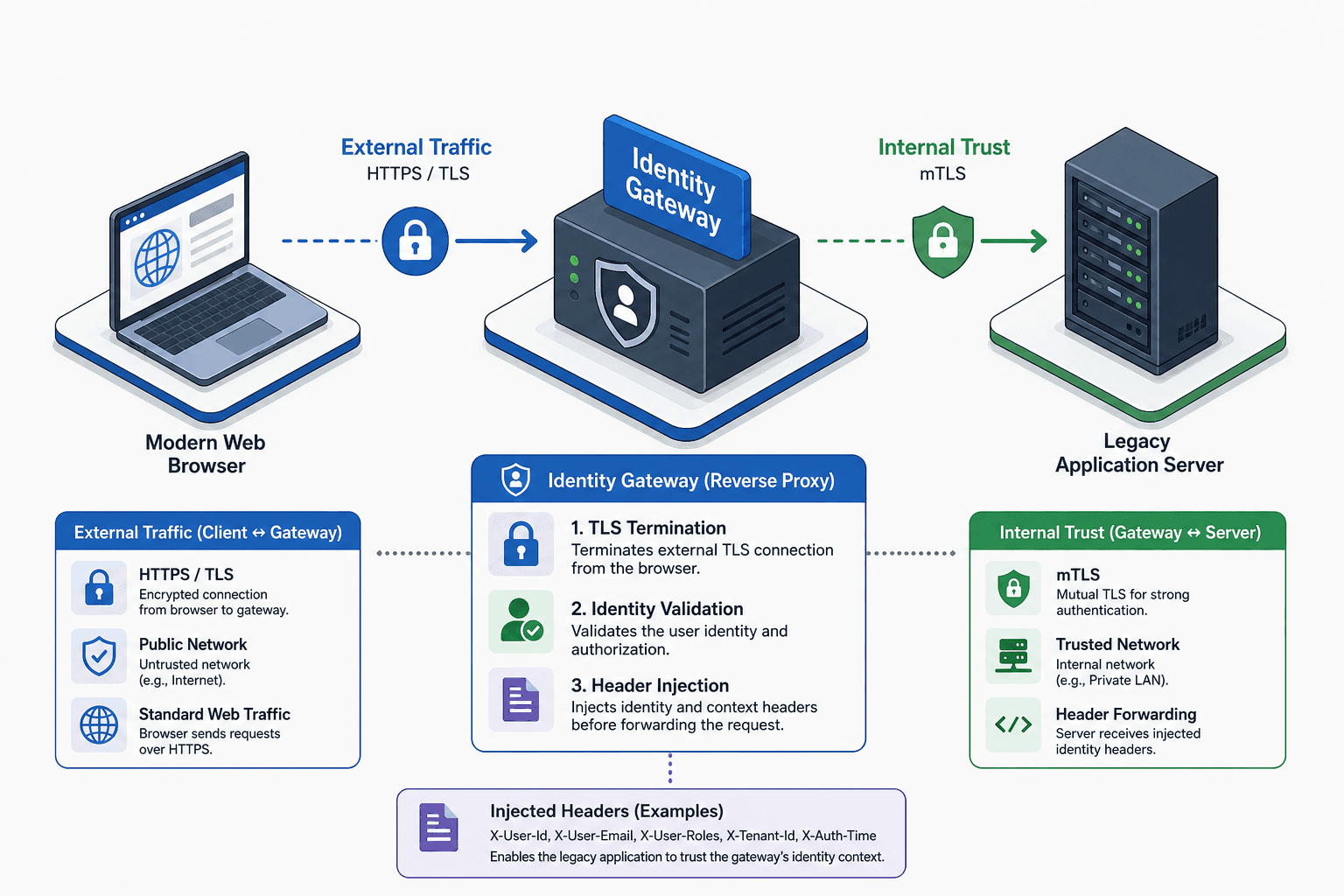
Legacy applications often run on protocols like basic HTTP or self-signed certificates, lacking the modern OAuth2 or OpenID Connect (OIDC) implementations required by today's security standards. Modifying these codebases to add authentication is frequently cost-prohibitive or impossible due to vendor lock-in or deprecated languages. The solution is not to refactor the application, but to wrap it. A reverse proxy identity gateway acts as a security perimeter that terminates TLS, validates user identities, and forwards authenticated requests to the legacy backend using internal trust mechanisms. This approach shifts the authentication burden from the application layer to the infrastructure layer.
The Mechanism of Invisibility
The core mechanism relies on the gateway acting as an opaque intermediary. When a client requests a resource, the gateway intercepts the connection before it reaches the legacy server. It validates the client's credentials against an external Identity Provider (IdP). If valid, the gateway strips the sensitive authentication data (like cookies or tokens) from the request and injects a lightweight, internal assertion before forwarding the traffic. Crucially, a deployment typically utilizes one of two distinct methods for the gateway-to-backend hop: either mutual TLS (mTLS) to establish a cryptographically verified channel where no authentication headers are needed, or header injection (e.g., adding X-Forwarded-User) where mTLS is not strictly required for the authentication step itself. To the legacy application, the request appears to come from a trusted internal service, effectively bypassing the need for the application to understand the user's identity.
Pomerium vs. Ory Oathkeeper
This mechanism differs significantly in implementation between popular tools like Pomerium and Ory Oathkeeper. Pomerium is designed as a data-plane focused solution that uses gRPC for internal communication and supports mTLS natively. Its configuration is declarative, defining rules that map URL paths to specific identity requirements. In contrast, Ory Oathkeeper focuses heavily on the policy engine. It acts as an API gateway that separates the authentication logic (who you are) from the authorization logic (what you can do) using JSON Web Tokens (JWTs) and allows for custom "preservation" and "mutate" adapters.
The Data Flow Walkthrough
Consider a concrete scenario involving a legacy inventory management system running on port 8080 inside a private network. The application accepts only basic HTTP and has no concept of JWTs. An organization deploys Pomerium as the gateway. Pomerium is configured to listen on port 443 for external traffic. When a developer attempts to access inventory.internal, Pomerium challenges the browser for SSO via Google Workspace. Upon successful login, Pomerium issues a short-lived session cookie. When the developer refreshes the page, Pomerium sees the valid session, extracts the user's email from the IdP, and rewrites the request headers to include X-Forwarded-User: developer@example.com. It then tunnels this request to the legacy inventory service. The inventory application sees a request from 127.0.0.1 with a new header, completely unaware that the user just logged in via Google.
The data flow in this architecture ensures that the legacy application never sees the user's raw credentials. In the Pomerium model, the internal communication often utilizes mutual TLS (mTLS), where the gateway presents a client certificate to the backend. This creates a strong trust boundary: even if the network is compromised, an attacker cannot spoof the legacy backend because they cannot present the correct client certificate. Ory Oathkeeper achieves similar trust by injecting a signed JWT into the request headers, which the backend can verify using a shared secret or public key.
Configuration and Deployment Patterns
Configuring a reverse proxy identity gateway requires precise definition of the trust relationships and mutation rules to ensure the legacy backend receives the expected assertions. While the core concepts of authentication and header injection remain consistent, the syntax and required explicitness vary significantly between Pomerium and Ory Oathkeeper. Teams must carefully review the specific schema requirements for each tool to ensure that session state is managed correctly and that the internal transport mechanism (mTLS or headers) is explicitly configured to avoid security gaps.
For a team choosing Pomerium, the configuration leverages a simple YAML structure that defines the service and the authentication provider. The gateway handles the complex dance of exchanging tokens for sessions automatically. However, mTLS is not implicit; it requires explicit certificate configuration.
# pomerium.yaml
authenticate_service_url: https://auth.example.com
policies:
  - from: https://legacy-app.internal
    to: http://inventory-service:8080
    allow:
      - email: "developer@example.com"
    # mTLS requires explicit 'client_tls' and 'server_tls' configuration
    # on both the gateway and the backend to establish the secure tunnel.
    # Without this, the tunnel is standard TLS, not mutual TLS.
Ory Oathkeeper requires a more explicit definition of the authentication flow and the mutation rules. It uses a JSON-based policy file where you define the "authenticator" (e.g., OIDC) and the "executor" (the backend). The key difference is that Ory Oathkeeper often requires you to explicitly define how the request is mutated, whereas Pomerium often handles this implicitly based on the policy context. Note that the configuration below correctly uses request_headers to inject new headers, rather than the incorrect preserved_headers which would only keep existing ones.
// oathkeeper.json
{
  "authenticators": {
    "oidc": {
      "config": {
        "issuer_url": "https://auth.example.com"
      }
    }
  },
  "authorizer": "allow_all",
  "rules": [
    {
      "match": "path",
      "path": "/inventory/*",
      "upstream": {
        "url": "http://inventory-service:8080"
      },
      "mutate": {
        "request_headers": {
          "X-User-Id": "{{ .Authenticator.Subject }}"
        }
      }
    }
  ]
}
A critical tradeoff exists in how these tools handle session state. Pomerium manages session cookies entirely within the proxy, offloading the state management from the backend. This is ideal for stateless legacy apps. Ory Oathkeeper can also manage sessions but often integrates more deeply with existing session stores if the backend needs to maintain state for other reasons. For organizations prioritizing zero-trust architecture where the backend must be strictly isolated, Pomerium's mTLS approach is generally preferred. However, for environments requiring complex, rule-based authorization logic (e.g., "allow access only if the user is in the 'finance' group AND the request is from the corporate subnet"), Ory Oathkeeper's policy engine offers more granular control.
Implementing this pattern requires careful consideration of the backend's network exposure. The legacy application should be bound to localhost or a private interface, accessible only by the identity gateway. This prevents direct access from the public internet, forcing all traffic through the security controls. If the legacy application must remain exposed, the gateway must be the sole entry point, and firewall rules must explicitly block all traffic to the legacy port except from the gateway's IP address.
Conclusion
Finally, while this architecture modernizes the authentication layer, it does not fix vulnerabilities in the application logic itself. The gateway secures the door, but the house remains vulnerable to SQL injection or XSS if the legacy code is flawed. Therefore, this strategy should be viewed as a necessary step in a broader modernization roadmap, not a permanent fix. It buys time by securing the perimeter, allowing teams to prioritize refactoring the application's core logic without exposing users to unauthenticated access.
In summary, reverse proxy identity gateways provide a mechanism to inject modern security controls into legacy systems without code changes. By terminating TLS and validating identities at the edge, they transform insecure, open services into protected resources. Whether using Pomerium's mTLS-centric data plane or Ory Oathkeeper's policy-driven architecture, the result is the same: a secure boundary that isolates the legacy application from the complexities of modern identity management.
FAQ
Q: Can I use a reverse proxy identity gateway with a legacy application that runs on HTTP? A: Yes, this is the primary use case. The gateway terminates the external HTTPS connection, authenticates the user, and then forwards the request to the legacy backend over HTTP (or internal mTLS), shielding the unencrypted internal traffic from the public internet.
Q: Will this solution add significant latency to my legacy application? A: The overhead is generally minimal, typically adding only 10-50ms depending on the IdP response time and the complexity of the policy checks. Modern gateways like Pomerium are optimized for high throughput and low latency.
Q: What happens if the identity gateway goes down? A: Depending on your configuration, you can set the gateway to fail open (allow traffic) or fail closed (block traffic). For security-critical legacy apps, failing closed is usually preferred to prevent unauthorized access, though this requires a highly available gateway setup.
Practical Takeaways
- Trust Boundary First: Always assume the network is hostile. Configure the backend to only accept traffic from the gateway's specific IP or certificate, ignoring any other source.
- Header Sanitization: Ensure the legacy application is configured to trust only the specific headers injected by the gateway and ignores any
X-Forwarded-*headers coming directly from clients. - Certificate Lifecycle: If using mTLS, treat the backend's client certificates as secrets. Implement automated rotation to prevent expiration outages.
Common Pitfalls
- Implicit Trust: Assuming the gateway handles all security without verifying that the backend isn't listening on a public interface.
- Configuration Drift: Allowing the gateway configuration to drift from the actual backend capabilities, leading to failed authentication loops or broken sessions.
- Ignoring Session State: Failing to account for stateful legacy applications that rely on cookies managed by the app itself, which can conflict with the gateway's session management.
Related posts
Security Architecture Review: Patterns for Identity-First Design
An examination of security architecture patterns centered on identity-first design, covering threat modeling and IAM strategies.
Angular OAuth2/OIDC: loadDiscoveryDocumentAndTryLogin
Learn how to use loadDiscoveryDocumentAndTryLogin and strict discovery document validation in Angular for secure OAuth2/OIDC authentication.
The AuthConfig Reference: Every Property That Matters
A complete reference for Angular-OAuth2-OIDC AuthConfig properties, covering requireHttps, remoteOnly, and nonceStateSeparator for secure Angular authentication.