OAuth2 Dynamic Client Registration for Multi-Tenant SaaS
An examination of OAuth2 Dynamic Client Registration (DCR) as a solution for automated client provisioning within multi-tenant SaaS environments.
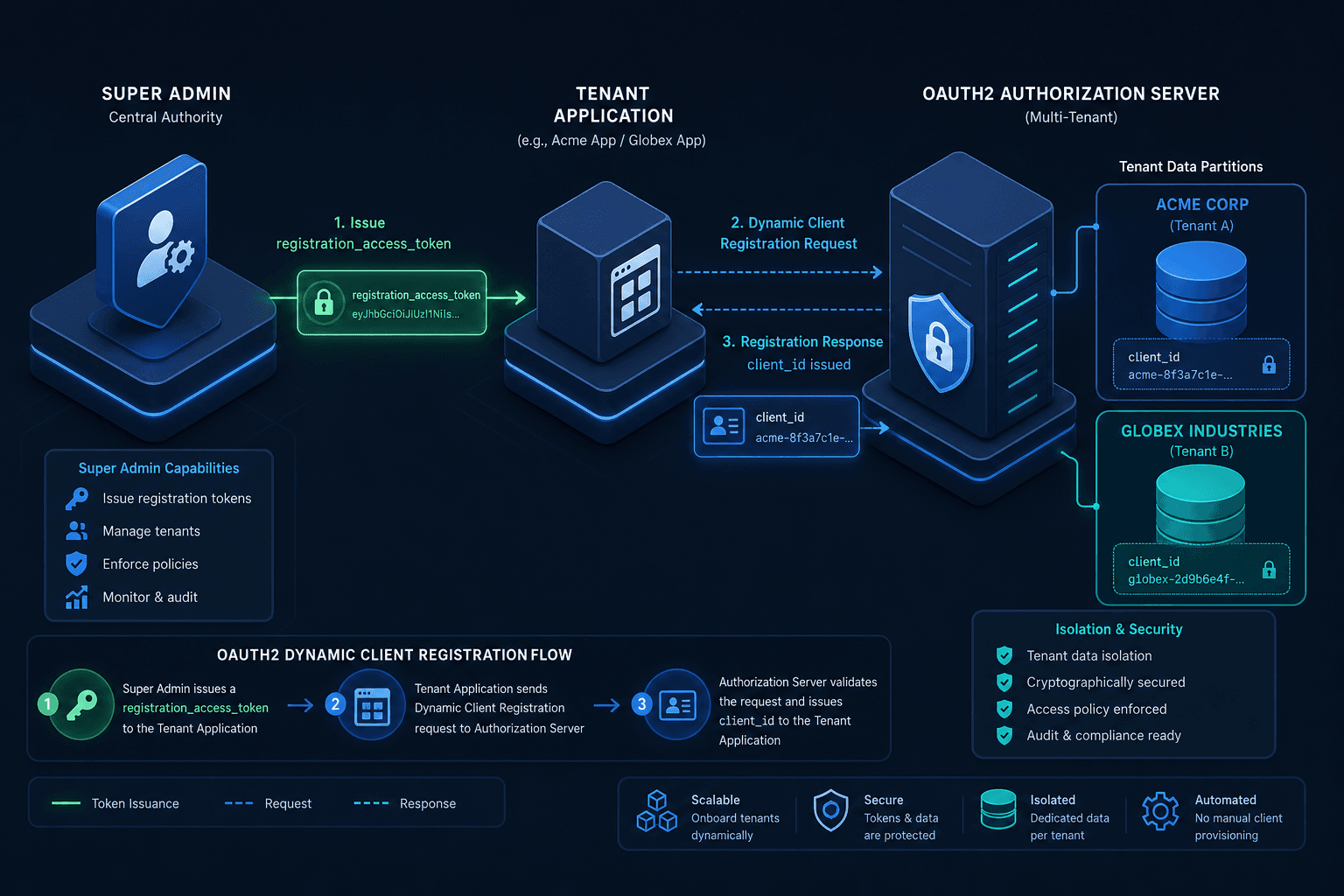
In a traditional multi-tenant SaaS architecture, provisioning a new client application for a customer often involves a manual intervention loop: a support ticket, an admin logging into a dashboard, generating a client ID and secret, and manually configuring redirect URIs. This approach creates a bottleneck and a security risk. The mechanism that solves this is OAuth2 Dynamic Client Registration (DCR), defined in RFC 7591. DCR allows a client application to register itself with the authorization server programmatically at runtime. For a multi-tenant platform, this shifts the boundary of trust: the "platform operator" issues a short-lived registration token, and the tenant's application uses that token to bootstrap its own identity within the system without further human touch.
The Mechanism of Registration
The core mechanism of DCR relies on a specific endpoint, the registration_endpoint, which accepts a POST request containing a JSON object. As defined in RFC 7591, this object includes the client_metadata—a set of parameters describing the client's requirements—and an optional registration_access_token. When a tenant application initiates the flow, it sends a request to this endpoint. The authorization server validates the registration_access_token (which proves the requester has been authorized by the platform to create clients) and then parses the metadata according to the specifications outlined in the OAuth 2.0 Dynamic Client Registration Protocol. If the metadata is valid, the server generates a unique client_id and, optionally, an initial client_secret. It then responds with a JSON payload containing these credentials and a registration_client_uri and registration_access_token for future updates.
Consider a scenario involving a SaaS platform named "Nexus" serving two tenants: "Acme Corp" and "Globex Industries." The Nexus platform operator maintains a master registration_access_token for Acme. When Acme's engineering team deploys a new microservice, the service sends a POST request to https://nexus.example.com/oauth2/register. The request body includes the client_metadata JSON:
{
  "client_name": "Acme Billing Service",
  "redirect_uris": [
    "https://acme.example.com/callback",
    "https://acme-billing.internal/callback"
  ],
  "grant_types": [
    "authorization_code",
    "refresh_token"
  ],
  "scope": "acme:read acme:write",
  "tenant_id": "acme-corp-001"
}
Tenant Isolation via Metadata
The authorization server processes this request. Crucially, the server does not just store the tenant_id string; it enforces isolation by binding the resulting client_id to the acme-corp-001 partition in its internal database. The response from the server includes a new client_id (e.g., c_8f3a2b1c) and a registration_access_token. This registration_access_token is distinct from the client_secret. It allows the client to update its metadata later, such as adding a new redirect URI, without needing to contact the platform administrator.
This mechanism ensures that tenant isolation is not just a database constraint but a protocol constraint. If Acme attempts to register a client with a scope of globex:admin, the server rejects the request immediately because the registration_access_token used to initiate the registration is scoped to acme only. The client_metadata acts as the contract between the tenant and the platform, defining exactly what resources the client can access. This eliminates the "shared secret" problem where a single global secret grants access to all tenants, a common vulnerability in older SaaS designs.

The Lifecycle of a Tenant Client
The lifecycle of a dynamically registered client involves strict token management. The registration_access_token returned in the initial response is designed to be short-lived. Once the client has secured its client_id and client_secret, it should rotate or discard the registration_access_token. This limits the window of opportunity for an attacker who might intercept the registration response. If the client needs to update its configuration later, it must use the registration_client_uri provided in the response, sending a PATCH request with the updated metadata and the current registration_access_token.
For the SaaS operator, this changes the operational model significantly. Instead of maintaining a registry of client IDs, the operator only manages the registration_endpoint configuration and the issuance of the initial registration_access_tokens. These tokens can be generated dynamically per tenant or per deployment environment using a signed JWT. When a new tenant signs up, the system generates a unique registration_access_token and provides it to the tenant's onboarding script. The script then executes the DCR flow, provisioning the client automatically.
One critical implementation detail is the handling of client_secret rotation. In the base DCR specification (RFC 7591), the client_secret is often returned only once during the initial registration. If the secret is leaked, the client cannot simply "reset" it via a standard password reset flow unless the server implements the Refresh Token Rotation extension defined in RFC 9700. Without this specific extension, the client must use the registration_client_uri to update its metadata, which may trigger the generation of a new secret depending on the server's configuration, but this is not a mandatory behavior of the core protocol. This forces a deliberate action for secret management, reducing the risk of accidental leakage in logs or configuration files.
The security posture of this system relies heavily on the integrity of the registration_access_token. This token must be treated as a high-privilege credential. If an attacker obtains the registration_access_token for a tenant, they can register malicious clients with arbitrary scopes and redirect URIs. Therefore, the distribution of this token must be secured, often via out-of-band channels or secure vaults. Additionally, the authorization server must validate the redirect_uris strictly against the tenant's allowed domains to prevent open redirection attacks, which are particularly dangerous in a multi-tenant context where one tenant's compromise could lead to cross-tenant data leakage.
Conclusion
In conclusion, OAuth2 Dynamic Client Registration is not merely a convenience feature; it is a fundamental architectural shift for multi-tenant SaaS platforms. By automating the provisioning of client identities, DCR reduces the attack surface associated with manual credential management and enforces tenant isolation at the protocol level. The mechanism ensures that every client is uniquely bound to its tenant's scope and configuration, preventing the lateral movement of privileges that plagues static, manually provisioned systems. As SaaS architectures grow more distributed, the ability to programmatically establish trust relationships becomes a requirement, not a luxury.
Common Pitfalls
Implementing DCR introduces specific risks that differ from static client configurations. Understanding these pitfalls is critical for maintaining security posture.
- Registration Token Leakage: The
registration_access_tokenis a high-privilege credential. Storing this token in client-side code, public repositories, or unencrypted configuration files allows attackers to register their own malicious clients under the tenant's identity. - Scope Misconfiguration: During the
client_metadatasubmission, if thescopeparameter is not strictly validated against the tenant's entitlements, a malicious actor could request broader permissions than intended, potentially accessing resources belonging to other tenants or administrative functions. - Redirect URI Validation Gaps: Failing to enforce strict validation of
redirect_urisagainst a whitelist of allowed domains can lead to Open Redirection vulnerabilities. In a multi-tenant setting, this could allow an attacker to intercept authorization codes for one tenant by exploiting a misconfigured redirect URI in another tenant's client.
Practical Takeaways
To successfully deploy DCR, adopt these mental models and rules:
- Token as a Key, Not a Secret: Treat the
registration_access_tokenas a temporary key that grants access to the registration endpoint, not as a permanent secret. It should have a short TTL and be rotated frequently. - Metadata is the Contract: The
client_metadatais the binding agreement between the tenant and the platform. Every field in this JSON object should be validated against the tenant's policy before acceptance. - Defense in Depth for Secrets: Do not rely solely on DCR for secret management. Implement additional controls, such as requiring out-of-band confirmation for sensitive metadata changes or integrating with a dedicated secrets management solution for long-term storage.
FAQ
Q: Can I use DCR for public clients?
A: Yes, DCR supports public clients (those that cannot keep a secret). However, the security model changes; without a client_secret, the registration_access_token becomes even more critical as it is the primary proof of identity for the registration process.
Q: How do I handle client_secret rotation if my server doesn't support RFC 9700?
A: If your server does not implement the Refresh Token Rotation extension (RFC 9700), you must rely on the registration_client_uri to update the client metadata. You can configure your server to generate a new client_secret upon a successful metadata update, effectively forcing a rotation when the tenant updates their configuration.
Q: Does DCR eliminate the need for manual onboarding?
A: DCR automates the technical provisioning of client credentials, but it does not eliminate the need for governance. You still need a process to issue the initial registration_access_token to the tenant securely and to audit the registered clients periodically.
Related posts
Understanding OAuth2 Incremental Authorization
A technical overview of incremental authorization in OAuth2 to improve scope management and consent user experience.
Securing OAuth2 Bearer Token Usage: RFC 6750 Best Practices
An examination of OAuth2 bearer token usage and RFC 6750 best practices for securing Authorization headers and handling common errors.
Understanding JWKS: Rotating Signing Keys Gracefully
An examination of JSON Web Key Set (JWKS) mechanisms for securely rotating signing keys and verifying JWTs without service interruption.