Securing OAuth2 Bearer Token Usage: RFC 6750 Best Practices
An examination of OAuth2 bearer token usage and RFC 6750 best practices for securing Authorization headers and handling common errors.
OAuth2 Bearer Token Usage: RFC 6750 Best Practices
Bearer tokens function as stateless credentials where possession equates to authority. Their security model relies entirely on the transport layer (TLS) and strict adherence to RFC 6750 header formatting, rather than the complexity of the token string itself. This guide examines the mechanism of token transmission, the critical role of secure channels, proper error handling, and lifecycle management strategies required to secure API interactions.
The Mechanism of Possession
The fundamental mechanism of an OAuth2 bearer token is simplicity disguised as complexity. Unlike a session ID stored in a cookie, which the browser manages automatically, a bearer token is a raw string of characters that acts as a digital key. When you present this key to a resource server, the server does not check a database of "valid sessions." Instead, it validates the token's signature and claims. If the token is valid, the server grants access.
The specification defines this relationship explicitly: "The client must not use the bearer token in a URL." This design choice forces the developer to handle the transmission explicitly, removing the ambiguity of how the credential travels across the network.
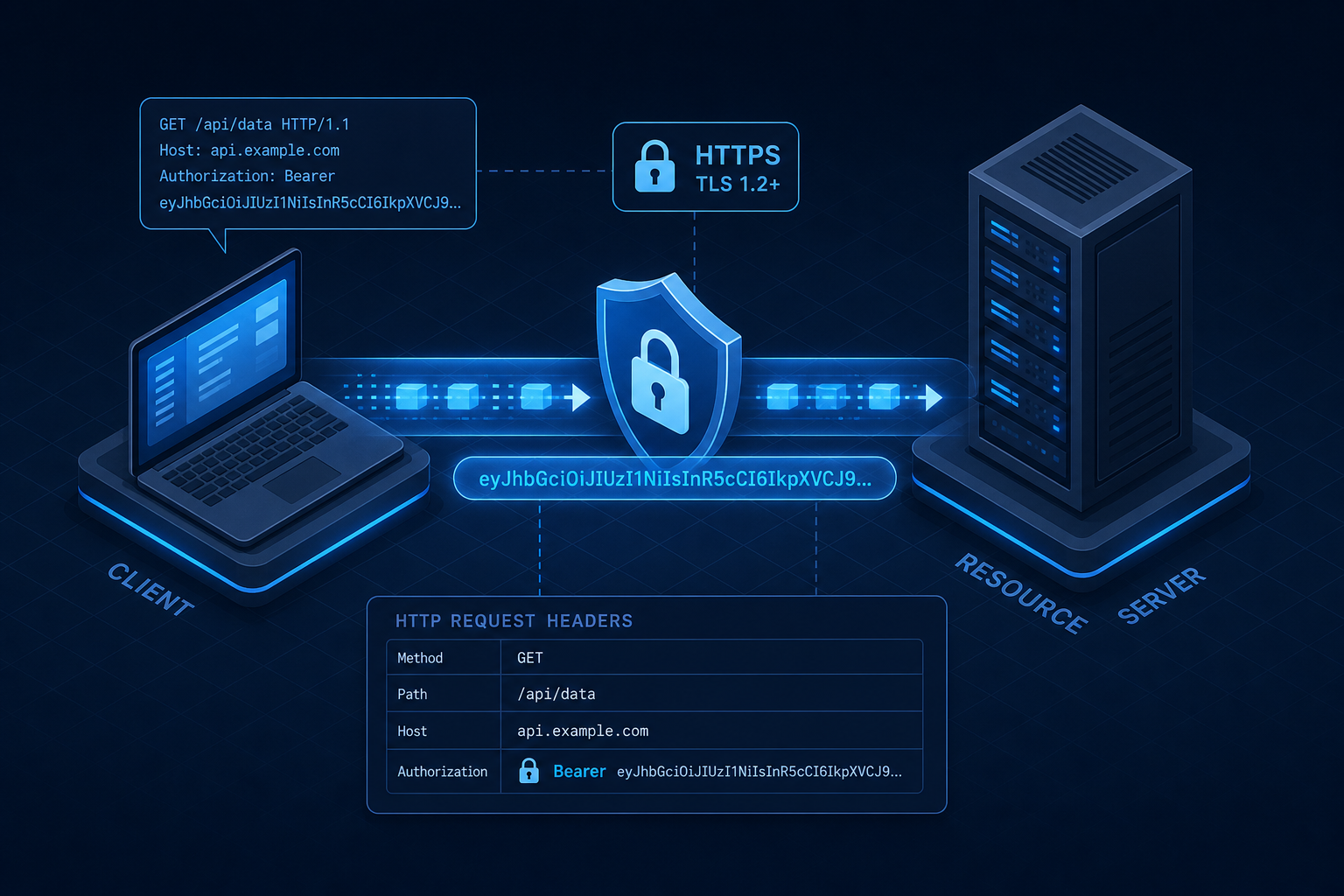
Consider a scenario where a mobile app needs to fetch a user's profile from an API. The app receives a token from the authorization server. To access the profile, the app constructs an HTTP GET request. The critical step here is the construction of the Authorization header. The client must format the header exactly as Authorization: Bearer <access_token>. Note the space between the word "Bearer" and the token value. If the client omits this space, or if it includes the word "Bearer" in lowercase as authorization: bearer <token>, the server will reject the request. RFC 6750 mandates case-sensitive matching for the scheme name. A server implementation that fails to validate this specific string format creates a vulnerability where attackers might bypass validation or cause denial of service by sending malformed headers.
Transport Security & Header Formatting
The security of this mechanism relies entirely on the transport layer. Because the token is a "bearer" token, anyone who possesses it can use it. There is no cryptographic binding to the specific device or IP address that requested it. Therefore, the specification requires that bearer tokens be transmitted only over secure channels. In practice, this means every request carrying a bearer token must use HTTPS with TLS 1.2 or higher.
If a developer allows a bearer token to be sent over an unencrypted HTTP connection, the token is effectively plaintext. Any attacker on the same network, such as someone on a public Wi-Fi, can intercept the packet, extract the token, and immediately impersonate the user. The token itself cannot distinguish between the legitimate user and the interceptor because it contains no proof of identity other than its validity.
Furthermore, RFC 6750 strictly prohibits placing the bearer token in the URI query string. Some developers attempt to simplify debugging by appending the token to the URL, like https://api.example.com/user?id=123&access_token=abc123. This is a critical failure. URLs are often logged in web server access logs, proxy logs, and browser history. Once the token appears in a log file, it is exposed to anyone with read access to those logs. The mechanism of bearer tokens assumes the token is never visible outside the direct request headers. By moving the token to the URL, you violate the core assumption of the security model.
Error Handling & HTTP Status Codes
When the server receives a request, it must validate the token. If the token is missing, expired, or malformed, the server must respond with a specific HTTP status code to guide the client. RFC 6750 defines a set of error responses to ensure the client knows exactly what went wrong.
If the token is missing, the server returns 401 Unauthorized. If the token is present but invalid (e.g., the signature is wrong or it has expired), the server returns 401 Unauthorized with a WWW-Authenticate header indicating the error type. For example:
WWW-Authenticate: Bearer error="invalid_token", error_description="The access token expired"This specific header allows the client to programmatically detect that the token is no longer usable and trigger a refresh flow without confusing the user.
Another critical error code is 401 Unauthorized or 403 Forbidden with the error invalid_scope. This occurs when the token is valid, but the client is trying to access a resource that requires permissions not granted in the token's scope. For instance, if a token has read:profile scope but the API endpoint requires write:profile, the server must reject the request. The scope validation logic is an authorization decision defined by the resource owner and the resource server implementation, not strictly mandated by the bearer specification itself. The server checks if the required scope exists in the token's metadata to prevent privilege escalation where a token with limited permissions could accidentally access sensitive data.
Token Lifecycle & Mitigation
The final layer of defense is the lifecycle management of the token. Because bearer tokens are stateless, the server does not know when a token is stolen. The only way to mitigate this is to make the token expire quickly. While RFC 6750 itself does not mandate a specific expiration time, RFC 6749 Section 5.1 and security best practices outlined in RFC 8252 (Security Considerations for OAuth 2.0) recommend that access tokens have short lifetimes.
If a token is valid for 30 days and is stolen, the attacker has 30 days to use it. If the token is valid for 15 minutes, the attacker has only 15 minutes. This is why the OAuth2 specification includes a refresh token mechanism. The access token is short-lived, and the client uses the refresh token to obtain a new access token when the old one expires. This limits the window of opportunity for an attacker.
Common Pitfalls
Developers frequently introduce vulnerabilities through implementation errors rather than protocol flaws. Three common pitfalls include:
- Bearer tokens in URLs: As noted, placing tokens in query strings exposes them to logs and browser history. Always use the
Authorizationheader. - Missing TLS: Transmitting tokens over HTTP without TLS encryption renders the "bearer" property useless, as the token is readable by any network observer.
- Improper error handling assumptions: Assuming that a
401always means "bad token" can lead to poor user experience. Clients must parse theWWW-Authenticateheader details to distinguish between expired tokens, malformed tokens, and missing scopes.
Practical Takeaways
To ensure robust security, adopt these mental models:
- Possession is Power: Treat the token string like a password; if you see it, you own the identity.
- Header Only: Never deviate from the
Authorization: Bearerheader format. - Assume Compromise: Design your system assuming every token in transit could be intercepted, which dictates short expiration times and strict TLS requirements.
Conclusion
Implementing OAuth2 bearer tokens according to RFC 6750 requires strict discipline. You must use the Authorization: Bearer <token> header, never the URL. You must enforce TLS 1.2+ for all transmissions. You must parse the specific error codes returned by the server to handle invalid tokens gracefully. And you must design your system to assume that any token in circulation could be compromised, necessitating short expiration times. The security of the system is not in the complexity of the token string, but in the rigorous adherence to these transmission and validation rules. Deviating from these mechanisms introduces vulnerabilities that cannot be fixed by simply making the token longer or more complex.
FAQ
Q: Can I use the Authorization header for POST requests?
A: Yes, the Authorization: Bearer header is standard for all HTTP methods (GET, POST, PUT, DELETE) that require authentication.
Q: What is the difference between an access token and a refresh token? A: An access token is short-lived and used to access resources directly. A refresh token is longer-lived and used specifically to obtain new access tokens when the current one expires.
Q: Why does my server return 401 instead of 403 for scope errors?
A: RFC 6750 allows both. Some implementations return 401 with invalid_scope to indicate the token lacks the necessary scope, while others return 403 to indicate the authenticated user is not permitted to perform the action. The specific behavior depends on the resource server implementation.
Related posts
Understanding JWKS: Rotating Signing Keys Gracefully
An examination of JSON Web Key Set (JWKS) mechanisms for securely rotating signing keys and verifying JWTs without service interruption.
OAuth2 Dynamic Client Registration for Multi-Tenant SaaS
An examination of OAuth2 Dynamic Client Registration (DCR) as a solution for automated client provisioning within multi-tenant SaaS environments.
Keycloak Client Scopes and Protocol Mappers Explained
A detailed look at Keycloak client scopes and protocol mappers for token customization and claim management.