Implementing Progressive Profiling in Identity Applications
A technical examination of progressive profiling strategies within CIAM systems to optimize user onboarding and profile enrichment.
In a standard Customer Identity and Access Management (CIAM) flow, the system often demands a complete identity snapshot before granting access. This approach treats user data as a monolithic requirement, forcing the user to provide their name, email, phone number, company, job title, and industry simultaneously. For the user, this is a high-friction transaction where they perform significant work before receiving any value. The mechanism at play is "cognitive load." When a form exceeds a threshold of fields, the perceived effort outweighs the perceived reward, leading to abandonment. Progressive profiling disrupts this mechanism by treating data collection as a series of micro-transactions rather than a single barrier. It leverages the existing trust established during initial authentication to request additional data only when the user has demonstrated sufficient engagement to justify the request.
The core mechanism relies on a persistent state machine within the identity provider. Unlike a standard registration form that validates all inputs against a schema before submission, a progressive system maintains a "known" set of attributes and an "unknown" set. When a user logs in, the system checks the current state of their profile against the desired state. If the user has provided a name and email but lacks a job title, the system does not display a full form. Instead, it presents a targeted, single-field or multi-field prompt that feels like a natural conversation extension. This strategy aligns with the "progressive data collection" principle, where information is revealed only when needed to complete specific user goals.
The Friction Mechanism and Latency Distribution
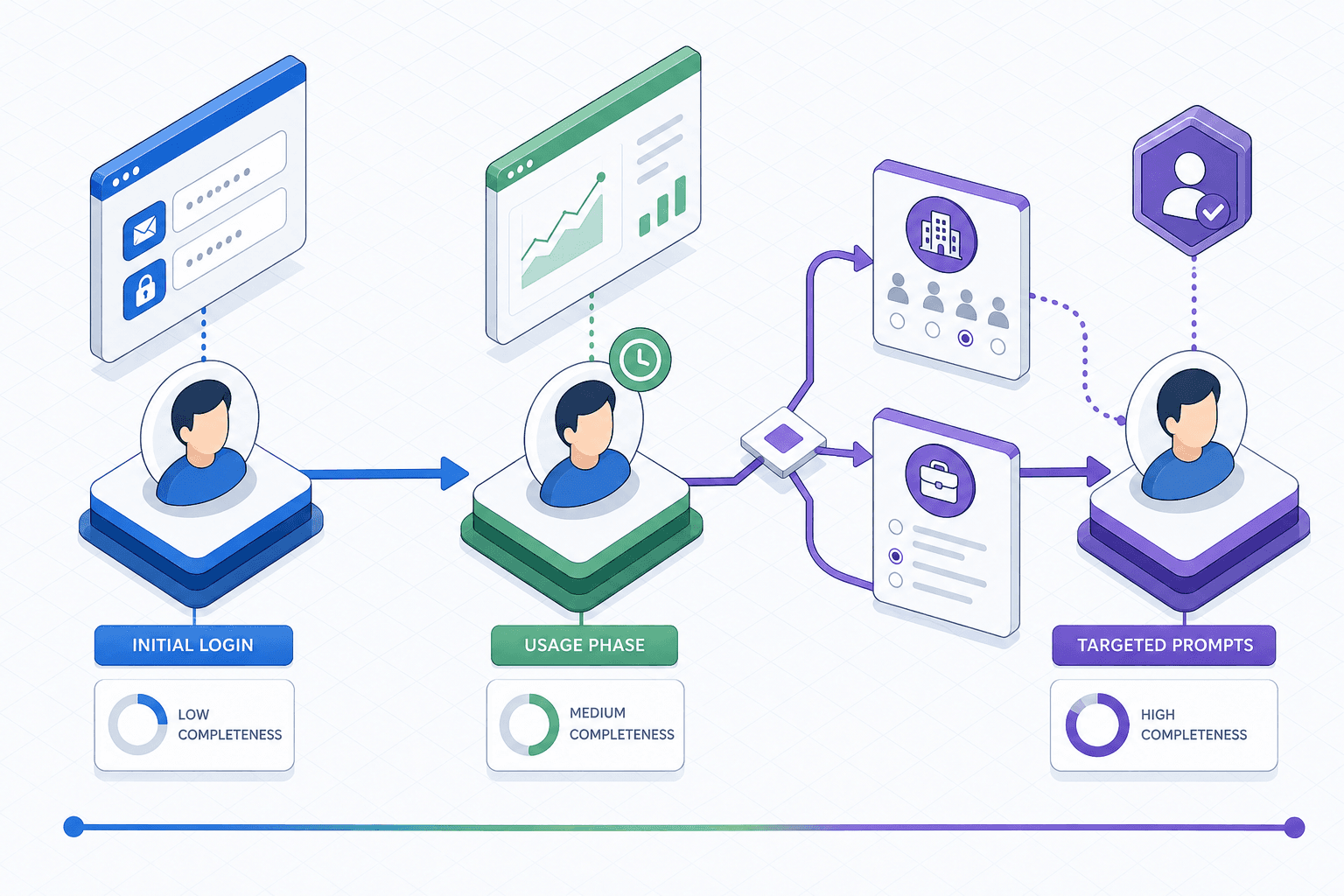
The traditional "registration wall" creates a cognitive bottleneck where users abandon flows due to excessive field counts. Progressive profiling functions as a latency-based distribution strategy, shifting data collection to moments of high trust.
Consider a concrete scenario involving two actors: Alice, a new user, and the Identity Provider (IdP) system named "Vertex." Alice visits a SaaS platform to try a free trial. In a traditional flow, Vertex forces Alice to fill out a 15-field registration form. Alice abandons the process after the 5th field because she doesn't want to type her phone number yet.
In a progressive profiling implementation, Vertex changes the protocol. Alice enters only her email and creates a password. Vertex creates a user record with status: active but profile_completeness: 15%. The system grants immediate access to the core feature. Alice uses the product for ten minutes. During this session, she clicks a "Get Started" button for a premium feature that requires knowing her company size. Vertex intercepts this intent. Instead of blocking her, Vertex triggers a modal overlay asking, "What is your company size?" This is a single-field request. Alice answers. Vertex updates her profile, marking company_size as known. Later, when Alice logs in again, Vertex recognizes her. She sees a different prompt: "We noticed you haven't specified your role. Who do you work with?"
This incremental approach works because the user has already invested time in the product, increasing their intrinsic motivation to complete the profile.
State Management and Trust Graph Architecture
The technical implementation of this strategy requires an event-driven architecture with resilient reliability. The IdP must expose an API or webhook system that allows the application to query the user's attribute status. The logic flow typically follows this pattern:
// Pseudocode for the Progressive Profiling Middleware
function checkProfileCompleteness(user, requiredAttributes) {
  const knownAttributes = user.getKnownAttributes();
  const missingAttributes = requiredAttributes.filter(attr => !knownAttributes.includes(attr));

  if (missingAttributes.length > 0) {
    // Delegate decision logic to IdP based on business context
    const recommendation = idp.getRecommendedNextAttribute(missingAttributes, user.context);

    return {
      action: 'show_modal',
      field: recommendation.field,
      context: 'onboarding_flow'
    };
  }
  return { action: 'allow_access' };
}
This logic must be embedded in the application layer, not just the IdP layer, to allow for contextual triggers. The IdP provides the schema and the storage, but the application decides when to invoke the check. For example, a user might be prompted for their phone number only when they attempt to enable Two-Factor Authentication (2FA), not during the initial login. This ensures the request is justified by the immediate need.
However, this architecture introduces a specific risk: data consistency. If Alice updates her job title in one session and her company size in another, the system must handle these updates without creating contradictions. A naive implementation might overwrite previous data or fail to merge updates correctly. The solution lies in a versioned profile schema. Every attribute update should be timestamped and logged. If a user provides conflicting information (e.g., "Engineer" in one session and "Manager" in another), the system does not automatically overwrite data based on recency. Instead, it flags the record for manual review or prompts the user to confirm the correct value during a dedicated "edit profile" flow. This reliance on user-initiated edits preserves the integrity of the progressive model, which assumes that missing fields are filled only when the user is ready to provide them.
Furthermore, the system must handle the "edit profile" loop gracefully. Users will eventually want to change the data they provided earlier. The progressive profiling mechanism must ensure that the "edit" interface is as frictionless as the initial collection. If a user has to navigate through a complex settings page to change a single field that was previously collected via a modal, the friction returns. The UI must present the collected data in a way that allows immediate modification.
Trigger Logic and Contextual Injection
There is also a critical security consideration regarding the user trust context. As the system collects more data, the user's profile becomes a richer target for social engineering. The IdP must ensure that the progressive collection does not inadvertently expose sensitive data or allow attackers to probe the system by attempting to fill in missing fields. The "unknown" attributes should not be exposed to the client in a way that suggests what information is missing unless necessary for the prompt.
From a data governance perspective, progressive profiling requires a clear definition of "required" versus "optional" attributes. Not all data collected is created equal. Some attributes are essential for legal compliance (like age verification), while others are purely for personalization. The system should treat these differently. Mandatory data collection can be enforced at specific high-value checkpoints (e.g., before a purchase), while optional data collection remains entirely progressive.
Implementing this strategy also impacts analytics. Traditional registration funnels measure conversion from "start" to "finish." With progressive profiling, the funnel becomes a spiral. You must track the conversion rate of each individual micro-interaction. Did the "company size" modal convert? Did the "phone number" prompt increase retention? Without granular tracking, you cannot optimize the sequence of questions. The data flow must support event logging for every attribute request and acceptance.
Data Consistency and Race Conditions
The trade-off here is complexity. A static form is simple to build; a progressive system requires a stateful backend, dynamic UI rendering, and careful logic to determine the next best question. It is an opinion that the complexity is justified only when the user acquisition cost is high and the lifetime value of the user depends on deep profile data. For low-value, high-volume applications, the overhead of maintaining a progressive state machine may outweigh the benefits of reduced abandonment.
Ultimately, progressive profiling is a mechanism for aligning user incentives with system data needs. It shifts the burden of data entry from the moment of skepticism (registration) to the moment of engagement (usage). By breaking the monolithic form into context-aware, high-value requests, CIAM systems can achieve higher completion rates without sacrificing data quality. The key is to ensure that every request feels like a necessary step in the user's journey, not an interrogation.
When designing the schema, consider the "edit" capability as a first-class citizen. If a user can easily correct a mistake made during a progressive prompt, they are more likely to trust the system and provide accurate data initially. This reduces the long-term maintenance cost of cleaning up bad data. The system should also allow users to skip prompts without penalty, but perhaps with a gentle nudge about the benefits of completing the profile later.
The final architectural decision involves the storage layer. Whether using a relational database or a NoSQL document store, the user profile must be mutable and versioned. A JSON document structure is often preferable for this use case, allowing attributes to be added dynamically without schema migrations. This flexibility supports the evolving nature of progressive data collection.
Common Pitfalls
Implementing progressive profiling introduces specific risks that can degrade the user experience if not managed carefully.
- Over-prompting: Triggering too many modal popups in a single session can overwhelm users, effectively recreating the friction of a long form. The system must intelligently space out requests across multiple sessions.
- Data Fragmentation: Collecting data piecemeal can lead to inconsistent user experiences if the application does not sync profile states reliably across different devices or sessions.
- User Fatigue: Users may feel interrogated if the prompts feel intrusive or irrelevant to their current task. Each request must clearly demonstrate immediate value to the user.
Practical Takeaways
To successfully deploy progressive profiling, focus on these core strategies:
- Context-Aware Triggers: Only request data when the user's current action implies a need for that specific information.
- Seamless Editing: Ensure that the interface for correcting previously provided data is as easy as the initial entry point.
- Granular Analytics: Track conversion rates for every individual prompt to continuously refine the sequence of questions.
FAQ
Q: Does progressive profiling require a new identity provider? A: Not necessarily. Many modern IdPs support attribute-based APIs that allow you to query and update profiles incrementally. The key is whether the IdP supports the state management logic required for progressive flows.
Q: How do I handle users who never complete their profile? A: Accept that some users will remain incomplete. Focus on the core value proposition of your product. You can still personalize the experience based on the data you have, but avoid blocking access to core features unless legally required.
Q: Can I use progressive profiling for mandatory fields like age verification? A: Yes, but with caution. Mandatory fields should be collected at high-trust moments (e.g., before a purchase) rather than during casual browsing. The justification for the request must be explicit.
Conclusion
In conclusion, progressive profiling is not merely a UI pattern; it is a data strategy. It requires a thorough knowledge of user psychology, a reliable backend state machine, and a commitment to minimizing friction at every step. When implemented correctly, it transforms the identity lifecycle from a gatekeeping event into a continuous, value-exchange relationship.
Related posts
Angular OAuth2/OIDC: loadDiscoveryDocumentAndTryLogin
Learn how to use loadDiscoveryDocumentAndTryLogin and strict discovery document validation in Angular for secure OAuth2/OIDC authentication.
The AuthConfig Reference: Every Property That Matters
A complete reference for Angular-OAuth2-OIDC AuthConfig properties, covering requireHttps, remoteOnly, and nonceStateSeparator for secure Angular authentication.
RFC 9700: The Mandatory Guardrails for OAuth 2.0
An examination of RFC 9700, detailing OAuth 2.0 security best current practices, including mitigation of mix-up attacks and redirect URI validation.