Understanding and Implementing CWE-287: Improper Authentication
An examination of CWE-287 improper authentication vulnerabilities, covering OWASP guidelines and essential security fixes for robust authentication systems.
Understanding and Implementing CWE-287: Improper Authentication
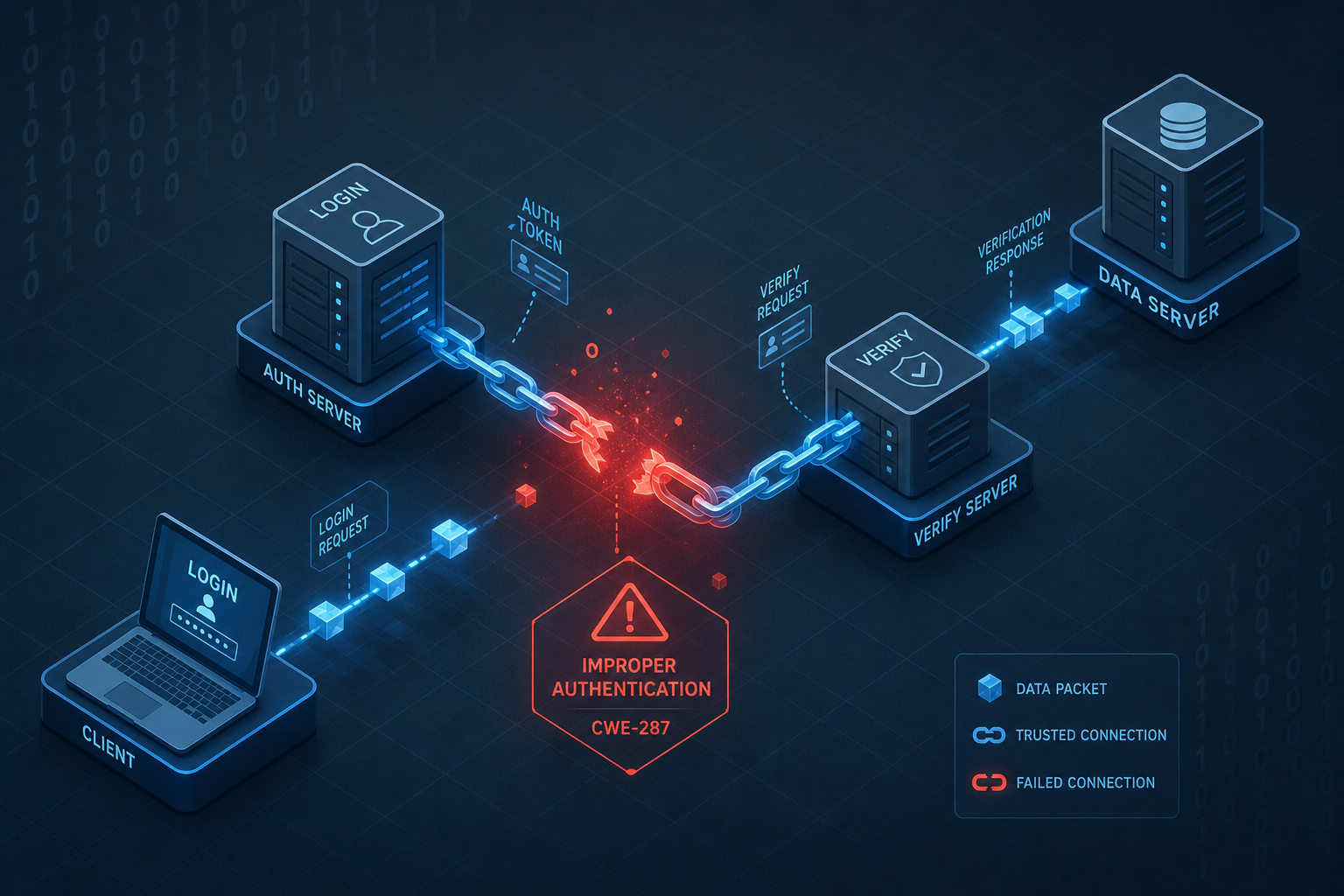
Improper Authentication (CWE-287) occurs when an application fails to prove the identity of a user before granting access to protected resources. In a correctly implemented system, the mechanism is a strict handshake: the client presents credentials, the server cryptographically verifies them against a trusted store, generates a unique session artifact, and then maintains a stateful link between that artifact and the verified identity for the duration of the interaction. While stateless models like JWTs rely on signature verification rather than server-side session lookups, the core principle of verifying identity remains the same. A failure in this chain—whether through weak password validation, predictable session IDs, or accepting unsigned tokens—allows an attacker to assume the identity of a legitimate user without possessing their secrets.
The core mechanism of a CWE-287 exploit relies on breaking the link between the session_id and the user_identity. Consider a scenario where a developer implements a login form but fails to implement secure session management. When a user logs in with the username alice and password hunter2, the server creates a session object. If the server generates a session ID using Math.random() or a predictable timestamp, an attacker can guess the ID. The server, seeing a valid ID in the Cookie header, assumes the request belongs to alice. The authentication check is effectively skipped because the server trusts the ID itself rather than verifying the ID's origin against a fresh credential check. This is the essence of improper authentication: the system trusts an assertion it cannot validate.
According to the Common Weakness Enumeration, CWE-287 covers failures in user identification and authentication mechanisms, including weak passwords, missing multi-factor authentication, and session management flaws. In OWASP Top 10 2021, Identification and Authentication Failures is listed as A07:2021, distinct from Broken Access Control (A01:2021). This category highlights risks where attackers compromise authentication credentials or exploit implementation flaws to assume other users' identities.
The Mechanism of Session Management
Session management is the primary vector for improper authentication. When a user authenticates, the server must issue a session token. This token acts as a temporary key. The mechanism fails when this key is transmitted insecurely, stored insecurely, or generated with insufficient entropy.
In a secure implementation, the session cookie must have the HttpOnly flag set to prevent client-side scripts from reading the token, preventing Cross-Site Scripting (XSS) theft. It must also have the Secure flag to ensure transmission only over HTTPS, preventing Man-in-the-Middle (MitM) interception. Furthermore, the SameSite attribute should be set to Strict or Lax to prevent Cross-Site Request Forgery (CSRF) attacks where a malicious site forces the browser to send the valid session cookie to the target application.
{
  "Set-Cookie": "session_id=abc123; Path=/; HttpOnly; Secure; SameSite=Strict"
}
If these flags are missing, the mechanism of "stateful trust" collapses. For example, if a cookie is not HttpOnly, a malicious JavaScript payload injected via an XSS vulnerability can execute document.cookie and exfiltrate the session token. The server then has no way to distinguish between the legitimate user and the attacker, as the token itself is the only proof of identity. The fix is not just adding flags; it is ensuring the token generation algorithm meets cryptographic standards. NIST SP 800-63B recommends that session identifiers must have sufficient entropy to prevent guessing, typically requiring at least 128 bits of randomness.
Credential Storage and Verification
The second mechanism layer involves how the application verifies the credentials provided by the user. A common failure is storing passwords in plaintext or using reversible encryption. If an attacker gains read access to the database, they immediately possess the keys to every user account.
The correct mechanism uses a one-way cryptographic hash function with a unique salt per user. When a user creates a password, the server generates a random salt, concatenates it with the password, and hashes the result. The salt and the hash are stored. During login, the server retrieves the salt, repeats the hashing process with the provided password, and compares the result to the stored hash.
Using outdated algorithms like MD5 or SHA-1 is a direct cause of CWE-287 because these functions are computationally fast and vulnerable to rainbow table attacks. Modern implementations must use adaptive hashing functions like Argon2id, bcrypt, or scrypt. These algorithms are designed to be computationally expensive, slowing down brute-force attempts. For instance, Argon2id is the winner of the Password Hashing Competition and is recommended by NIST for its resistance to both GPU-based parallel attacks and side-channel timing attacks.
Consider a flawed implementation where the application checks if (password == input). This fails immediately because it relies on the assumption that the database is immutable and the comparison is secure. The proper implementation involves crypto.hash(password + salt) and hash.compare(stored_hash, computed_hash). The failure here is not just the algorithm choice but the lack of a salting mechanism, which allows pre-computed tables to crack thousands of passwords simultaneously.
Identity Assertion and Token Validation
In modern architectures, particularly those using OAuth2 or OpenID Connect, improper authentication often manifests in the handling of JSON Web Tokens (JWTs). The mechanism here relies on the server trusting the signature of the token. If the server accepts a token without verifying the signature, or worse, accepts a token signed with "none" algorithm, it falls victim to CWE-287.
A JWT consists of three parts: Header, Payload, and Signature. The server must verify the signature using the public key of the issuer. If the server configuration allows the alg parameter to be set to none, an attacker can forge a token with any payload, such as {"role": "admin"}, and the server will accept it without cryptographic proof. This is a critical flaw in the trust chain.
The fix requires strict validation of the alg field in the token header. The server should only accept algorithms it explicitly trusts, such as RS256 or ES256. Additionally, the server must validate the exp (expiration) and nbf (not before) claims to ensure the token is currently valid. Relying solely on the token structure without cryptographic verification is a classic implementation error. The OWASP Authentication Cheat Sheet emphasizes that all tokens must be validated against the issuer's public key and that the signature algorithm must be strictly enforced.
Operational Hardening: Rate Limiting and Lockouts
Even with strong cryptography, improper authentication can occur due to a lack of operational controls. Brute-force attacks exploit the statistical probability of guessing weak credentials. Without rate limiting, an attacker can attempt millions of password combinations per second.
The mechanism for defense is to throttle the authentication endpoint. This involves tracking the number of failed login attempts associated with a specific IP address or user account. If the threshold is exceeded, the system should temporarily block further attempts or require a CAPTCHA. However, simple lockouts can lead to Denial of Service (DoS) attacks against legitimate users. A more robust mechanism, as suggested by NIST, is to delay the response time of the server after a failure, making automated attacks slower without locking the account entirely.
Additionally, the system must handle account recovery securely. If a password reset link is sent to an email address that was compromised, the attacker can reset the password. The mechanism must ensure that the recovery process does not bypass the initial authentication check. This includes verifying the user's identity through multiple factors or checking for suspicious activity patterns before issuing a reset token.
Conclusion
CWE-287 is not a single bug but a collection of failures in the identity verification pipeline. The root cause is almost always a deviation from the principle of "never trust, always verify." Whether it is the generation of session IDs, the hashing of passwords, or the validation of tokens, each step requires rigorous cryptographic standards and strict adherence to protocols. Developers must move beyond surface-level checks and understand the underlying mechanisms of trust. By implementing secure session management, using adaptive hashing, enforcing strict token validation, and applying operational rate limits, organizations can effectively mitigate the risks associated with improper authentication. The cost of implementing these mechanisms is negligible compared to the cost of a data breach caused by a single weak authentication point.
The path to securing authentication is not about adding more features but about rigorously applying existing standards. As the threat landscape evolves, relying on custom authentication logic is a recipe for failure. The industry standard is to use established libraries and frameworks that have been audited for these specific vulnerabilities. When building authentication systems, the primary question should not be "how do we let users in?" but "how do we prove they are who they say they are?" The answer lies in the mechanism, not the marketing.
Common Pitfalls
Developers frequently stumble into specific traps that weaken authentication mechanisms:
- Reversible Encryption: Storing passwords using reversible encryption (like AES) instead of one-way hashing, allowing attackers to decrypt stolen data instantly.
- Algorithm Agnosticism: Configuring JWT libraries to accept the
nonealgorithm or allowing algorithm switching without explicit whitelisting. - Predictable Session IDs: Generating session tokens using non-cryptographic random number generators, making them susceptible to prediction attacks.
Practical Takeaways
Adopting these mental models will help secure your authentication architecture:
- Assume Compromise: Design systems assuming the database will be breached; ensure credentials remain useless without the salt and hashing logic.
- Zero Trust for Tokens: Never trust a token based on its structure alone; always validate the signature and claims against the issuer's key.
- Defense in Depth: Combine strong cryptography with operational controls like rate limiting and CAPTCHA to mitigate brute-force attempts.
FAQ
What is CWE-287? CWE-287, or Improper Authentication, refers to weaknesses where an application fails to properly verify a user's identity, allowing attackers to bypass access controls.
How do I fix JWT vulnerabilities?
Ensure your server strictly validates the alg parameter to prevent none attacks, verifies the signature using the correct public key, and checks expiration (exp) and not-before (nbf) claims.
Why is application security testing important for authentication? Application security testing helps identify identity management flaws and credential handling best practices violations before deployment, ensuring that session management and hashing logic are robust.
Related posts
JWT Expiration, Rotation, and Revocation: A Lifecycle Guide
A guide to JWT expiration, rotation, and revocation strategies for secure token lifecycle management.
Cross-Origin Resource Sharing (CORS) Security: Configuration Guide
A guide to configuring CORS security, managing preflight requests, and troubleshooting cross-origin issues in Spring applications.
AWS WAF and Shield: Protecting Applications from Layer 7 Attacks
Learn how AWS WAF and AWS Shield protect applications against Layer 7 attacks, covering DDoS defense, API security, and OWASP compliance.