The Future of Authentication: Passkeys, AI, and Passwordless in 2025
Explore the future of authentication with passkeys, AI integration, and the shift toward a passwordless future in 2025.
This article is Part 1 of the AWS IAM & Cloud Security Series.
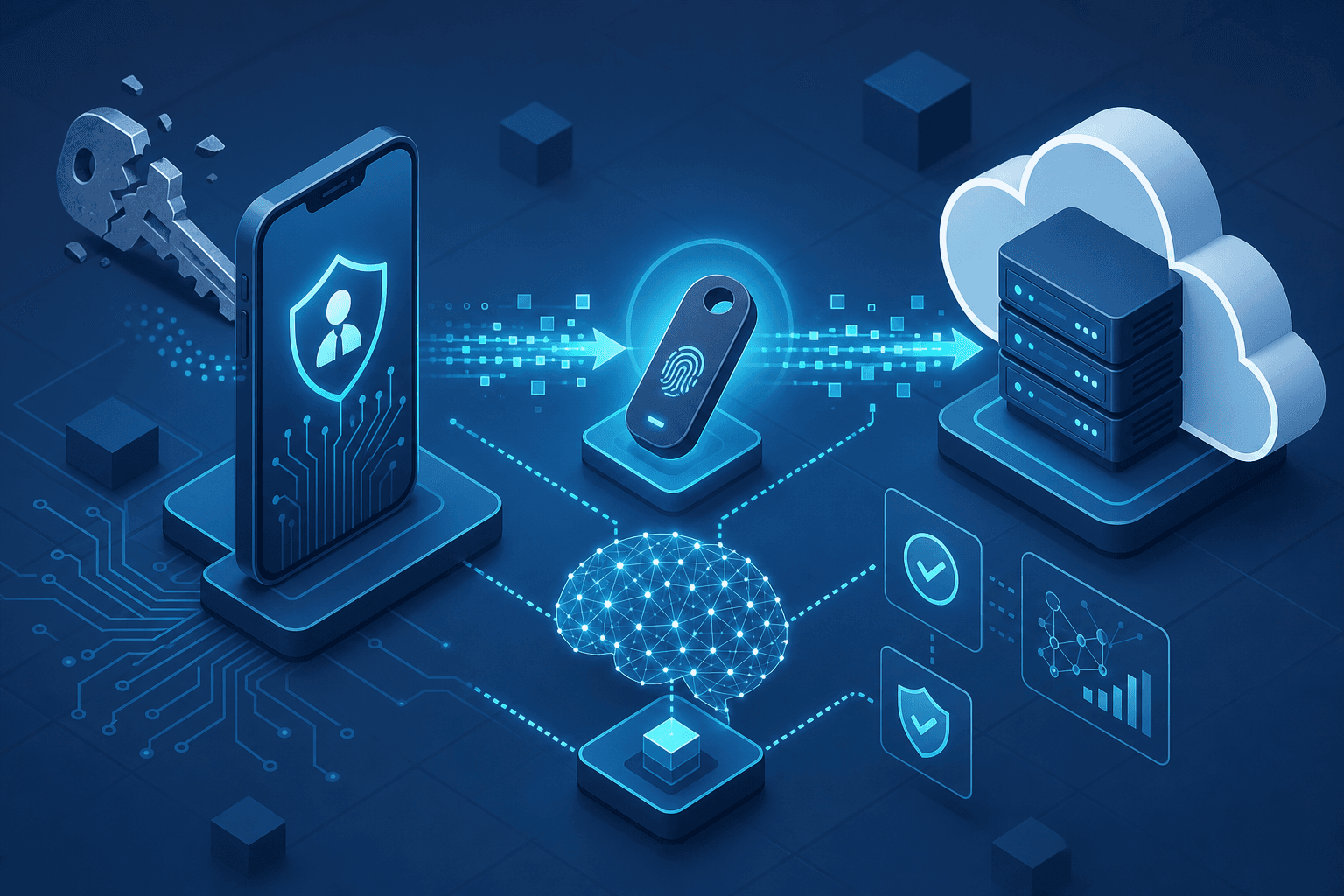
The narrative surrounding 2025 authentication is often reduced to marketing slogans about "passwordless" security. However, the mechanism driving this shift is not a software update; it is a fundamental change in how cryptographic trust is established. By 2025, the industry aims to move away from the fragile model where a user memorizes a secret string (a password) that is transmitted over a network to be verified. Instead, the mechanism relies on asymmetric cryptography anchored in hardware. The private key, which proves identity, never leaves the user's device. The public key, stored on the server, is used only to verify a signature generated by that private key. This architectural flip renders traditional phishing attacks mechanically impossible because the credential cannot be intercepted or copied.
Asymmetric Cryptography and the FIDO2 Mechanism
Consider the specific mechanism of a passkey interaction between a user named Alex and a cloud service provider, AWS, in 2025. When Alex attempts to log in, the browser invokes the Web Authentication API. The device's Trusted Platform Module (TPM) or Secure Enclave generates a unique cryptographic pair: a private key that remains encrypted within the hardware and a public key sent to AWS. When Alex authenticates, the device uses the private key to sign a challenge provided by the server. This signature is mathematically bound to the specific domain (e.g., aws.amazon.com). If an attacker intercepts the traffic, they cannot replay it because the signature is tied to the domain and the specific challenge nonce. Unlike a password, which is static and reusable, this passkey is dynamic and context-aware.
AI as a Contextual Risk Engine
The role of AI in this ecosystem is often misunderstood as an autonomous gatekeeper. In reality, AI functions as a high-frequency risk assessment engine that operates in the background of the authentication flow. In 2025, the "passwordless" experience is rarely a binary pass/fail decision based solely on the passkey. Instead, the system evaluates a vector of signals: device posture, geolocation consistency, and behavioral biometrics. If Alex logs in from a known device at a standard time, the passkey verification completes the transaction instantly. If the login attempt originates from a new device in a different geographic region, the AI engine flags the anomaly. It does not block the login; it triggers a "step-up" challenge. This might require a secondary biometric scan or a push notification approval. The mechanism here is risk-based adaptive authentication, where the cost of friction is proportional to the calculated risk.
The Brokered Identity Data Flow
This shift fundamentally changes the data flow of identity management. In the legacy model, the user provides a password to the application, which then validates it against a database. The application holds the secrets. In the 2025 model, the application acts as a broker. The identity provider (IdP) manages the trust anchor. When Alex logs in, the IdP verifies the passkey signature and issues a short-lived JSON Web Token (JWT) to the application. The application never sees the private key, nor does it store the user's credentials. It only trusts the JWT. This decoupling means that even if the application database is breached, the attacker gains no usable credentials. They only have access tokens that are useless without the corresponding device and the user's biometric presence. This architecture aligns with the Zero Trust principle that no entity is trusted by default, even within the network perimeter.
Operational Tradeoffs and Legacy Dependencies
However, the transition to this future presents challenges. A significant tradeoff exists in the provisioning and recovery of these keys. In a corporate environment, managing the lifecycle of hardware-backed keys for thousands of employees requires a robust enterprise key management system. If Alex loses their device, the private key is lost unless a cloud backup mechanism (like iCloud Keychain or Google Password Manager) was enabled. This introduces a new dependency on the device manufacturer's ecosystem. Furthermore, legacy systems that do not support FIDO2 protocols still require fallback mechanisms, often reverting to passwords or SMS-based OTPs, which are known weak points. From an operational standpoint, the "passwordless" future of 2025 is a hybrid state where passkeys are the default for modern applications, but passwords remain the necessary fallback for interoperability.
Common Pitfalls
As organizations prepare for this shift, several specific pitfalls can undermine the security benefits of passkeys:
- Device Loss Without Backup: The most critical failure point occurs when a user loses their primary device and has not enabled cloud sync or enterprise backup. Unlike a password reset via email, a lost hardware-backed private key can result in permanent account lockout if recovery keys were not distributed during provisioning.
- Over-Reliance on Manufacturer Ecosystems: Security posture can become fragmented if an organization relies heavily on a single device manufacturer's ecosystem for key storage. If that ecosystem suffers a compromise or a policy change, the entire user base's access could be jeopardized.
- Insecure Legacy Fallbacks: Organizations often implement FIDO2 for new applications but leave legacy systems accessible via SMS or email-based passwords. Attackers frequently target these weaker fallback vectors to bypass the stronger passkey authentication on newer systems, creating a "weakest link" vulnerability.
Practical Takeaways
To navigate this transition effectively, security leaders should adopt the following mental models:
- Trust the Silicon, Not the Secret: Shift your security strategy to assume that secrets (passwords) are inherently vulnerable. Treat the device hardware (TPM/Secure Enclave) as the primary trust anchor, ensuring that the private key never traverses the network.
- Friction Scales with Risk: Do not view multi-factor authentication as a binary switch. Implement risk-based adaptive authentication where friction is dynamic; low-risk logins should be seamless, while high-risk anomalies trigger progressive challenges.
- Broker, Don't Store: In your architecture, the application should never hold the "keys to the kingdom." Ensure the Identity Provider (IdP) handles the verification and passes a signed token (JWT) to the application, maintaining a strict separation of duties.
FAQ
Q: How do I recover access if I lose my device with a passkey? A: Recovery depends entirely on the backup configuration enabled at the time of setup. If cloud backup (e.g., iCloud Keychain, Google Password Manager) or an enterprise recovery key was configured, the private key can be restored to a new device. Without this, the account may be permanently inaccessible unless the administrator can revoke the old credential and issue a new one.
Q: Does AI replace human oversight in authentication? A: No. AI acts as a risk engine that analyzes context (location, device, behavior) to suggest the appropriate level of challenge. It does not make the final trust decision autonomously; it informs the flow, ensuring that human judgment or biometric confirmation is required when risk thresholds are exceeded.
Q: Can we use passkeys for legacy systems that don't support FIDO2? A: Not directly. Legacy systems require a protocol bridge or a gateway that supports FIDO2 on the front end while translating the request to the legacy backend protocol. Alternatively, organizations must rely on fallback methods like passwords or OTPs, though this reintroduces the vulnerabilities passkeys are meant to solve.
Conclusion
The convergence of passkeys and AI in 2025 creates a system that is more resilient to credential stuffing and phishing but introduces complexity in device management and user education. The mechanism of trust has moved from the human mind to the hardware silicon. While the user experience improves with fewer passwords to remember, the underlying infrastructure demands a higher level of coordination between device manufacturers, identity providers, and application developers. As we move through 2025, the success of this transition will depend less on the sophistication of the AI models and more on the widespread adoption of the FIDO standards across the entire software supply chain. The future is not just about removing passwords; it is about ensuring that the cryptographic handshake is the only thing that matters.
Related posts
Passkeys Guide: Google, Apple, Microsoft Ecosystems
A technical guide to implementing passkeys across Google, Apple, and Microsoft ecosystems using WebAuthn for cross-device synchronization.
Implementing WebAuthn in Keycloak: Passkey Authentication Setup
A walkthrough for configuring WebAuthn and passkeys within Keycloak to enable passwordless authentication using FIDO2 standards.
FIDO2 and WebAuthn: Building Phishing-Resistant Authentication
An examination of FIDO2 and WebAuthn standards for implementing phishing-resistant authentication and secure credential management.