AWS Secrets Manager vs Parameter Store: Secrets Management Comparison
A comparison of AWS Secrets Manager and Parameter Store for secrets management, covering credential rotation and AWS security best practices.
AWS Secrets Manager vs Parameter Store: Secrets Management Comparison
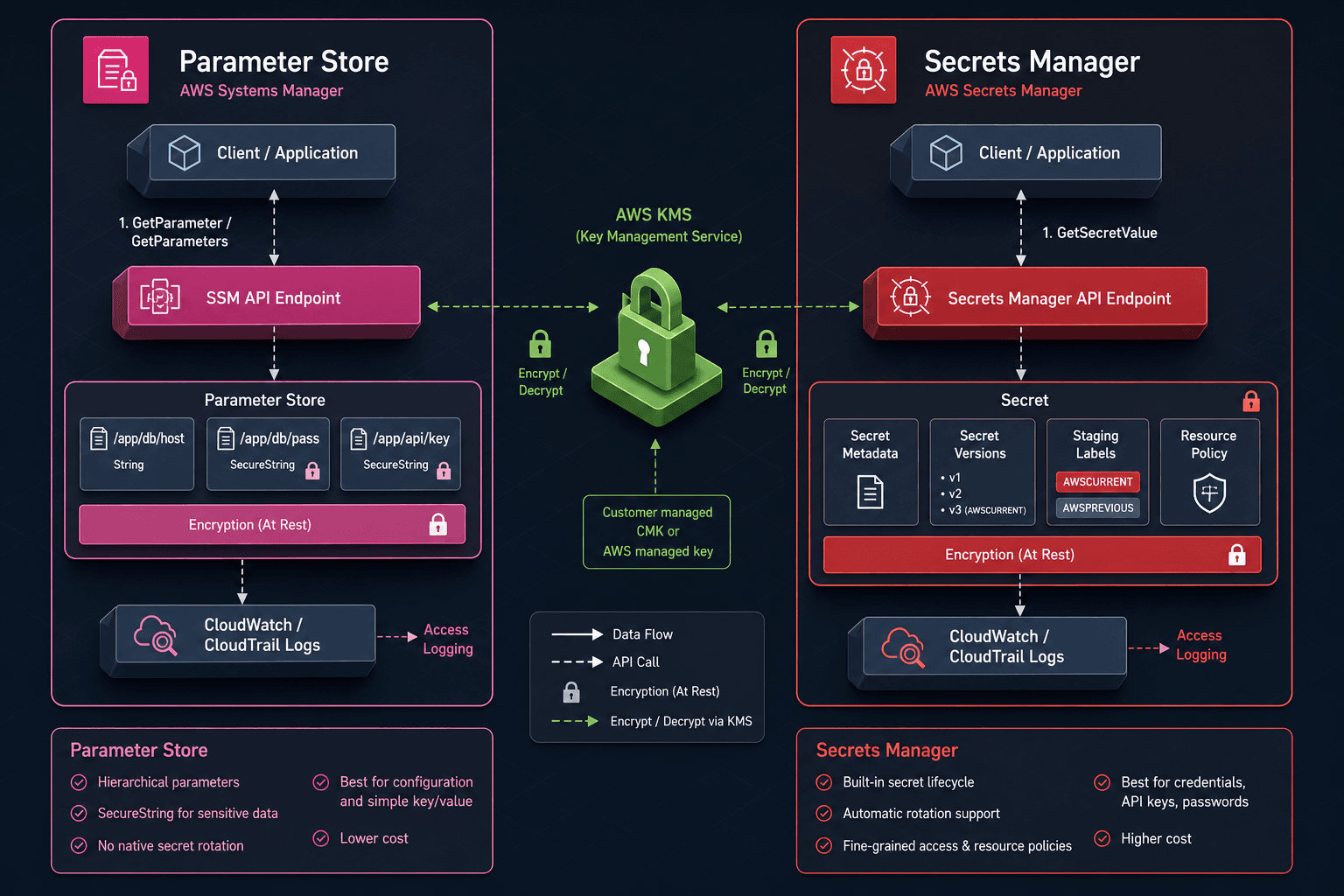
Part 7 of the AWS IAM & Cloud Security Series. Understanding the difference between AWS Secrets Manager and Systems Manager Parameter Store requires focusing on operational and architectural differences rather than physical storage layers. Systems Manager Parameter Store functions as a hierarchical key-value store where secrets are treated as encrypted strings. AWS Secrets Manager, conversely, is a specialized object store designed for credential lifecycle management. This fundamental architectural divergence dictates how each service handles rotation, versioning, and integration with broader cloud-infrastructure security patterns.
In contrast, AWS Secrets Manager is built as a specialized object store designed specifically for credentials. When you create a secret, the service creates a dedicated secret object that includes not only the encrypted value but also metadata about its lifecycle, such as the last rotated date and the next scheduled rotation. This structural difference dictates the operational flow. In Parameter Store, the application retrieves the secret by calling GetParameter, receives the string, and assumes the role of validating its freshness. In Secrets Manager, the service manages the state of the secret object, allowing the application to request the current value while the service handles the history and versioning of that value internally. This architectural separation allows Secrets Manager to enforce policies that Parameter Store cannot natively support without external glue code.
The Underlying Data Model
Systems Manager Parameter Store stores data as encrypted strings within the Systems Manager service architecture. It treats secrets as just another configuration parameter. The service encrypts the value using a customer-managed or AWS-managed Key Management Service (KMS) key before writing it to the underlying storage. While Parameter Store supports multiple data types (String, StringList, SecureString), it lacks native metadata fields for tracking expiration or rotation status. The critical distinction is that Parameter Store does not inherently understand the concept of "expiration" or "rotation." It simply returns the string associated with the key. If the password changes, you must explicitly overwrite the value at that path. There is no built-in lifecycle management for the data itself.
{
  "Name": "/prod/database/password",
  "Type": "SecureString",
  "Value": "EncryptedString...",
  "DataType": "string"
}
AWS Secrets Manager, however, stores secrets as objects with rich metadata. Each secret version includes a unique ID, a timestamp, and specific staging labels like AWSCURRENT or AWSPENDING. This metadata structure enables the service to maintain a complete history of all secret versions. Unlike Parameter Store, which requires the application to manage version logic, Secrets Manager automatically tracks these states, allowing for seamless rollbacks and automated version promotion during rotation events. This data model is optimized for high-security environments where auditability and state consistency are paramount.
The Rotation Mechanism
The most significant divergence between these two services appears in the mechanism of credential rotation. Rotation is the process of automatically changing a secret, such as a database password, and updating the application to use the new value. In AWS Parameter Store, this process is entirely manual regarding the service's native capabilities. The service provides no native scheduler or trigger for rotation. To implement rotation, you must construct a custom workflow. Typically, this involves creating an AWS Lambda function containing the logic to generate a new password and update the RDS instance. You then configure an Amazon EventBridge rule to trigger this Lambda function on a specific schedule. When the function executes, it calls the PutParameter API to overwrite the value in the store. You must also manually handle the application restart or dynamic reload logic to pick up the new value.
AWS Secrets Manager, however, implements a native, event-driven rotation mechanism. When you enable rotation on a secret, Secrets Manager provisions a pre-built Lambda function template (or uses your custom one) and configures the internal scheduling infrastructure. The service automatically triggers the rotation Lambda on a defined schedule (e.g., every 30 days). The Lambda function then performs the rotation logic: it generates a new password, updates the target resource (like an RDS database), and then calls the Secrets Manager API to create a new version of the secret object. Crucially, Secrets Manager maintains version history. If a rotation fails, the service retains the previous version, allowing for immediate rollback. This mechanism reduces the operational burden from "build and maintain a rotation pipeline" to "configure a schedule."
Security and Access Control
Both services rely on AWS KMS for encryption at rest, but their integration with security auditing differs in depth and automation. When you store a secret in Parameter Store, you must explicitly associate a KMS key with the parameter. If you use an AWS-managed key, the rotation of that key is handled by AWS, but the visibility into who accessed the parameter relies on standard CloudTrail logs generated by the GetParameter or PutParameter API calls. While these logs exist, they are generic. You do not get a dedicated view of the secret's lifecycle events unless you parse the CloudTrail logs and filter for specific parameter names.
Secrets Manager integrates more tightly with the AWS security ecosystem. Every time a secret is retrieved, rotated, or updated, the service generates specific CloudTrail events that are tagged with the secret's ARN and action type. Furthermore, while KMS key rotation is a property of the KMS service configured separately, Secrets Manager handles secret rotation natively. This means the service ensures the credentials themselves are rotated according to policy, even if the underlying KMS keys are managed on a different schedule. Additionally, Secrets Manager provides a dedicated "Secret Rotation" feature that can be audited independently, offering a clearer audit trail for compliance frameworks like SOC2 or HIPAA that require strict evidence of credential management.
# Example CloudTrail log entry for Secrets Manager rotation
{
  "eventVersion": "1.08",
  "userIdentity": {
    "type": "AWSService",
    "principalId": "secretsmanager.amazonaws.com",
    "arn": "arn:aws:iam::123456789012:role/secretsmanager-role"
  },
  "eventTime": "2024-05-21T10:00:00Z",
  "eventName": "RotateSecret",
  "sourceIPAddress": "secretsmanager.amazonaws.com",
  "requestParameters": {
    "secretId": "arn:aws:secretsmanager:us-east-1:123456789012:secret:mydb-abc123"
  },
  "responseElements": {
    "ARN": "arn:aws:secretsmanager:us-east-1:123456789012:secret:mydb-abc123",
    "VersionId": "12345678-abcd-efgh-ijkl-123456789012",
    "VersionStages": [
      "AWSCURRENT",
      "AWSPENDING"
    ]
  }
}
Cost Implications
The cost structure reflects the mechanism differences. Parameter Store operates on a pay-per-use model. You pay a small fee for each parameter stored and for every API call made to retrieve or update it. There is no monthly fee for the storage itself beyond the API usage. This makes it extremely cost-effective for storing non-sensitive configuration data or secrets that you rotate manually and infrequently. If you are storing 10,000 parameters and making 1 million requests a month, the cost remains negligible.
Secrets Manager, conversely, charges a monthly fee per secret stored, regardless of whether you access it or not. This fee covers the overhead of the rotation infrastructure, versioning, and the specialized secret object management. You also pay for API calls, but the base cost is the primary differentiator. For example, storing a single secret in Parameter Store might cost fractions of a cent, whereas storing the same secret in Secrets Manager incurs a fixed monthly charge. This pricing model is designed to offset the value of the managed rotation service. If you require automated rotation and compliance-ready audit trails, the cost is justified by the reduction in engineering hours spent building and maintaining custom Lambda functions and EventBridge rules.
Conclusion
The choice between AWS Secrets Manager and Parameter Store depends on the complexity of your rotation requirements and your security posture. If your application uses static credentials that change rarely, or if you have the engineering capacity to build and maintain a custom rotation pipeline, Parameter Store offers a lightweight, low-cost solution. It is an excellent fit for configuration data where the "secret" aspect is secondary to the "configuration" aspect. However, if you are managing database credentials, API keys, or certificates that require frequent, automated rotation to meet security standards, Secrets Manager provides a native, event-driven mechanism that eliminates the need for custom orchestration code. The mechanism of Secrets Manager shifts the burden of rotation logic from your infrastructure to the service, providing a higher degree of security assurance out of the box.
FAQ
Q: Can I use Parameter Store for secrets that need rotation? A: Yes, but you must build and maintain a custom automation pipeline using Lambda and EventBridge. Parameter Store does not offer native rotation capabilities.
Q: Does Secrets Manager support rotating KMS keys automatically? A: No. Secrets Manager rotates the secrets themselves. KMS key rotation is a separate configuration managed within the AWS KMS service, though Secrets Manager benefits from the security of rotated keys.
Q: Which service is better for storing non-sensitive configuration data? A: Parameter Store is generally preferred for non-sensitive configuration data due to its lower cost and simpler key-value structure. Secrets Manager is optimized for sensitive credentials requiring lifecycle management.
Common Pitfalls
- Assuming Parameter Store handles rotation: Engineers often assume that because Parameter Store supports encryption, it handles rotation automatically. This leads to stale credentials if no custom Lambda function is deployed.
- Ignoring KMS Key Permissions: Both services require the IAM role to have permission to use the specific KMS key. Missing
kms:Decryptorkms:GenerateDataKeypermissions will cause runtime failures. - Over-provisioning Secrets Manager: Using Secrets Manager for simple, static configuration values can result in unnecessary monthly costs compared to the pay-per-call model of Parameter Store.
Practical Takeaways
- Leverage Native Rotation: Use Secrets Manager when automated, compliant rotation is a requirement to reduce operational overhead.
- Optimize for Cost: Choose Parameter Store for large volumes of configuration data where rotation is infrequent or handled externally.
- Secure Your Keys: Always ensure your KMS keys are properly configured and rotated independently of the secrets they protect to maintain a robust cloud-infrastructure security posture.
Related posts
Identity in Serverless Architectures: Authentication Patterns for Lambda and Cloud Functions
An examination of identity management patterns for Lambda and cloud functions, focusing on Cognito authorizers and serverless security.
AWS Network Security: VPC, SG, NACLs & IAM Integration
An examination of AWS VPC, security groups, and NACLs with IAM integration for advanced network security.
The Mechanics of AWS Security Visibility: CloudTrail, CloudWatch & GuardDuty
A detailed examination of AWS CloudTrail, CloudWatch, and GuardDuty for effective security monitoring and incident response.