Identity Data Security: Encrypting and Tokenizing PII in Identity Stores
An examination of identity data security strategies focusing on encrypting and tokenizing personally identifiable information within identity stores.
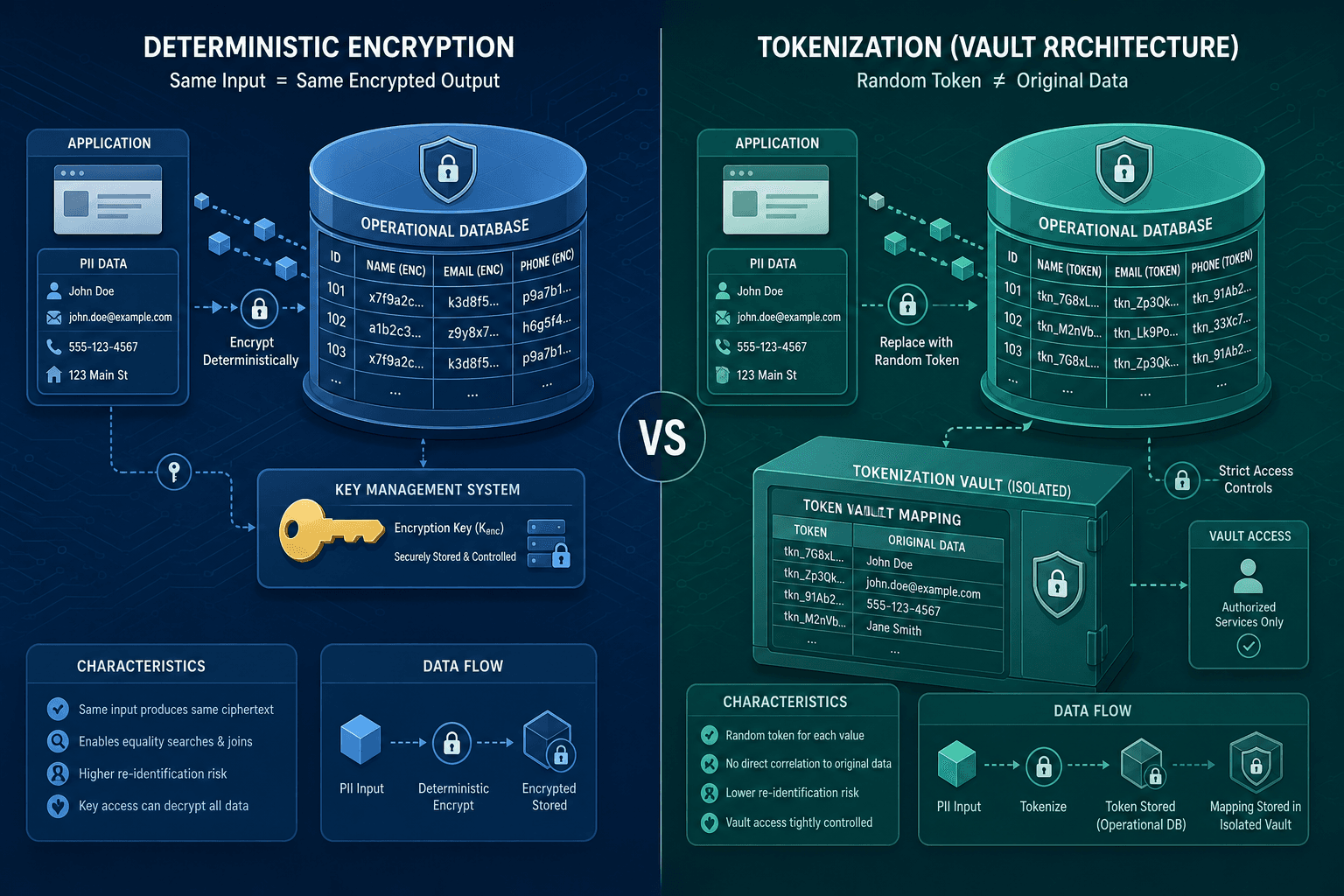
When an identity store registers a user, it handles Personally Identifiable Information (PII) like SSNs differently than non-sensitive attributes like a user_id. The fundamental distinction lies not in the algorithm, but in retrieval mechanisms and plaintext location. Encrypting PII keeps ciphertext in the database, requiring decryption for logic. Tokenizing PII removes original data from the store entirely, replacing it with a surrogate lacking a mathematical link to the source.
The Mechanics of Encryption in Identity Stores
Consider a scenario where a legacy identity management system stores user email addresses. The system needs to enforce uniqueness constraints (e.g., preventing two users from having alice@example.com). If you apply standard probabilistic encryption (where the same input produces different ciphertexts every time), the database cannot determine if alice@example.com already exists because the encrypted hash will differ on every write.
To solve this, identity architects often employ Deterministic Encryption. In this mechanism, the same plaintext input always produces the exact same ciphertext output, byte-for-byte. This allows the database to perform equality checks (SELECT * FROM users WHERE email = ?) directly on the encrypted column.
The workflow involves a symmetric key, typically AES-256-GCM, stored in a Hardware Security Module (HSM) or a dedicated Key Management Service (KMS). When the application writes alice@example.com, the client-side SDK or middleware retrieves the key, encrypts the string, and writes the resulting ciphertext blob to the users.email column. When the application needs to verify the email during login, it sends the plaintext to the middleware, which encrypts it again using the same key and compares the resulting ciphertext against the stored value.
However, this mechanism introduces a specific vulnerability: Access Pattern Leakage. Because the ciphertext for alice@example.com is always identical, an attacker who gains read access to the database can perform frequency analysis. If they see that the ciphertext 0x9f2a... appears 500 times, they know that 500 users share that specific attribute. Furthermore, deterministic encryption requires the key to be available for both writing and reading, increasing the attack surface if the key management boundary is breached.

The Mechanism of Tokenization
Tokenization offers a different architectural approach. Instead of transforming the data mathematically, tokenization replaces the PII with a surrogate value called a token. This token is generated by a secure Token Vault service. The critical mechanism here is the separation of data: the identity store never holds the plaintext PII, nor does it hold a reversible cipher of it. It only holds the token.
Imagine a scenario where a healthcare provider needs to store a patient's SSN in their identity directory. The application sends the SSN 123-45-6789 to the Token Vault. The Vault generates a random, non-sequential token, such as TKN-8829-XJ99, and stores the mapping TKN-8829-XJ99 <-> 123-45-6789 in a highly secured, isolated vault database. The application then receives the token and writes TKN-8829-XJ99 into the users.ssn column of the identity store.
If the identity store is compromised, the attacker finds only TKN-8829-XJ99. Without access to the isolated Token Vault, this string is mathematically useless. Unlike encryption, there is no key to steal that unlocks the data. The token has no mathematical relationship to the original value, meaning brute-force attacks or rainbow tables are ineffective.
The downside of this mechanism is the loss of native data utility within the identity store. You cannot query the identity store for "all users with SSN ending in 1234" because the tokens are random. To perform such a search, the application must send the plaintext SSN to the Token Vault, which looks up the corresponding token, and then returns that token to the identity store for the query. This adds network latency and creates a dependency on the availability of the Token Vault service. A mature approach to secure identity management relies on this strict isolation to minimize the blast radius of breaches.

Operational Tradeoffs and Identity Data Security
The choice between encryption and tokenization dictates the operational design of the identity system. Encryption is generally preferred for PII where searchability is a functional requirement, such as email addresses, phone numbers, or usernames. The ability to run WHERE email = ? queries is essential for password reset flows and unique constraint enforcement. However, this comes at the cost of key management complexity and the risk of access pattern leakage.
Tokenization is the superior strategy for high-sensitivity, low-search-frequency data like SSNs, credit card numbers, or medical record IDs. Since these fields rarely need to be queried directly in the identity store (they are usually looked up by a unique ID like user_id), the inability to search the tokenized field is an acceptable tradeoff for the near-total removal of risk.
From a compliance perspective, regulations like GDPR and CCPA treat these mechanisms differently. If data is encrypted with a strong key, it is often considered "protected" but still requires access controls. If data is tokenized and the tokens are stored separately from the vault, the identity store may no longer be considered to hold "PII" under certain interpretations, significantly reducing the scope of the audit. However, this is an opinion based on the strict separation of the vault; if the vault is co-located with the identity store on the same physical disk, the protection is illusory.
In practice, a comprehensive identity architecture often employs a hybrid model. Sensitive, searchable fields like email are encrypted deterministically to maintain query performance. High-value, non-searchable fields like SSNs are tokenized to eliminate the presence of plaintext in the primary store. This approach balances the need for operational efficiency with the highest standard of data isolation.
Ultimately, the mechanism you choose defines your threat model. If you fear key compromise, tokenization is the answer. If you fear database corruption or loss of query capability, encryption is the necessary tool. Both require rigorous key rotation policies and strict access controls, but they protect the data in fundamentally different ways.
Common Pitfalls
Implementing these strategies often leads to specific failure points if not carefully managed:
- Key Management Complexity: Deterministic encryption requires strict control over key rotation. If keys are not rotated frequently or if the rotation process disrupts the ability to decrypt historical data, the system faces immediate data loss or service interruption.
- Access Pattern Leakage: Even with strong encryption, deterministic schemes leak metadata through frequency analysis. Attackers can infer sensitive information by correlating the frequency of specific ciphertexts with known population distributions.
- Token Vault Dependency: Tokenization creates a single point of failure. If the Token Vault becomes unavailable, the identity system cannot resolve tokens to plaintext, potentially halting critical authentication or lookup flows that require the original PII.
Practical Takeaways
To navigate these tradeoffs effectively, adopt the following mental models:
- Searchability vs. Isolation: Prioritize encryption if your business logic requires direct querying of the data (e.g., unique constraints). Choose tokenization if the primary goal is minimizing the value of stolen data, accepting the loss of direct search capabilities.
- The Vault Boundary: The security of tokenization is entirely dependent on the physical and logical isolation of the Token Vault. Co-location with the primary identity store negates the security benefits.
- Hybrid Necessity: Rarely is one method sufficient for all data types. A mature security posture typically encrypts searchable fields while tokenizing high-sensitivity, non-searchable fields to balance utility and risk.
FAQ
Q: Can I use probabilistic encryption for email addresses? A: No. Probabilistic encryption generates a different ciphertext for every write, making it impossible to enforce uniqueness constraints or perform equality checks within the database without decrypting the data first.
Q: Does tokenization reduce the scope of compliance audits? A: Yes, potentially. If the tokens are stored separately from the vault and the identity store holds only the tokens, regulators may determine that the identity store does not hold PII, thereby reducing the audit scope. This depends on the strictness of the vault separation.
Q: What happens if the encryption key is lost? A: If the key for deterministic encryption is lost, the data is permanently unreadable. Unlike tokenization, where the plaintext is stored in a separate vault, encrypted data relies entirely on the availability of the specific key used for generation.
Conclusion
Securing PII in identity stores requires a deliberate choice between the utility-preserving nature of deterministic encryption and the risk-isolating nature of tokenization. While encryption enables critical search operations on sensitive data, it introduces vulnerabilities related to key management and access patterns. Tokenization, conversely, offers superior protection for high-risk data by removing the plaintext from the environment entirely, though it sacrifices native query capabilities. A mature security architecture often leverages both strategies in a hybrid model to align data protection with operational requirements and regulatory obligations.
Related posts
Implementing Conditional Access Policies with Keycloak and ForgeRock
A technical examination of implementing conditional access policies using Keycloak and ForgeRock for context-aware access control.
Identity as the Perimeter
Explore how treating identity as the new security perimeter enables continuous evaluation and strong authentication within a zero trust architecture.
What Zero Trust Actually Requires
An examination of the practical requirements for Zero Trust Architecture based on NIST 800-207, covering tenets, maturity models, and implementation steps.