Building a Multi-Tenant OAuth 2.0 Authorization Server
A technical walkthrough of building a multi-tenant OAuth 2.0 authorization server with Keycloak for SaaS identity and tenant isolation.
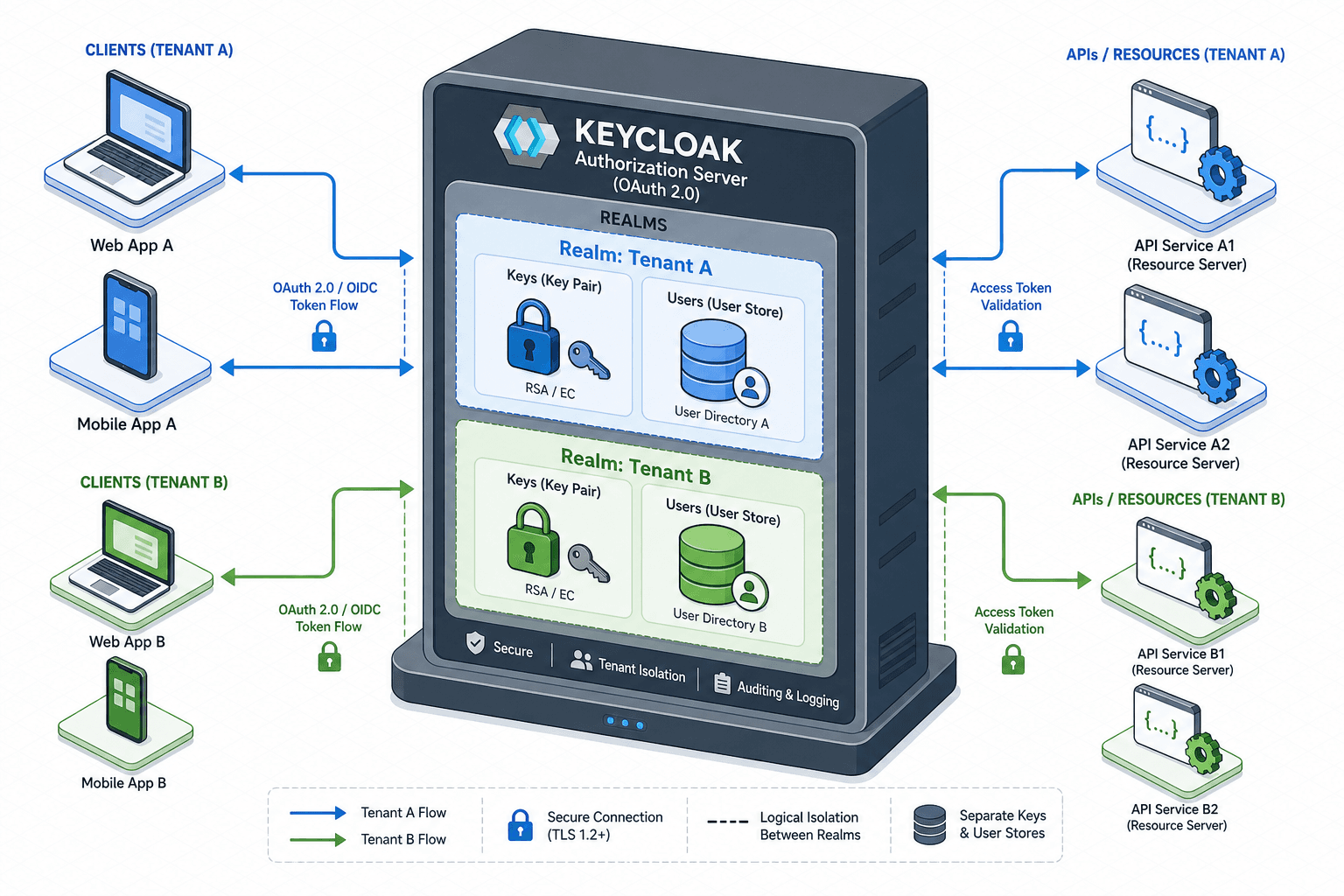
The fundamental challenge in building a multi-tenant OAuth 2.0 authorization server is not simply managing multiple user bases, but enforcing strict cryptographic and logical boundaries so that a credential issued for one tenant cannot be reused by another. In a SaaS context, this means ensuring that an access token generated for "Acme Corp" cannot be presented to an API endpoint expecting "Globex Inc," even if both are hosted on the same infrastructure. We achieve this isolation not through network segmentation alone, but by leveraging the mechanism of Keycloak Realms to create distinct trust zones, each with its own key pairs, user directories, and client configurations. This approach forms the backbone of a robust authorization server architecture, ensuring that trust boundaries are maintained at the cryptographic level rather than relying solely on application logic.
The Isolation Mechanism: Realms as Trust Boundaries
The core architectural primitive in Keycloak for multi-tenancy is the Realm. When you initialize a Keycloak server, it starts with a default master realm, but for a SaaS application, you must provision a distinct Realm for each tenant. This is not merely a database schema separation; it is a complete cryptographic partition. Each Realm generates its own set of RSA or ECDSA key pairs used to sign JSON Web Tokens (JWTs).

Consider a scenario where Tenant A (Acme) and Tenant B (Globex) exist on the same Keycloak instance. When Acme requests an access token, Keycloak signs it using Acme's specific private key. If a malicious actor attempts to take Acme's token and present it to Globex's API, the validation fails immediately. Globex's API is configured to validate tokens only if they are signed by Globex's public key, which resides strictly within the Globex Realm. This mechanism ensures that even if the underlying database is shared, the cryptographic trust chain is severed between tenants.
# Example: Creating a new Realm via Keycloak CLI
kc.sh realm create --realm=acme-corp --enabled=true

# Verifying the unique key set for the new realm
kcadm.sh get realms -r master -s realm=acme-corp
By isolating the key sets, we prevent "key collision" attacks where a token from one tenant could theoretically be valid in another if a single global key set were used. The iss (issuer) claim in the JWT will explicitly point to the realm URL (e.g., https://auth.example.com/realms/acme-corp), providing an immediate, human-readable indicator of the token's origin.
Tenant-Specific Client Configuration
Once the realms are established, we must configure the Clients within each realm to enforce data scoping. In a multi-tenant environment, a "Client" represents the application or service requesting access. We cannot rely on a single global client ID because that would allow any tenant to authenticate as any other tenant's application.
Instead, we define a Client ID pattern that includes the tenant identifier, or we enforce strict mapping at the protocol level. For instance, if we have a SaaS application app-v1, we might configure the client ID as acme-app-v1 within the acme-corp realm. More importantly, we must configure the audience claim in the access token. The aud claim tells the resource server exactly which service the token is intended for.
Let's trace the mechanism of a token request. An administrator for Acme Corp creates a client in the Keycloak Admin Console. They enable the "Access Type" as confidential and configure the "Valid Redirect URIs" to match only Acme's domain. Crucially, under the "Advanced" settings, they enable the "Access Token Response Type" to include the aud claim explicitly set to api.acme-corp.com.
When the user logs in, the Authorization Server constructs the JWT. The mechanism here is critical: the server injects the aud claim based on the client's configuration in that specific realm. If the downstream API receives a token with aud: api.globex.com, it knows immediately that this token belongs to a different tenant, regardless of whether the sub (subject/user ID) looks similar to an existing user.
// Example Access Token Payload (Decoded)
{
  "iss": "https://auth.example.com/realms/acme-corp",
  "sub": "user-12345",
  "aud": "api.acme-corp.com",
  "exp": 1678886400,
  "iat": 1678882800,
  "azp": "acme-app-v1"
}
Notice that the azp (authorized party) claim also reflects the client ID. This double-check (aud and azp) ensures that even if a token is stolen, it cannot be used by a different application instance belonging to the same tenant, let alone a different tenant.
The Token Validation Flow
The final piece of the puzzle is how the resource server (the API) validates these tokens. In a multi-tenant setup, the API cannot use a single static JWKS (JSON Web Key Set) URL. It must dynamically resolve the correct public key based on the token's issuer.
When a request hits the API, the middleware extracts the iss claim from the incoming JWT. It then parses the realm name from the issuer URL. For example, if iss is https://auth.example.com/realms/acme-corp, the middleware knows to fetch the public keys specifically from the acme-corp realm's JWKS endpoint.
This dynamic resolution is the mechanism that prevents cross-tenant token replay. If an attacker tries to replay a token from the acme-corp realm against the globex API, the API first resolves the public key from the issuer specified in the token (Acme's keys). Even if the signature validates cryptographically against Acme's keys, the subsequent check of the aud claim fails because the Globex API expects api.globex.com, not api.acme-corp.com.

// Pseudo-code for dynamic key resolution in a Java Spring Boot application
public Key getKey(String issuerUrl) {
    String realm = extractRealm(issuerUrl); // e.g., "acme-corp"
    String jwksUrl = String.format("https://auth.example.com/realms/%s/protocol/openid-connect/certs", realm);
    return fetchKeys(jwksUrl).getPublicKey();
}

public boolean validateToken(String token) {
    Claims claims = parseToken(token);
    String audience = claims.getAudience().stream().findFirst().orElse("");

    // Check if the audience matches the current tenant's API identifier
    if (!audience.equals(currentTenantApiId)) {
        throw new UnauthorizedException("Token audience mismatch");
    }

    // Validate signature using the resolved key
    return verifySignature(token, getKey(claims.getIssuer()));
}
This flow ensures that the validation logic is tightly coupled to the tenant context. The API does not just check "is this a valid signature?" but "is this a valid signature for me, issued by my tenant's identity provider?"
Operational Tradeoffs
Architecting with one Realm per tenant is the most robust approach for security and compliance, but it introduces operational complexity. Every tenant gets a dedicated database schema, a dedicated set of keys, and a dedicated set of users. If you have 10,000 tenants, you are managing 10,000 distinct configuration sets (users, clients, policies). However, this is not an unmanageable manual burden; these configurations are typically managed via a single admin client or automation scripts, allowing for scalable provisioning without manual intervention.
Some teams opt for a single Realm with a custom attribute (e.g., tenant_id) on the user object and rely on the aud claim to distinguish tenants. While this simplifies management, it weakens the isolation mechanism. If the single realm's private key is compromised, every tenant is at risk. Furthermore, a single realm makes it harder to enforce tenant-specific password policies or MFA requirements without complex custom SPIs (Service Provider Interfaces).
I argue that for production SaaS applications handling sensitive data, the multi-realm approach is superior despite the overhead. The cost of managing multiple realms is linear and predictable, whereas the risk of a single-point-of-failure in a shared realm is exponential. The mechanism of separate key pairs provides a physical barrier to compromise that configuration flags alone cannot match.
Common Pitfalls
Even with a solid architectural foundation, implementation details can introduce vulnerabilities. Be mindful of the following common pitfalls when deploying a multi-tenant Keycloak setup:
- Key Rotation Overhead: Each realm maintains its own key set. When rotating keys, you must ensure all tenants update their token consumption simultaneously, or your API must support validating tokens signed by old keys for a grace period. Failing to coordinate this can lead to sudden authentication failures across your entire platform.
- Realm Cloning Errors: When onboarding new tenants, avoid blindly cloning an existing realm configuration without auditing the
rootUrlandwebOrigins. Incorrectly copied redirect URIs can inadvertently allow a tenant to authenticate requests from unauthorized domains, breaking the isolation boundary. - JWKS Caching Staleness: Resource servers often cache JWKS endpoints to reduce latency. In a multi-tenant environment, if a realm rotates its keys, stale cached keys in the API can lead to false negatives (valid tokens rejected) or, worse, if the cache is shared incorrectly, potential security gaps. Ensure your caching strategy is scoped per-realm or has a very short TTL.
Practical Takeaways
To successfully implement a secure multi-tenant environment, focus on these core architectural decisions:
- Use Realms for Cryptographic Isolation: Never rely solely on application-level checks; isolate tenants at the Keycloak Realm level to ensure distinct key pairs and trust boundaries.
- Enforce Audience Claims: Rigorously validate the
audclaim in every request to ensure the token is intended for the specific API endpoint being accessed. - Automate Realm Management: Treat realm creation and configuration as code. Use Terraform, Ansible, or Keycloak's REST API to provision tenants programmatically to handle scale without manual error.
FAQ
Can I use a single Realm for all tenants? Technically, yes, but it is strongly discouraged for SaaS platforms. A single realm means all tenants share the same signing keys and user store. A compromise in one tenant's data or a key leak exposes all tenants. The multi-realm approach provides a necessary security boundary.
How do I handle key rotation across thousands of realms? You must automate the process. Use Keycloak's REST API or CLI scripts to trigger key rotation for all realms simultaneously. Configure your API to accept a "grace period" where it accepts tokens signed by the previous key set while the new keys are propagated.
What about performance implications with many realms? Keycloak handles thousands of realms efficiently if the underlying database is optimized. The primary performance cost comes from dynamic JWKS fetching. Mitigate this by implementing per-realm JWKS caching on the resource server side with appropriate invalidation strategies.
Conclusion
Building a multi-tenant OAuth 2.0 authorization server requires moving beyond surface-level configuration to gain a deep understanding of the mechanisms of trust. By utilizing Keycloak Realms to isolate cryptographic key pairs and enforcing strict aud and azp claim validation, we create a system where tenants are logically and mathematically separated. The API's ability to dynamically resolve the correct public key based on the token's issuer is the linchpin that prevents cross-tenant access. This architecture ensures that even in a shared infrastructure, the identity boundary remains impenetrable.
Related posts
Keycloak Architecture: Realms, Clients, and the Data Model
An examination of Keycloak architecture, focusing on realms, clients, and the underlying data model for platform and identity engineers.
Keycloak and Spring Boot Integration: Advanced Patterns
Explore advanced Keycloak and Spring Boot integration patterns including multi-tenant setups and reactive security.
Why Multi-Cloud Identity Fragments
An examination of identity fragmentation across AWS, Azure, and GCP, comparing identity models to understand multi-cloud challenges.