Implementing OAuth 2.0 Client Credentials Flow for Microservices
An examination of implementing the OAuth 2.0 client credentials flow to secure machine-to-machine authentication in Spring Boot microservices.
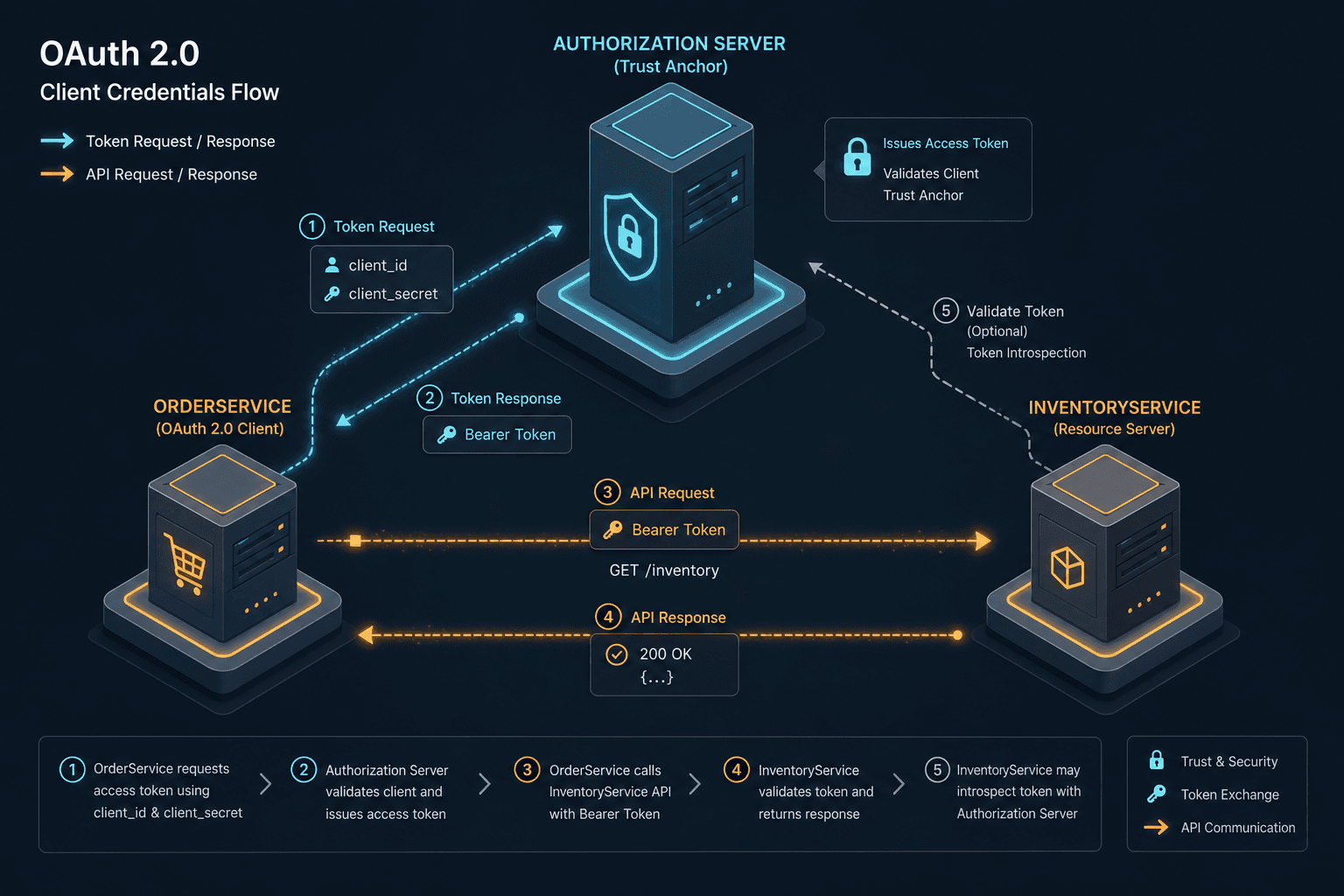
In a microservices architecture, the "user" is often a process, not a person. When OrderService needs to call InventoryService, it cannot ask the user for a username and password. Instead, it must prove its own identity. The mechanism that enables this is the OAuth 2.0 client credentials flow. Unlike authorization code flows which grant access on behalf of a resource owner, this flow grants access to the client itself. It is the standard for machine-to-machine (M2M) authentication.
This article is Part 3 of the "OAuth 2.0 Deep Dive Series" series.
The Trust Anchor: Client Identity
The foundation of this flow is the registration of the client application with the Authorization Server. In this context, a "client" is simply a microservice instance. The server issues two artifacts: a client_id and a client_secret. These are not dynamic; they are static credentials embedded in the service configuration or retrieved from a secrets manager.
The client_id is a public identifier, similar to a username, while the client_secret is a private key known only to the client and the server. When the client initiates authentication, it must present both. This pairing proves that the caller is the legitimate owner of the client_id. If an attacker intercepts the client_id but lacks the client_secret, they cannot generate a valid token. Conversely, if the secret is leaked, the attacker gains full impersonation rights for that service.
This differs fundamentally from user flows where the secret is never transmitted directly to the client in a way that allows it to be reused for future requests without user interaction. Here, the secret is the only proof of identity required before a token is issued.

The Token Acquisition Mechanism
Once the OrderService starts up, it performs a specific HTTP transaction to obtain access. This is not a redirect; it is a direct API call. The client sends a POST request to the Authorization Server's token endpoint, typically /oauth/token.
The request body must be encoded as application/x-www-form-urlencoded. The critical parameter is grant_type, which must be set to client_credentials. The server validates the client_id and client_secret against its internal registry. If valid, it generates a token, usually a JSON Web Token (JWT), and returns it in the response body.
Here is the raw HTTP interaction:
POST /oauth/token HTTP/1.1
Host: auth.company.com
Content-Type: application/x-www-form-urlencoded
Authorization: Basic base64(client_id:client_secret)

grant_type=client_credentials&scope=inventory:read
Notice the Authorization header. While some implementations allow passing credentials in the body, the standard recommendation is to use HTTP Basic Authentication for the credentials themselves, encoding them as base64(client_id:client_secret). The response looks like this:
{
  "access_token": "eyJhbGciOiJSUzI1NiIsInR5cCI6IkpXVCJ9...",
  "token_type": "Bearer",
  "expires_in": 3599,
  "scope": "inventory:read"
}
The access_token is a bearer token. Anyone holding this string can impersonate the OrderService. The expires_in field dictates the token's lifetime. The client must cache this token and reuse it until it expires, at which point it requests a new one. This caching is critical to avoid rate-limiting the Authorization Server.
Spring Boot Configuration: The Client Side
Implementing this in Spring Boot 3 requires leveraging the Spring Security OAuth2 Client module. We no longer rely on manual HTTP clients for every call; instead, we configure the framework to manage the token lifecycle.
First, we define the client registration. This tells Spring Boot where the authorization server lives and what credentials to use.
@Configuration
public class Oauth2Config {

    @Bean
    public ClientRegistrationRepository clientRegistrationRepository() {
        return new InMemoryClientRegistrationRepository(
            ClientRegistration.withRegistrationId("inventory-service")
                .clientId("order-service-client")
                .clientSecret("your-secure-secret")
                .authorizationUri("https://auth.company.com/oauth2/authorize")
                .tokenUri("https://auth.company.com/oauth2/token")
                .scope("inventory:read")
                .clientAuthenticationMethod(ClientAuthenticationMethod.CLIENT_SECRET_BASIC)
                .build()
        );
    }

    @Bean
    public OAuth2AuthorizedClientManager authorizedClientManager(
            ClientRegistrationRepository clientRegistrationRepository) {

        // Use DefaultOAuth2AuthorizedClientManager to handle token storage and re-acquisition
        DefaultOAuth2AuthorizedClientManager manager =
            new DefaultOAuth2AuthorizedClientManager(
                new InMemoryOAuth2AuthorizedClientRepository(),
                clientRegistrationRepository
            );

        // Configure the token provider to handle the client credentials grant
        OAuth2AuthorizedClientProvider provider = OAuth2AuthorizedClientProviderBuilder.builder()
            .clientCredentials()
            .build();

        manager.setAuthorizedClientProvider(provider);
        return manager;
    }
}
The InMemoryClientRegistrationRepository is used here for brevity, but in production, you would inject these values from environment variables or a secrets manager like HashiCorp Vault. The DefaultOAuth2AuthorizedClientManager is the engine that intercepts requests, checks if a valid token exists in the cache, and automatically triggers a new authentication request using the client secret if the current token has expired or is missing. Note that the Client Credentials flow does not support refresh tokens; it requires full re-authentication upon expiration.
The Resource Server Handshake
The InventoryService acts as the resource server. It receives the request from OrderService with the Bearer token in the Authorization header. The resource server must verify that this token is valid and intended for it.
In Spring Boot, this is achieved by enabling the resource server support. The framework automatically extracts the token and validates its signature.
@EnableWebSecurity
public class ResourceServerConfig {

    @Bean
    SecurityFilterChain securityFilterChain(HttpSecurity http) throws Exception {
        http
            .authorizeHttpRequests(auth -> auth
                .requestMatchers("/inventory/items").permitAll() // Public endpoint
                .anyRequest().authenticated() // Protected endpoints
            )
            .oauth2ResourceServer(oauth2 -> oauth2
                .jwt(jwt -> jwt
                    .jwtDecoder(jwtDecoder()) // Custom decoder
                )
            );
        return http.build();
    }

    @Bean
    JwtDecoder jwtDecoder() {
        // The decoder fetches the public keys from the issuer's JWK Set URI
        // This ensures the token was signed by the trusted Authorization Server
        return NimbusJwtDecoder.withJwkSetUri(
            "https://auth.company.com/.well-known/jwks.json"
        ).build();
    }
}
The JwtDecoder is the mechanism of trust. It does not just check the token's expiration; it fetches the public keys from the Authorization Server's JWK Set URI (.well-known/jwks.json). It then performs a cryptographic signature verification (e.g., RS256). If the signature matches the public key, the token is valid. If the token claims a scope that the resource server does not support, the request is rejected.
This mechanism ensures that the OrderService cannot forge a token even if it knows the client_secret, because it does not possess the private key used to sign the JWT. The private key resides exclusively on the Authorization Server.

Operational Tradeoffs and Secrets Management
The client credentials flow is efficient for M2M communication, but it introduces specific operational risks. The primary concern is the client_secret. Since this secret is required for every token request, it must be stored somewhere accessible to the application. Storing it in a application.properties file is a common anti-pattern because it ends up in version control or container images.
Opinion: For high-security environments, embedding the client_secret in environment variables is insufficient. You should use a secrets manager (like AWS Secrets Manager or Vault) that rotates the secret periodically. Furthermore, consider using mutual TLS (mTLS) as an alternative to the client secret. mTLS uses a client certificate to authenticate the service, which is often more secure than a shared secret string.
Another tradeoff is the lack of audit trails per user. Since the token represents the service, not a human, the logs will show that "OrderService" accessed the inventory, but not which specific human initiated the order. To solve this, the X-User-ID header is passed by the user-facing gateway to the OrderService during the initial user login (which uses a different flow like Authorization Code), and the OrderService then propagates this claim for the downstream InventoryService call. This ensures the human identity is preserved across the service chain despite the machine-to-machine authentication.
Finally, token expiration management is critical. If the OrderService crashes and restarts, it must be able to quickly re-acquire a token. The Spring Boot implementation handles this gracefully by caching the token, but you must ensure your infrastructure allows the client to reach the authorization server immediately upon startup. If the auth server is down, the entire microservice chain halts.
By understanding the mechanism of the token exchange and the cryptographic validation of the JWT, you can implement a solid, secure foundation for your microservices. The client credentials flow removes the complexity of user sessions while providing a standardized, auditable method for service authentication.
Common Pitfalls
When implementing OAuth 2.0 Client Credentials, several recurring mistakes can compromise security or availability:
- Hardcoding Secrets: Embedding
client_secretdirectly in source code or configuration files is a critical failure. Always externalize these credentials using environment variables, Kubernetes Secrets, or a dedicated secrets manager. - Ignoring Token Expiration: Assuming tokens are valid indefinitely leads to authentication failures when the Authorization Server rotates keys or the token expires. Ensure your application logic explicitly handles the
expires_invalue and triggers a new request immediately upon expiry. - Misconfigured mTLS: If opting for mutual TLS instead of client secrets, failing to configure the correct client certificates and truststores on the application side will result in connection refusal. Verify that the CA chain is correctly installed on the client service.
Practical Takeaways
To master the Client Credentials flow, internalize these mental models:
- Static Identity, Dynamic Access: The
client_idandsecretare static and permanent, while theaccess_tokenis dynamic and short-lived. - No Refresh Tokens: Unlike user flows, this flow does not issue refresh tokens. When the access token expires, the client must re-authenticate from scratch using its credentials.
- Trust is Cryptographic: The resource server trusts the token solely based on the digital signature, not the knowledge of the client secret. The secret is only used to obtain the token, not to validate it.
FAQ
Q: Can I use refresh tokens with the Client Credentials flow?
A: No. The OAuth 2.0 specification does not define a refresh token grant for the client credentials flow. When the access token expires, the client must perform a new authentication request using its client_id and client_secret.
Q: Why is the Authorization header used for credentials instead of the request body?
A: While the spec allows credentials in the body, using HTTP Basic Authentication (encoding client_id:client_secret in the Authorization header) is the industry standard recommendation. It prevents credentials from being logged in server access logs, which often record the request body but may filter headers depending on the configuration.
Q: How do I handle service restarts without losing token validity?
A: The DefaultOAuth2AuthorizedClientManager in Spring Boot caches the token. On restart, the manager checks the cache. If the token is expired, it automatically triggers a new authentication request using the stored client_id and client_secret to fetch a fresh token before allowing outbound traffic.
Conclusion
The OAuth 2.0 client credentials flow provides a standardized, reliable mechanism for securing machine-to-machine communication in microservices architectures. By anchoring trust in static client credentials and leveraging short-lived bearer tokens, services can authenticate without human intervention. Implementing this flow correctly in Spring Boot involves configuring the ClientRegistrationRepository for the client side and the JwtDecoder for the resource side, ensuring that tokens are validated cryptographically against the Authorization Server's JWK Set. While operational tradeoffs regarding secret management exist, utilizing secrets managers and considering mTLS can mitigate these risks, ensuring a secure and scalable service mesh.
Related posts
Implementing Mutual TLS in Spring Boot Applications
A guide on configuring mutual TLS and X.509 authentication within Spring Boot applications for enhanced certificate-based security.
Building a Developer Identity Portal with Spring Boot and Keycloak
A walkthrough for constructing a self-service identity portal using Spring Boot and Keycloak to enhance developer experience and manage API keys effectively.
Spring Security OAuth2 Resource Server: Securing APIs
Learn how to configure a Spring Security OAuth2 resource server with JWT decoder for API security and token validation.