OAuth 2.0 Token Introspection & Revocation Strategies
Production strategies for OAuth 2.0 token introspection and revocation covering lifecycle management and security across ForgeRock and Keycloak.
Decoupling Trust from Invalidity
Part 4 of the OAuth 2.0 Deep Dive Series
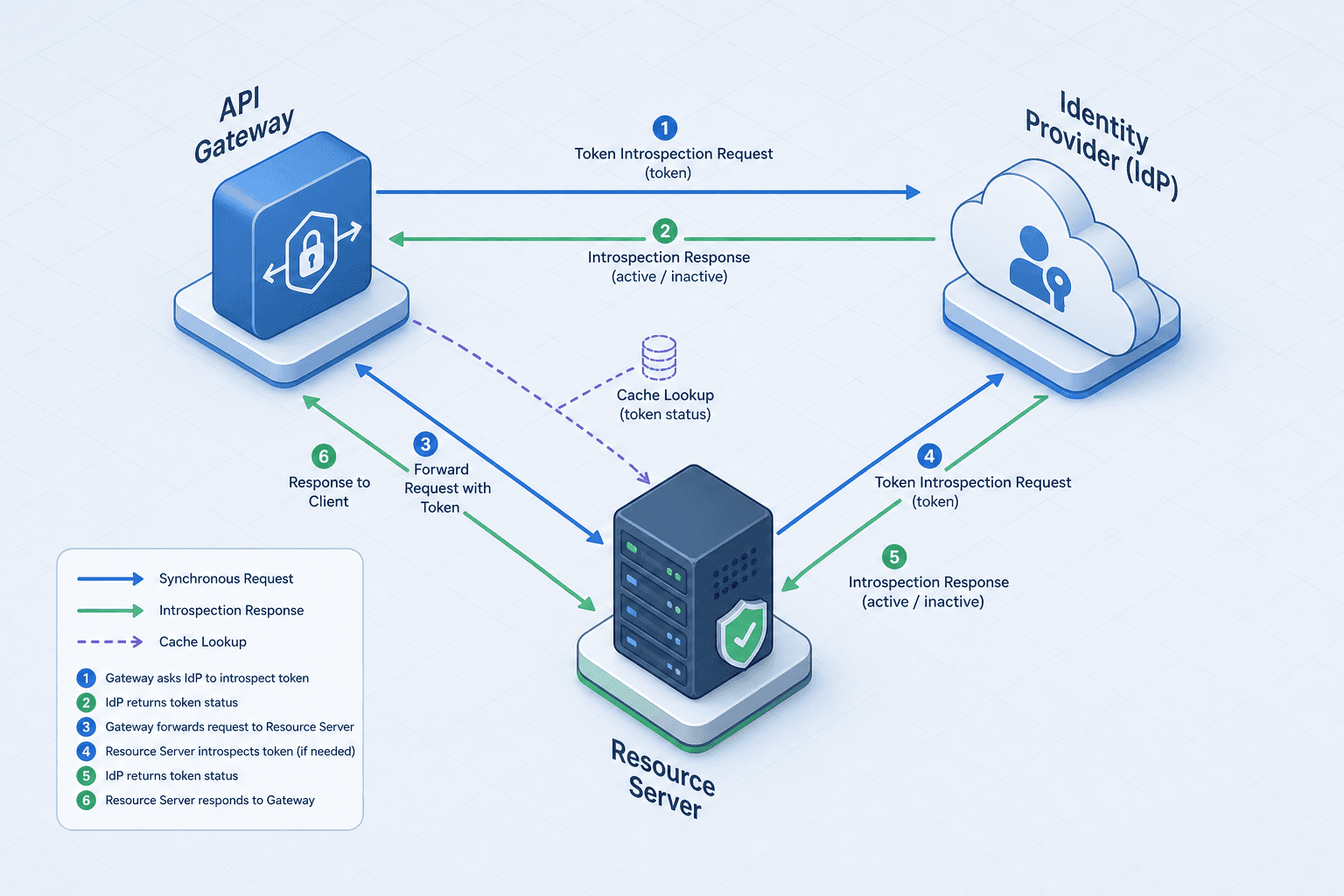
In production environments, the most dangerous assumption is that a valid cryptographic signature equals an authorized user. The mechanism at the heart of OAuth 2.0 security is the ability to query the state of a token in real-time. This is where the Token Introspection Protocol (RFC 7662) diverges from standard JWT validation. When an API Gateway receives a request, it cannot simply verify the digital signature; it must ask the Identity Provider (IdP) if the token has been revoked, suspended, or if the associated user session has expired. This distinction is critical because a token can be cryptographically perfect yet operationally useless.
Consider a scenario where a user logs out. The client sends a request to the /revoke endpoint defined in RFC 7009. The IdP must update its internal state so that subsequent introspection requests return active: false. If the system relies solely on the token's expiration time, the user remains authenticated until the access token naturally expires, potentially minutes later. In high-security contexts, this window is unacceptable. The mechanism here is a synchronous lookup: the resource server pauses the request, sends an HTTP POST to the introspection endpoint with the token, and waits for a JSON response containing the active boolean.
The Latency Trap and Caching Strategies
The primary failure mode in introspection implementations is latency. Every introspection request adds network round-trips and database lookups to the request path. If your API handles 10,000 requests per second, a 50ms delay per introspection adds 500 seconds of aggregate wait time. To solve this, you must implement a caching layer that mirrors the IdP's state but reduces the read pressure.
The mechanism involves a "check-then-cache" pattern. When the resource server receives a token, it first checks a local cache (e.g., Redis or an in-memory LRU map). If the token is present and marked as active, the request proceeds. If absent or marked inactive, the server queries the IdP. Crucially, the cache must have a TTL (Time-To-Live) strictly shorter than the token's remaining lifetime to ensure stale data does not grant access.
For example, if an access token has a 5-minute lifespan, the cache entry for that token ID should expire in 4 minutes. This ensures that even if a revocation event occurs, the cache will eventually drop the entry, forcing a fresh lookup that returns active: false. However, this introduces a race condition: a token could be revoked, the cache entry drops, and a new request hits the IdP. If the IdP is slow, the user gets denied access for a brief moment. This is a known tradeoff: availability vs. immediate consistency. In most production systems, we prioritize availability, accepting a few seconds of "stale validity" during cache turnover.
ForgeRock Access Management Implementation
ForgeRock Access Management (AM) implements introspection via the /oauth2/default/introspect endpoint (or a tenant-specific path). The mechanism here relies on the AM's session store. When a token is issued, AM creates a session object linked to the token ID. During introspection, AM queries this session store.
If you are using ForgeRock, the configuration lies in the OAuth2 realm settings. You must enable the "Token Introspection" feature and configure the "Session Timeout" to match your security policy. The response from ForgeRock includes the active claim, which is the boolean gatekeeper.
curl -X POST https://am.example.com/oauth2/default/introspect \
  -H "Content-Type: application/x-www-form-urlencoded" \
  --user "resource-server-client:secret_value" \
  -d "token=eyJhbGciOiJSUzI1NiIsInR5cCI6IkpXVCJ9..."
Note: Using HTTP Basic Auth (--user) is recommended over passing credentials in the form body to avoid exposing secrets in server logs.
ForgeRock's specific behavior differs from standard implementations in how it handles the scope claim. It returns the exact scopes granted to the token at issuance. If the user's permissions change in the directory (e.g., LDAP) after the token is issued, the introspection endpoint does not automatically reflect this change unless the token is refreshed. This is a critical mechanism gap. The token carries a snapshot of permissions. If a user is demoted in the directory, the old token remains valid until expiry. To mitigate this, ForgeRock allows configuring "Session Refresh" policies where the access token is forced to re-validate against the directory every time it is used for a sensitive operation, effectively turning the access token into a "check" token rather than a "trust" token.
Keycloak and the Revocation Store
Keycloak handles introspection similarly but offers more flexibility through its "Realm" settings and custom SPIs. By default, Keycloak stores tokens in the database (if using JDBC) or in memory. Crucially, the default in-memory or H2 store is non-distributed and does not support cluster-wide introspection. For sharded clusters or production deployments, you must configure a shared database backend (PostgreSQL or MySQL) or a distributed cache (Redis) to ensure all nodes share the same token state. The introspection endpoint returns the active status based on the token's presence in this shared store.
The mechanism in Keycloak becomes complex when dealing with "soft revocation." Keycloak allows you to configure the "Access Token Lifespan" independently from the "Refresh Token Lifespan." When a user logs out, Keycloak can revoke the refresh token immediately, preventing new access tokens from being generated, but the existing access token remains valid until it expires. This is the "grace period" strategy.
However, if you require immediate invalidation of the access token, you must enable the "Revoke Refresh Token" feature and configure the realm to support token revocation lists or use the built-in introspection endpoint with a custom IntrospectionEndpoint SPI. The SPI allows you to inject logic that checks a separate "blacklist" table in the database.
{
  "active": true,
  "client_id": "resource-server",
  "username": "jdoe",
  "scope": "read:orders write:orders",
  "exp": 1678886400,
  "iat": 1678886100,
  "sub": "12345678-1234-1234-1234-123456789012"
}
In Keycloak, the active field is the only boolean that matters. If active is false, the resource server must reject the request. The mechanism here is a direct database lookup. If your Keycloak cluster is sharded, you must ensure the introspection request hits a node that has the latest state of the token. This usually requires a shared database backend (PostgreSQL or Oracle) rather than the default H2 or in-memory store.
The Revocation Race Condition
The most difficult problem in token lifecycle management is the "refresh token race." Consider this sequence:
- User has an access token (expires in 5 mins) and a refresh token.
- User logs out. The IdP revokes the refresh token immediately.
- The user's app tries to refresh the access token 10 seconds later.
- The refresh fails because the refresh token is gone.
- The user is stuck with an access token that is still valid for 4 more minutes.
If the system relies solely on the access token's signature, the user is still logged in. To fix this, you must implement a "last activity" timestamp mechanism. Note: last_activity is a custom claim defined by specific IdP implementations (ForgeRock/Keycloak) and is NOT part of the RFC 7662 standard schema. The IdP records the time of the last successful token usage. When a revocation request arrives, the IdP updates this timestamp. The resource server, during introspection, compares the current time against the last_activity timestamp. If the token was revoked, the last_activity is set to the revocation time, which is in the past.
This is an opinionated but necessary strategy for high-security environments. Relying on the token's exp claim alone is insufficient because it is a static value. The last_activity mechanism introduces a dynamic check. However, this requires the resource server to trust the last_activity claim returned by the introspection endpoint. If the introspection endpoint is compromised, an attacker could manipulate this timestamp. Therefore, the introspection endpoint must be protected by mutual TLS (mTLS) or strict client credentials. Setting last_activity to a past value on revocation is an IdP-specific extension distinct from the standard exp claim, not a universal mechanism.
Operational Tradeoffs: Cache vs. Database
In production, the decision to cache introspection results is a tradeoff between consistency and performance. A pure database-backed approach (no cache) guarantees that a revocation is seen immediately, but it introduces high latency and database load. A pure cache approach (e.g., Redis with a long TTL) is fast but risks serving stale "active" states.
The optimal strategy is a hybrid: use a short-lived cache (e.g., 30 seconds) for the active status, but rely on a message queue (like Kafka or RabbitMQ) to propagate revocation events to the cache layer. When a revocation occurs, the IdP publishes an event token_revoked(token_id). The cache service consumes this event and immediately invalidates the key in Redis. This reduces the database load significantly while ensuring that the "window of vulnerability" is limited to the time it takes for the message to propagate (milliseconds).
This architecture is standard in large-scale OAuth2 deployments. It decouples the write-heavy revocation operations from the read-heavy introspection operations. Without this decoupling, the database becomes a bottleneck during high-traffic periods, leading to introspection timeouts and failed API requests.
Conclusion
Token introspection and revocation are not just protocol features; they are architectural decisions that define the security posture of your system. The mechanism of checking active status must be fast enough to not degrade user experience but consistent enough to enforce security policies immediately. Whether using ForgeRock's session store or Keycloak's database-backed introspection, the core challenge remains the same: managing the state of a token in a distributed, high-latency environment. The solution lies in caching with short TTLs, asynchronous event propagation for revocations, and a clear understanding that a valid signature does not imply a valid session.
Common Pitfalls
- Race Conditions: Failing to account for the window between revocation and cache expiration can leave users authenticated longer than intended.
- Stale Cache Data: Using a cache TTL that exceeds the token's remaining lifetime creates a security gap where revoked tokens appear valid.
- Credential Leakage: Passing client secrets in URL parameters or form bodies instead of HTTP Basic Auth or headers exposes them in server logs and proxy logs.
Practical Takeaways
- Decouple State: Always use a shared database or distributed cache for token state in clustered environments; never rely on in-memory stores for production clustering.
- Hybrid Caching: Implement short-lived caching combined with event-driven invalidation to balance latency and consistency.
- Custom Claims: Treat non-standard claims like
last_activityas implementation-specific extensions requiring strict validation and secure transport.
FAQ
Q: How does introspection latency impact user experience? A: Introspection adds network round-trips. In high-throughput systems, this can cause significant delays. Caching with short TTLs and event-driven invalidation is the standard mitigation to keep latency low while maintaining security.
Q: Does revoking a refresh token immediately invalidate the access token?
A: Not necessarily. Revoking a refresh token prevents the generation of new access tokens, but existing access tokens remain valid until their exp time unless the IdP implements a custom revocation strategy (like last_activity checks).
Q: What database configuration is required for Keycloak clustering? A: For Keycloak clusters, you must configure a shared external database (PostgreSQL, MySQL, Oracle) or a distributed cache (Redis). The default H2 or in-memory stores do not support state synchronization across cluster nodes.
Related posts
Understanding JWKS: Rotating Signing Keys Gracefully
An examination of JSON Web Key Set (JWKS) mechanisms for securely rotating signing keys and verifying JWTs without service interruption.
OAuth2 Client Authentication Methods: client_secret_basic, private_key_jwt, and More
An examination of OAuth2 client authentication methods including client_secret_basic and private_key_jwt to enhance security protocols.
OAuth2 Token Exchange: Delegation and Impersonation Flows
An examination of OAuth2 token exchange mechanisms per RFC 8693, covering delegation, impersonation, and on-behalf-of flows within Keycloak.