OAuth2 Client Authentication Methods: client_secret_basic, private_key_jwt, and More
An examination of OAuth2 client authentication methods including client_secret_basic and private_key_jwt to enhance security protocols.
The Mechanism of Identity: How OAuth2 Clients Prove They Are Who They Say They Are
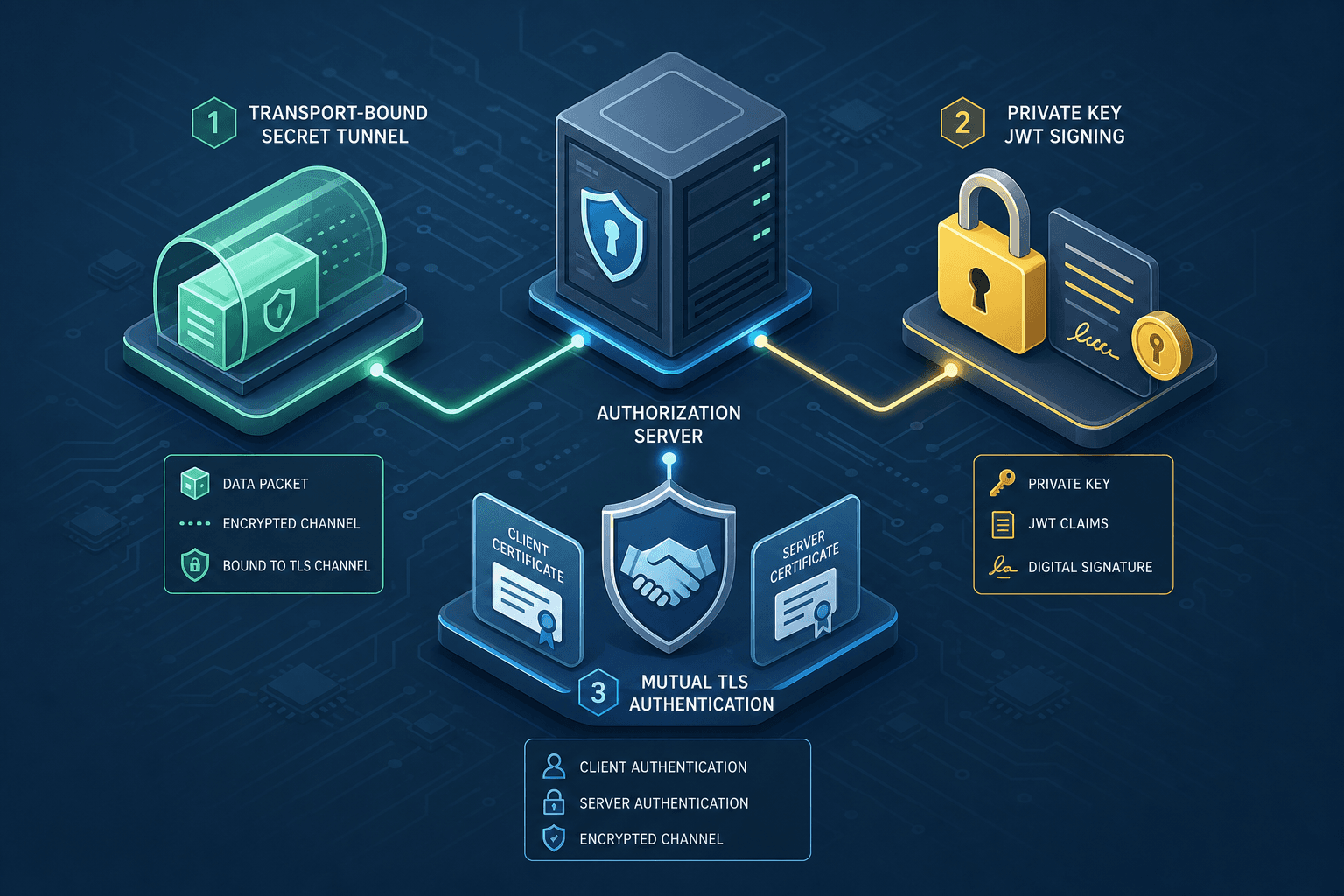
In OAuth2, a client proves its identity to an Authorization Server via a discrete mechanism selection. This choice defines the cryptographic or transport-level guarantees of the transaction. When requesting a token, the client must authenticate to prevent impersonation. The system's security posture relies on the method's ability to bind the client's identity to a secret that an attacker cannot easily steal or forge. We must look past surface labels to understand the underlying data flow and constraints of each method.
The Transport-Bound Secret: client_secret_basic
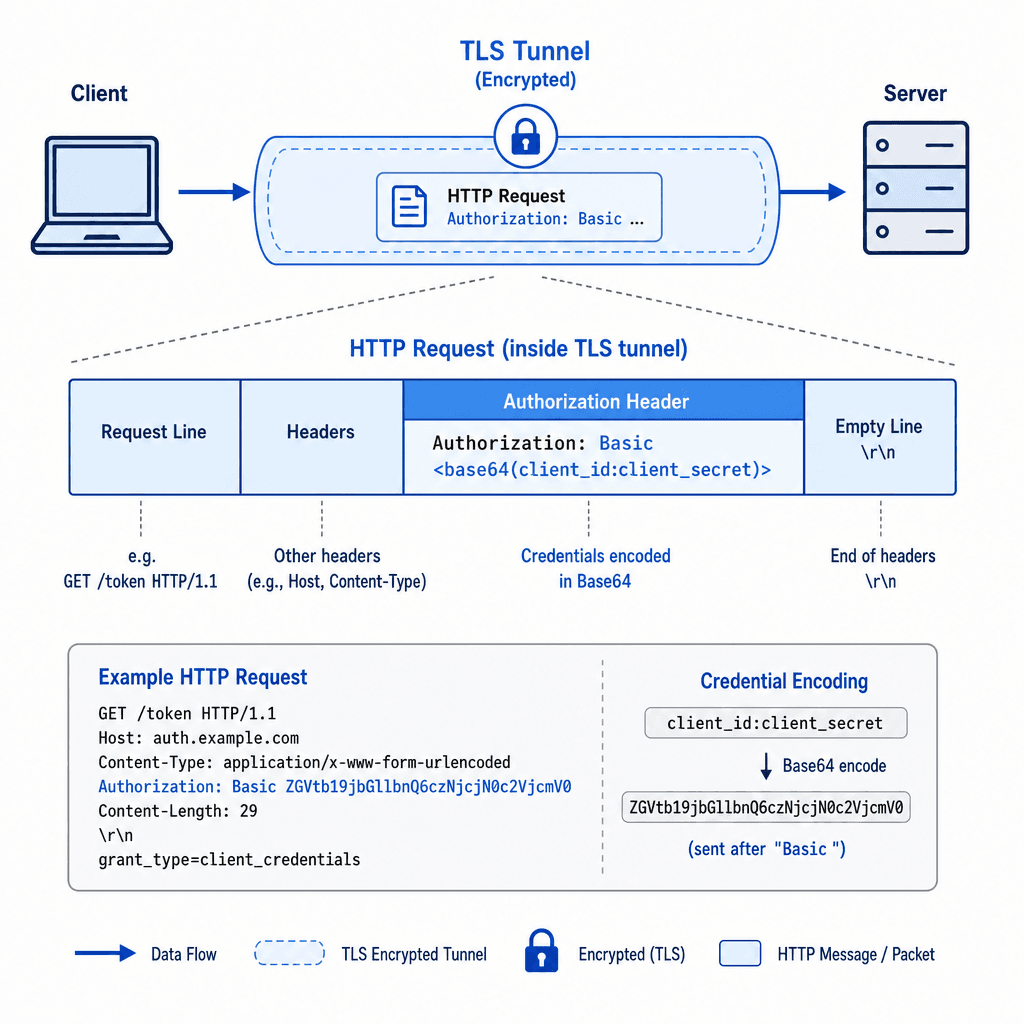
The most fundamental mechanism, client_secret_basic, relies on the confidentiality of the transport layer rather than complex cryptography. In this scenario, the client possesses a static string known as a client_secret. When the client initiates a token request, it transmits its client_id and client_secret together.
The mechanism here is simple: the Authorization Server expects these credentials to be sent within the HTTP Authorization header, specifically using the Basic authentication scheme. The client base64-encodes the string client_id:client_secret and prefixes it with Basic . For example, if the client_id is my-app and the secret is super-secret-123, the header looks like this:
Authorization: Basic bXktYXBwOnN1cGVyLXNlY3JldC0xMjM=The server decodes this string, splits it by the colon, and verifies the secret against its database. The critical security constraint is that this mechanism assumes the HTTP connection is encrypted via TLS (HTTPS). If the traffic is not encrypted, the secret travels in cleartext, allowing any network observer to capture it and replay it later. The client_secret is a shared secret; it is not a proof of possession but a shared password.
This method is defined in the core OAuth2 specification (RFC 6749, Section 2.3.1) as a standard option for confidential clients. It is effective only when the client is a server-side application that can securely store the secret and enforce TLS for all outbound connections. In a public client scenario, such as a single-page application running in a browser, this method fails because the secret would be exposed in the client-side code, rendering the transport encryption irrelevant.
The Cryptographic Proof: private_key_jwt
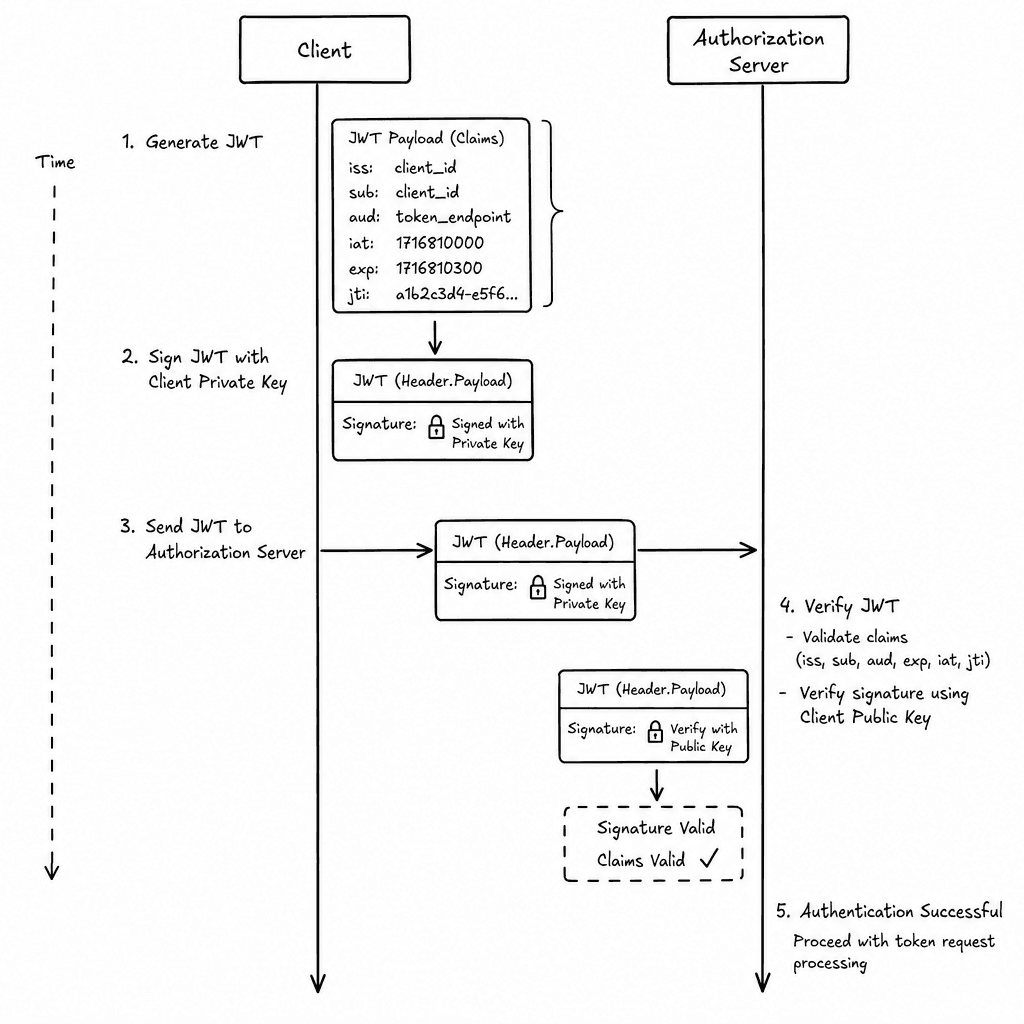
To mitigate the risks of shared secrets and transport reliance, the private_key_jwt method shifts the mechanism from transmission to cryptographic signing. Here, the client does not send a secret. Instead, it generates a JSON Web Token (JWT) and signs it with a private key. The Authorization Server holds the corresponding public key or certificate to verify the signature.
The mechanism works as follows: The client constructs a JWT containing specific claims. The iss (issuer) claim must match the client_id. The sub (subject) claim also matches the client_id. Crucially, the aud (audience) claim must identify the Authorization Server's token endpoint, and the iat (issued at) and exp (expiration) claims define the validity window of the token. This ensures the token is short-lived and intended for a specific server.
{
  "iss": "my-app-client-id",
  "sub": "my-app-client-id",
  "aud": "https://auth.example.com/oauth/token",
  "iat": 1678886400,
  "exp": 1678886700
}
The client then signs this payload using a private key (typically RSA or ECDSA). The resulting signature is placed in the assertion parameter of the token request. The Authorization Server retrieves the public key associated with the client_id, verifies the signature, and checks the claims. If the signature is valid and the token is not expired, the server accepts the authentication.
This approach, detailed in RFC 7523, decouples authentication from the transport layer. Even if an attacker intercepts the HTTP request, they cannot forge a valid signature without the private key. Furthermore, the private key never leaves the client's secure environment. This makes private_key_jwt significantly more resistant against man-in-the-middle attacks compared to client_secret_basic, as the credential is not transmitted at all. It is the preferred method for server-to-server applications where key management infrastructure (like a Key Management Service) is available.
The Channel Identity: tls_client_auth
A third mechanism, tls_client_auth, moves the authentication burden entirely to the TLS handshake layer. Instead of sending credentials in the HTTP request body or headers, the client presents a client certificate during the TLS negotiation. The Authorization Server validates the certificate chain against a trusted Certificate Authority (CA).
The mechanism here binds the identity to the network connection itself. If the TLS handshake succeeds and the client certificate is valid, the server assumes the client is authenticated. This method requires a Public Key Infrastructure (PKI) where every client is issued a unique certificate. While this provides a very strong guarantee of identity, it introduces significant operational overhead for certificate lifecycle management (issuance, rotation, revocation).
This method is described in RFC 8705 as part of the OAuth 2.0 Mutual-TLS Client Authentication and Certificate-Bound Access Tokens profile. It is often used in high-security environments where the cost of managing certificates is justified by the need to eliminate all credential transmission risks. However, for many standard API deployments, the complexity of PKI management makes this less practical than private_key_jwt.
Common Pitfalls
Implementing OAuth2 client authentication often leads to failures due to configuration errors rather than protocol flaws.
- Hardcoded Secrets in Public Clients: Attempting to use
client_secret_basicin a Single Page Application (SPA) or mobile app is a critical failure. The secret becomes visible in the source code or bundle, allowing any user to extract it and impersonate the application. - Missing
audClaim Validation: Inprivate_key_jwt, failing to validate theaud(audience) claim allows a JWT signed for one authorization server to be accepted by another, potentially leading to cross-service impersonation attacks. - Stale Certificates in mTLS: With
tls_client_auth, relying on long-lived certificates without a robust revocation mechanism (OCSP or CRL) can leave systems vulnerable if a certificate is compromised years after issuance.
Practical Takeaways
Selecting the right authentication method requires applying specific mental models to your architecture.
- Secrets vs. Keys: Treat
client_secret_basicas a shared password andprivate_key_jwtas a unique digital signature. Prefer signatures where the secret cannot be physically isolated from the client code. - Transport Independence: If your threat model includes network interception, avoid methods that rely solely on TLS for credential confidentiality. Cryptographic proofs (
private_key_jwt) provide security even if TLS is misconfigured. - Operational Complexity: The strongest method (
tls_client_auth) often has the highest operational cost. Balance security needs against the team's ability to manage certificates and keys effectively.
Operational Tradeoffs and Security Realities
When selecting a method, the decision is rarely about which is "best" in a vacuum, but which fits the threat model and operational maturity of the system. The client_secret_basic method is the default for a reason: it is simple. However, its reliance on a shared secret means that if the secret is leaked, the attacker gains full access until the secret is rotated. In a private_key_jwt setup, the private key is mathematically harder to steal in transit, but if the private key is stolen from the disk, the attacker can impersonate the client indefinitely unless key rotation is automated.
For modern server-side OAuth2 implementations, private_key_jwt is recommended as the default choice over client_secret_basic. The operational cost of setting up key generation and distribution is outweighed by the reduction in attack surface. Relying on the confidentiality of TLS for a shared secret is a fragile security model; a single misconfiguration in the proxy or load balancer can expose the secret.
Public clients, such as mobile apps or SPAs, cannot use client_secret_basic or private_key_jwt effectively because they cannot keep a secret or a private key secure. These clients must rely on the Authorization Code Flow with PKCE (Proof Key for Code Exchange), which is a separate mechanism designed to prevent authorization code interception. For these clients, the concept of "client authentication" is effectively removed, and the security relies on the short-lived nature of the authorization code and the PKCE verifier.
The choice of authentication method fundamentally changes the trust model. client_secret_basic trusts the network and the storage of a string. private_key_jwt trusts the cryptographic integrity of the key and the signature verification process. tls_client_auth trusts the PKI and the TLS handshake. Understanding these mechanisms allows engineers to design systems where the failure of one component does not lead to a total compromise of the API. Security is not a feature added at the end; it is the result of selecting the correct mechanism for the specific data flow and threat landscape.
Conclusion
OAuth2 client authentication is a spectrum of mechanisms ranging from simple transport-bound secrets to complex cryptographic proofs. By understanding the specific constraints of client_secret_basic, private_key_jwt, and tls_client_auth, developers can make informed decisions that align with their application's security requirements and operational capabilities. Moving away from default configurations towards stronger mechanisms like private_key_jwt is a critical step in hardening API ecosystems against modern threats.
FAQ
Q: Can I use private_key_jwt with a mobile application?
A: Generally, no. Mobile apps are considered public clients and cannot securely store a private key. They should use the Authorization Code Flow with PKCE instead.
Q: Is client_secret_basic insecure if I use HTTPS?
A: It is less secure than private_key_jwt because the secret is still transmitted. If the TLS connection is terminated prematurely or if there is a man-in-the-middle attack on the certificate validation, the secret is exposed.
Q: How often should I rotate keys in a private_key_jwt setup?
A: Rotation frequency depends on your threat model and key management capabilities, but industry standards often recommend rotating keys every 90 days or immediately upon any suspected compromise.
Related posts
Understanding JWKS: Rotating Signing Keys Gracefully
An examination of JSON Web Key Set (JWKS) mechanisms for securely rotating signing keys and verifying JWTs without service interruption.
OAuth 2.0 vs JWT: Understanding the Relationship
An examination of the relationship between OAuth 2.0 and JSON Web Tokens, covering opaque tokens, token format selection, and JWT best practices.
OAuth 2.0 Token Introspection & Revocation Strategies
Production strategies for OAuth 2.0 token introspection and revocation covering lifecycle management and security across ForgeRock and Keycloak.