Event-Driven Architecture for Identity: Security Events and Real-Time Monitoring
Examination of event-driven identity architectures focusing on security events, real-time monitoring, and identity analytics using Kafka security and event sourcing.
Traditional identity management often relies on a polling or snapshot model where a database holds the current state of a user, and security tools query this state periodically. This approach introduces latency and blind spots that attackers can exploit. In an event-driven architecture, the "current state" is a derived projection of a log of all past actions. The core mechanism here is Event Sourcing: the system stores the sequence of state changes, not the state itself. When a user logs in, the system does not update a status column; it emits a UserLoggedIn event. This shift transforms security monitoring from checking a static picture to watching a live movie of identity behavior.
The core tension in identity security is between the speed of an attack and the speed of detection. In a polling model, if a breach occurs at 10:00:00 and the next poll is at 10:05:00, the attacker has a five-minute window. In an event-driven model, the moment the event is written to the log, it is available to consumers. The mechanism relies on the immutable log as the single source of truth. Every interaction with the identity fabric—authentication, authorization, token refresh, password reset—becomes an immutable record.
The Mechanism of State Inference
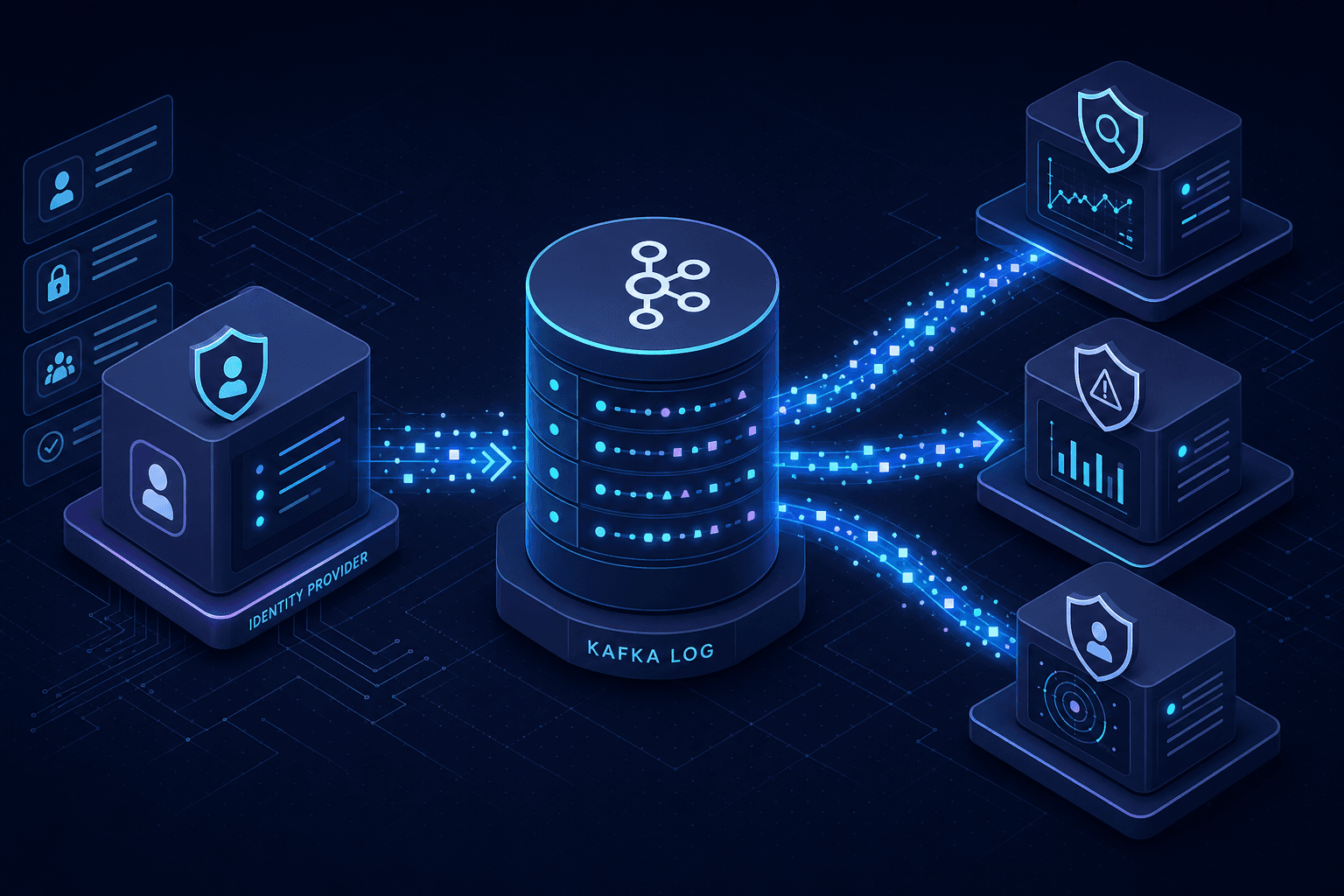
In this architecture, an Identity Provider (IdP) acts as the central publisher. The IdP emits events to a Kafka topic named identity-events. These events are strictly typed using a schema registry (e.g., Confluent Schema Registry with Avro). A typical event payload might look like this:
{
  "event_id": "uuid-550e8400-e29b-41d4-a716-446655440000",
  "timestamp": "2023-10-27T10:15:30Z",
  "actor": "user-alice",
  "action": "LOGIN_ATTEMPT",
  "context": {
    "ip_address": "192.168.1.50",
    "user_agent": "Mozilla/5.0...",
    "geolocation": { "lat": 40.7128, "lon": -74.0060 },
    "device_fingerprint": "fp-xyz-123"
  },
  "outcome": "SUCCESS",
  "risk_score": 12
}
This structure ensures that downstream consumers do not need to parse unstructured logs. They consume the raw event stream. The security engine is a Kafka Streams application or an Apache Flink job that subscribes to this topic. It does not query a database; it consumes the stream.
The Kafka Security Pipeline
The mechanism for real-time monitoring is stream processing. A consumer group named security-anomaly-detector reads the identity-events topic. It maintains a sliding window of recent events for each user. If a user bob generates a LOGIN_SUCCESS from New York at 10:00 AM and a LOGIN_SUCCESS from London at 10:05 AM, the stream processor calculates the distance and time delta. Since this exceeds the physical velocity of travel, the processor emits a new event: ANOMALY_DETECTED_IMPOSSIBLE_TRAVEL.
This is not a rule-based check against a static IP blacklist. It is a dynamic inference based on the sequence of events. The processor aggregates events by actor key and applies a stateful function. If the state transitions from NORMAL to HIGH_RISK, the system immediately triggers a response. This could be a synchronous call to the IdP to force a re-authentication or an asynchronous alert to the SIEM (Security Information and Event Management) system.
The advantage of this approach over traditional log aggregation (like sending logs to Splunk and running a query) is the reduction of latency and the ability to handle high throughput without blocking the IdP. The IdP writes to Kafka and forgets the data. The security consumer processes it at its own pace. If the security engine is under load, the events persist in the Kafka partition until the consumer catches up. This decoupling is critical during a Distributed Denial of Service (DDoS) attack or a credential stuffing attempt, where the volume of events spikes. The IdP remains responsive because it is not waiting for the security team to acknowledge the log entry.
Let's look at the flow of a credential stuffing attack. An attacker script attempts to log in with a leaked password for user-jane. The IdP receives the request and validates the credentials. If the password is correct, the IdP emits a LOGIN_SUCCESS event. If the password is incorrect, the IdP emits a LOGIN_FAILED event. The security consumer sees a burst of LOGIN_FAILED events from a specific IP range targeting user-jane.
The stream processor detects this pattern within a 1-minute window. It does not wait for the user to report it. It calculates the rate of failure events. If the rate exceeds the threshold, it emits a LOCK_ACCOUNT event. This event is consumed by a separate service responsible for enforcing account locks. The lock is applied immediately. The IdP might receive a directive to invalidate existing sessions. The entire chain—from the failed login attempt to the account lock—happens in seconds, driven by the event stream.
Real-Time Anomaly Detection and State Machine Validation
A common misconception is that event sourcing replaces the need for a relational database. It does not. The database still holds the "current state" projection (e.g., user_jane_is_locked = true). However, the database is updated from the events, not the other way around. If the database corrupts or the service crashes, the system can rebuild the entire state by replaying the Kafka log from the beginning. This provides a robust audit trail that is cryptographically verifiable.
For forensic analysis, the immutable log allows you to "time travel." If a breach occurred yesterday, you can spin up a temporary consumer, replay the events from yesterday's date, and reconstruct the exact sequence of actions that led to the compromise. You can see exactly which API calls were made, which tokens were issued, and where the attacker originated. This level of detail is often lost in standard log files where fields are dropped or truncated after a certain retention period.
The security implications of this architecture are profound. It shifts the boundary of trust. Instead of trusting the perimeter (firewalls, WAFs), you trust the event stream. Every action is validated against the sequence of previous actions. If an event contradicts the expected state (e.g., a PASSWORD_RESET event without a preceding PASSWORD_CHANGE_REQUEST), the stream processor can reject it or flag it. This is known as state machine validation at the event level.
However, there are tradeoffs. The complexity of maintaining the event schema increases. If you change the structure of an identity-event message, you must manage schema compatibility carefully. You cannot simply drop a field; you must use backward-compatible evolution strategies (e.g., adding new fields with defaults). If the schema evolves incorrectly, downstream security consumers might fail to parse the events, creating a blind spot.
Another consideration is data privacy. Since every event is logged, you are capturing sensitive PII (Personally Identifiable Information) in the stream. You must ensure that the Kafka topic is encrypted at rest and in transit. You also need to implement masking or tokenization for fields like email addresses or IP addresses before they enter the stream, depending on your compliance requirements (GDPR, CCPA). The event store becomes a high-value target, so access control to the Kafka cluster must be as strict as the IdP itself.
Common Pitfalls
Implementing event-driven identity security introduces specific challenges that require careful architectural planning. First, schema evolution poses a significant risk. Unlike traditional APIs where versioning is explicit, event streams often evolve implicitly. If a downstream security consumer expects a specific field structure and the IdP introduces a breaking change without proper deprecation, the entire detection pipeline can fail silently or crash. Organizations must enforce strict schema validation at the producer level and utilize schema registries with compatibility checks to prevent data corruption.
Second, PII handling in high-volume streams requires a "privacy by design" approach. Because event sourcing captures every action, sensitive data like full names, email addresses, and IP addresses flow through the entire pipeline. Failure to mask or tokenize this data at the point of ingestion can lead to compliance violations. Additionally, the immutable nature of the log means that once data is written, it cannot be easily deleted to satisfy "right to be forgotten" requests without complex tombstoning or encryption key rotation strategies.
Finally, the operational complexity of event replay can be underestimated. While replaying logs is a powerful forensic tool, it requires significant compute resources and time. Replaying months of high-fidelity identity events to debug a production issue can strain infrastructure. Teams must implement efficient replay mechanisms, such as partitioned replay or sampling, and ensure that their consumer logic is idempotent to prevent duplicate actions during reconstruction.
Practical Takeaways
- Decouple Security from Identity: By writing events to Kafka, the IdP remains responsive even when security analysis is under heavy load, preventing authentication bottlenecks during attacks.
- Immutable Audit Trails: Event sourcing provides a cryptographically verifiable history of all identity actions, enabling perfect reconstruction of incidents for forensics.
- Stateless Detection: Stream processors analyze behavior in real-time without relying on periodic database snapshots, drastically reducing the window of exposure for zero-day attacks.
- Schema Discipline: Strict schema management is non-negotiable; use schema registries to enforce backward compatibility and prevent pipeline failures.
- Privacy-First Design: Implement data masking and encryption at the source to ensure sensitive PII does not traverse the stream in plain text.
FAQ
Q: Does event sourcing eliminate the need for a database? A: No. Event sourcing is complementary to traditional databases. The database is used to store the "current state" projection (e.g., user balance, account status) derived from the event log. The log serves as the source of truth, while the database optimizes read performance for the current state.
Q: How do we handle breaking changes in event schemas? A: You must use backward-compatible evolution strategies. New fields should be added with defaults, and old fields should never be removed immediately. Use a schema registry to validate that new producers do not break existing consumers. Deprecate fields gradually over multiple versions.
Q: Is event sourcing suitable for high-transaction identity systems? A: Yes, but with caveats. While Kafka handles high throughput well, the complexity of maintaining consistency and handling replay operations increases with scale. It is best suited for systems where auditability and real-time security are prioritized over simple CRUD operations.
Call to Action
Evaluate your current identity infrastructure for latency gaps in threat detection. If you are still relying on periodic polling or unstructured log aggregation, you may be missing critical attack windows. Begin by auditing your existing identity event logs for schema consistency and PII exposure, then design a proof-of-concept Kafka security pipeline to validate real-time anomaly detection capabilities.
Conclusion
Event-driven identity architecture transforms security monitoring from a passive, retrospective activity into an active, real-time defense mechanism. By treating identity state as a sequence of immutable events, organizations can detect anomalies faster, reconstruct incidents with perfect fidelity, and scale their security operations without introducing latency. The mechanism is not magic; it is the disciplined application of event sourcing and stream processing to the domain of identity.
The strategic value extends beyond immediate threat mitigation. As identity systems become more distributed across microservices and hybrid clouds, the event stream serves as the universal ledger of trust. It enables a shift from perimeter-based security to behavior-based security, where every action is contextualized by the entire history of the user's journey. Looking forward, we can expect the integration of machine learning models directly into the stream processing layer, allowing for adaptive risk scoring that evolves with attacker tactics in real-time.
Future trends will likely see the convergence of event-driven identity with decentralized identity protocols. As users gain more control over their digital identities, the event stream will become the primary interface for verifying credentials and managing consent across diverse ecosystems. Organizations that master the discipline of event sourcing today will be best positioned to navigate the complexities of tomorrow's identity landscape, ensuring that their security posture moves as fast as the digital world it protects.
Related posts
Implementing Conditional Access Policies with Keycloak and ForgeRock
A technical examination of implementing conditional access policies using Keycloak and ForgeRock for context-aware access control.
Implementing Entitlement Management for Fine-Grained Authorization
An examination of entitlement management and fine-grained authorization using XACML and policy engines for secure access control.
Multi Cloud Identity Management Framework: A Reference Architecture
A reference framework for cross-cloud IAM that addresses multi-cloud identity management, entitlements, and reference architecture for architects.