Implementing SCIM 2.0: Automated User Provisioning and De-provisioning
A technical guide to implementing SCIM 2.0 for automated user provisioning and de-provisioning across identity lifecycles.
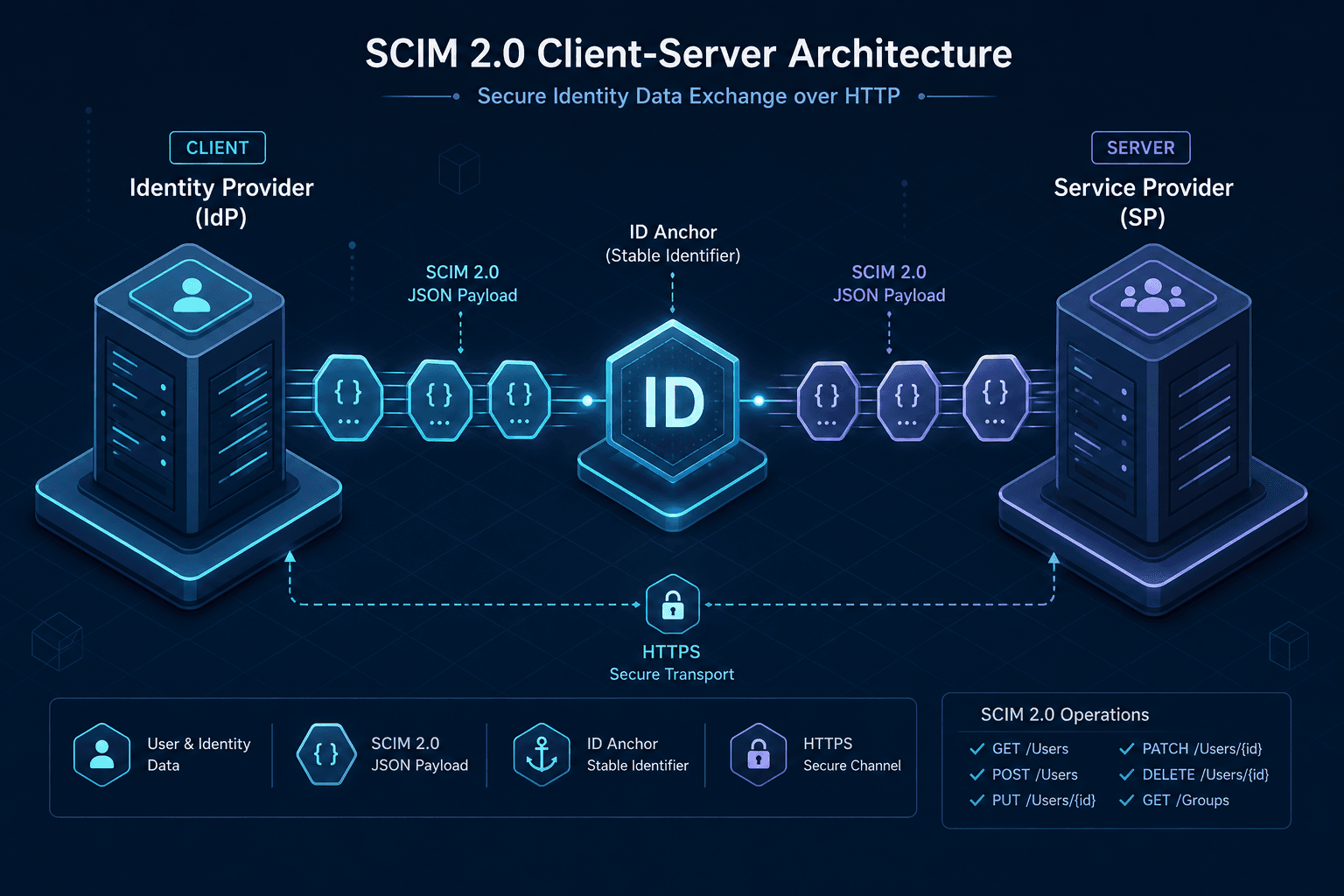
The core mechanism of SCIM 2.0 is a strict contract between two systems over HTTP. In this architecture, the Identity Provider (IdP) acts as the SCIM Client, and the target application (Service Provider or SP) acts as the SCIM Server. While Clients can generate identifiers, this guide focuses on the SP-generation pattern where the SP assigns the unique id. The protocol relies on a single source of truth for this id. When an IdP creates a user, it receives this id from the SP and must store it to reference the user in subsequent operations. Without this persistent mapping, the IdP cannot issue a PATCH or DELETE request because it has no way to tell the SP which specific row in the database to update.
The Client-Server Model and Resource Anchoring
Consider a concrete scenario involving "Alice," an engineer joining Acme Corp. Alice's data lives in the IdP, let's call it "AuthCenter." When Alice is added to the engineering group in AuthCenter, AuthCenter initiates the provisioning flow. It constructs a JSON object conforming to the SCIM User schema defined in RFC 7643 (Core Schema). This payload includes the userName (alice@acme.com), name (formatted as {"familyName": "Smith", "givenName": "Alice"}), and active set to true. AuthCenter sends this as a POST request to the SP's endpoint, typically https://app.acme.com/scim/v2/Users.
{
  "schemas": ["urn:ietf:params:scim:schemas:core:2.0:User"],
  "userName": "alice@acme.com",
  "name": {
    "familyName": "Smith",
    "givenName": "Alice"
  },
  "emails": [
    {
      "value": "alice@acme.com",
      "type": "work",
      "primary": true
    }
  ],
  "active": true,
  "title": "Senior Engineer"
}
The SP receives this request and performs two critical actions. First, it validates the payload against its internal schema rules. Second, it attempts to create the user in its local database. If successful, the SP returns a 201 Created status code. Crucially, the response body must include the newly generated id assigned by the SP. This id is opaque to the IdP in terms of format; the IdP does not need to know the SP's internal database primary key, but it must store this value to reference Alice in future updates. Note that while the SP typically generates the ID, RFC 7644 Section 3.1.1 allows Clients to supply an id if the Server supports it. If the SP returns a 409 Conflict, it means a user with that userName already exists, and the IdP must decide whether to update the existing record or abort.
The Create and Update Lifecycle
Once Alice is provisioned, her lifecycle is dynamic. Suppose Alice changes her department to "Product." AuthCenter detects this change and issues a PATCH request. Unlike POST, which creates, PATCH modifies. The request targets the specific resource URL using the stored id: https://app.acme.com/scim/v2/Users/{id}. The payload uses the Operations array format to specify the action. In this case, we use the replace operation to update the title attribute.
{
  "schemas": ["urn:ietf:params:scim:api:messages:2.0:PatchOp"],
  "Operations": [
    {
      "op": "replace",
      "path": "title",
      "value": "Lead Product Engineer"
    }
  ]
}
The SP applies this change atomically. If the path refers to a nested attribute, the SP must navigate the JSON structure correctly. If the SP cannot find the user with the provided id, it returns a 404 Not Found. If the id is valid but the user is inactive, the behavior depends on the SP's policy; some systems allow updates to inactive users, while others reject them with a 403 Forbidden. This granularity allows the IdP to maintain a precise state without polling.
De-provisioning Strategies: Hard vs. Soft Delete
The most critical failure point in identity management is de-provisioning. When Alice leaves Acme Corp, AuthCenter must remove her access immediately. SCIM provides two mechanisms for this. The first is a hard delete via DELETE /Users/{id}, which permanently removes the resource. The second, often preferred in enterprise environments for audit trails, is a soft delete. This involves sending a PATCH request to set active to false.
{
  "schemas": ["urn:ietf:params:scim:api:messages:2.0:PatchOp"],
  "Operations": [
    {
      "op": "replace",
      "path": "active",
      "value": false
    }
  ]
}
From a security perspective, the soft delete is generally safer. It allows the SP to revoke all active sessions and prevent new logins while retaining the user record for compliance reporting. A hard delete might trigger the deletion of associated audit logs or historical data linked to that user ID, complicating forensic investigations. However, if the SP's policy mandates that active=false users are immediately purged from the database, the IdP must rely on the SP's documentation rather than assuming standard behavior.
Error Handling and State Management
Error handling in SCIM is not optional; it is the backbone of reliability. The SP must return specific error codes to guide the IdP. A 400 Bad Request indicates malformed JSON or missing required attributes. A 500 Internal Server Error suggests the SP is down or encountered a database deadlock. In these cases, the IdP should implement exponential backoff before retrying. The IdP should never assume a request succeeded just because it sent it. If the SP returns a 409 Conflict during a PATCH, it is typically due to a version mismatch (precondition failed) or a uniqueness constraint violation on userName per RFC 7644 Section 3.5, rather than a simple failure of the change itself.
Implementing SCIM 2.0 requires strict adherence to the RFCs. The protocol defines a specific set of attributes like meta (timestamps, version) that the SP must populate in responses. If the IdP expects these fields and the SP omits them, the synchronization logic may break. Furthermore, the meta object includes a version field that increments with every modification. This allows the IdP to detect if a user was modified outside of the IdP's control (e.g., by a manual admin login to the SP). If the IdP sees a version mismatch during a PATCH, it can choose to fail the operation to prevent overwriting external changes, preserving data integrity. The IdP achieves this by using the If-Match HTTP header containing the meta.version value, as required by RFC 7644 Section 3.5.
In practice, the complexity lies in the mapping. The SCIM schema is generic, but enterprise applications often have custom attributes. While SCIM 2.0 supports extensions via the urn:ietf:params:scim:schemas:extension:... namespace, the IdP and SP must agree on the schema definitions beforehand. If the IdP tries to push a custom attribute that the SP does not recognize, the SP might ignore it or reject the entire request depending on its strictness settings. This is why a pre-deployment schema discovery phase is essential.
Conclusion
Ultimately, SCIM 2.0 transforms identity management from a series of manual scripts into a state-driven protocol. By relying on the id as the anchor and using standard HTTP verbs to manipulate state, organizations can ensure that user access is granted and revoked with minimal latency. The tradeoff is the initial effort to map custom attributes and configure the endpoints correctly, but the long-term reduction in helpdesk tickets regarding "I can't access my app" or "Why do I still have access after quitting?" makes the investment necessary for any mature identity infrastructure.
Common Pitfalls
- ID Mapping Loss: The most common cause of sync failure is losing the mapping between the IdP's internal user ID and the SP's SCIM
id. If the IdP's database is reset or the mapping table is not persisted, subsequentPATCHorDELETErequests will fail with404 Not Foundbecause the IdP cannot locate the correct resource URL. - Schema Extension Mismatches: Relying on custom attributes without explicit agreement can lead to silent failures. If the SP does not support a specific extension defined by the IdP, the request might be rejected entirely or the attribute silently ignored, leading to data inconsistency between systems.
- Race Conditions in De-provisioning: Concurrent updates can cause issues if the IdP attempts to update a user who has already been soft-deleted by the SP, or vice versa. Without proper handling of the
409 Conflictstatus for version mismatches, the IdP might overwrite a de-provisioning action with an update, inadvertently re-enabling access.
Practical Takeaways
- Assume Opaque IDs: Treat the SCIM
idas a black box. Do not attempt to parse or infer the SP's internal database key from the ID string; simply store and reuse it exactly as returned. - Always Use ETags: Never send a
PATCHrequest without theIf-Matchheader. Always include themeta.versionfrom the last known state of the resource to prevent accidental overwrites of concurrent changes. - Validate Schema First: Before enabling production provisioning, perform a full schema discovery and validation test. Ensure both the Core schema and any required Extensions are explicitly supported by the SP before attempting to sync custom attributes.
FAQ
Q: Can I use my own internal user IDs instead of the SCIM id?
A: Yes, RFC 7644 Section 3.1.1 allows the Client to supply an id during creation if the Server supports it. However, this is less common in enterprise scenarios where the SP acts as the system of record. If you do this, ensure the SP explicitly accepts the provided ID; otherwise, the SP will generate its own, causing a mismatch.
Q: How do I handle users who are deleted in the IdP but still exist in the SP?
A: Implement a "soft delete" strategy where the IdP sets active to false via a PATCH request. This revokes access without destroying the record. If a hard delete is required, the IdP must send a DELETE request, but be aware that this may permanently remove audit trails depending on the SP's retention policy.
Q: What happens if the SCIM endpoint is temporarily unavailable?
A: The IdP should implement an exponential backoff retry strategy. Do not immediately retry on a 500 Internal Server Error or 503 Service Unavailable. Instead, wait progressively longer intervals between retries to avoid overwhelming the SP and to respect rate limits.
Related posts
SAML vs OAuth 2.0 vs OIDC: Which Protocol to Choose in 2025
Compare SAML, OAuth 2.0, and OIDC to select the right identity protocol for enterprise authentication and SSO in 2025.
SAML 2.0 Explained: The Complete Guide to Enterprise SSO
A walkthrough of SAML 2.0, covering how identity providers and service providers enable enterprise single sign-on using SAML assertions.
SAML Artifact Binding: Low-Latency SSO Architecture
An examination of SAML artifact binding for achieving low-latency SSO performance and reducing network overhead.