SAML vs OAuth 2.0 vs OIDC: Which Protocol to Choose in 2025
Compare SAML, OAuth 2.0, and OIDC to select the right identity protocol for enterprise authentication and SSO in 2025.
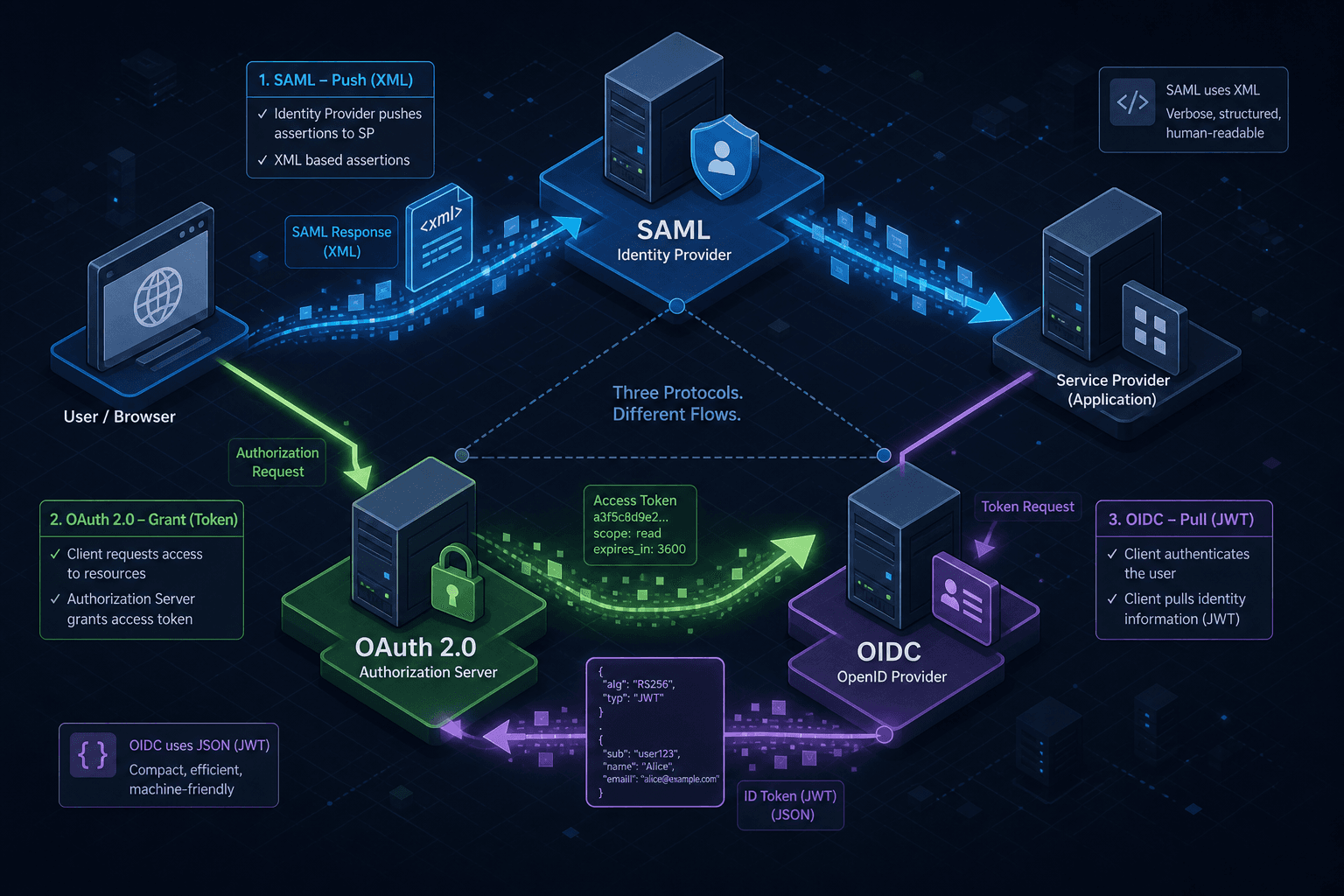
The confusion surrounding identity protocols in 2025 often stems from treating them as interchangeable synonyms for "Single Sign-On." They are not. The fundamental distinction lies in the mechanism of trust transfer and the direction of data flow. SAML (Security Assertion Markup Language) operates on a "push" model where the Identity Provider (IdP) sends a signed assertion directly to the Service Provider (SP) via the user's browser, relying heavily on XML canonicalization. In contrast, OIDC (OpenID Connect) operates on a "pull" model where the application requests a JSON Web Token (JWT) from the Authorization Server, decoupling the authentication event from the resource access event.
This guide, Part 3 of the SAML Mastery Series, dissects these mechanisms to help you architect for the modern cloud-native landscape.
The Mechanism of Trust in SAML
To select the right protocol, you must first understand the mechanism of the SAML assertion. When a user attempts to access a legacy enterprise application, the SP redirects the user's browser to the IdP. The IdP authenticates the user (often against an on-premise Active Directory) and then generates an XML document containing the user's attributes and an assertion of their identity. This XML is signed using a private key held by the IdP. The browser then POSTs this XML back to the SP. The SP validates the signature against the IdP's public certificate. If the signature is valid and the assertion has not expired, the SP creates a session.
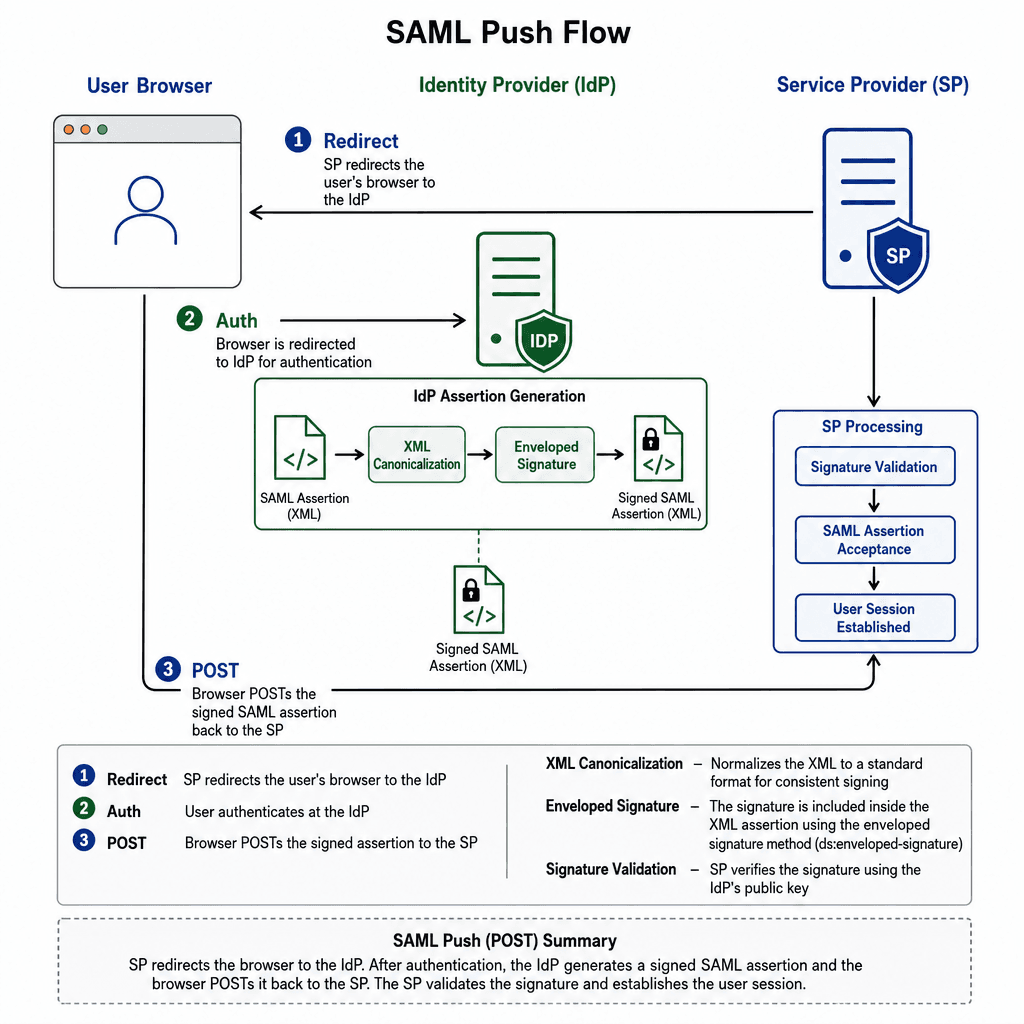
This mechanism is reliable for environments where the IdP is the source of truth and the SP is a passive consumer of that truth, but it introduces complexity due to XML parsing, canonicalization requirements, and the reliance on the browser as the transport channel for the credential.
The Mechanism of Access in OAuth 2.0 and OIDC
Conversely, OIDC is built on top of OAuth 2.0 but adds a specific layer for authentication. OAuth 2.0 defines a framework for authorization, allowing a client to get an access token to access resources without exposing user credentials. OIDC wraps this with an authentication layer. When a user logs in, the application redirects them to the Identity Provider. The user authenticates, and the provider returns an authorization code to the application's backend. The application then exchanges this code for two tokens: an ID Token and an Access Token. The ID Token is a JWT, a compact, URL-safe string containing claims about the user (e.g., sub, iss, email).
{
  "alg": "RS256",
  "iss": "https://auth.example.com",
  "sub": "user-12345",
  "aud": "client-app-67890",
  "exp": 1705329600
}
The application validates the JWT signature locally, often using a set of public keys fetched from the provider's discovery document. This mechanism allows the application to make decisions locally without round-trip network calls to the IdP for every request, making it ideal for mobile and single-page applications where the browser cannot securely store secrets.
The Data Flow Difference
The critical difference in 2025 is not just the format (XML vs. JSON) but the architectural dependency. SAML assertions are self-contained and signed; the SP validates them locally using the IdP's certificate without requiring the IdP to be online for every validation (unless checking revocation via CRL/OCSP). OIDC is "stateless" regarding the session itself; once the JWT is validated, the application holds the state. This makes OIDC the native choice for cloud-native architectures like Kubernetes or serverless functions, where scaling requires stateless instances that can validate tokens independently.
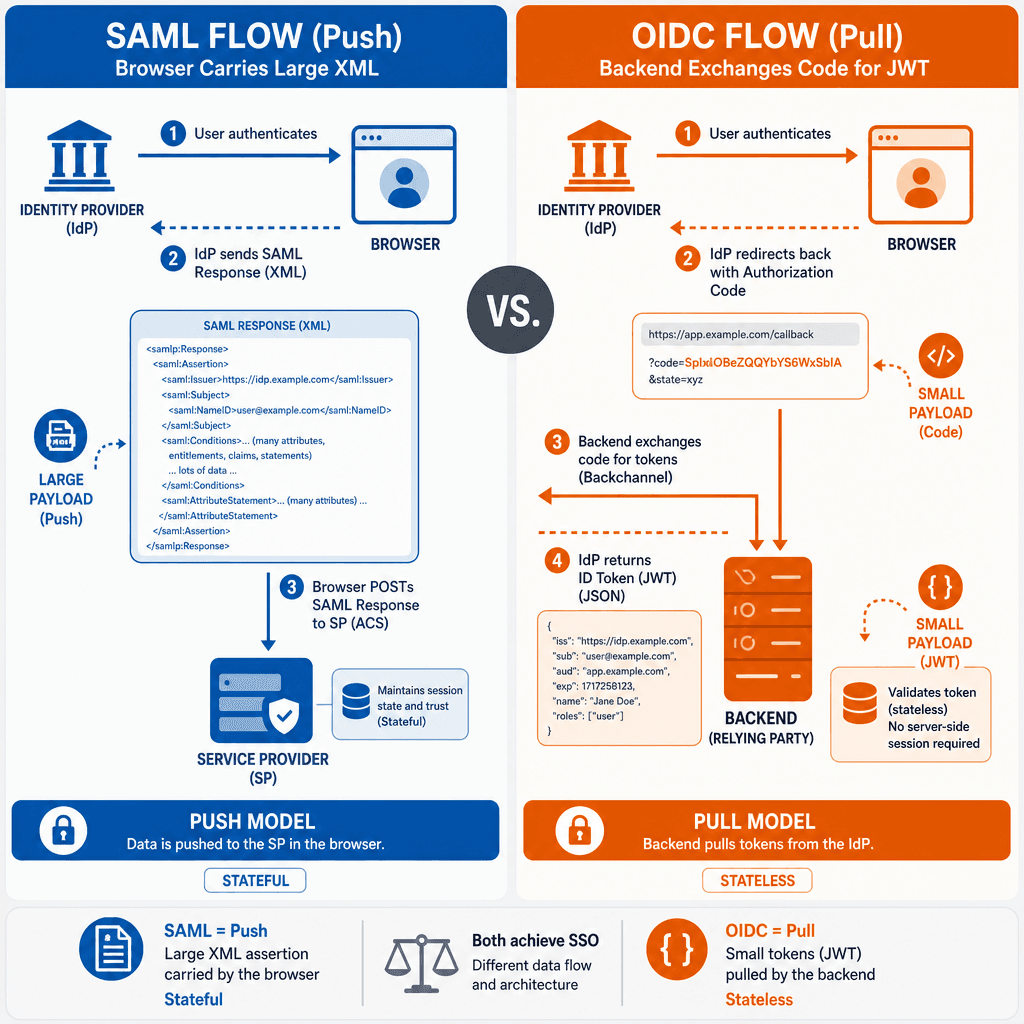
Consider a scenario involving a modern microservices architecture versus a legacy ERP system. In the microservices scenario, you have a frontend React app and a backend API. If you use SAML, the React app must handle the XML assertion, which is verbose and difficult to parse in JavaScript. Furthermore, pure SAML flows lack a native token exchange mechanism for API backends, often requiring an adapter to translate the assertion into a format the API can consume. With OIDC, the React app gets a JWT. The app attaches this JWT to the API request headers. The API validates the JWT signature locally. This is a clean, decoupled flow. However, if you are integrating with a legacy on-premise ERP that only supports SAML 2.0, you cannot force it to understand OIDC. In this case, you might use an Identity Broker or a gateway that translates OIDC tokens into SAML assertions, effectively acting as a protocol adapter.
2025 Strategic Selection
Why does OAuth 2.0 exist separately from OIDC? OAuth 2.0 is strictly an authorization framework; it does not define what an "identity" is. It simply grants permission to act on behalf of a user. OIDC defines the identity layer on top of OAuth 2.0. If your goal is purely to allow a user to log in to your application and retrieve their profile, OIDC is the correct tool. If your goal is to grant an application permission to read a user's Google Drive files without seeing their email, OAuth 2.0 is the tool. In 2025, almost all authentication scenarios require the identity layer, meaning OIDC is the default choice unless constrained by legacy infrastructure.
The decision matrix for 2025 should prioritize OIDC for new development. The JSON format is natively supported by every modern programming language, the token size is small, and the stateless nature aligns with cloud scaling patterns. SAML should be reserved for scenarios where you are integrating with legacy systems that cannot be updated, or where your organization has strict compliance requirements that mandate the specific XML-based assertion model used in government or financial sectors. Do not choose SAML because it is "older"; choose it only because the target system demands it.
Common Pitfalls
When selecting between these protocols, organizations frequently fall into specific traps that complicate future maintenance. First, ignoring legacy constraints can lead to dead ends; forcing OIDC on a system that only speaks SAML requires significant middleware overhead. Second, over-engineering simple applications by implementing full OIDC flows when a simple SAML SSO would suffice adds unnecessary complexity to the stack. Third, misunderstanding token lifecycles often leads to security vulnerabilities; developers sometimes treat SAML assertions like short-lived JWTs or fail to implement proper refresh logic for OIDC access tokens, resulting in frequent re-authentication or stale sessions.
Practical Takeaways
- Prioritize OIDC for New Builds: Adopt OIDC as the default for all new cloud-native applications to leverage stateless scaling and native JSON support.
- Bridge Legacy with Care: Use an identity broker or gateway to translate protocols when integrating modern OIDC apps with legacy SAML systems, rather than rewriting the legacy system.
- Validate Locally: Ensure your architecture supports local token validation (JWT) to minimize latency and dependency on IdP uptime for session management.
FAQ
Q: Can I use OAuth 2.0 for authentication? A: Technically no, OAuth 2.0 is an authorization framework, not an authentication protocol. You must use OpenID Connect (OIDC) on top of OAuth 2.0 to perform authentication and retrieve user identity information.
Q: Is SAML slower than OIDC? A: SAML often involves larger payloads due to XML formatting and can be slower to parse, but the primary performance difference usually comes from the complexity of the browser redirection flow compared to the direct token exchange in OIDC.
Q: Do I need both SAML and OIDC in my infrastructure? A: Yes, it is common to maintain both. You typically use OIDC for modern internal and external applications while keeping SAML active for legacy enterprise integrations, connected via an identity bridge.
Conclusion
In summary, the mechanism of trust in SAML is a browser-mediated XML push, while the mechanism in OIDC is a backend-mediated JSON pull. For 2025 enterprise strategy, the path is clear: adopt OIDC as the primary standard for new applications and APIs, and maintain SAML only as a bridge for legacy integration points. The future of identity is stateless, scalable, and JSON-based.
While SAML offers a "set it and forget it" model for simple SSO, its complexity in debugging and the verbosity of XML make it a liability in modern DevOps environments. Many organizations report higher maintenance overhead with XML schemas and canonicalization errors compared to the streamlined nature of JWTs. If you are starting a new project in 2025, choosing SAML over OIDC is a strategic error unless explicitly forced by a third-party vendor.
Related posts
OpenID Connect Guide: Extending OAuth 2.0 for Identity Verification
An examination of OpenID Connect (OIDC) and how it extends OAuth 2.0 to handle identity verification using ID tokens and discovery protocols.
Decoding client_secret_basic Default in RFC 8414
An examination of the token_endpoint_auth_methods_supported metadata field in RFC 8414 and why client_secret_basic remains the default authentication method.
Understanding OAuth2 Multiple Response Types: A Technical Guide
An examination of OAuth2 response types including hybrid flow, OIDC response types, and authorization server configurations for beginners.