SAML Metadata Management: Best Practices
Examination of SAML metadata management, certificate rotation, and identity federation trust to ensure secure integration.
In an identity federation environment, configuring a Service Provider (SP) to trust an Identity Provider (IdP) establishes a cryptographic contract rather than a simple URL setting. This contract resides within the SAML metadata XML document. Treating this metadata as static configuration introduces a single point of failure; if the IdP rotates its signing certificate while the SP relies on a cached version, the authentication flow collapses. The mechanism of trust in SAML relies entirely on the synchronization of these XML documents. To manage this securely, you must understand that metadata is dynamic state, not static config.
This article is Part 8 of the "SAML Mastery Series" series.
The Anatomy of Trust in EntityDescriptor
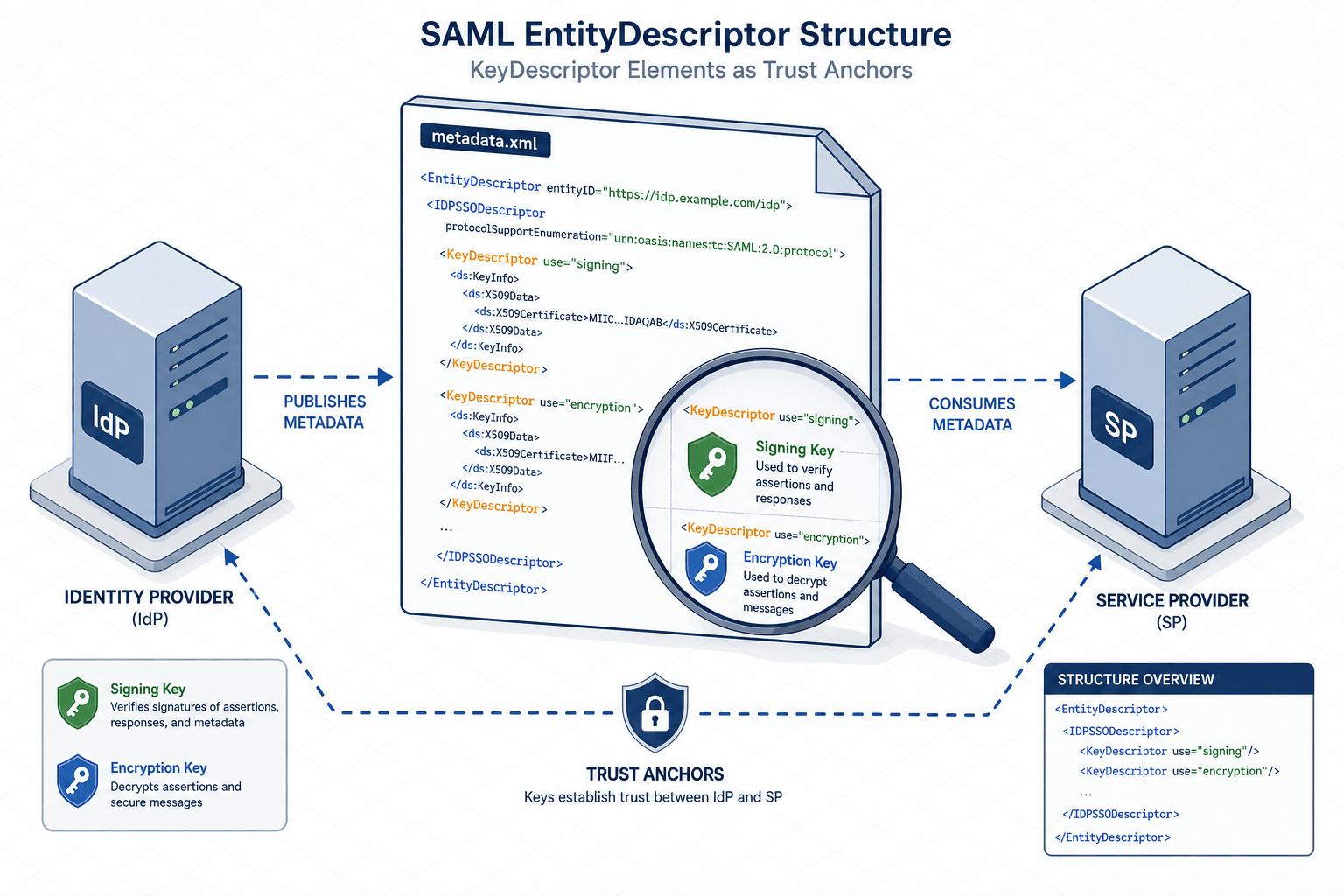
The SAML metadata document is an XML structure defined by the SAML V2.0 Core Specification. It contains an EntityDescriptor element that acts as the container for the entity's public identity. Within this container, the most critical component for integration is the KeyDescriptor element. This element holds the public key used to verify signatures on SAML assertions or to encrypt SAML requests. A single metadata document can contain multiple KeyDescriptor elements, often distinguishing between signing keys (used to sign responses) and encryption keys (used to encrypt requests).
Consider a scenario where "Acme Corp" (the SP) trusts "GlobalAuth" (the IdP). GlobalAuth publishes its metadata at https://globalauth.example.com/metadata.xml. Acme Corp downloads this file and parses it. The parser extracts the <ds:KeyInfo> block inside <KeyDescriptor use="signing">. It then stores this X.509 certificate in its local trust store. When a user attempts to log in, GlobalAuth returns a SAML Response signed with the private key corresponding to that public certificate. Acme Corp's SP verifies the digital signature using the stored certificate. If the certificate in the metadata does not match the one used to sign the response, the verification fails, and the SP returns a SAML Requester status code (urn:oasis:names:tc:SAML:2.0:status:Requester). While the SP may map this internal status to an HTTP 400 or 403 response depending on implementation, the Requester status is a distinct SAML XML protocol error, not an HTTP code itself.
The danger lies in the fact that this XML file is often fetched once at startup and cached indefinitely. If GlobalAuth rotates its keys, the XML file changes. If Acme Corp does not fetch the new file, it continues to trust the old key. The mechanism breaks because the cryptographic proof (signature) no longer matches the trusted anchor (stored certificate).
The Rotation Strategy: Dual-Key Overlap
Certificate rotation is the most dangerous operation in SAML federation. A naive approach—updating the metadata file and restarting the application—creates a race condition. If the IdP switches to a new key at 12:00:00 but the SP fetches the new metadata at 12:00:01, the SP might still be holding the old key in memory or cache, causing a validation failure for any assertions signed with the new key during that window.
The standard mechanism for rotation is the "Dual-Key" or "Overlap" strategy. This requires the IdP to publish metadata containing both the old (expiring) key and the new (active) key simultaneously for a defined grace period. The IdP signs the metadata document itself using a dedicated metadata signing key, which is distinct from the authentication signing keys being rotated, to ensure integrity.
Imagine GlobalAuth needs to rotate its signing certificate. At T-minus-7 days, GlobalAuth updates its metadata XML to include the new public key in a second KeyDescriptor block, while keeping the old one. The metadata is signed by the IdP's metadata signing key. Acme Corp's SP, configured to poll for metadata every 15 minutes, fetches the updated file. It sees two keys. It begins to accept assertions signed by either key.
This overlap period allows for a gradual migration during SAML certificate rotation. The IdP signs new assertions with the new private key. The SP, seeing the new key in the metadata, validates them. If the SP has a bug or a slow update cycle, it can still fall back to the old key. Once the overlap period expires (e.g., after 30 days), GlobalAuth removes the old key from the metadata. At this point, any assertion signed by the old key will be rejected by the SP because the old key is no longer present in the trusted metadata.
Automating Metadata Fetch and Signature Verification
Relying on manual file uploads or static XML snapshots is an anti-pattern. In production, metadata must be fetched dynamically. However, simply downloading an XML file from an HTTPS URL is insufficient if you do not verify the integrity of the metadata itself. An attacker who compromises the network could serve a modified metadata file with a malicious public key, allowing them to intercept SAML tokens or impersonate the IdP.
The correct mechanism involves two layers of verification. First, the transport layer (HTTPS) ensures the file is delivered by the claimed domain. Second, the application layer must verify the digital signature of the metadata XML itself. SAML metadata documents are often signed by a dedicated "metadata signing key." This key is distinct from the IdP's authentication signing key.
Here is how an automated fetcher should operate using a hypothetical CLI tool or script logic:
# Pseudo-code logic for metadata refresh
curl -s https://globalauth.example.com/metadata.xml > temp_metadata.xml

# Verify the metadata signature using the known metadata signing certificate
# This certificate is usually pre-provisioned or fetched from a separate trusted source
# The --id-attr flag ensures the verifier locates the signature node correctly
xmlsec1 --verify --pubkey-cert-pem trusted_metadata_cert.pem --id-attr:ID id temp_metadata.xml

# If verification passes, parse the file and extract the new signing keys
python extract_keys.py temp_metadata.xml > new_signing_keys.json
If the xmlsec1 command fails, the script must abort and alert the operations team. Do not proceed with updating the trust store. This step prevents a "man-in-the-middle" attack where the attacker redirects the metadata URL to a server they control. The metadata signature acts as a seal of authenticity for the keys contained within.
Furthermore, the SP should implement a "stale" check. If the metadata has not been updated in a long time (e.g., 30 days), the system should trigger a hard alert, even if the signature is valid. This catches scenarios where the IdP's metadata endpoint is down or the IdP has stopped publishing updates, which would eventually lead to a failure when the current keys expire.
Operational Drift and Monitoring
Even with perfect automation, "operational drift" occurs. This is the state where the IdP's metadata is up-to-date, but the SP's local configuration or cache is stale. This often happens due to container restart policies, Kubernetes liveness probes that don't force a metadata refresh, or application logic that caches the XML string in memory without a TTL.
The mechanism to detect this is active monitoring of the certificate validity dates. You should not wait for a signature failure to realize the certificate has expired. Instead, parse the NotBefore and NotOnOrAfter attributes of the X.509 certificates found in the metadata. Set up an alert when NotOnOrAfter is less than 7 days in the future.
For example, if the IdP's metadata shows a signing certificate expiring on November 15, 2023, and today is November 8, 2023, the monitoring system must trigger a critical alert. This forces the engineering team to verify that the IdP has already initiated the rotation process and that the SP is configured to accept the new key.
Opinion: Many organizations treat metadata as "set and forget." This is a critical error. Metadata is a living artifact that requires the same level of monitoring as SSL certificates on web servers. The cost of a failed SAML handshake is often higher than a failed web page because it blocks access to the entire application suite, disrupting SSO flows for all users.
Common Pitfalls
Managing SAML metadata involves navigating several specific traps that can silently break authentication.
- Aggressive Caching: Configuring the SP to cache the metadata XML for too long (e.g., hours or days) prevents it from seeing new keys immediately after rotation. If the IdP pushes a new key but the SP is stuck on the old cached version, valid users will be rejected.
- Key Mismatch in Configuration: A common error occurs when administrators manually configure the SP to trust a specific key fingerprint, but the metadata document contains a different fingerprint. This creates a hard conflict where the SP ignores the metadata entirely, rendering automated rotation useless.
- Stale Endpoints: IdP metadata endpoints sometimes go down for maintenance or due to network issues. If the SP does not handle 404 or 503 errors gracefully, it may default to the last known good state indefinitely, creating a false sense of security until the next scheduled rotation.
Practical Takeaways
To maintain a resilient federation, adopt these mental models:
- Metadata is State, Not Config: Treat the XML file as a live stream of truth that changes frequently, not a static configuration file written once and never touched again.
- Verify the Seal, Not Just the Source: Never trust the content of the metadata file just because it arrived over HTTPS. You must cryptographically verify the document's own signature to ensure the keys inside haven't been swapped.
- Monitor Before Failure: Do not wait for an authentication error to alert you. Monitor the expiration dates of the certificates inside the metadata proactively to allow time for remediation.
FAQ
Q: Can I use the authentication signing key to sign the metadata document? A: Technically yes, but it is strongly discouraged. Best practice dictates using a dedicated metadata signing key. This separates the lifecycle of the authentication keys (which rotate frequently for security) from the metadata signing key (which should be highly stable). Rotating the auth key shouldn't require re-signing the metadata document if a separate key is used.
Q: How often should the SP poll for metadata updates? A: The frequency depends on your rotation strategy. For standard dual-key overlap periods, polling every 15 to 30 minutes is usually sufficient. If you are using a webhook-based push model, the interval becomes less relevant, but a fallback polling mechanism is still recommended.
Q: What happens if the metadata signing key itself expires? A: If the metadata signing key expires, the SP can no longer verify the integrity of the metadata document. This is a critical failure state. You must have an out-of-band mechanism to provision a new metadata signing certificate to the SP before the old one expires.
Conclusion
Managing SAML metadata is fundamentally about managing the lifecycle of trust anchors. The mechanism of trust relies on the synchronization of public keys between the IdP and SP. Manual updates are too slow and prone to human error. The industry standard for resilience is the dual-key rotation strategy combined with automated, signed metadata fetching. By implementing a polling loop that verifies the metadata signature and monitors certificate expiration dates, you ensure that your identity federation remains resilient against key rotations and network attacks. The goal is to make the trust chain as transparent and automatic as the TLS handshake itself.
Related posts
SAML Artifact Binding: Low-Latency SSO Architecture
An examination of SAML artifact binding for achieving low-latency SSO performance and reducing network overhead.
SAML Single Logout: Implementation Patterns and Pitfalls
An examination of SAML single logout implementation patterns, covering session management and pitfalls in SP-initiated and IdP-initiated logout flows.
Troubleshooting SAML: Common Issues and Fixes
An examination of common SAML errors, debugging techniques, and signature validation fixes for advanced users.