Migrating from SAML to OIDC: A Practical Migration Guide
A practical guide for organizations migrating from SAML to OIDC to achieve identity modernization and adopt modern authentication standards.
Migrating from SAML to OIDC: A Practical Migration Guide
Migrating from Security Assertion Markup Language (SAML) to OpenID Connect (OIDC) is a fundamental shift in how trust is established between the Identity Provider (IdP) and the Service Provider (SP). While SAML relies on stateful, XML-based envelopes, OIDC utilizes lightweight JSON Web Tokens (JWT). This transition enables stateless validation, native mobile support, and a streamlined single-sign-on experience. This guide walks through the mechanism-level changes required to execute this OIDC adoption without breaking legacy workflows.
The Protocol Mechanism Shift
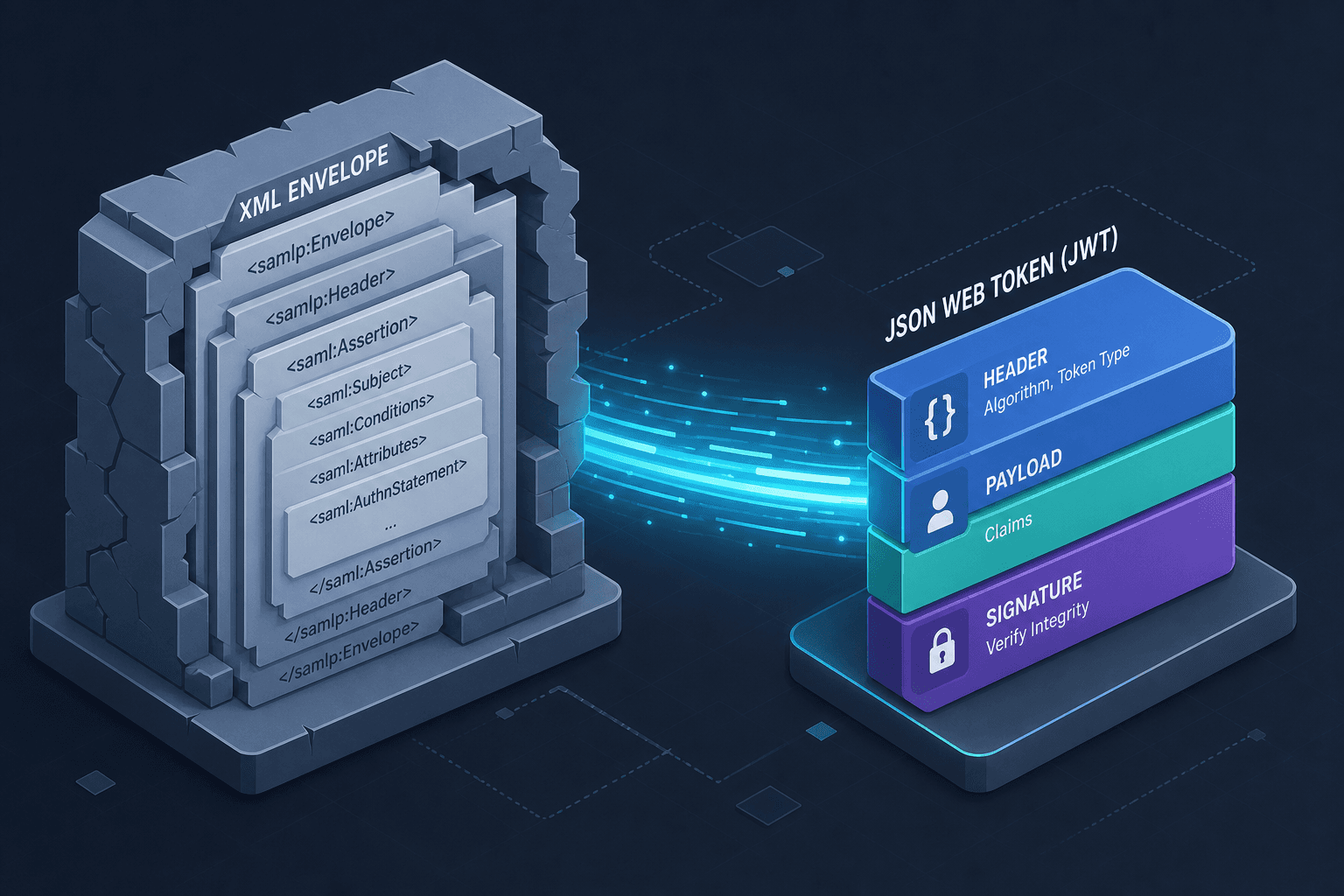
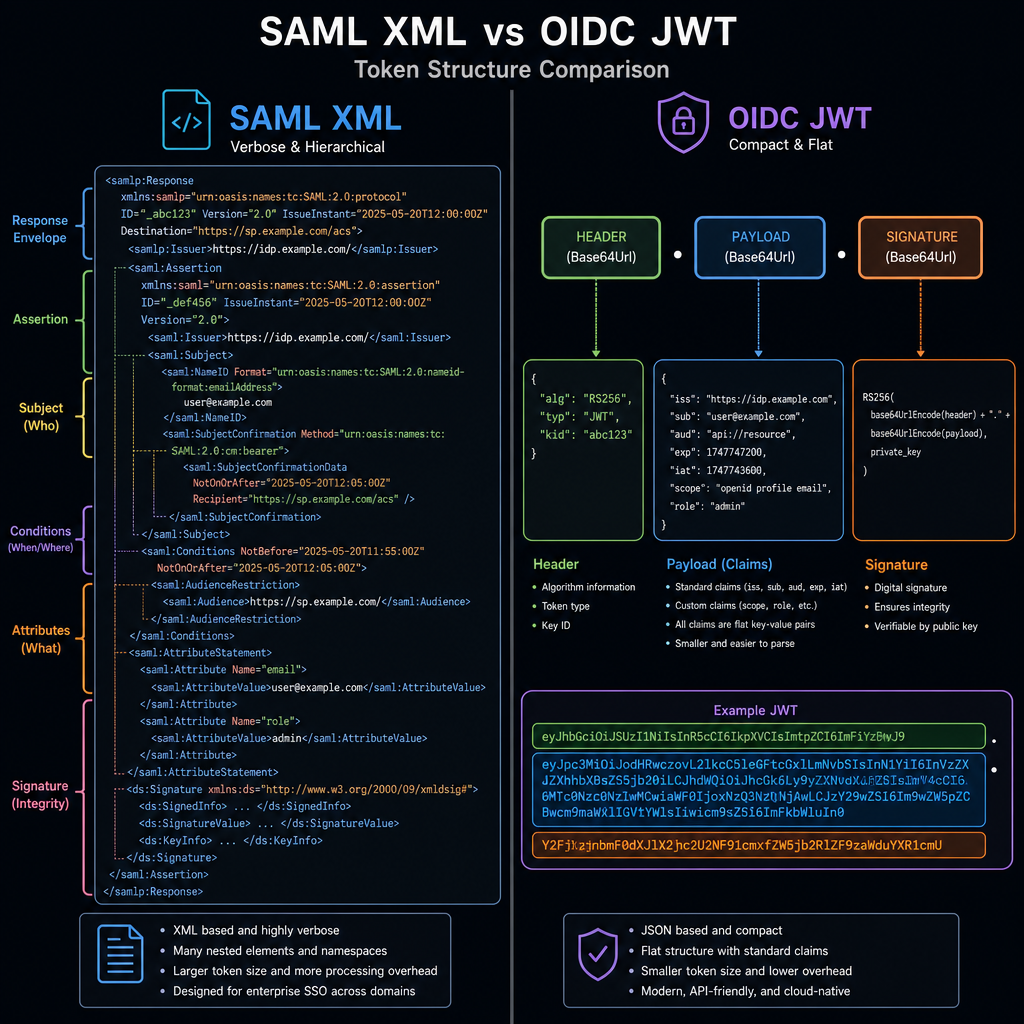
At the core of the migration is the change in how authentication data is packaged and transmitted. In a SAML flow, the IdP generates a signed XML assertion. This assertion is typically POSTed to the Service Provider via the user's browser (HTTP Redirect or POST binding). The SP must parse the XML, verify the digital signature using a public key, and then interpret the XML schema to extract user attributes. This process is heavy, verbose, and prone to parsing errors if the XML structure deviates even slightly.
OIDC changes this by returning a JSON Web Token (JWT). Instead of a large XML block, the IdP sends a compact, URL-safe string representing a JSON object. The mechanism here is critical: the token contains a header, a payload, and a signature. The payload includes standard claims like sub (subject), iss (issuer), and aud (audience), but it also supports custom claims. The SP does not need to parse complex XML schemas; it simply decodes the base64url string, verifies the signature using the IdP's public key (often fetched from a JWKS endpoint), and validates the token's expiration time (exp).
Consider a scenario where a legacy enterprise application, "LegacyApp," expects a SAML response. A new microservice, "MobileApp," needs to authenticate. Under SAML, "MobileApp" would require a browser redirect loop and XML parsing logic that is difficult to implement in a mobile environment. Under OIDC, "MobileApp" can initiate an authorization code flow. The IdP returns a short-lived access token and an ID token. The mobile client stores the ID token and uses the access token to call the API. The mechanism shifts from "post-and-parse" to "decode-and-verify," reducing latency and complexity.
The Dual-Run Strategy
You cannot simply flip a switch. Most organizations have a mix of modern microservices and monolithic legacy applications that are locked into SAML. The practical approach is a dual-run strategy where both protocols coexist during the migration window. The goal is to route traffic based on the client type or application identity, ensuring that the IdP acts as a unified hub.
To achieve this, you configure the IdP to issue both SAML assertions and OIDC tokens for the same user identity. The IdP must maintain a consistent mapping between the SAML NameID and the OIDC sub claim. When a request arrives, the routing logic determines the protocol. For a browser-based legacy app, the IdP serves the SAML response. For a mobile app or a modern SPA, the IdP serves the OIDC tokens.
A common implementation pattern involves a "protocol adapter" layer. Imagine a gateway service sitting in front of your legacy SAML applications. This gateway intercepts the request. If the user presents a valid OIDC token, the gateway validates it, extracts the user's identity, and then dynamically generates a SAML assertion on the fly to satisfy the legacy backend's requirements. This decouples the legacy system from the need to understand OIDC. The legacy system continues to see exactly what it expects: a signed XML assertion. The gateway handles the translation.
This approach minimizes risk. If the OIDC implementation fails, the SAML path remains intact. If the legacy system breaks, the new OIDC path for other services remains unaffected. The key is ensuring that the user session state is synchronized across both protocols so a user does not have to log in twice.
Token Lifecycle and Validation Mechanics
One of the most confusing aspects for engineers migrating from SAML is the concept of token expiration. SAML assertions themselves are stateless tokens where the SP validates the signature, yet SP implementations often maintain local session state for the duration of the assertion validity. This differs significantly from OIDC, which enforces an explicit lifecycle of short-lived access tokens and long-lived refresh tokens.
In an OIDC flow, the Access Token is the primary artifact for API authorization. It usually expires in minutes. The ID Token is used for authentication and also has a short lifespan. To maintain a user session without forcing re-authentication, the client must use a Refresh Token. When an Access Token expires, the client sends the Refresh Token to the IdP to exchange it for a new pair of tokens. This mechanism is stateless for the resource server but stateful at the IdP.
The validation mechanism also changes. In SAML, the SP often trusts the IdP's signature implicitly. In OIDC, the SP must actively fetch the IdP's public keys from a JSON Web Key Set (JWKS) URI. This allows for key rotation without downtime. If the IdP rotates its signing keys, the SP automatically updates its local cache of public keys from the JWKS endpoint. This dynamic key rotation is a significant security improvement over SAML, where certificate updates often require manual configuration changes on every SP.
For example, if "MobileApp" receives an expired Access Token, it does not retry the request. Instead, it silently calls the /token endpoint with the Refresh Token. If the Refresh Token is valid, the IdP issues new tokens. If the Refresh Token has been revoked or expired, the user is prompted to log in again. This granular control over session validity is impossible with standard SAML flows.
Handling Legacy Systems Without Code Changes
The most challenging part of the migration is often the legacy systems that cannot be easily rewritten. These systems might be built on older frameworks that only support SAML bindings. Rewriting them is costly and risky. The solution is to wrap them in an OIDC-aware proxy or use a reverse proxy that handles the protocol translation.
Consider a legacy CRM system, "CRM-Legacy," that only accepts SAML POST bindings. You deploy an OIDC proxy, "Auth-Proxy," in front of "CRM-Legacy." When a user tries to access "CRM-Legacy" via the OIDC flow, the "Auth-Proxy" intercepts the request. It validates the incoming OIDC token. If valid, the proxy generates a temporary SAML assertion containing the user's attributes and forwards the request to "CRM-Legacy" as if it came from the IdP directly.
This pattern allows "CRM-Legacy" to remain untouched. It sees a standard SAML login, unaware that the underlying mechanism is now OIDC. The "Auth-Proxy" acts as the bridge. The trade-off is added latency due to the token generation step, but this is often negligible compared to the cost of rewriting the legacy application. Additionally, this proxy can enforce additional policies, such as IP whitelisting or MFA challenges, before generating the SAML assertion, effectively adding security layers to the legacy system without touching its code.
Another strategy is to use a "SAML-to-OIDC" bridge provided by modern IdPs. IdPs like Okta, Azure AD, and Ping Identity support dual-protocol configuration, allowing you to configure a single application entity that supports both protocols. The IdP detects the request type and serves the appropriate response. This reduces the infrastructure overhead of maintaining a custom proxy. However, for highly customized legacy apps, a custom proxy offers more control over the attribute mapping and session logic. This flexibility is crucial when dealing with deep SAML legacy dependencies that cannot be easily abstracted.
Conclusion
Migrating from SAML to OIDC is not a simple configuration change; it is an architectural evolution. It moves the ecosystem from a heavy, XML-centric, stateful model to a lightweight, JSON-centric, stateless model. By understanding the mechanism of JWT validation, the lifecycle of refresh tokens, and the strategy of dual-run protocol bridges, organizations can modernize their identity stack without disrupting existing operations. The goal is not just to adopt a new standard, but to build a more resilient, scalable, and secure authentication infrastructure that supports the future of cloud-native applications. The transition requires careful planning, but the long-term benefits in developer experience and security posture are substantial.
Common Pitfalls
- Session Synchronization Failures: If the IdP does not perfectly synchronize the session state between the SAML and OIDC flows, users may find themselves logged out when switching between a legacy portal and a modern app, forcing a re-authentication.
- Attribute Mapping Errors: SAML attributes and OIDC claims often have different naming conventions and structures. Failing to map these correctly can result in missing user roles or permissions in the target application, leading to access denials.
- Key Rotation Timing: During the transition, if the IdP rotates signing keys before all SPs have updated their JWKS caches, the system may reject valid tokens. Synchronizing the key rotation schedule with the migration timeline is critical to avoid service outages.
Practical Takeaways
- Think in Flows, Not Just Protocols: Focus on the user journey. Whether the underlying transport is XML or JSON, the goal is a seamless, uninterrupted session for the user across all application boundaries.
- Decouple Trust from Implementation: Use the dual-run strategy to separate the identity provider's trust logic from the specific application's consumption logic. This allows you to modernize the consumer without immediately rewriting the provider.
- Prioritize Observability: Implement robust logging for both SAML and OIDC events during the migration. You need visibility into where failures occur to distinguish between protocol translation errors and identity configuration issues.
FAQ
Q: Can I migrate to OIDC without touching my legacy applications? A: Yes, by using a protocol adapter or reverse proxy. These tools sit between the OIDC client and the legacy SAML application, translating the OIDC token into a SAML assertion on the fly, allowing the legacy app to remain unchanged.
Q: How do I handle user sessions if one app uses SAML and another uses OIDC? A: You must configure the IdP to share session state or implement a shared session cookie strategy. The IdP should recognize the user's active session regardless of the protocol used to establish it initially.
Q: Is key rotation harder in OIDC than SAML? A: No, it is generally easier and more secure. OIDC relies on JWKS endpoints that allow SPs to automatically fetch and cache the latest public keys, whereas SAML often requires manual certificate updates on each SP.
Related posts
Understanding OAuth2 Multiple Response Types: A Technical Guide
An examination of OAuth2 response types including hybrid flow, OIDC response types, and authorization server configurations for beginners.
OIDC Front-Channel vs Back-Channel Logout: Implementation Guide
A technical examination of OIDC front-channel and back-channel logout mechanisms, comparing implementation strategies for session management.
Implementing OIDC Authentication in Spring Boot with Keycloak
A walkthrough for implementing OIDC authentication in Spring Boot using Keycloak, covering setup and configuration.