SAML in Microservices: Patterns and Anti-Patterns
An examination of SAML integration patterns and anti-patterns within microservices architectures, covering API gateway strategies and token translation.
SAML was architected for browser-based Single Sign-On (SSO) in the early 2000s, relying on XML and stateful cookies. Microservices, however, are stateless, containerized components demanding low-latency, JSON-based interactions. Introducing SAML directly into a gRPC service or serverless function creates a fundamental mismatch. You cannot simply "drop" a SAML flow into these environments without introducing significant latency, complexity, and security risks due to the protocol's browser-centric design.
The fundamental mechanism conflict lies in the transport layer. SAML assertions are typically delivered via an HTTP POST to a Service Provider (SP) Assertion Consumer Service (ACS) URL. This flow requires the user's browser to maintain a session cookie with the IdP and the SP to validate a RelayState parameter to prevent Cross-Site Request Forgery (CSRF). In a microservices architecture, the "user" is often an API client (a mobile app, a frontend framework, or another service), not a browser. These clients do not manage cookies, and they cannot participate in the redirect loop required by standard SAML binding. Attempting to force a browser-centric protocol onto a stateless API endpoint creates a fragile boundary.
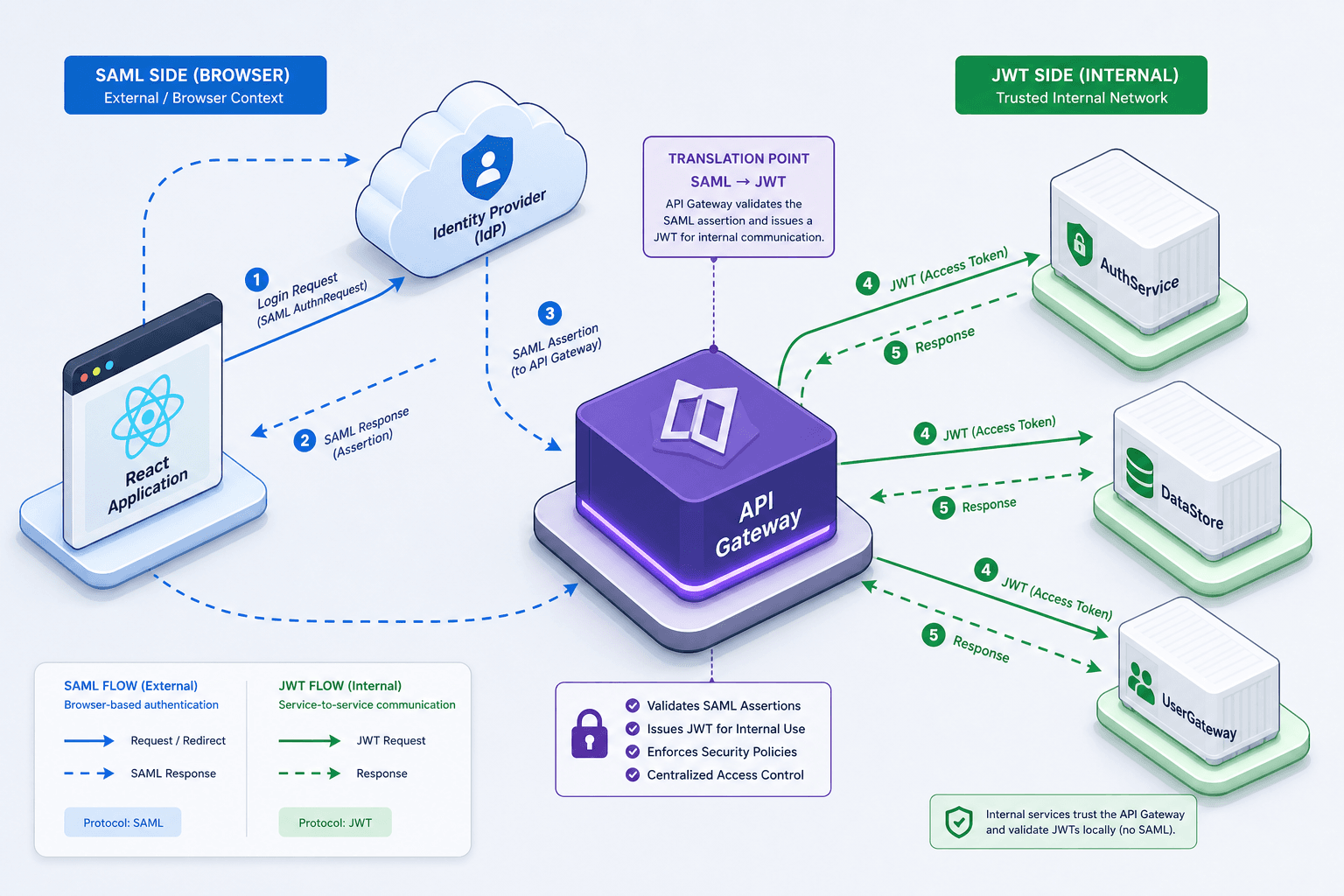
To resolve this, the industry standard pattern is the API Gateway Identity Translator. In this architecture, the API Gateway acts as the sole SAML Service Provider. It presents the SAML login flow to the human user (via their browser) or acts as the token issuer for machine users. Once the Gateway receives a valid SAML Assertion from the IdP, it performs the critical translation step: it extracts the identity attributes, validates the digital signature using the IdP's public key, and issues a new, stateless token (usually a JWT) to the client.
Consider a scenario involving AuthService, API Gateway, and DataStore. A user attempts to access GET /api/v1/users via a React application.
- The React app sends a request to
API Gateway. API Gatewaydetects no valid session and redirects the browser to the IdP for SAML authentication.- The IdP authenticates the user and sends a SAML Assertion back to
API Gateway's ACS endpoint. API Gatewayvalidates the SAML XML signature. It parses the<AttributeStatement>to find theemailandroleattributes.API Gatewayconstructs a JWT containingsub(derived from SAMLNameID),email, andgroups(mapped from SAML attributes).API Gatewayreturns this JWT to the browser/client.- Subsequent requests include this JWT in the
Authorization: Bearerheader. - Downstream services like
DataStorenever see the SAML XML. They only validate the JWT signature.
This pattern isolates the complexity of XML parsing, SAML binding handling, and IdP certificate rotation to a single entry point. The downstream services remain agnostic of the underlying identity protocol.
The mechanism of token translation is where most implementations fail. SAML attributes are often hierarchical and loosely typed, while JWT claims are flat and strictly typed. A deterministic translation logic must map SAML attributes to JWT claims. For example, a SAML attribute urn:oid:0.9.2342.19200300.100.1.3 (mail) should map to the JWT claim email. However, a critical anti-pattern emerges here: over-exposing PII (Personally Identifiable Information).
In the SAML world, it is common to pass the user's full name, department, and email in the assertion. If your microservices all receive these attributes directly, you violate the principle of least privilege. The DataStore service might only need the user ID (sub) to fetch records. It does not need the user's manager's name. The Gateway must act as a filter, stripping unnecessary claims during translation. If you pass the raw SAML attributes to every service, you create a "data sprawl" where any compromised service can exfiltrate sensitive identity data.
Furthermore, consider the lifecycle of the token. SAML assertions are typically long-lived (valid for hours) because the user session persists. In a microservices environment, a long-lived token is a security risk. If an attacker steals a JWT, they have access for hours. The Gateway should issue short-lived JWTs (e.g., 15 minutes) and use a refresh token mechanism (handled separately, often via a secure cookie or out-of-band channel) to extend the session. This limits the blast radius of a token compromise.
Now, let's look at the Anti-Pattern: Direct SAML Parsing.
Some teams attempt to skip the Gateway translation and configure every microservice to act as a SAML Service Provider. They embed the SAML library (e.g., python-saml, saml2-js) into every container. This is a catastrophic architectural failure.
- Certificate Management: Every service must store the IdP's public key and rotate it when the IdP rotates its signing keys. If you have 50 services, you have 50 points of failure for certificate updates.
- Logic Duplication: Every service must implement the logic to parse the XML, validate the signature, check the
NotBeforeandNotOnOrAfterconditions, and validate theIssuer. This is error-prone and leads to inconsistent security postures. - Latency: XML parsing is CPU-intensive. Doing this at the edge of every service adds milliseconds of latency to every request, compounding across the call graph.
If you find yourself writing SAML parsing logic inside a PaymentService or InventoryService, stop. That logic belongs at the perimeter. The internal services should only trust the identity asserted by the Gateway.
Another subtle anti-pattern is Stateful Session Cookies in Stateless APIs. Because SAML relies on browser cookies to maintain the session state between the IdP and the SP, some developers try to replicate this by having microservices set cookies for their own sessions. This breaks the stateless nature of the architecture. If Service A sets a cookie, Service B cannot easily read it without sharing the same domain or proxying requests, which complicates scaling and deployment. The solution is to stick to the token-based model (JWT) for API calls, reserving cookies only for the initial SAML redirect flow at the Gateway.
Finally, consider the role of the Service Mesh in this ecosystem. Once the Gateway issues the JWT, the internal traffic between microservices is often secured via mTLS (Mutual TLS) using a service mesh like Istio or Linkerd. A common misconception is that the service mesh needs to understand SAML. It does not. The service mesh should validate the mTLS certificate (identifying the service) and optionally validate the JWT (identifying the user). If the Gateway has already translated the SAML assertion into a JWT, the service mesh can simply treat the JWT as the source of truth for user identity. The mesh validates the service identity via certificates, and the application validates the user identity via the JWT. Mixing these concerns—asking the mesh to parse SAML XML—reintroduces the complexity you tried to eliminate. Properly configured service mesh auth ensures that internal traffic remains secure without burdening the mesh with identity protocol details.
Conclusion
In summary, SAML in microservices requires a clear boundary. Use SAML for the human login flow at the API Gateway. Translate the resulting assertion into a short-lived, scoped JWT. Filter out unnecessary attributes. Distribute the JWT, not the SAML XML. This approach respects the stateless nature of microservices while leveraging the federated identity benefits of SAML. Any pattern that pushes SAML parsing into the core business logic or relies on long-lived tokens without refresh mechanisms is an anti-pattern that will degrade performance and security over time.
The tradeoff here is architectural complexity versus runtime simplicity. You add a Gateway layer that must handle SAML, but you gain a clean, uniform interface for all downstream services. The cost of maintaining the Gateway's SAML logic is far lower than the cost of maintaining SAML logic across 50 distributed services. This separation of concerns is the only viable path for scaling SAML in a microservices environment.
Common Pitfalls
- Distributed SAML Parsing: Embedding SAML libraries in every microservice leads to certificate management nightmares and logic duplication. This fails because it multiplies the attack surface and makes key rotation a chaotic, error-prone process across dozens of containers.
- Over-Exposure of Claims: Passing the entire SAML attribute set to all downstream services violates the principle of least privilege. This fails because it creates data sprawl, allowing any compromised service to access sensitive PII (like department names or full addresses) that it does not actually need.
- Stateful Cookies in Stateless APIs: Attempting to use cookies for session management within microservices breaks the stateless contract of the architecture. This fails because it complicates horizontal scaling, as services cannot easily share or validate session state without complex domain sharing or proxying.
Practical Takeaways
- Perimeter Translation: Treat the API Gateway as the sole translator. Internal services should never see SAML XML; they should only consume JWTs.
- Filter First: Apply strict claim filtering during the translation phase. Only pass the
sub,email, and necessary group claims to downstream services. - Short Lifecycles: Never issue long-lived JWTs derived from SAML. Enforce short expiration times (e.g., 15 minutes) and use a separate refresh mechanism to mitigate token theft risks.
- Separation of Concerns: Keep
service mesh authfocused on mTLS for service identity, leaving user identity validation to the application layer via the JWT.
FAQ
Q: Can I use SAML assertions directly for internal microservice-to-microservice communication? A: No. SAML assertions are XML-heavy and designed for browser redirects. Internal traffic should use mTLS for service identity and JWTs for user identity. Using SAML internally introduces unnecessary parsing overhead and complexity.
Q: How does the Service Mesh handle user identity if it only sees mTLS? A: The Service Mesh validates the service identity via mTLS certificates. It does not need to parse user identity. The application layer (or the API Gateway) validates the JWT contained in the request headers to determine user permissions. The mesh acts as a secure transport, not an identity provider.
Q: What is the best practice for SAML configuration rotation in a microservices setup? A: Only the API Gateway needs to be configured with the IdP's signing keys. When the IdP rotates keys, you only update the configuration at the Gateway. Downstream services remain untouched, eliminating the risk of inconsistent key versions across the fleet.
Related posts
Building an Identity Gateway with Spring Cloud Gateway
A technical guide on implementing an identity gateway using Spring Cloud Gateway with JWT filters and OAuth2 support for microservices.
gRPC Security: TLS, Token Propagation, and Interceptor Patterns
An examination of gRPC security mechanisms including TLS, mTLS, token propagation, and interceptor patterns for advanced implementations.
Keycloak Architecture Deep Dive: Internal Components and Data Flow
An examination of Keycloak architecture, internal components, SPI extensions, themes, and the core data model for advanced developers.