SAML Artifact Binding: Low-Latency SSO Architecture
An examination of SAML artifact binding for achieving low-latency SSO performance and reducing network overhead.
Understanding SAML Artifact Binding: Low-Latency SSO
The primary friction point in enterprise Single Sign-On (SSO) is often not the cryptographic verification of the identity, but the transport of the assertion itself. When a Service Provider (SP) relies on standard SAML bindings like HTTP-Redirect or HTTP-POST, the Identity Provider (IdP) must embed the entire Security Assertion Markup Language (SAML) Assertion into the HTTP response sent to the user's browser. This assertion contains the user's claims, attributes, and the signature. In high-throughput environments or when attribute profiles are verbose, this payload can balloon to several kilobytes. The browser must then parse, decode, and display this data, or at least process it through the redirect mechanism. If the assertion exceeds the URL length limits of the browser or the intermediate proxy (often 2000–8000 characters), the authentication flow fails entirely.
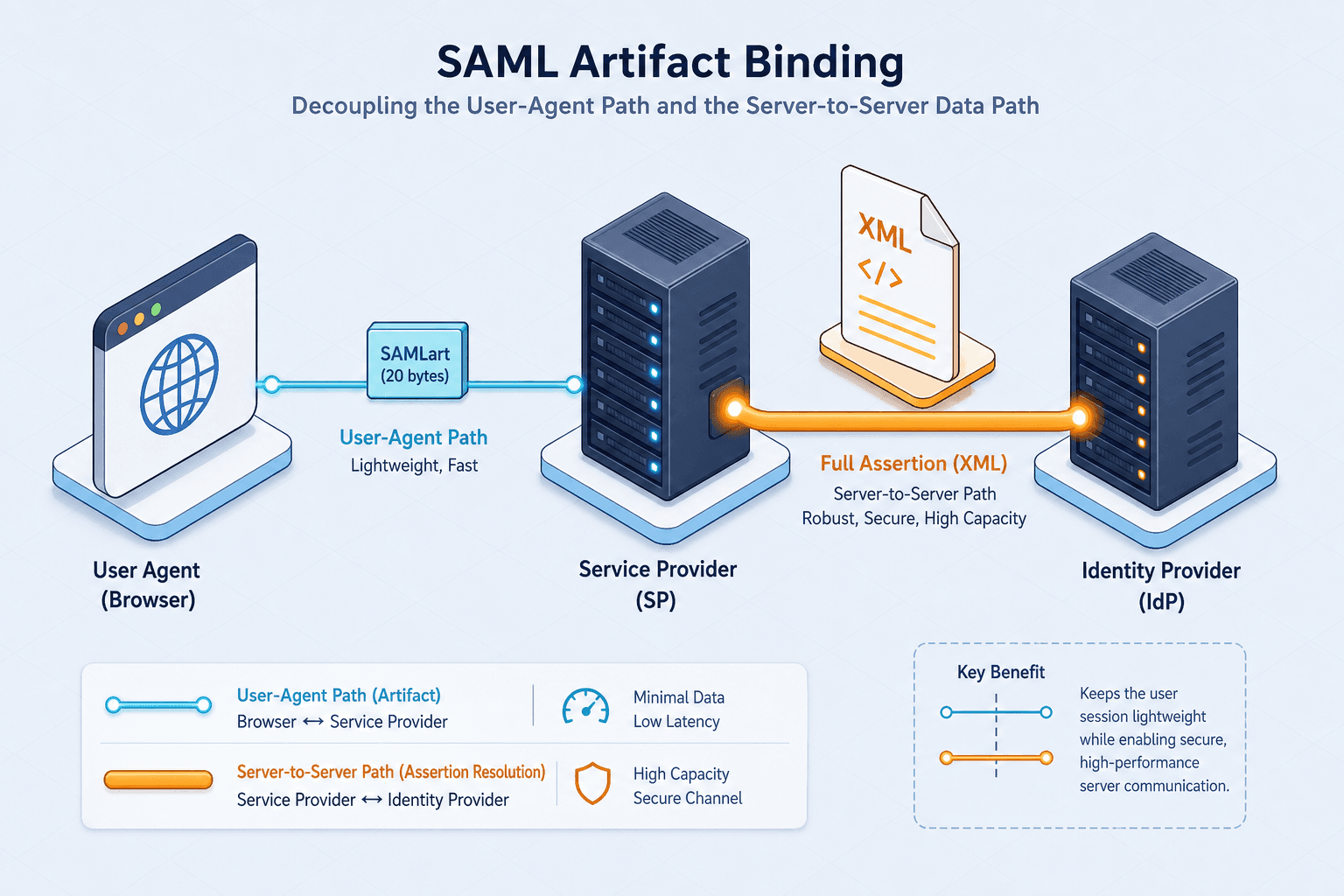
The mechanism that solves this is the SAML Artifact Binding. Instead of sending the full XML document across the public internet to the user's client, the IdP sends a short, opaque 20-byte string known as an artifact. The browser receives this tiny reference and immediately navigates to the SP. The SP then initiates a direct, server-to-server communication channel with the IdP to resolve the artifact into the full assertion. This decouples the user experience from the data transmission volume. The user perceives a faster load time because the browser does not wait for a massive XML payload to render or parse.
The Cost of Verbose Redirects
Consider a scenario where Alice, a user at corp.example.com, attempts to access app.internal-saas.com. The SaaS application is the SP, and the corporate directory is the IdP. Alice clicks a link.
In a standard HTTP-Redirect binding, the IdP generates a SAML Response containing the full assertion. It URL-encodes this massive XML blob, appends it to a base URL, and sends an HTTP 302 Redirect. The browser follows this redirect. If the assertion includes standard attributes like email, department, manager, and employeeID, plus the digital signature, the resulting URL might exceed 15,000 characters. Many infrastructure components (e.g., IIS, Apache, Nginx) impose limits typically between 2,000 and 8,000 characters, though specific thresholds vary by configuration. Even if the infrastructure supports it, the browser must spend CPU cycles decoding and validating the signature on a large string before passing it to the application logic.
In HTTP-POST, the IdP generates an HTML form with a hidden input field containing the full assertion. The browser submits this form via a POST request. While this avoids URL length limits, the browser still receives a large payload in the body of the response. The network latency here is dominated by the time it takes to transmit the bytes from the IdP to the client. In a geographically distributed environment, where the IdP is in one region and the user is in another, this "long-haul" transmission adds milliseconds of latency per request. For a workforce of 10,000 users logging in simultaneously, this cumulative overhead creates a noticeable delay in application availability.
The Artifact Resolution Mechanism
The Artifact Binding changes the data flow. The process begins exactly the same way: Alice requests access to the SaaS application. However, instead of the IdP sending the assertion, it performs the following sequence:
- Artifact Generation: The IdP generates a unique 20-byte binary string (standard size per SAML Core Specification Section 3.4.1.2). This artifact is not a random number; it is a pointer. It typically contains a
KeyIdentifier(pointing to the specific key used to sign the assertion) and aMessageHandle(a unique ID for the specific assertion instance). - Redirect: The IdP sends an HTTP-Redirect response to Alice's browser. The URL parameter
SAMLartcontains the Base64-encoded artifact (e.g.,AQIDBA==). The browser receives this and navigates to the SP. The payload size here is negligible (under 50 bytes). - Artifact Resolution Request: The SP's backend receives the artifact. It constructs a new, direct SOAP request to the IdP's Artifact Resolution Service. This service is a dedicated endpoint on the IdP's infrastructure, distinct from the web-facing login page. Unlike the HTTP-POST binding used for browser transport, the Artifact Resolution Service specifically utilizes the SOAP protocol for resolution.
- Resolution: The IdP receives the resolution request. It looks up the
MessageHandlein its local cache (where it stored the assertion generated in step 1). It retrieves the previously generated and signed assertion from its cache and sends it to the SP. - Validation: The SP receives the full assertion, validates the signature against the IdP's public key, and establishes the session.
The critical mechanism here is the separation of the user-agent path (IdP -> Browser -> SP) from the data path (SP -> IdP). The user-agent path only carries the 20-byte artifact. The heavy lifting happens on the private network or a secure, direct internet connection between the SP and IdP servers.
This architecture significantly reduces latency for the end-user. The browser does not wait for the large XML to download. It receives the artifact, makes the initial request to the SP, and the SP begins the resolution process in parallel or immediately. The user sees the login screen or the application much faster. Furthermore, because the artifact is small, it never triggers URL length errors in proxies or firewalls.
Operational Dependencies and Tradeoffs
While the performance gains are clear, the Artifact Binding introduces specific infrastructure dependencies that do not exist in Redirect or POST bindings.
First, the SP must be able to reach the IdP's Artifact Resolution Service. In the Redirect/POST model, the IdP pushes data to the user; the SP only receives what the user sends back. In the Artifact model, the SP must initiate a connection to the IdP. This requires the IdP to expose a public endpoint (usually on port 443) that accepts SOAP requests. If the SP is behind a strict firewall that only allows inbound traffic from the user, it may block the outbound connection to the IdP unless explicitly configured. This is a common configuration error in hybrid cloud environments where the IdP is on-premise and the SP is in AWS or Azure.
Second, the IdP must maintain state. The artifact is a reference to an assertion stored in the IdP's memory or database. If the IdP restarts, or if the assertion cache expires before the SP resolves the artifact, the resolution fails. The IdP must ensure the artifact remains valid long enough for the SP to resolve it. Standard practice is to set a short validity window (e.g., 2–5 minutes). If the user's browser lags or the network between SP and IdP is congested, the artifact may expire. In Redirect/POST, the assertion is self-contained and valid as long as the signature is valid and the timestamp is within the window, regardless of intermediate server restarts.
Third, the Artifact Binding adds a network hop. The user's request goes to the SP, and the SP goes to the IdP. In a Redirect binding, the user goes to the IdP, and the IdP sends the user back to the SP. The total round-trip time (RTT) for the data might be similar or slightly higher in the Artifact model due to the extra server-to-server latency. However, for the user, the perceived latency is lower because the browser is not waiting for the large payload. The "bottleneck" moves from the WAN link to the user (which is often the slowest part of the chain) to the LAN or private link between SP and IdP (which is usually fast).
From a security perspective, the artifact itself is useless without the context of the resolution request. An attacker intercepting the artifact in the browser cannot replay it to gain access unless they can also intercept the SP's resolution request to the IdP. The resolution request includes a specific binding protocol (SOAP) and often requires the SP to present its own credentials or certificate. This adds a layer of defense-in-depth compared to a raw assertion in a URL parameter, which, if intercepted, could theoretically be replayed if the session is not properly validated.
When to Deploy Artifact Binding
The decision to implement Artifact Binding depends on the scale and constraints of your federation.
If your assertions are small (e.g., just NameID and Email), and your infrastructure is stable, the overhead of managing the Artifact Resolution Service might not be justified. The Redirect or POST bindings are simpler to configure and debug.
However, if you are dealing with:
- Large Attribute Profiles: SaaS applications requiring dozens of user attributes.
- Strict URL Limits: Environments with legacy proxies or mobile clients that aggressively truncate URLs.
- High Volume: Enterprise environments where thousands of users log in daily, and the cumulative bandwidth savings and reduced browser load time are measurable.
...then the Artifact Binding is the superior architectural choice. It transforms the SAML flow from a "push" model constrained by the user's browser capabilities into a "pull" model optimized for server-to-server efficiency.
In practice, the mechanism works because it treats the artifact as a pointer to a resource held by the IdP, rather than a carrier of the resource itself. By offloading the transmission of the XML payload to a dedicated, high-bandwidth channel between the SP and IdP, the system achieves low-latency SSO without sacrificing the rich data exchange required for modern identity federation.
Common Pitfalls
Implementing Artifact Binding requires careful attention to infrastructure nuances that can easily lead to authentication failures.
- IdP State Management: The IdP must retain the assertion in its cache until the SP resolves it. If the IdP's cache is configured with a very short TTL (Time-To-Live) or if the IdP service is restarted during a user's login attempt, the artifact becomes invalid. Administrators must align the cache expiration policy with the expected maximum time for a user to interact with the SP after the initial redirect.
- Firewall Configuration: A frequent oversight is assuming the SP can reach the IdP's Artifact Resolution Service. While the user's browser connects to the IdP's web interface, the SP must initiate a separate outbound connection to the IdP's backend resolution endpoint. Network security groups, firewalls, or reverse proxies must explicitly allow this server-to-server traffic on the specific SOAP port.
- SOAP vs HTTP-POST Confusion: Engineers sometimes confuse the HTTP-POST binding (used for browser transport) with the SOAP protocol (used for artifact resolution). While both involve POST-like methods, the Artifact Resolution Service expects a specific SOAP envelope structure. Sending a standard HTTP-POST form data payload to the resolution endpoint will result in parsing errors and failed authentication.
Practical Takeaways
To effectively leverage SAML Artifact Binding, consider these mental models:
- Decoupling is Key: Treat the artifact as a "ticket" to a resource, not the resource itself. The user gets the ticket; the server fetches the resource.
- Server-to-Server Efficiency: Recognize that the performance gain comes from moving heavy data traffic off the slow, constrained user-agent path and onto a high-bandwidth, private server-to-server link.
- Statefulness is the Price: Acknowledge that the IdP must maintain temporary state. This trade-off is necessary to achieve the bandwidth and URL-length benefits, requiring robust cache management strategies.
FAQ
Q: Does the artifact have a validity window? A: Yes. The artifact is valid only for a short duration (typically 2–5 minutes) while the IdP retains the corresponding assertion in its cache. If the SP does not resolve the artifact within this window, the resolution will fail, and the user must re-initiate the login.
Q: Why is SOAP required for artifact resolution? A: The SAML specification defines the Artifact Resolution Service to use the SOAP protocol. This ensures a structured, reliable message format for exchanging the large XML assertion between servers, distinct from the lighter HTTP-POST binding used for browser-based redirection.
Q: Can Artifact Binding completely eliminate URL length issues? A: It effectively eliminates them for the user-agent path since the artifact is only 20 bytes. However, it does not eliminate the need for the IdP to generate a large assertion internally; it simply shifts where that large payload is transmitted (server-to-server instead of browser-to-IdP).
Conclusion
SAML Artifact Binding offers a reliable solution for enterprise SSO environments facing URL length constraints and high-latency network conditions. By shifting the transmission of large XML assertions from the user-agent path to a dedicated server-to-server channel, organizations can achieve faster login times and more reliable authentication flows. While this approach introduces dependencies on IdP availability and requires careful network configuration, the benefits in scalability and performance make it the preferred choice for complex identity federations.
Related posts
SAML Single Logout: Implementation Patterns and Pitfalls
An examination of SAML single logout implementation patterns, covering session management and pitfalls in SP-initiated and IdP-initiated logout flows.
Troubleshooting SAML: Common Issues and Fixes
An examination of common SAML errors, debugging techniques, and signature validation fixes for advanced users.
SAML Metadata Management: Best Practices
Examination of SAML metadata management, certificate rotation, and identity federation trust to ensure secure integration.