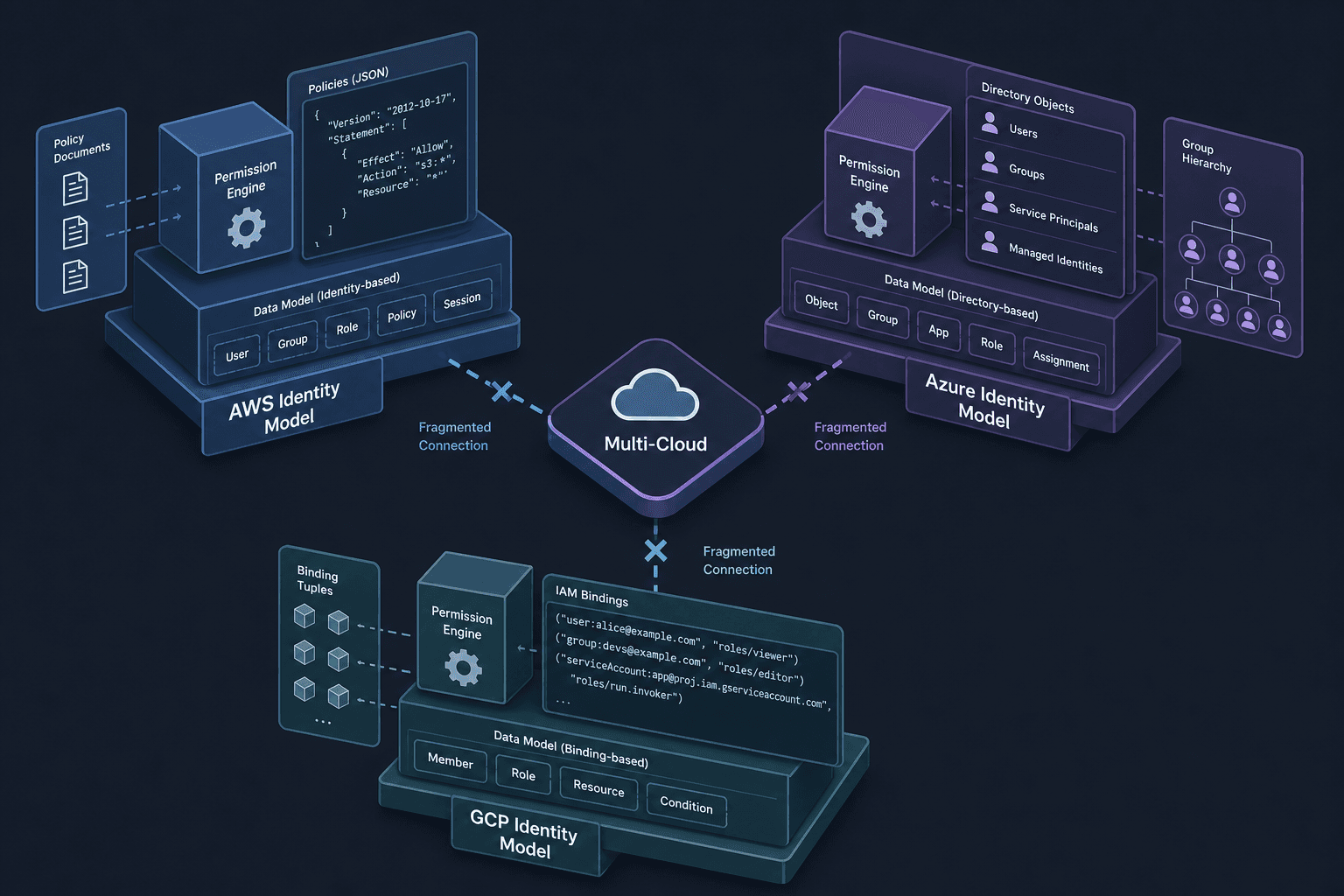
Why Multi-Cloud Identity Fragments
An examination of identity fragmentation across AWS, Azure, and GCP, comparing identity models to understand multi-cloud challenges.
Identity fragmentation in multi cloud identity environments is often mistaken for a governance failure. Architects blame poor onboarding processes or lack of training. However, the fragmentation is structural. It arises because AWS, Azure, and GCP do not just offer different tools; they implement fundamentally different logical models for what an identity is and how it interacts with compute resources. When you combine these models, you do not get a unified security perimeter. You get three distinct permission engines running in parallel, each with its own data structures, evaluation logic, and failure modes.
Part 1 of the Multi-Cloud Identity series.
To understand why this happens, we must look at the mechanism-level differences in how each provider constructs trust.
The AWS Model: Resource-Centric and Policy-Driven
In the context of multi cloud identity, AWS Identity and Access Management (IAM) is built on a resource-centric model. In AWS, an identity (user, group, or role) is essentially a container for permissions. These permissions are defined as JSON policy documents that explicitly allow or deny actions on specific resource ARNs (Amazon Resource Names).
The core mechanism here is the Policy Evaluation Logic. When an API call is made, AWS evaluates all attached policies against the request context. If any policy explicitly denies the action, the request fails. If no policy explicitly allows it, the request also fails. This is a default-deny system.
Consider a developer needing access to an S3 bucket. In AWS, you must attach a policy to the user or role that specifies s3:GetObject on arn:aws:s3:::my-bucket/*. The identity has no inherent relationship to the bucket other than the policy document. This creates a "pull-based" permission model where the identity must be explicitly granted access to each resource.
This model scales poorly in multi cloud identity scenarios because it requires manual mapping of every resource across clouds. There is no native concept of a "group" that automatically inherits permissions across unrelated resource types without explicit policy attachment.
The Azure Model: Identity-Centric and Membership-Driven
Microsoft Entra ID (formerly Azure AD) operates on an identity-centric model. Here, the primary object is the user or group, and resources are assigned to these identities through Role-Based Access Control (RBAC) or Conditional Access policies.
In Azure, you typically create a security group, add users to it, and then assign a role (e.g., "Reader") to that group at a specific scope (subscription, resource group, or resource). The mechanism is membership propagation. The identity inherits permissions because it belongs to a group that has been granted a role.
This is fundamentally different from AWS. In Azure, the identity is the primary actor, and resources are secondary. This aligns well with enterprise Active Directory structures, where users have a consistent identity across on-premises and cloud environments. However, in a multi cloud identity context, this creates a disconnect. Azure’s identity objects do not natively translate to AWS IAM users or GCP service accounts. The "scope" in Azure is often broader and more hierarchical than AWS’s flat ARN-based policy structure.
The GCP Model: Hierarchical and Role-Based
Google Cloud IAM presents a hybrid approach. It uses a hierarchical resource structure, organizing resources into Folders, Organizations, and Projects. GCP IAM relies on Bindings that link a principal (user, group, service account) to a predefined Role on a resource.
Unlike AWS, where you write custom JSON policies, GCP primarily uses predefined roles (e.g., roles/viewer). You can create custom roles, but the default experience is role-based. The key mechanism here is the Binding, which is a simple tuple: (Principal, Role, Resource).
GCP’s model is closer to Azure in its use of roles, but it lacks Azure’s deep integration with enterprise identity providers out-of-the-box without federation. More importantly, GCP’s evaluation logic is simpler: if a binding exists, the permission is granted. There is no complex policy language to parse for standard roles. This simplicity makes GCP easier to manage in isolation but harder to reconcile with AWS’s granular policy engine or Azure’s conditional access framework in a multi cloud identity setup.
The Fragmentation Mechanism
In the realm of multi cloud identity, when you deploy workloads across AWS, Azure, and GCP, these three models collide. The fragmentation occurs at three specific points:
- Inconsistent Least-Privilege Enforcement: AWS allows fine-grained, resource-specific policies. Azure and GCP rely more on broader roles. An engineer accustomed to AWS’s precision may over-provision in Azure or GCP by assigning broad roles, creating security gaps. Conversely, an engineer used to Azure’s group-based management may struggle with AWS’s need to attach policies to individual roles.
- Cross-Cloud Trust Complexity: To share identities, you must use OpenID Connect (OIDC) federation. This requires setting up external identity providers (IdPs) in each cloud. AWS uses
AssumeRoleWithWebIdentity, Azure uses Enterprise Applications with SAML/OIDC, and GCP uses Workload Identity Federation. Each mechanism has different token validation, claim mapping, and expiration behaviors. Misconfiguring one of these leads to silent authentication failures or, worse, privilege escalation if claims are not strictly validated. - Lifecycle Sprawl: In a single-cloud environment, you might use SCIM (System for Cross-domain Identity Management) to sync users from an IdP. In multi cloud identity environments, you must maintain separate SCIM connections or scripts for each provider. The data models differ: AWS IAM Users have distinct attributes from Azure Entra ID Users. Mapping these attributes consistently is a significant engineering burden.
Operational Impact
The result is an identity landscape where no single view of truth exists. An auditor cannot easily verify least-privilege compliance because the definition of "privilege" changes per cloud. An incident responder cannot trace a user’s access across clouds because the identity identifiers (IAM User ID vs. Object ID vs. Email) are not normalized.
For architects, this means that "multi-cloud" is not just a deployment strategy; it is an identity integration challenge. Mitigation requires a centralized identity governance layer that can abstract these differences, but such layers are complex to implement and often introduce their own latency and failure modes.
The fragmentation is not a bug. It is a feature of competing design philosophies. Recognizing this allows architects to plan for abstraction rather than expecting native unity. Without this understanding, multi cloud identity management will remain a source of continuous risk and operational debt.
Conclusion
Understanding the divergent architectural foundations of AWS, Azure, and GCP IAM models is the first step toward managing multi-cloud identity. By recognizing that fragmentation is an inherent result of these design choices, teams can move beyond blaming configuration errors and start building effective abstraction layers that mitigate the resulting security and operational risks.
Related posts
Least Privilege in Practice
A practical guide to implementing least privilege in AWS using IAM Access Analyzer, policy generation, and condition keys for secure access management.
Identity in Serverless Architectures: Authentication Patterns for Lambda and Cloud Functions
An examination of identity management patterns for Lambda and cloud functions, focusing on Cognito authorizers and serverless security.
AWS Security Hub, Config, and Audit Manager Compared
A comparison of AWS Security Hub, Config, and Audit Manager for cloud engineers managing compliance and security conformance.