RFC 8414 Explained: OAuth 2.0 Authorization Server Metadata
RFC 8414 defines the Authorization Server Metadata protocol, enabling OAuth 2.0 clients to automatically discover endpoints and capabilities via a well-known URI.
Before RFC 8414, integrating with an OAuth 2.0 provider was an exercise in manual configuration and fragile assumptions. Developers had to know, by heart or via documentation, the exact URLs for the authorization endpoint, token endpoint, and user info endpoint. These values were hardcoded into the client application. If the provider changed their infrastructure, updated their TLS certificates, or migrated to a new subdomain, every client integration broke until the developer manually updated the configuration.
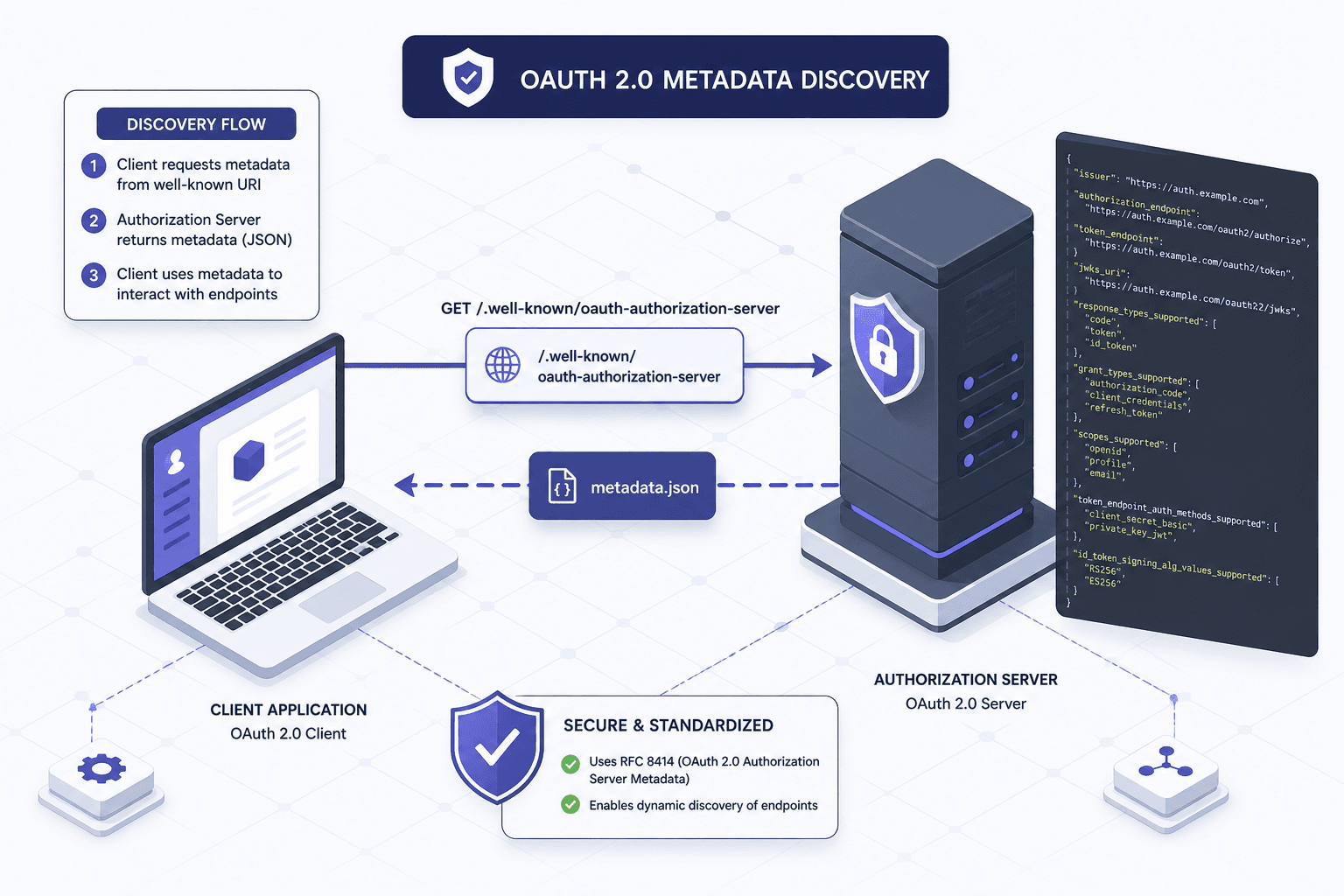
RFC 8414, titled "OAuth 2.0 Authorization Server Metadata," introduced a standardized mechanism for clients to automatically discover these endpoints and capabilities. It defines a well-known URI that returns a JSON document describing the server's configuration. This shift moves the source of truth from static code to dynamic, machine-readable metadata.
The Problem: Hardcoded Endpoints
OAuth 2.0 (RFC 6749) defines the flow but deliberately does not specify how a client finds the server's endpoints. It assumes the client already knows them. In practice, this meant:
- The developer reads the provider's documentation.
- The developer copies the
authorization_endpoint(e.g.,https://auth.example.com/authorize) andtoken_endpoint(e.g.,https://auth.example.com/token) into their codebase. - The client makes HTTP requests to these hardcoded URLs.
This approach has two critical flaws:
- Brittleness: Any change in the provider's URL structure requires a code deployment.
- Security Risk: If the client does not validate the issuer, it could be vulnerable to redirection attacks if the DNS or network is compromised, though this is mitigated by TLS. More importantly, it creates confusion about which issuer is being contacted.
RFC 8414 solves this by defining authorization server metadata as a standard, discoverable resource, eliminating the need for manual configuration.
The RFC 8414 Mechanism: Well-Known URIs
RFC 8414 leverages the concept of "well-known" URIs, defined in RFC 5785. A client constructs a specific URI based on the provider's base URL and fetches metadata from it.
The standard path is /.well-known/oauth-authorization-server. For an issuer https://auth.example.com, the client requests:
GET /.well-known/oauth-authorization-server HTTP/1.1
Host: auth.example.com
The server responds with a JSON document containing key-value pairs. The most critical fields are:
issuer: The unique identifier for the authorization server. This is the primary anchor for security validation.authorization_endpoint: The URL to which the client redirects users for authentication.token_endpoint: The URL to which the client sends credentials to exchange an authorization code for tokens.jwks_uri: The URL pointing to the JSON Web Key Set (JWKS), containing public keys for verifying JWT signatures.
Example response:
{
  "issuer": "https://auth.example.com",
  "authorization_endpoint": "https://auth.example.com/authorize",
  "token_endpoint": "https://auth.example.com/token",
  "jwks_uri": "https://auth.example.com/.well-known/jwks.json",
  "response_types_supported": ["code"]
}
Security: Validating the Issuer
The most important security mechanism in RFC 8414 is the validation of the issuer field. When a client fetches the metadata, it must compare the issuer value in the JSON response against the expected issuer configured in the client.
If they do not match, the client must reject the response. This prevents a scenario where an attacker intercepts the request (e.g., via DNS spoofing or MITM) and returns a valid-looking metadata document with endpoints pointing to a malicious server. By binding the metadata to the issuer, the client ensures it is communicating with the intended authority.
This validation is critical because the metadata document itself is not signed. It is only protected by TLS during transport. Without checking the issuer, the client has no way to verify that the endpoints it receives are legitimate.
Advanced Discovery: JWKS Integration
One of the most significant benefits of RFC 8414 is the standardization of the jwks_uri field. Before RFC 8414, clients often had to manually configure the URL for public keys or rely on non-standard discovery mechanisms.
With RFC 8414, the client can:
- Fetch the authorization server metadata.
- Extract the
jwks_uri. - Fetch the JWKS document (a JSON object containing one or more public keys).
- Use these keys to verify the signature of ID tokens or access tokens (JWTs) received from the provider.
This enables stateless API validation. An API server can verify a JWT presented by a client without maintaining a database of client secrets or public keys, as long as it can discover the provider's JWKS via RFC 8414.
Practical Implementation
Here is a simplified example of how a backend service might implement RFC 8414 discovery in pseudocode:
import requests
import json

def discover_oauth_server(issuer_url):
    # Construct the well-known URI
    metadata_url = f"{issuer_url}/.well-known/oauth-authorization-server"

    # Fetch metadata
    response = requests.get(metadata_url)
    response.raise_for_status()
    metadata = response.json()

    # Validate issuer
    if metadata.get("issuer") != issuer_url:
        raise ValueError("Issuer mismatch: possible MITM attack")

    return metadata

# Usage
issuer = "https://auth.example.com"
metadata = discover_oauth_server(issuer)

# Use discovered oauth endpoints
auth_endpoint = metadata["authorization_endpoint"]
token_endpoint = metadata["token_endpoint"]
jwks_uri = metadata["jwks_uri"]

print(f'OAuth Endpoints: {auth_endpoint}, {token_endpoint}')
print(f"JWKS URI: {jwks_uri}")
This code demonstrates the core loop: construct URI, fetch JSON, validate issuer, and use the discovered values. This pattern replaces the need for hardcoded URLs and makes the integration resilient to changes in the provider's endpoint structure.
Conclusion
RFC 8414 is a foundational improvement for OAuth 2.0 interoperability. By defining a standard mechanism for discovering endpoints and capabilities, it reduces the friction of integration and improves security through issuer validation. For backend developers and identity engineers, understanding RFC 8414 is essential for building maintainable, and secure OAuth 2.0 clients. It transforms OAuth from a manual configuration task into a dynamic, self-describing protocol interaction.
Related posts
Understanding OAuth2 Authorization Server Metadata (RFC 8414)
An examination of RFC 8414 regarding OAuth2 authorization server metadata, covering discovery mechanisms and configuration endpoints for secure integration.
Understanding OAuth2 Multiple Response Types: A Technical Guide
An examination of OAuth2 response types including hybrid flow, OIDC response types, and authorization server configurations for beginners.
Angular OAuth2/OIDC: loadDiscoveryDocumentAndTryLogin
Learn how to use loadDiscoveryDocumentAndTryLogin and strict discovery document validation in Angular for secure OAuth2/OIDC authentication.